
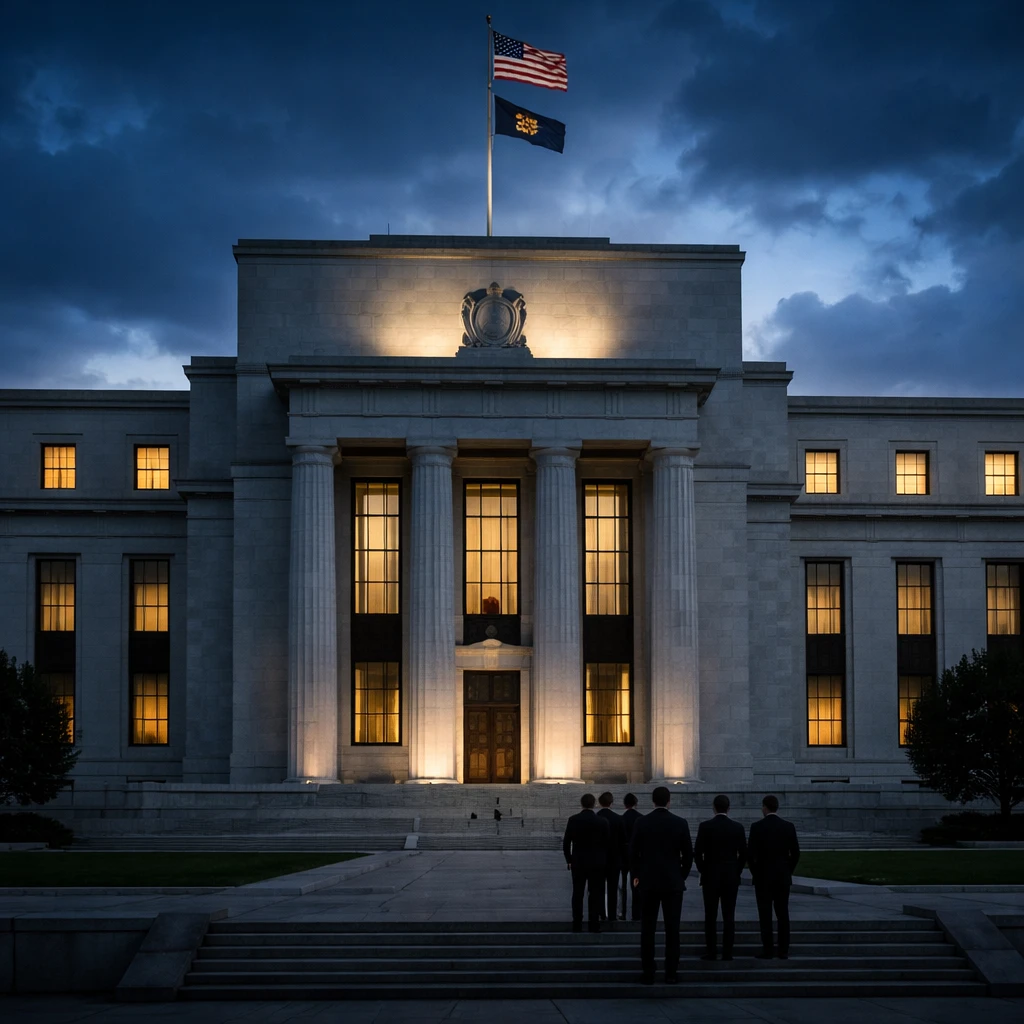
The Federal Reserve appears poised to maintain its benchmark interest rate this week as policymakers meet amid an unusually fraught political environment for the U.S. central bank. That environment includes a Justice Department subpoena and a threatened criminal probe of the Fed chair, an unfolding effort to remove a sitting governor that reached the Supreme Court, and the approaching selection of a successor to lead the central bank when Jerome Powell steps down in May.
Powell is in the final phase of an eight-year run as the central bank's top official, with only three scheduled policy meetings left during his tenure. What would normally be a routine handover has become loaded with potential disruptions. Observers say the controversy surrounding his leadership, alongside the high-stakes legal and political fights over other Fed officials, has put the institution's independence squarely in the spotlight.
Markets, however, have not yet registered widespread alarm. Analysts note that market-derived measures of inflation expectations and longer-term Treasury yields have not shown broad-based signs of distress tied to the central bank's governance.
"It’s not possible to view the actions of the next Fed chair as separate from the economic environment or their ability to influence other FOMC participants," said Tim Duy, chief U.S. economist with SGH Macro Advisors. He added that any incoming chair will still need to persuade the other governors and the five voting regional Federal Reserve Bank presidents to embrace a course of action, including any decision to cut rates.
Duy also commented on the White House objective, noting that a broader turnover among Fed officials would be necessary for a president to exercise more meaningful control over the central bank. "Trump will need greater turnover at the Fed to fully control the institution," he said.
President Donald Trump is expected to announce a nominee to replace Powell at any time, perhaps this week. Reported finalists for the job include Trump economic adviser Kevin Hassett, Fed Governor Christopher Waller, former Fed Governor Kevin Warsh, and Rick Rieder, the chief bond investment officer at BlackRock. The president has publicly criticized the Fed and Powell for not enacting the aggressive rate cuts he believes the economy needs.
Policy Outlook and Economic Data
The Fed’s two-day meeting will finish on Wednesday, and officials are widely expected to hold the benchmark federal funds rate in the current 3.50% to 3.75% range. No fresh economic or policy projections are scheduled for release at the close of this meeting. Market participants currently anticipate that the Fed will defer any further reductions in its target rate until around June, with such moves likely to occur under Powell’s successor.
Recent economic indicators have offered little directional impetus for an immediate change in policy guidance. Labor market readings show a mixed picture: job growth has softened, yet the unemployment rate fell to 4.4% in December amid continued robust economic expansion and consumer spending. Inflation readings have remained slightly elevated relative to the Fed’s 2% goal, with the Personal Consumption Expenditures Price Index measuring 2.8% in November.
Powell is scheduled to conduct his customary post-meeting press conference on Wednesday. But observers expect his comments will likely focus as much on developments since the last meeting as on the policy debate itself. Those developments include the DOJ subpoena and the threatened criminal probe, and Powell’s subsequent video statement characterizing the actions as part of political pressure to force rate cuts.
Supreme Court Hearing and Board Composition
Last week, the Supreme Court heard arguments related to the Trump administration’s attempt to remove Fed Governor Lisa Cook. The hearing appeared to reduce short-term fears that she would be immediately ousted, as justices seemed inclined to leave her in place. Still, the case brought renewed attention to the president’s interest in reshaping the Fed’s membership more quickly than the normal rotation of terms would permit.
As matters stand, the nominee to succeed Powell would occupy a seat that would require another Trump-appointed governor to vacate a position that would otherwise remain filled. That other governor, Stephen Miran, is on leave from the administration and faces the expiration of his Fed term this month. Unless there is a resignation or removal, the next available seat is Powell’s.
Powell has the option to remain on the Fed’s Board of Governors for up to two years after leaving the chairmanship, potentially serving as a swing vote on matters overseen by the seven-member board beyond monetary policy. The prospect of him remaining in that role creates an added layer of complexity for the transition.
President Trump acknowledged that dynamic in public remarks at the World Economic Forum in Davos, Switzerland, saying, "If he stays, he stays." He also reiterated a concern common among presidents: appointees sometimes adopt stances once in office that diverge from the administration’s preferences. "The problem is they change once they get the job," the president said in a television interview.
Such independence from presidential pressure is an essential feature of how the central bank functions. That is why the legal proceedings over Governor Cook, the possibility Powell could continue as a governor, and the Senate confirmation process for the next chair have drawn so much attention.
Political Pressure, Institutional Response and Market Reaction
The White House’s rationale for pursuing Cook’s removal centers on alleged misstatements on mortgage documents, which the administration views as disqualifying for someone responsible for setting rates. At the Supreme Court hearing both liberal and conservative justices emphasized the importance of the Fed’s independence and questioned whether the president’s allegations justified a removal and what harm would occur from doing so.
The threats aimed at Powell have triggered a notable backlash, both domestically and abroad. Several Republican senators have suggested they would delay action on any nominee for the Fed chair until the investigation into Powell is resolved. The criminal inquiry prompted Powell to move from a more passive approach to a forceful, public defense of the central bank.
Powell’s heightened engagement included attending Governor Cook’s Supreme Court hearing and issuing a video statement. He will have another opportunity to discuss the situation during the press conference following the policy meeting.
Economic Outlook and Policy Expectations
With the federal funds rate near what policymakers consider a neutral level - a stance neither stimulating nor restraining economic activity - and with no clear signs of mounting job losses or accelerating inflation, some economists judge the near-term macroeconomic outlook as relatively benign. Michael Pearce, chief U.S. economist at Oxford Economics, wrote that while the immediate outlook is calm, external events could disrupt the Fed’s future policy path.
Pearce outlined a view that the standard case remains for rate cuts to begin in June and continue into September, pausing with the policy rate still around 3%. That forecast implies that even a successor to Powell may find it difficult to enact the swift, deep cuts the president seeks. Pearce added that a much quicker and more aggressive easing would likely require a pronounced weakening in the labor market - an outcome he considers unlikely.
What Comes Next
The confluence of legal proceedings, political pressure and the selection of a new Fed leader is producing a transition period that could test longstanding norms around central bank independence. While markets have not yet signaled broad anxiety, the coming days and months - including the announcement of a nominee, any resolution of the inquiry into the chair, and the Supreme Court’s decisions - could shape investor expectations and the Fed’s capacity to chart a steady course on monetary policy.
For now, most analysts expect the central bank to leave rates unchanged this week and to defer substantive policy moves until later in the year, when the contours of leadership and ongoing economic data will provide clearer guidance.