
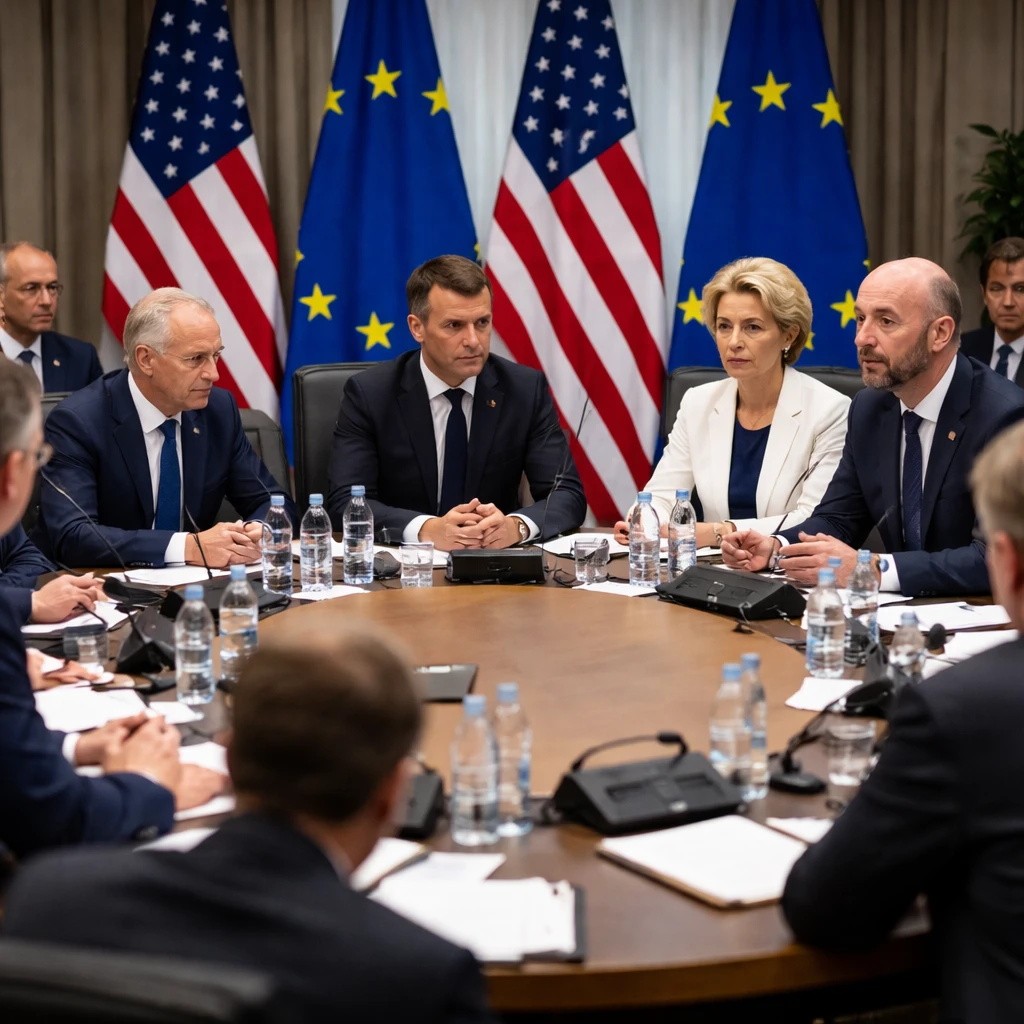
In the wake of President Donald Trump's unexpected withdrawal of tariff threats against eight European countries and his dismissal of military intervention plans to acquire Greenland, the European Union is convening an emergency summit on Thursday to deliberate on the future of its transatlantic relations. The initial hostility surrounding the potential tariffs and forceful acquisition tactics sharply undermined trust between the EU and the U.S., prompting European leaders to contemplate paths toward reducing their heavy reliance on Washington.
German Chancellor Friedrich Merz publicly welcomed President Trump’s sudden policy reversal regarding Greenland. Merz emphasized the importance of not hastily abandoning the longstanding transatlantic partnership despite recent strains. Nevertheless, there remains a palpable wariness among EU members about the unpredictability of the American president, who is increasingly perceived as employing coercive tactics. European diplomats express the need to devise a sustainable strategy that accounts for potential future volatility in U.S. policies over the coming years and administrations.
One European diplomat summarized the prevailing sentiment, asserting that President Trump’s actions have crossed a significant threshold, likening it to crossing the Rubicon. He emphasized that reverting to previous norms appears unlikely, and EU leaders will use the summit as an opportunity to discuss this new reality. This diplomat also highlighted the necessity for Europe to initiate a gradual process toward greater self-reliance, while simultaneously attempting to maintain constructive engagement with the U.S. government.
The EU’s dependence on the U.S. remains ingrained through decades of NATO alliance cooperation, particularly in defense. However, Europe currently lacks key capacities such as intelligence sharing, strategic transportation, missile defense infrastructure, and domestic production capabilities to adequately defend against potential threats from Russia. This asymmetry grants the United States substantial influence over European security.
Beyond defense, the economic partnership between the U.S. and Europe also poses vulnerabilities. The U.S. stands as the EU’s most significant trading partner, thus exposing the European bloc to risks from tariff impositions intended to narrow the American trade deficit or secure specific geopolitical objectives, exemplified by the Greenland dispute.
Reflecting this environment of uncertainty, a second EU diplomat outlined the imperative to clearly define red lines and strategies in dealing with what is perceived as bullying tactics from across the Atlantic. Although President Trump currently renounced tariffs, the diplomat questioned the sustainability of this stance, indicating concern over potential abrupt policy reversals. The EU had been preparing a countermeasure package that included retaliatory tariffs on U.S. goods valued at €93 billion ($108.74 billion) or alternative anti-coercion responses if American tariffs had materialized, despite potential economic damage on both sides.
Regarding the situation in Greenland, details remain scant about the framework agreement reportedly reached between President Trump and NATO Secretary General Mark Rutte during the World Economic Forum in Davos. Several diplomats expressed frustration over the ongoing ambiguity and reiterated demands for increased resilience, greater unity within the internal market, and enhanced competitiveness. There was also a consensus on refusing further tariff coercion.
Mark Rutte explained in an interview from Davos that the accord with President Trump entails Western allies reinforcing their presence in the Arctic, and ongoing dialogues among Denmark, Greenland, and the United States on various specific matters. Despite the temporary de-escalation achieved through this agreement, diplomats underscored that the longer-term challenge of managing the EU-U.S. relationship remains unresolved.
One EU diplomat highlighted the success of presenting a united front in support of Denmark and Greenland while seeking pathways to de-escalate tensions as a positive development. However, he stressed the importance of reflecting on the broader state of the relationship and deliberating on the strategic approach moving forward given the recent tumultuous experiences. This dialogue comes amid considerations of how to balance solidarity, de-escalation, and future-proofing the transatlantic alliance.