
Economy March 25, 2026

ECB to Track Firms' Price Plans and New-Hire Wages as Energy-Driven Inflation Risk Looms

Chief economist Philip Lane flags selling-price expectations, wage tracker and weak confidence as key gauges for policy meetings

By Ajmal Hussain
ECB to Track Firms' Price Plans and New-Hire Wages as Energy-Driven Inflation Risk Looms

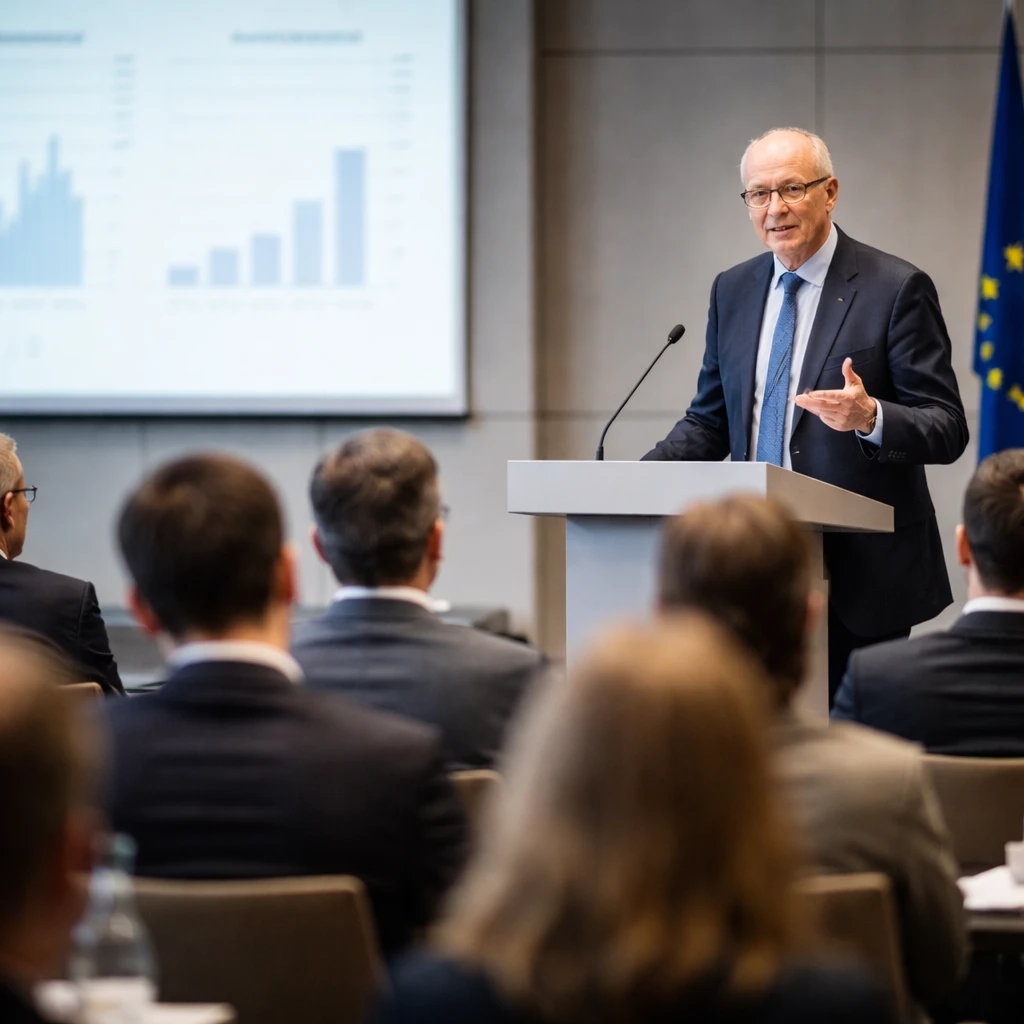
The European Central Bank will closely monitor companies' expected selling prices and wages paid to new hires as signals of whether recent energy-driven price shocks will translate into sustained inflation, ECB Chief Economist Philip Lane said at a Frankfurt conference. Markets appear to be pricing a one-off price-level jump rather than persistent inflation above the 2% target, but the central bank will assess the evolving economic scenario at each policy meeting.

Key Points

  • ECB will closely monitor firms' selling-price expectations and wages for new hires as key indicators - impacts corporate pricing behaviour and labour cost trends.
  • Financial markets are pricing a price-level jump in the euro zone linked to higher energy prices rather than a sustained rise above the ECB's 2% inflation target - this dynamic affects financial markets and energy sector outlooks.
  • Consumer confidence has fallen significantly and purchasing managers' indices show a downturn, providing weaker demand signals that bear on consumer-facing sectors and industrial activity.

European Central Bank Chief Economist Philip Lane said the institution will pay close attention to two corporate indicators - firms' expectations for selling prices and wages for recent hires - as it assesses inflation risks linked to the war-related rise in energy costs.

Speaking at a conference in Frankfurt, Lane described how financial markets have priced in what he characterised as a price-level jump for the euro zone stemming from higher energy prices, rather than anticipating a sustained increase in inflation that would exceed the ECB's 2% objective.

Lane said the ECB will evaluate the prevailing economic scenario at every meeting. He highlighted a marked deterioration in consumer confidence and pointed out that purchasing managers' indices show a downturn, signals the bank will weigh in its policy deliberations.

On inflation expectations, Lane noted a pronounced impact in the first year and then a smaller effect thereafter. He said markets are forecasting particularly large readings in March and April before expectations return to more typical levels.

Lane stressed that a clear understanding of selling-price expectations among companies will be central to the ECB's assessment of price dynamics going forward. He also described the ECB's wage tracker as a useful leading indicator for negotiated wages, citing it as important for judging whether pay pressures might sustain inflation.

Summing up the market picture, Lane's presentation suggested that current dynamics are consistent with a one-off increase in the price level rather than a persistent acceleration of inflation above the ECB's 2% target.


Context and implications

Lane linked several observable data points - financial market pricing, consumer sentiment, purchasing managers' indices, firms' price expectations and the wage tracker - as the set of indicators the bank will monitor closely as it determines its policy stance at successive meetings.

He did not indicate any specific policy moves in his remarks, but underscored that the ongoing assessment will be data-driven and revisit the evolving scenario at each meeting.

Risks

  • A war-driven spike in energy prices could produce a marked price-level increase, complicating the ECB's task of distinguishing between a temporary shock and persistent inflation - risk to energy, consumer and inflation-sensitive financial sectors.
  • Significant decline in consumer confidence and downturns in purchasing managers' indices introduce uncertainty about demand and growth, which affects consumer-facing industries and industrial production forecasts.
  • Inflation expectations are projected to show large readings in March and April before normalising, creating near-term uncertainty for markets and policymakers about wage-setting and price-setting behaviour.

More from Economy

Iran Conditions Hormuz Reopening on Compensation, Signals Wider Disruption Risk Apr 5, 2026 Why Japan Equities Deserve a Place in Long-Term Portfolios Apr 5, 2026 Europe’s Quantum Moment: From Lab Leadership to Industrial Scale? Apr 5, 2026 AI-Driven Memory Demand Forces Strategic Shift at Samsung and SK Hynix Apr 5, 2026 Markets Pin Eyes on Inflation as Middle East Conflict Keeps Investors on Edge Apr 5, 2026