
Overview
Manufacturing performance in North America has taken markedly different paths, with the United States accelerating ahead of Canada in both output and investment intensity. In a note shared by CIBC economists Benjamin Tal and Katherine Judge, U.S. manufacturing GDP is reported to have climbed almost 10% above pre-pandemic levels while Canadian output still struggles to reach its 2019 baseline.
Capital intensity as the principal driver
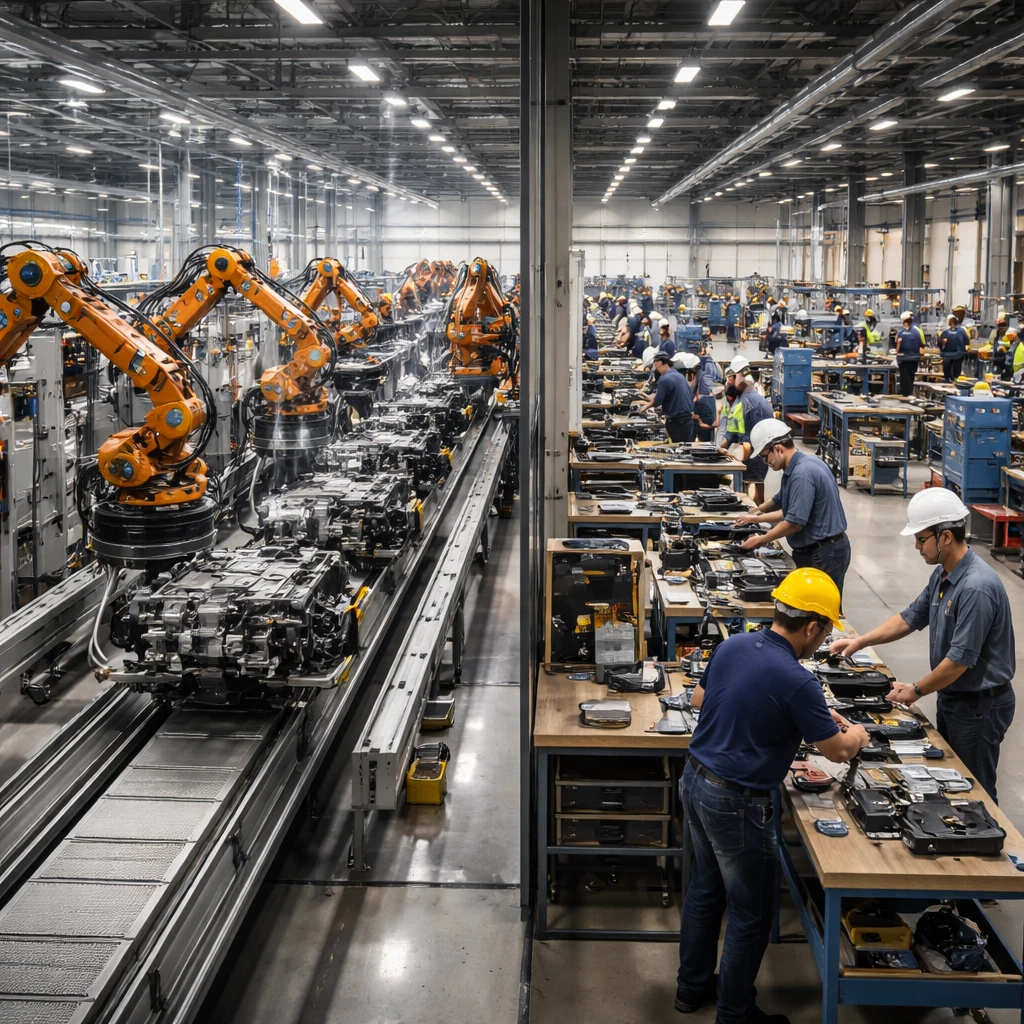
The economists attribute much of the U.S. lead to a structural shift toward more capital-intensive production. "The US performance is not only stronger but it’s also much more capital intensive," Tal and Judge wrote, pointing to a clear divergence in how firms in each country are deploying machinery, automation and related technologies.
According to CIBC's calculations, the U.S. capital-intensity index rose by more than 10% between 2019 and 2024, a change that outstrips previous cycles. By contrast, the ratio of production in capital-intensive industries to labor-intensive ones has actually fallen in Canada during that same window, indicating that Canada has not matched the U.S. move toward asset-heavy manufacturing.
Implications for profits and national wealth
CIBC highlights the financial consequences of this structural change. Capital-heavy firms generally achieve larger profit margins than labor-dependent operations, and that difference has contributed materially to the output gap. As the economists noted, "Capital-intensive manufacturing industries contributed no less the 8%-pts. to the performance gap since 2019."
AI and the future direction
Looking ahead, the note flags artificial intelligence as a catalyst that could amplify the current divide. The analysts warned that "the rapid pace of AI technology adoption means that capital intensity in US manufacturing will rise even faster in the coming years." Their assessment suggests the U.S. is positioned to extract further productivity gains from automation as AI tools become more embedded on factory floors.
Outlook for Canada and strategic choices
CIBC's economists acknowledge that Canada may derive some resilience from a less-leveraged, more labor-intensive manufacturing structure in a high-rate environment. However, they stress that closing the productivity and output gap will require significant shifts in industrial strategy to capture available technological gains before the AI era further widens the divide.
Key points
- U.S. manufacturing GDP has climbed almost 10% above pre-pandemic levels while Canadian output remains below its 2019 baseline.
- U.S. capital-intensity index rose by more than 10% between 2019 and 2024; Canada saw a decline in the ratio of capital- to labor-intensive production.
- AI adoption is expected to accelerate capital intensity in U.S. manufacturing, potentially widening the gap further.
Risks and uncertainties
- Continued divergence in capital investment could depress Canadian manufacturing competitiveness and profit margins in sectors reliant on heavy automation.
- Faster AI-driven capital intensity in the U.S. may create longer-term productivity and output disparities that are difficult for Canada to close without a major industrial pivot.
- The balance between leverage and resilience in a high-rate environment creates uncertainty for which types of manufacturers and supply-chain participants will fare better.
Tags: manufacturing, Canada, US, automation, AI