
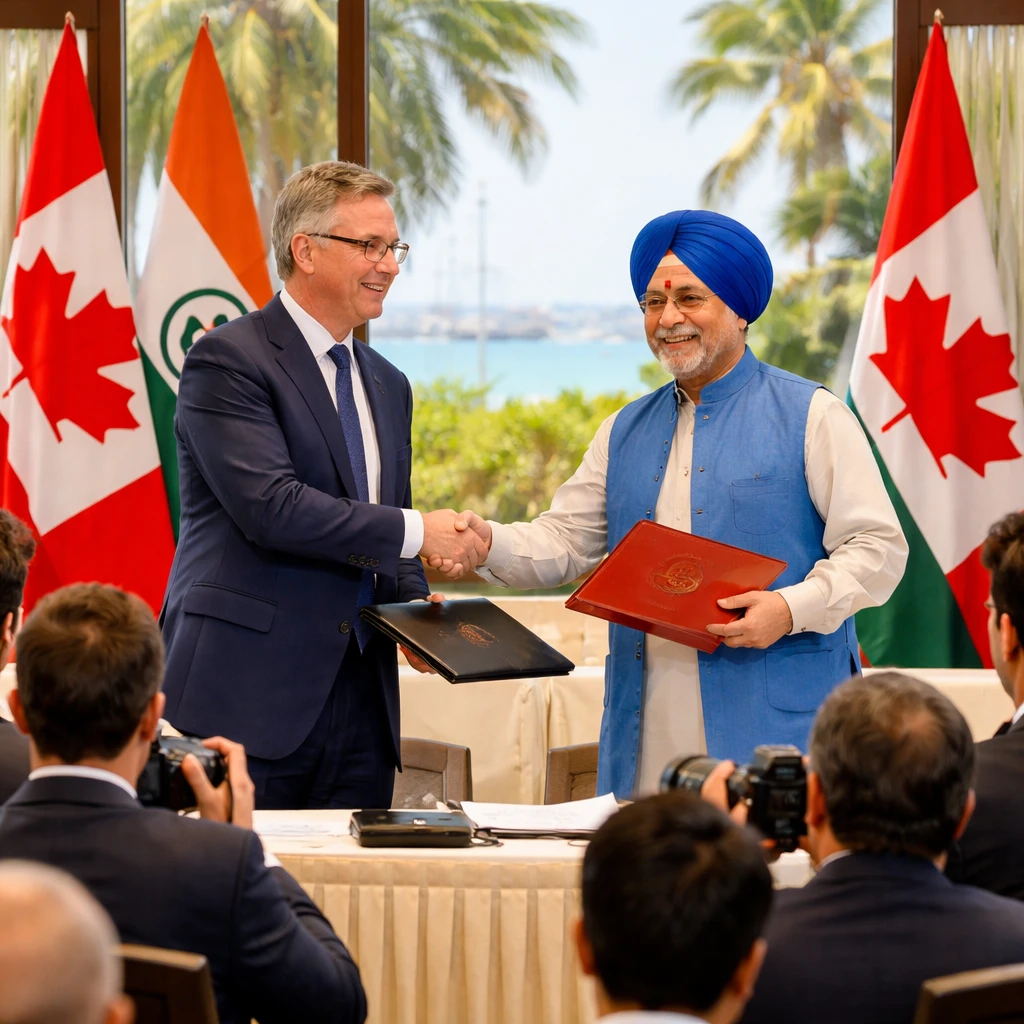
Canada and India have established a formal energy arrangement that directs Canadian crude oil and liquefied natural gas (LNG) toward Indian markets while Indian refined petroleum products will flow to Canada, according to a joint statement released Tuesday from Goa by Energy Ministers Timothy Hodgson and Hardeep Singh Puri.
The agreement was publicized after Canada participated at the senior level for the first time at India Energy Week, an engagement that helped resume broader bilateral discussions. The ministers framed the pact around shared priorities, saying that energy security and diversity of supply are essential to the safety, wellbeing, and economic vitality of both countries as they operate in a volatile global environment.
This diplomatic shift traces back to a June 2025 directive from Prime Ministers Mark Carney and Narendra Modi. The two leaders, who met on the margins of the G7 Summit in Kananaskis, called for restarting senior ministerial and working-level engagements to repair what they described as a fractured relationship.
As part of Ottawa’s strategy, Canada intends to leverage the Trans Mountain Expansion (TMX) Pipeline and West Coast terminal facilities to move more crude and LNG to non-U.S. destinations. The government has signaled an ambition to position Canada as an energy supplier to fast-growing markets, with India identified as a priority given projections in the agreement that place the country at the center of roughly one-third of global energy demand growth over the next two decades.
The energy partnership is being advanced alongside a broader Canadian trade strategy under Prime Minister Mark Carney. That strategy recently produced a landmark agreement with China, announced last week, in which reduced tariffs on Chinese electric vehicles were exchanged for lower duties on Canadian canola. Carney has publicly defended these initiatives as a form of risk management, following remarks at the World Economic Forum in Davos urging middle powers to coordinate against economic hegemony.
Those shifts in trade orientation have prompted a sharp response from Washington. The statement notes that President Donald Trump has warned of imposing 100% tariffs on Canadian goods should the Canada-China trade deal proceed. Despite this tension with the United States, Ottawa appears determined to broaden its export destinations and lessen reliance on a single market.
Implications and context
The agreement formalizes a reciprocal energy flow between two major countries and signals Canada’s intent to use existing export infrastructure to reach Asian buyers. It also sits alongside a recalibrated trade policy that has already produced significant bilateral arrangements in other regions.