
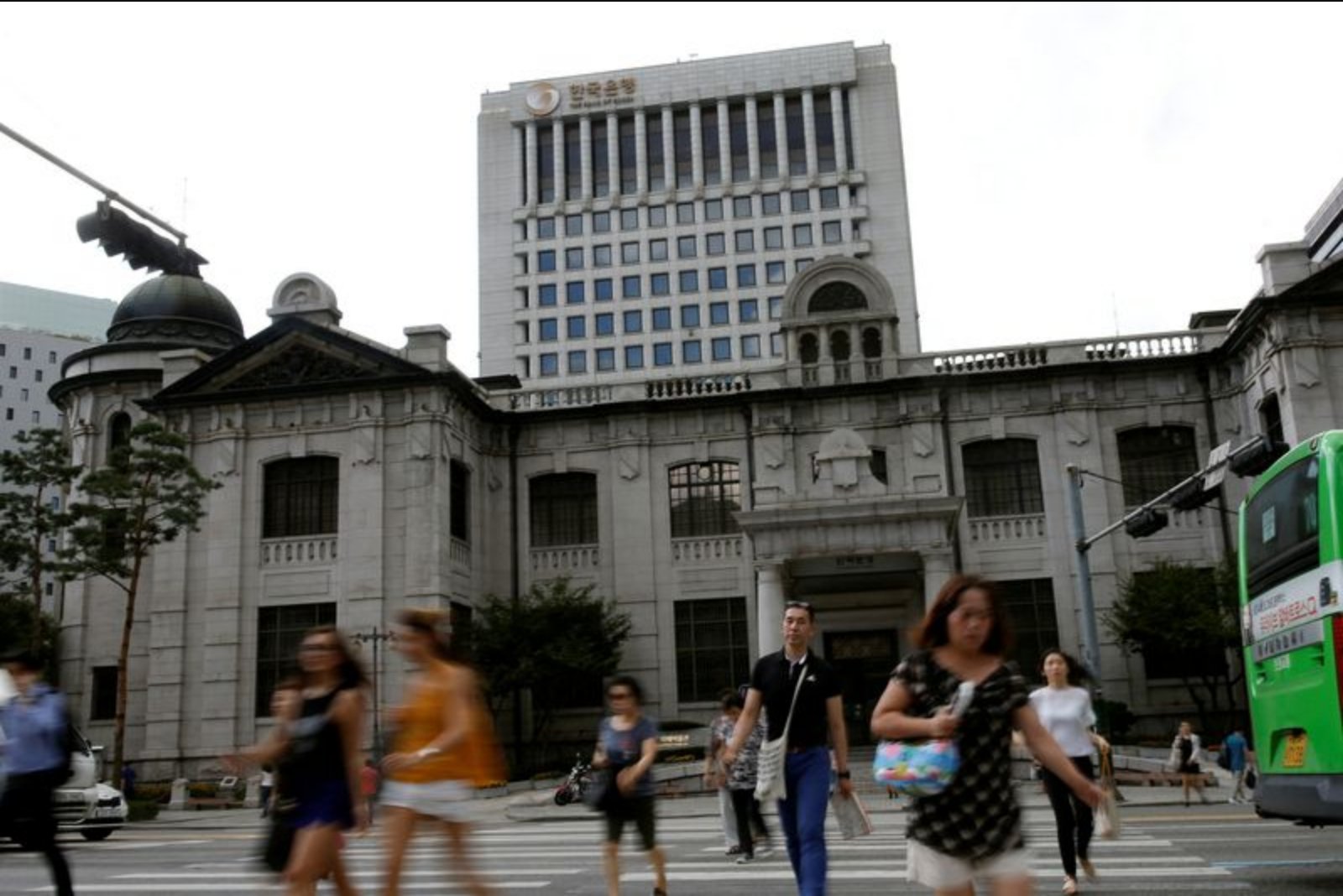
The Bank of Korea is widely expected to leave its key interest rate at 2.50% at its upcoming meeting and to maintain that level for the rest of the year, according to a Reuters poll of economists. The consensus reflects policymakers' caution as they evaluate how the surge in oil prices following the onset of U.S.-Israeli strikes on Iran will affect domestic inflation and growth.
Oil prices have climbed by more than 50% since the conflict began, lifting risks for both economic growth and consumer price pressures in South Korea. The country is the world's fourth-largest importer of oil, with roughly 70% of its supply originating from the Gulf region, leaving it vulnerable to disruptions and cost shocks abroad.
At its February meeting, held days before the war started, the central bank signalled forward guidance that rates would remain at 2.50% at least until August. In that meeting the Bank of Korea also raised its growth forecast for 2026 to 2.0% from a prior 1.8%, and projected inflation of 2.1% based on an assumed oil price of $64 per barrel.
Inflation in South Korea edged up to 2.2% in March, a touch above the central bank's 2% target but below a median estimate of 2.4% recorded in a separate Reuters poll. In the April 2-7 poll of economists, all 31 respondents expected the central bank to keep the base rate at 2.50% on April 10.
"The central bank will adopt a cautious monetary policy stance rather than lock onto a specific direction," said Jeeho Yoon, senior economist at BNP Paribas. "At this meeting they won’t provide their new updated growth and inflation forecast but they can provide a signal of where we are headed to and we think the BOK will highlight the risks of lower growth while highlighting upside risk to inflation."
The Korean won has weakened about 4% against the U.S. dollar since the war began. On March 31 the currency touched its weakest level since the 2009 global financial crisis, a development that has heightened concerns that currency-driven import costs could push consumer inflation higher.
Economists polled expect inflation to rise to 2.6% this quarter and to average 2.4% in 2026, up from a 1.9% forecast for this year in a January poll and above the central bank's inflation target. Among 30 economists who provided a longer-term projection, 26 predicted no change to policy rates through 2026, three saw the base rate rising to 2.75% by year-end, and one forecast it reaching 3.00%.
Stephen Lee, chief economist at Meritz Securities, noted that while the central bank is not explicitly targeting the exchange rate, it will be monitoring the won because its depreciation can be transmitted into consumer inflation via increased import prices. "Assuming the war's impact on headline inflation turns out to be transitory, I believe the case for monetary policy will be rate freeze until end-of-year. That said, there are many upside risks for inflation," Lee said.
Taken together, the poll responses and central bank signalling point to a path of policy caution. Officials appear prepared to pause rate adjustments while allowing incoming data on oil prices, the exchange rate and domestic price trends to determine whether tightening or easing is warranted in future meetings.
For markets and businesses, the mix of higher oil costs and a softer won implies greater near-term pressure on inflation-sensitive sectors, while the central bank's current posture suggests a limited near-term impact on borrowing costs for households and companies should the pause endure.