
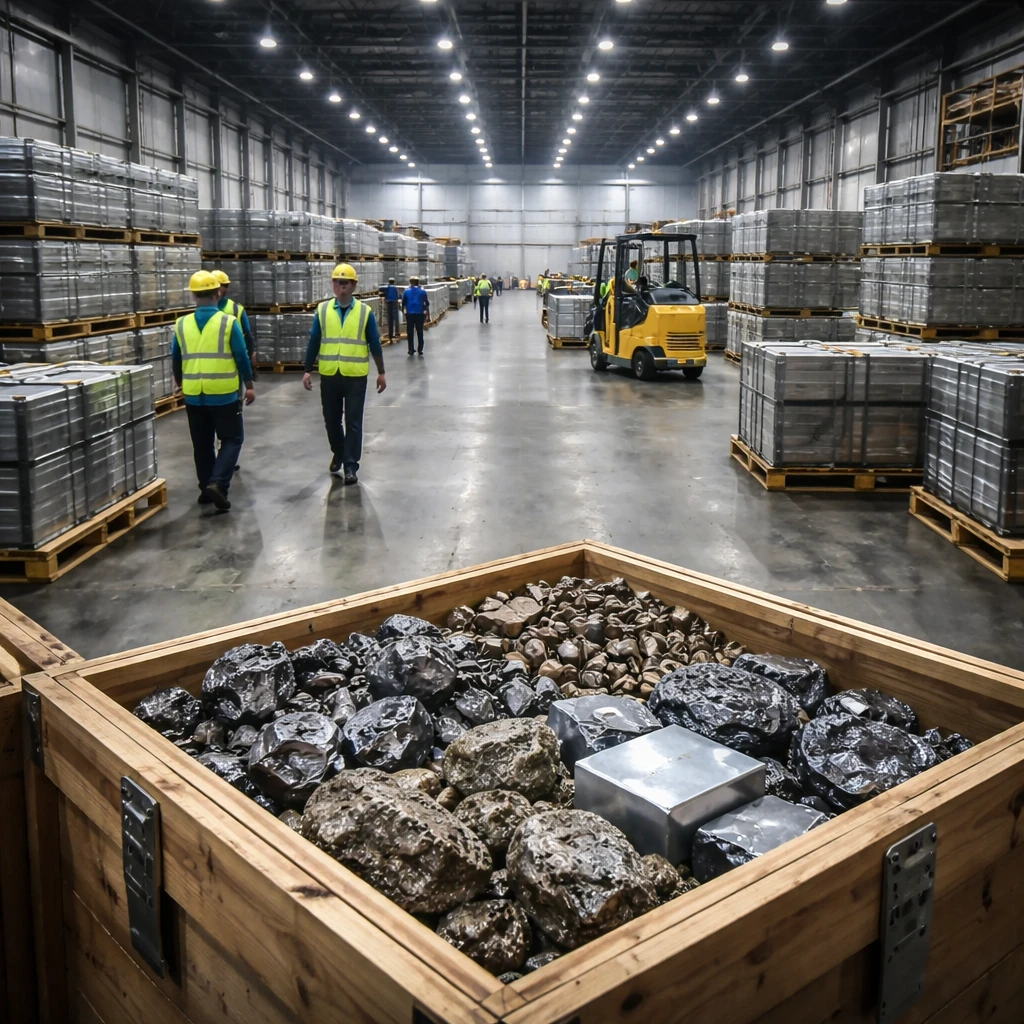
The administration plans to create a $12 billion strategic reserve of critical minerals aimed at reducing U.S. reliance on Chinese supplies and shielding American manufacturers from supply interruptions. The initiative, called Project Vault, is structured as a public-private partnership combining government financing with private capital.
Under the arrangement, the U.S. Export-Import Bank would provide $10 billion in financing, while private investors would contribute $1.67 billion toward procuring and storing minerals seen as essential to modern manufacturing. The minerals targeted include gallium and cobalt, which are used in a range of products from smartphones to batteries and jet engines.
Project Vault is being designed to operate in a fashion similar to the nation’s Strategic Petroleum Reserve, but with a focus on strategic metals and minerals rather than crude oil. More than a dozen companies have joined the effort, among them General Motors Co., Stellantis NV, Boeing Co., Corning Inc., GE Vernova Inc., and Alphabet Inc.’s Google.
Three commodities trading firms - Hartree Partners LP, Traxys North America LLC, and Mercuria Energy Group Ltd. - have been selected to manage the buying of raw materials for the stockpile. The involvement of these trading firms is intended to handle procurement operations on behalf of the partnership.
The Export-Import Bank’s board is set to vote on Monday on whether to authorize a 15-year loan to support the program. If approved, that loan would exceed by more than two times the size of the bank’s prior largest transaction.
Officials describe the initiative as a substantial element of the administration’s strategy to lower U.S. dependence on China, which currently dominates global production and processing of many critical minerals. Project Vault aims to create a buffer for manufacturers that rely on secure access to these inputs.
Summary
Project Vault will create a $12 billion stockpile of strategic minerals, financed primarily by a $10 billion Export-Import Bank loan plus $1.67 billion in private capital, focused on materials such as gallium and cobalt. Major manufacturers and tech firms are participants, and three trading firms will oversee purchasing. The Export-Import Bank board will vote on a 15-year loan on Monday.
Key points
- Finance structure includes $10 billion from the U.S. Export-Import Bank and $1.67 billion in private capital - impacting government finance and industrial procurement.
- Stockpile targets minerals like gallium and cobalt that are critical to electronics, batteries, and aerospace manufacturing - affecting technology, automotive, and defense supply chains.
- Major manufacturers and tech companies have joined the project, and three commodities traders will handle material purchases - influencing commodity trading and industrial sourcing sectors.
Risks and uncertainties
- The Export-Import Bank’s board must authorize the proposed 15-year loan at a vote scheduled for Monday - the outcome is not yet determined.
- China currently dominates global production and processing of many critical minerals, and Project Vault represents a step to reduce that dependence - the broader challenge of shifting supply chains remains an uncertainty.