
Tariff actions intended to weaken China’s manufacturing footprint produced disruption for many companies. For Agilian Technology - a contract electronics maker that derives more than half its revenue from U.S. customers and runs about $30 million in annual sales - last year’s tariff swings were a stark test of how resilient China’s production ecosystem can be when confronted with geopolitical shockwaves.
Agilian spent much of 2025 with U.S. orders frozen and clients urging it to shift output outside China. The firm moved to establish operations in Malaysia and India as contingency measures, but the company’s management ultimately found that relocating production carries its own set of challenges, including slower ramp times, customs friction, incomplete local supply chains and higher costs.
Tariffs, a contracting PMI and retaliatory controls
The tariff campaign coincided with a period of weakness in China’s official manufacturing purchasing managers’ index (PMI), which contracted through much of the year and registered its weakest reading in April 2025 since December 2023. Beijing’s response to U.S. levies included export controls on minerals and metals that are processed largely in China and are difficult for some U.S. industries to source elsewhere. Those controls, by highlighting U.S. dependence on Chinese-processed materials, contributed to a reduction in the effective impact of the U.S. levies.
By March of the subsequent reporting period, China’s official PMI grew at its fastest pace in a year, a shift that coincided with easing trade tensions. The recovery in Chinese manufacturing helped Agilian recover activity after months when customers held shipments and paused orders.
Trade balances and export shifts
Official figures cited a widening of China’s trade surplus - rising to $213.6 billion for the first two months of 2026 from $169.21 billion a year earlier - and a record full-year surplus of $1.2 trillion in 2025, up about one-fifth from the previous year. Those aggregate numbers, however, hid variation by market and sector: exports to the United States fell 20% in 2025, a decline that hit manufacturers like Agilian that are heavily exposed to American buyers.
At the factory gate: customer freezes and the scramble to diversify
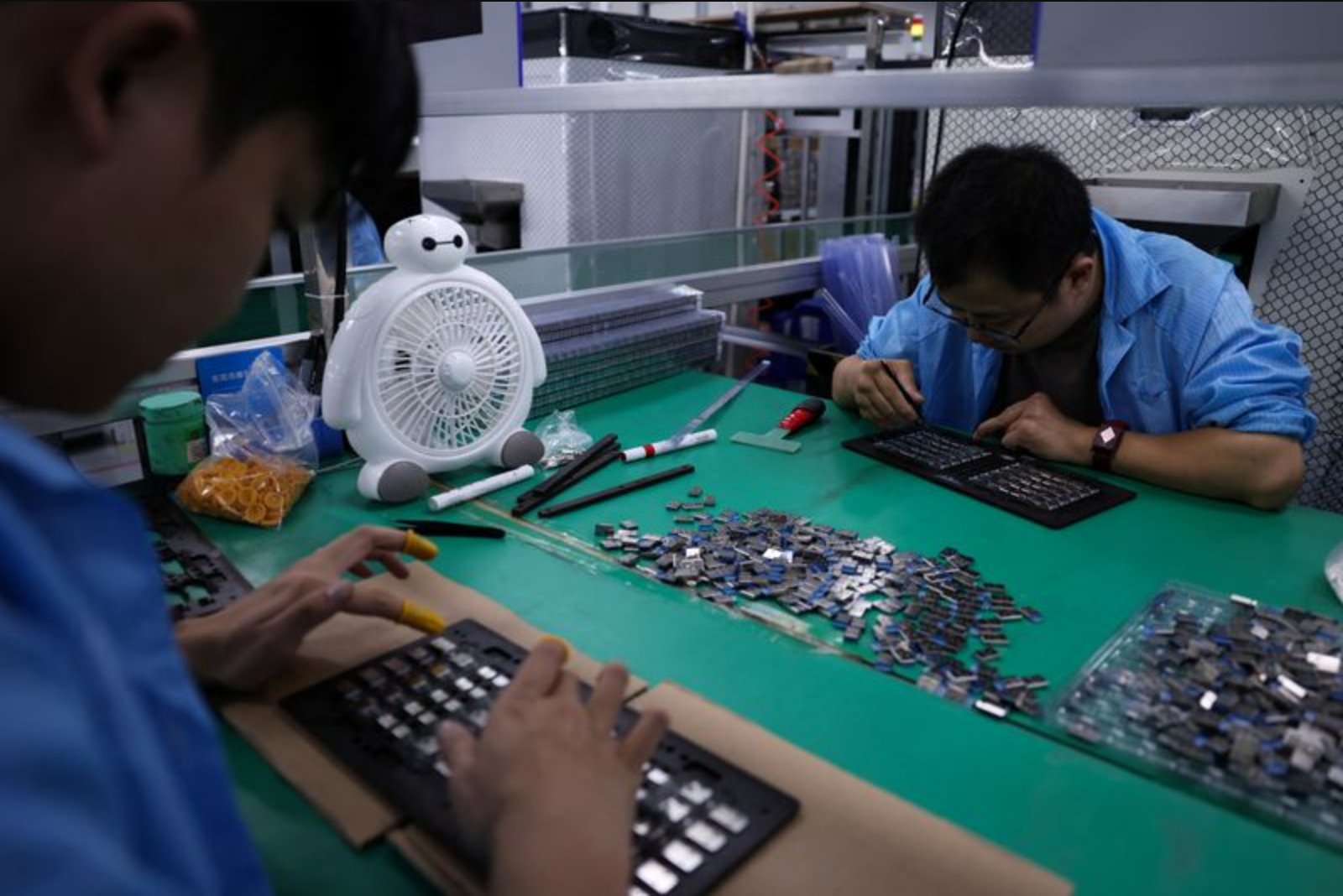
At Agilian’s Dongguan plant, which spans about 12,000 square metres (130,000 square feet), the company experienced the immediate operational consequences of tariff escalation. After successive tariff increases culminating in an April move that added 34 percentage points to duties on Chinese exports, many clients cancelled orders and pallets of finished goods accumulated inside the factory.
“Things were frozen,” said Renaud Anjoran, the company’s vice-president, describing post-election calls from alarmed clients and the decision by several customers to press the firm to set up production outside China. Executives at Agilian reacted by exploring multiple alternatives simultaneously.
The Malaysia and India experiments
Agilian selected Penang, Malaysia, as a preferred offshore partner because it is not located in the South China Sea shipping lanes where military tensions are a concern, and because it offered a ready partner factory. The firm also established an entity in India and scouted industrial space in Dharwad. Yet both paths revealed operational trade-offs.
Clients who examined India as an alternative were often deterred by concerns about slower manufacturing ramps and customs delays. “India takes time,” Agilian’s chief executive Fabien Gaussorgues said, recalling that it took a year to get the official company in place. Pre-production runs in Penang began mid-year, but the team learned that the pace of onboarding and output was markedly slower than what they were used to in Dongguan.
Agilian also briefly considered moving production to the United States but found that U.S. supply chains remained incomplete for its needs, leaving any U.S. facility dependent on tariffed Chinese components and facing higher labor costs.
Escalation, retaliation and the pivot back
After the tariff spike in April, China applied export controls that exposed U.S. dependence on certain processed materials. Such measures pressured U.S. industries including autos and defence that rely on specialized inputs. Escalations drove bilateral levies above 100% on both sides before the end of the month, contributing to the pause in commercial activity Agilian experienced.
By October, a meeting between the U.S. president and China’s leader led to a reduction of tariffs by 10 percentage points, and a subsequent retreat in hostilities coincided with a recovery in demand. Agilian reported that production hours in the second half of 2025 rose 29% compared with the first half, making it the company’s busiest period on record. As levies became steep but more predictable, clients thawed and resumed orders, some even placing new ones.
Enduring practical advantages of China’s ecosystem
Despite maintaining development work on facilities in India and Malaysia as an “insurance policy,” Gaussorgues said the company regards its Dongguan base as indispensable. The falling cost and improving quality of Chinese components, together with well-established supplier networks and faster production cycles, underpinned that assessment.
However, executives remain mindful of the contingency value of offshoring. Anjoran summarized the stance: the firm aims to be a multination manufacturer and to focus on the longer arc of time when shaping its capacity and footprint. He also noted that if extreme tariff conditions - such as a return to 100% duties - reappeared, U.S.-exposed customers would likely freeze production and hold shipments.
Political calculus and upcoming diplomacy
The timing of a planned visit by the U.S. president to China in May has prompted questions about whether a durable agreement can be struck to limit future flare-ups. Fabien Gaussorgues wondered aloud whether the visit would produce a breakthrough, while analysts suggested that the most likely outcome would be continued dialogue and possibly a framework to reduce the risk of tensions spiraling again.
Nick Marro, principal economist for Asia and global trade lead at the Economist Intelligence Unit, said the data show that tariffs did not halt manufacturing momentum in China and that levies prompted a reworking of trade linkages and supply chains. He suggested that any diplomatic progress would likely extend a detente between the two competitors rather than deliver a sweeping resolution.
China’s Ministry of Commerce spokesperson He Yadong emphasized that prior agreements and subsequent talks should be implemented. Meanwhile, Denis Depoux, general manager at consultancy Roland Berger, used stark language to describe China’s leverage in processed materials, saying China has shown rare earths as “a leverage of mass destruction” and calling it “a nuclear weapon of trade.”
Outlook and constraints
Agilian’s leadership has set a goal to grow revenue by about 30% over the next three years, yet executives acknowledge that future political and geopolitical moves remain an overhang on that ambition. Gaussorgues pointed to broader geopolitical shocks - noting the Iran conflict as a factor that undercut early-year optimism - as examples of events that can complicate business planning.
For now, the firm’s experience through 2025 has crystallized a dual approach: retain and expand the advantages of an efficient Chinese manufacturing base while building secondary capacity in Malaysia and India to serve as insurance against future trade shocks.
Promotional note included in reporting materials
Materials accompanying this reporting referenced an investing product and advisory tool, which described how institutional-grade data and AI-powered insights can help identify investment opportunities. Those promotional lines appeared in the reporting materials provided to the newsroom.