
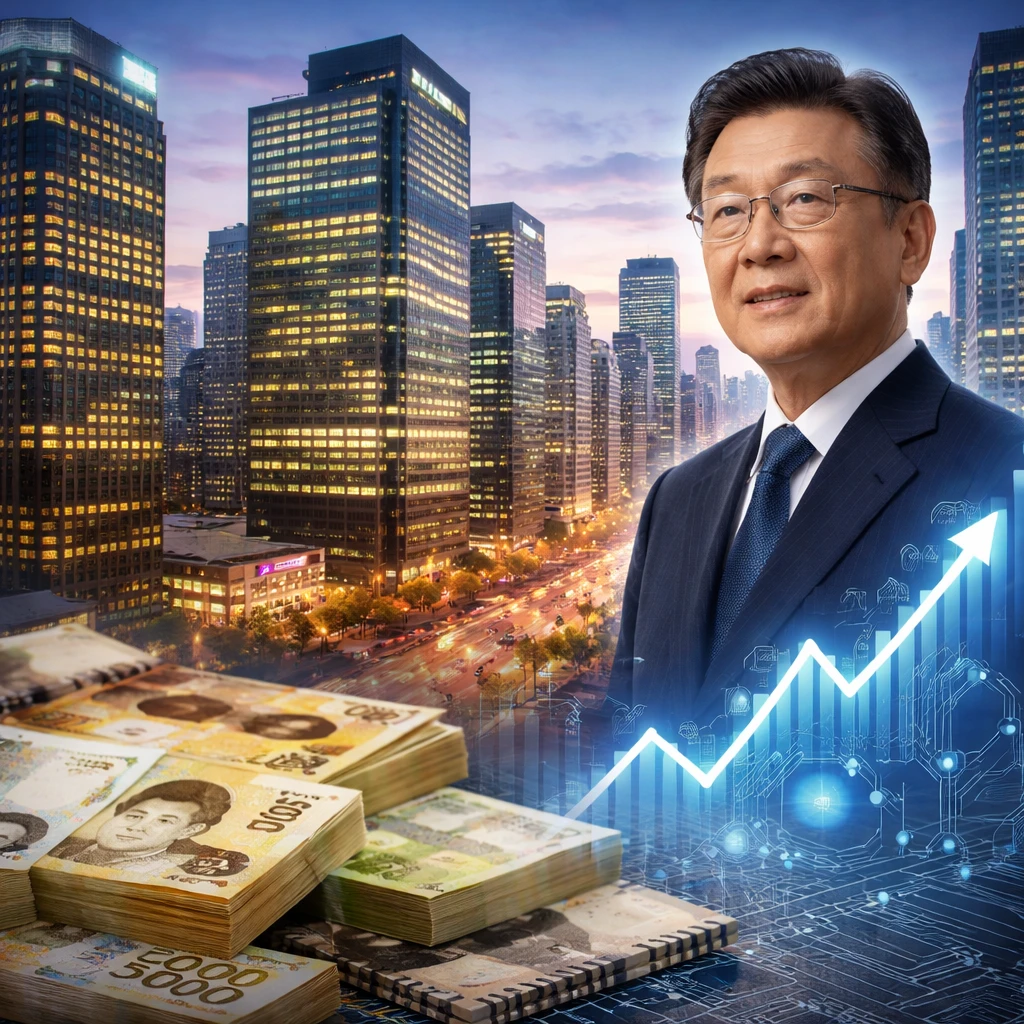
South Korea’s President Lee Jae Myung shared insights on Wednesday regarding the outlook for the domestic currency and equity markets, emphasizing both anticipated currency appreciation and perceived undervaluation in the stock market.
During a press briefing, Lee conveyed that officials responsible for currency policy expect the Korean won to strengthen to a level around 1,400 won per US dollar within the next one to two months. Following his remarks, the won appreciated by as much as 0.5%, reaching approximately 1,468.8 against the dollar, after earlier hitting its weakest point since December 24 at 1,481.4.
Market participants noted that the dollar-won exchange rate dropped sharply as traders adjusted their long dollar positions in response to the president’s comments. This adjustment underlines the sensitivity of the won to policy signals and market sentiment.
Since late last year, South Korean authorities have implemented various measures designed to support the currency, which had declined to levels not seen in about 16 years. These efforts reflect concerns that the won’s depreciation was not fully justified by economic fundamentals.
However, Lee cautioned that these domestic initiatives would be insufficient as standalone solutions to reverse the won’s recent weakening, partly because the won’s performance is linked to developments in the Japanese yen. He noted that comparatively, the won has held up better against the yen, despite regional currency challenges.
The president affirmed his commitment to continuing efforts aimed at discovering sustainable policies to stabilize exchange rates over the longer term.
Turning to the equity market, Lee addressed the persistent issue of the "Korea Discount," a phenomenon where South Korean equities trade at lower valuations relative to global counterparts. Factors historically contributing to this undervaluation include concerns related to national security, domestic political conditions, corporate governance standards, and certain market practices. Lee noted that progress has been made in addressing some of these issues.
Reflecting on recent market performance, the benchmark KOSPI index surged 15% so far this month, fuelled notably by strong advances in semiconductor firms and automobile manufacturers. This bullish momentum has been linked to growing enthusiasm surrounding artificial intelligence technologies, following the KOSPI's remarkable 76% rise last year—the best since 1999.
As of Wednesday, the KOSPI hovered around 4,880 points after offsetting earlier declines. Lee commented that the index appears positioned to exceed the 5,000-point mark, driven by factors that were previously unforeseen, specifically the substantial impact of AI and semiconductor sector growth.
These developments reflect the dynamic interplay between currency movements and equity valuations in South Korea, highlighting the importance of policy and market sentiment in shaping investor outlooks.