
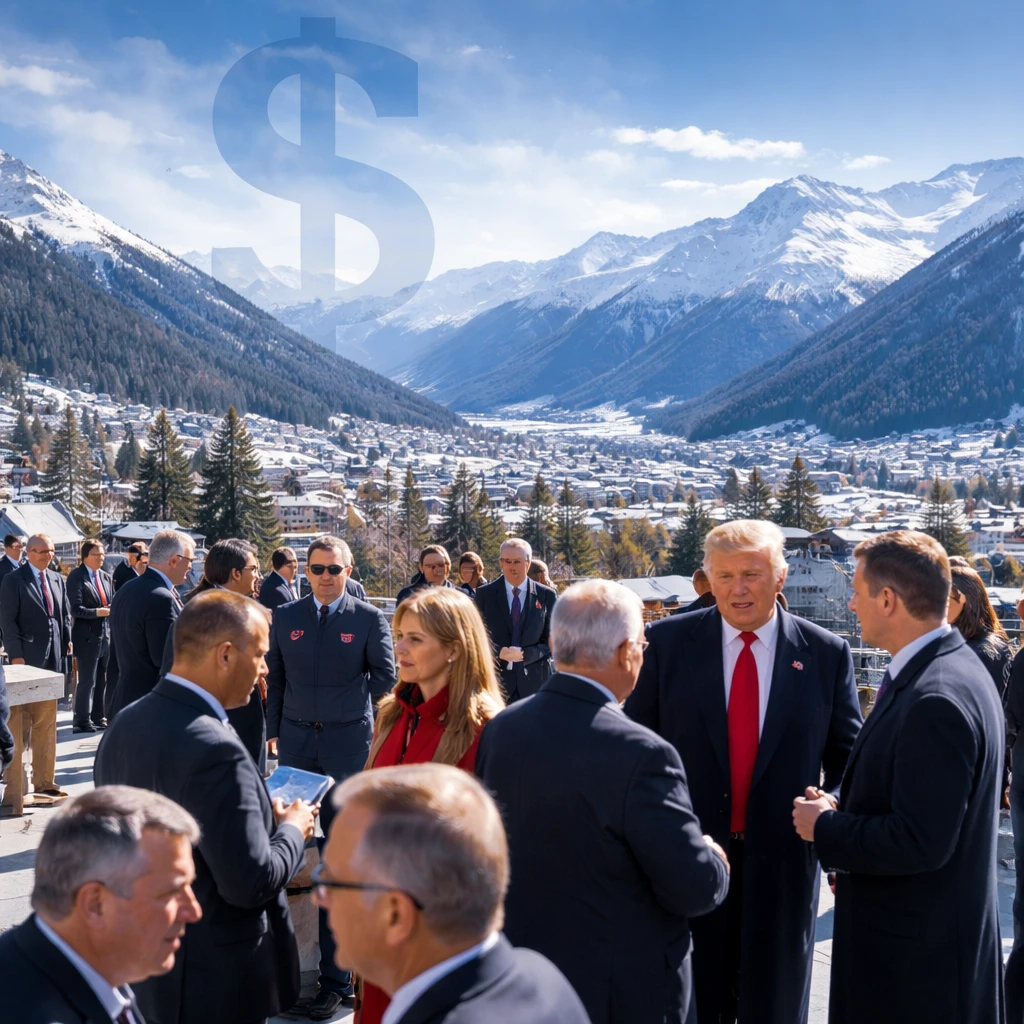
The U.S. dollar continued its slide near recent lows as President Donald Trump renewed his controversial stance on acquiring Greenland, a Danish territory, ahead of his speech at the World Economic Forum in Davos. Meanwhile, economic data from the U.K. indicating higher-than-expected inflation provided modest support to the British pound. Across Asia, currency pairs adjusted to shifts in government bond markets and central bank policy announcements, reflecting ongoing global economic and geopolitical uncertainties.
Key Points
- U.S. dollar remains pressured near recent lows influenced by President Trump's renewed focus on acquiring Greenland, creating geopolitical uncertainties impacting currency markets.
- British pound gains slightly after higher-than-expected U.K. inflation data, influencing expectations for possible monetary policy decisions by the Bank of England.
- Japanese government bonds experience heavy selling due to investor concerns over fiscal expansion plans under new Prime Minister Sanae Takaichi, affecting the yen and global bond markets.
In mid-Asian trading hours on Wednesday, the U.S. dollar maintained levels close to its recent lows after President Donald Trump reiterated his intention to acquire Greenland. As of 03:55 ET (08:55 GMT), the Dollar Index, which measures the greenback's value against six major currencies, slipped 0.1% to 98.400, extending the previous session's decline of 0.8%. That fall marked the sharpest daily drop the dollar experienced in six weeks.
President Trump's renewed focus on Greenland has kept currency markets on edge. He emphasized America's necessity to control the semi-autonomous Danish territory for national security reasons, suggesting ongoing negotiations to secure a mutually agreeable arrangement. When pressed about the exact measures he was willing to take to acquire Greenland, his response was notably vague, saying, "You'll find out."
Trump's forthcoming speech at the World Economic Forum in Davos, Switzerland, is highly anticipated for potential escalations on this front. Analysts at ING highlighted Greenland as a likely dominant topic during the forum, noting the possibility that diplomatic engagements there could ease tensions and provide some relief to the dollar. They remarked that face-to-face meetings between Trump and leaders from the European Union often offer opportunities to de-escalate previously heightened frictions.
In Europe, the British pound experienced a slight uptick against the dollar, rising 0.1% to 1.3442. This movement followed the release of December's inflation data showing a consumer price index (CPI) increase of 3.4% year-over-year, exceeding market expectations of 3.3% and up from 3.2% in November. The stubbornly high inflation rate in the U.K., which remains the highest among Group of Seven nations despite sluggish economic growth, may influence the Bank of England’s future monetary policy decisions. Although the central bank reduced interest rates by 25 basis points in December, the recent inflation figures could encourage policymakers to consider maintaining current settings at their February meeting.
Conversely, the euro retreated slightly, losing 0.1% against the dollar to 1.1709 after having reached three-week highs the previous day. The ongoing uncertainty linked to discussions over Greenland appeared to weigh on the euro, with analysts at ING expressing the view that, barring significant increases in bond market volatility, the EUR/USD exchange rate is likely to settle below 1.170 during this period, which is typically strong for the dollar.
Turning to Japan, the yen steadied after a period marked by pronounced volatility. The USD/JPY pair declined 0.2% to 157.84, stabilizing following a sharp selloff in Japanese government bonds. Investor concerns about fiscal sustainability intensified amid Prime Minister Sanae Takaichi’s proposed aggressive spending policies, notably including plans to suspend the national sales tax on food. These proposed fiscal measures spurred a spike in yields on long-dated government debt, such as the 40-year Japanese government bond, to record highs. The apprehension surrounding Japan’s expanding deficits and national debt triggered significant selling in sovereign bonds, driven by tepid auction demand.
The political landscape in Japan is also in flux, with Prime Minister Takaichi calling a snap election for February 8. This move aims to bolster her political mandate to advance her economic and fiscal agenda.
Elsewhere in Asia, the Chinese yuan saw modest gains, with USD/CNY up 0.1% at 6.9653 following the People's Bank of China’s recent decision to hold its loan prime rate steady. Other commodity-linked currencies showed strength: the Australian dollar increased 0.3% to 0.6752, while the New Zealand dollar also rose 0.3% to 0.5847.
Overall, global currency markets remain sensitive to geopolitical developments and economic data releases. The greenback’s recent weakness underscores the broader uncertainties amid trade, fiscal policies, and inflation dynamics worldwide, with key central bank meetings and political events in the coming weeks poised to further influence currency trajectories.
Risks
- Geopolitical tensions stemming from the U.S. stance on Greenland could escalate, impacting currency volatility and international relations, particularly between the United States and Europe.
- Persistently high inflation in the U.K. may lead to unexpected monetary policy shifts by the Bank of England, affecting financial markets and economic growth prospects.
- Japan's fiscal sustainability concerns and record-high yields on long-term government bonds create risks for Japanese financial markets and may influence currency stability as political elections approach.