
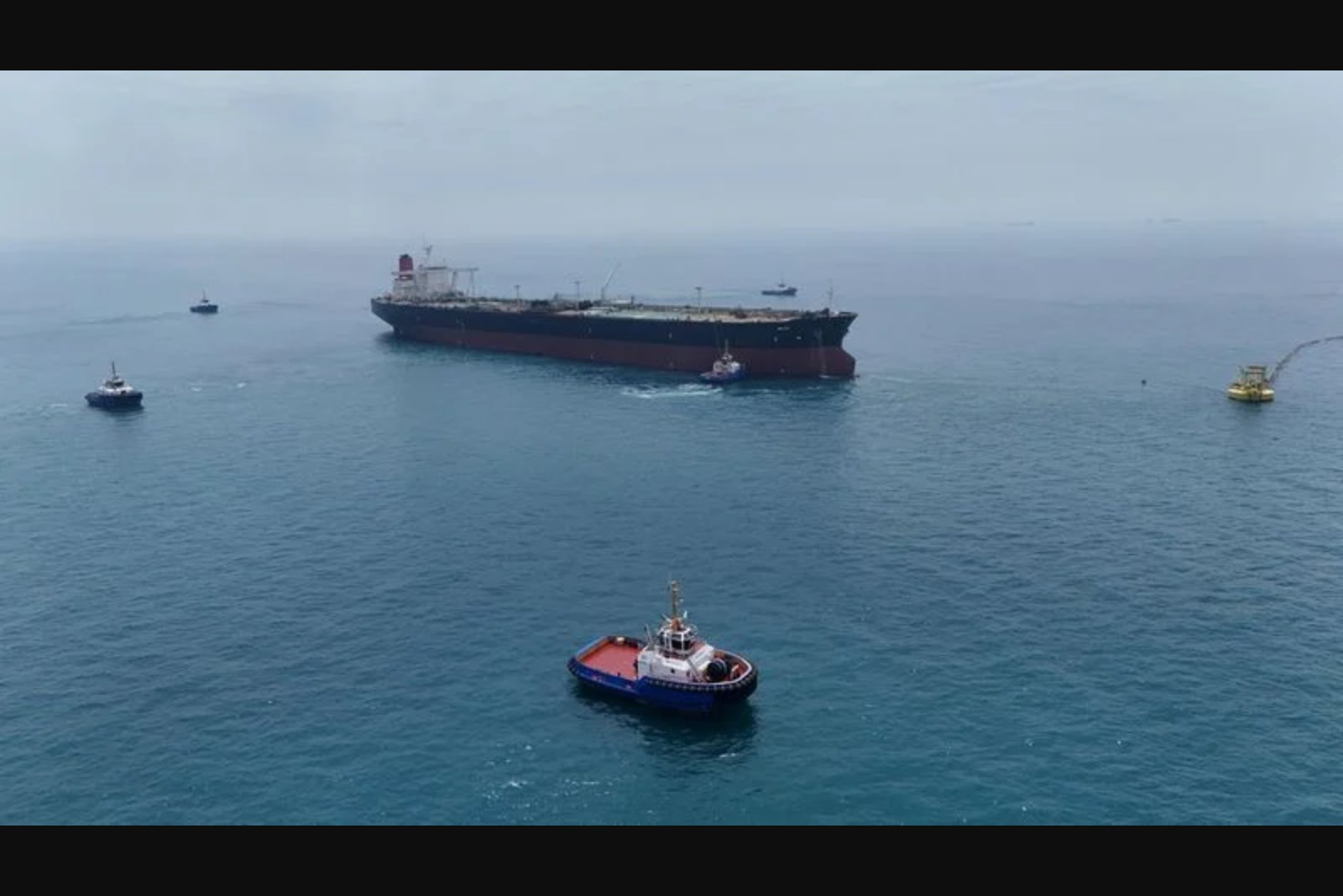
Overview
Brent crude has rallied in recent weeks yet failed to sustain a move above $100 a barrel despite a fresh escalation in the U.S.-Iran confrontation that has interrupted flows from the Strait of Hormuz and the Red Sea. Industry tallies show Middle East crude shipments have fallen to about 11 million barrels per day (bpd) from roughly 18 million bpd prior to the outbreak of hostilities seven months ago, underscoring why market reaction has been mixed.
How much oil is still moving through Hormuz?
Not all exports stopped when conflict intensified. In the week before the latest flare-up on August 30, around 8 million to 9 million bpd passed through the Strait of Hormuz - about double the week before, according to Rystad Energy's chief economist, Claudio Galimberti. While flows declined to below 2 million bpd following the renewed fighting, the daily moving average has been roughly 4 million to 5 million barrels. Galimberti suggested that level corresponds to a "fair" Brent price near $95 a barrel.
Other industry tallies place current daily exports from the Gulf in a 6 million to 8 million bpd range. Vessel-tracking data show no very large crude carrier (VLCC) left the strait since September 2, a sign of the reduced but not wholly halted traffic. During a short-lived easing in July under an interim U.S.-Iran arrangement, throughflows briefly returned to pre-conflict volumes of about 16 million bpd.
Alternative routes and port adjustments have softened the shock
Gulf producers have increasingly relied on workarounds to keep cargoes moving. Ship-to-ship transfers conducted outside the strait and diversions to alternate load ports have replaced some of the lost direct Hormuz shipments.
Saudi Aramco resumed loadings from Ras Tanura inside the Gulf in August. However, exports from its Red Sea terminal at Yanbu have been constrained by a naval blockade imposed by Yemen's Iran-aligned Houthi forces; provisional data show Yanbu shipments fell to a six-month low of 1.429 million bpd in August, down from an average near 3.9 million bpd over the previous three months.
Other Gulf and regional ports have picked up volumes. Egypt's Sidi Kerir exported 2.139 million bpd in August, more than double June levels. Iraq's exports rebounded to around 2.34 million bpd in August. Shipments from the United Arab Emirates held near 2.9 million bpd in July and August after a June record. Kuwaiti crude exports recovered to about 1 million bpd in July and August. At the same time, Iran's own exports have plunged amid a U.S. blockade.
Non-OPEC supply gains are filling some of the shortfall
Outside the OPEC sphere, producers are adding significant volumes. The United States, Canada and Guyana are expected to raise combined output by around 1.4 million bpd this year, according to Jarand Rystad, founder of Rystad Energy. Those increases are partly offsetting lost Middle Eastern barrels.
Russian crude exports have remained about 5.5 million bpd in July and August, down from a June peak of 6.4 million bpd. Despite that month-to-month decline, exports are still about 23% higher than in February. This comes alongside reduced processing at some Russian refineries because of damage to domestic plants from Ukrainian attacks. Separately, Russia has trimmed its 2026 oil output forecast down to what was described as a 17-year low projection - a factor that could weigh on future export volumes.
Demand destruction, led by China, is substantial
On the demand side, the market has seen pronounced reductions in petrochemicals and transport fuel consumption. Rystad Energy estimates demand destruction ran at about 3.5 million bpd in the third quarter, down from 4.5 million bpd in the second quarter. More than half of the decline is attributed to China, where rising transport electrification and increased use of coal for chemical feedstocks have suppressed crude imports.
China curtailed seaborne crude shipments to about 7 million bpd in July and August, from more than 11 million bpd in February. In addition, large stockpiles provide a buffer; Kpler estimates Beijing's reserves at 1.17 billion barrels, a level that has helped temper market concern.
Physical markets point to localized tightness
Despite the supply cushions described above, physical differentials have tightened. Spot premiums for Middle East grades rebounded to levels last seen in April, with Dubai and Oman trading at $19 to $20 a barrel premiums for cargoes loading in November. Oman futures were quoted at $104.54 a barrel and cash Dubai at $105.10 a barrel on the relevant trading day.
Argus chief economist David Fyfe noted the disconnect between headline Brent levels and the physical market, saying: "At the moment, it’s telling us that physically things are incredibly tight." He also highlighted acute stress in the diesel market, which is signaling shortages in some regions as refiners lift runs to meet diesel demand and U.S. diesel prices reach record highs.
Market forecasts have moved up
Reflecting the heightened geopolitical risk and the supply-demand dynamics, several banks have revised their Brent outlooks upward. Morgan Stanley raised its view to expect Brent averaging $100 a barrel in the fourth quarter. Goldman Sachs increased its Brent and WTI projections by $5 a barrel for December 2026 and for 2027, citing an expectation that Middle East shipping disruptions could persist into next year. Goldman now projects Brent at $85 a barrel and WTI at $80 for December 2026, and $80 and $75 a barrel respectively for 2027.
Bottom line
Brent's recent rally reflects the market balancing act between disrupted Gulf flows and mitigating factors that limit upside. Ongoing rerouting, higher output from non-OPEC producers, and pronounced demand destruction - most prominently in China - have constrained price moves above $100. Yet physical indicators, notably sharp diesel differentials and elevated spot premiums for certain Middle Eastern cargoes, show parts of the market are tightly supplied and sensitive to further disruptions.
Reporting focuses on observed shipments, price differentials, producer adjustments and analyst forecasts without introducing additional context beyond available market data and industry estimates.