
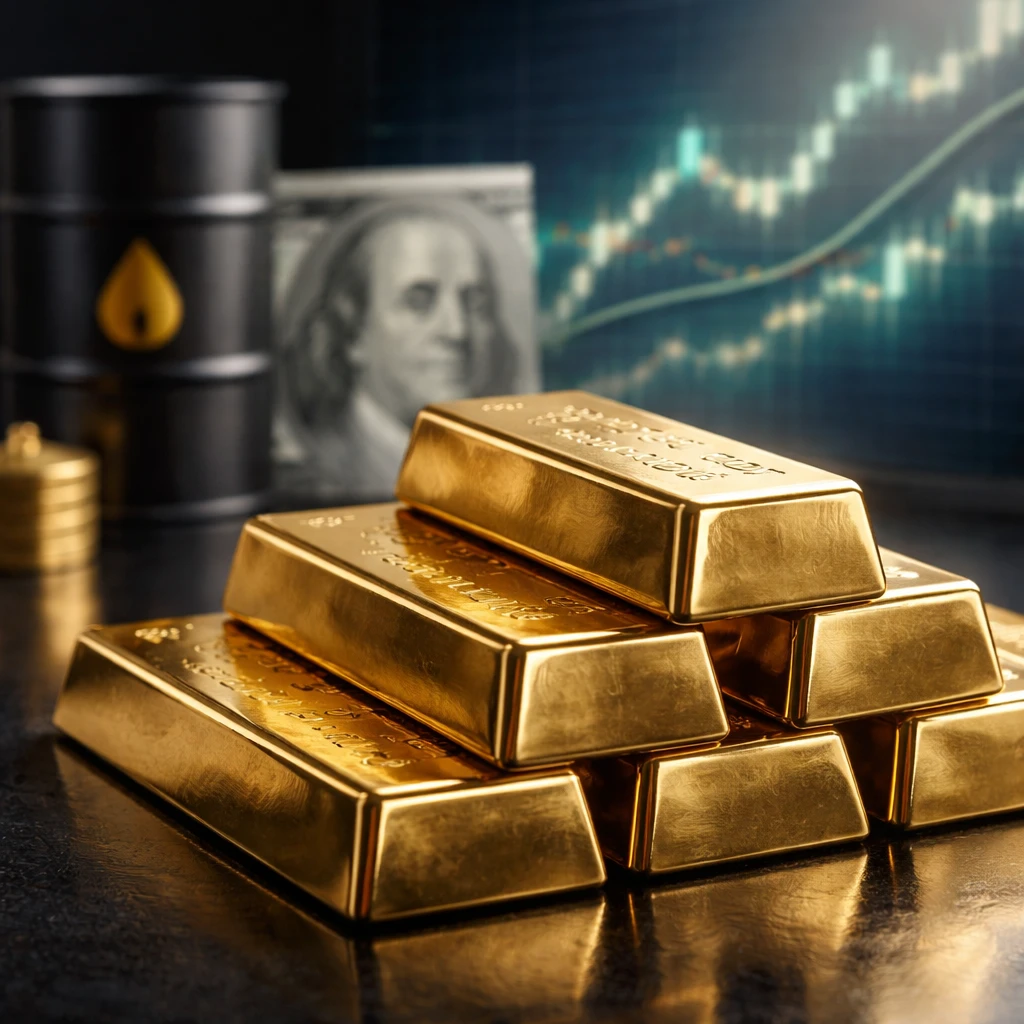
Gold has come under renewed pressure since the joint U.S. and Israeli assault on Iran in late February, and UBS analysts say the metal’s price action is increasingly being shaped by economic forces rather than geopolitics alone.
In a note from UBS, analysts including Dominic Schnider and Wayne Gordon argue that a sharp rise in oil has heightened concerns about energy-driven inflation. Those inflationary risks could prompt central banks such as the Federal Reserve and the European Central Bank to consider additional rate hikes. Because gold does not yield interest, it typically underperforms in environments where policy rates and real yields are rising.
Government bond yields have recently climbed, a move that is mechanically at odds with bond prices. "Against this backdrop, the inverse relationship between U.S. real yields and gold has reasserted itself over recent months," the UBS analysts wrote. They also highlighted that a tracker measuring the correlation between rate-sensitive 2-year Treasury yields and gold has flipped to negative; earlier in 2026 that same gauge was slightly positive, indicating a shift in how markets price opportunity cost.
"In our view, markets are rediscovering the concept of opportunity cost, with gold’s non-yielding characteristics once again becoming a more important consideration as real rates remain elevated," the note said. The UBS team added: "Earlier in the year, gold increasingly traded as a liquidity and fiscal hedge, but investors are now rotating back toward many money market instruments."
At the same time, the firm pointed to a stronger U.S. dollar as another headwind for bullion, saying that a firmer dollar can raise the effective price of gold for overseas purchasers. The U.S. dollar index has risen by 1.3% over the past three months, the analysts noted.
On Tuesday, spot gold declined by 1.0% to $4,524.75 an ounce. Over the last three months bullion has fallen by more than 12%.
Despite these near-term pressures, UBS expects supportive structural factors to re-emerge in the medium term. The analysts singled out "elevated global debt burdens, persistent fiscal deficits in the U.S., and continued reserve diversification trends" as forces that could bolster the strategic case for hard assets.
UBS said these dynamics could resurface especially if oil prices moderate toward the end of the year and if softer U.S. GDP growth allows the Federal Reserve to deliver what the firm described as a "growth insurance" rate cut in December. The analysts forecast that such a sequence would again strengthen the rationale for holding gold.
Bottom line: UBS sees current gold weakness as primarily tied to higher real yields, a stronger dollar and oil-related inflation fears, but believes structural drivers could lift the metal later in the year if oil eases and growth softens enough for a Fed rate cut.