
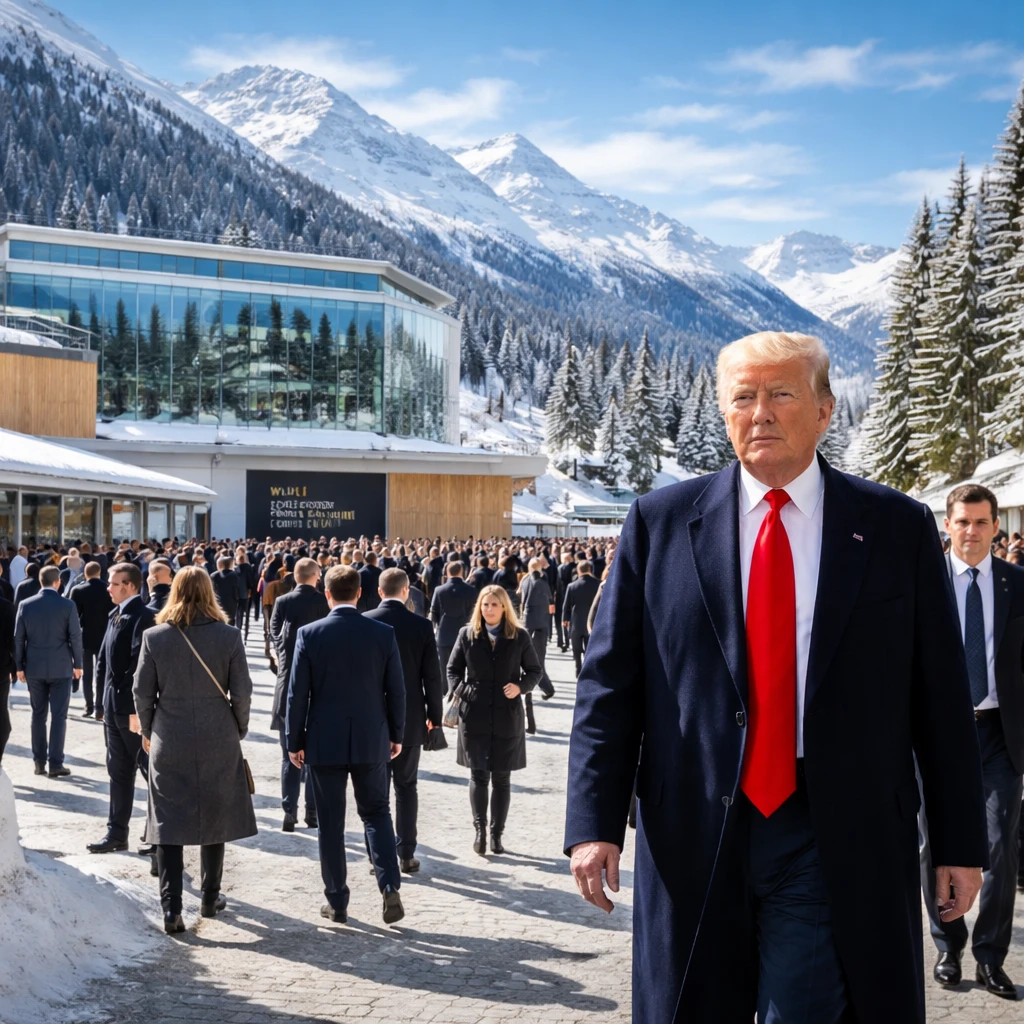
Global financial markets exhibited signs of cautious optimism early Wednesday after earlier sharp declines in equities, bonds, and the U.S. dollar began to stabilize. The heightened market attention centers on the U.S. President Donald Trump's arrival in Davos, with investors awaiting his address at the World Economic Forum (WEF) and speculating on how the administration might proceed regarding its contentious tariff threats targeting Europe in relation to Greenland.
The stance from the White House remains firm, with President Trump reaffirming he will not retreat from his position, while European leaders hold resolute in their commitment to retaliate if the planned tariffs set for February 1 are implemented. This dynamic fuels uncertainty over the trajectory of U.S.-European trade relations.
In advance of the President’s speech, market participants are assessing the broader implications, notably how rising U.S. Treasury yields may influence the administration's decisions on trade policy, particularly in the midst of a critical mid-term election year. Historical precedent from last April suggests that surges in Treasury yields can pressure the administration to reconsider tariff strategies, though whether this will occur in the current context remains uncertain.
Meanwhile, European officials have escalated countermeasures, suspending ongoing trade negotiations and threatening to reinstate more than $100 billion in tariffs on American products should the U.S. proceed with its planned import levies. French President Emmanuel Macron underscored the EU’s disapproval at Davos, labeling Washington's continuous tariff impositions as "fundamentally unacceptable" and advocating for the activation of the EU's "Anti-Coercion Instrument" in response. His remarks emphasized a preference for established legal frameworks over aggressive trade tactics.
The tension extends beyond traditional trade disputes, with the Greenland issue illustrating broader strategic and territorial concerns. Europe's diminishing willingness to yield under trade pressure signals a possibility of prolonged transatlantic friction, which could prompt markets to account for scenarios involving reciprocal punitive tariffs, curbs on investment, or even financial embargoes. These developments could directly impact Europe's substantial holdings in U.S. securities, stirring potential volatility in global asset markets.
On the corporate front, Netflix reported better-than-expected revenue and earnings for the holiday quarter but saw its stock decline more than 4% in after-hours trading. The streaming giant has introduced an all-cash bid valued at $82.7 billion to acquire Warner Bros Discovery’s studio and streaming assets, a strategic move intended to outpace Paramount's competing acquisition efforts without increasing the offer price. Netflix’s announcement coincided with a pause in its share repurchases to conserve capital for the transaction and a fiscal year outlook projecting performance at the lower bandwidth of analyst expectations.
Looking ahead, market participants are focused on President Trump's WEF speech for insights on potential trade escalations, the anticipated U.S. Supreme Court hearing on Federal Reserve Governor Lisa Cook’s legal challenge, and corporate earnings releases from significant players including Citizens Financial Group, Halliburton, Johnson & Johnson, and Kinder Morgan.
Key Points:
- President Trump is expected to intensify efforts to acquire Greenland and push trade measures during the WEF, heightening U.S.-Europe tensions.
- European nations are firmly preparing counteractions against U.S. tariffs, signaling a less conciliatory approach than in previous trade disputes.
- Rising U.S. Treasury yields could exert pressure on U.S. policymakers amid the trade conflict, a factor closely monitored by financial markets and political stakeholders.
Risks and Uncertainties:
- Potential escalation of tariff impositions could trigger broader retaliatory measures by Europe, disrupting transatlantic trade and investment flows.
- Increased volatility in U.S. Treasury yields may impact financing costs and investor confidence, affecting both the domestic economy and global markets.
- Corporate sector uncertainties persist due to high-profile acquisitions and mixed earnings outlooks, exemplified by Netflix's competitive bid and cautionary guidance.
Disclosure: The views expressed here are those of the author and do not necessarily represent the perspectives of any affiliated organizations. This article aims to provide a fact-based analysis of market developments without bias.