
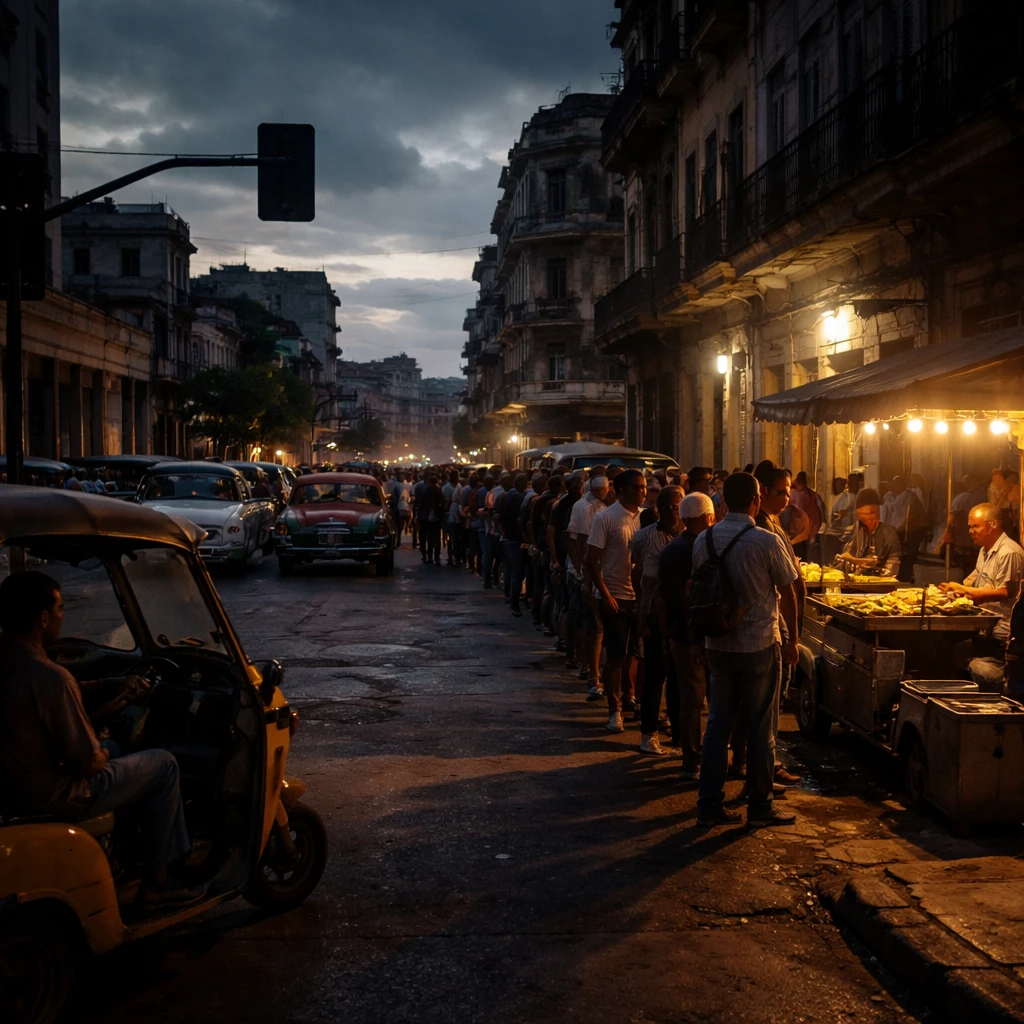
Residents across Havana and surrounding districts describe a city in which routine life has been reduced to meeting immediate survival needs as electricity outages lengthen and the cost of basic goods rises. Over three dozen people from street vendors to taxi drivers, private-sector workers and state employees were interviewed for this reporting, painting a portrait of mounting scarcity concentrated around fuel-dependent goods and services.
For much of rural Cuba, periodic power failures and resource shortages are familiar. The island’s aging power infrastructure has been deteriorating for years and many residents have adjusted to prolonged periods without electricity, internet or functioning water pumps. The seaside capital, however, historically benefited from somewhat more stable service and greater access to hard currency through tourism. That relative stability is now fraying as fuel supplies tighten and prices climb.
The immediate squeeze has been driven by interruptions to oil deliveries. Shipments that once came from Venezuela and then from Mexico have been halted, cutting off supplies that prop up domestic energy and transport. Washington has warned that it will impose tariffs on imports from countries that supply Cuba with oil, increasing pressure on the island’s economy. U.S. President Donald Trump, when asked about the prospect of military intervention in Cuba shortly after the capture of Venezuelan President Nicolas Maduro, said he did not think an attack was necessary because "it looks like it’s going down."
In response to the U.S. tariff warning, Cuba’s Foreign Minister Bruno Rodriguez declared an "international emergency," calling the warning "an unusual and extraordinary threat." Beyond that declaration, official information about how the government plans to manage the growing humanitarian pressures has been limited.
Daily life and livelihoods under strain
People across professions say the immediate priorities are food, fuel for cooking and water. The peso has lost more than 10% of its value against the dollar in three weeks, pushing up grocery prices and worsening purchasing power for those paid in national currency. "This has put me in an impossible situation," said Yaite Verdecia, a Havana resident and housewife. "There’s no salary that can cope with this."
Fuel availability has shifted significantly. Since deliveries from Venezuela were effectively blocked in mid-December, much of the gasoline available in the city is being sold at a premium in dollars - a currency that most ordinary Cubans do not have access to. Lines at service stations that still receive fuel have lengthened in recent days. An app that previously let residents know when it was their turn to fill up has stopped enabling purchases in national currency, according to Havana resident Jesus Sosa, who said, "It used to be that you could sign up and get fuel once a month (in pesos). Not anymore. Sales in national currency have stopped."
Transport networks are directly affected. Reduced fuel availability has put some state-run buses and private taxis out of service and forced surviving operators to raise fares. For commuters this means longer trips and higher transport costs. Daylan Perez, 22, who hails private taxis for clients in Old Havana, said fewer buses left people with little choice but to pay growing fees for private transport: "You have to pay the price or stay home," he said.
Electric vehicles, once seen as a partial solution to petrol scarcity, are also being undermined by the longer power outages. Taxi driver Alexander Leyet switched to a three-wheeled electric taxi hoping to avoid fuel dependency, but now finds his vehicle limited by power cuts: "Now because of the blackouts I can only charge my taxi for four or five hours," he said.
Public order, dissent and the social response
The socioeconomic squeeze might be expected to produce visible unrest. In many countries comparable strains have produced street protests. In Cuba, where dissent has long been curtailed and the government has taken strict measures against organized opposition, there has been little visible sign of mass protest so far. Much of the organized opposition inside the country has been diminished by sharp crackdowns and by significant emigration since the pandemic - estimates cited by residents put that emigration figure between one and two million people. The most recent broad public demonstrations cited by interviewees occurred in 2021 during the pandemic.
Interviews indicate a reluctance to discuss the prospect of protests. Nevertheless, interviewees did not dispute that change is needed. Some expressed fear, others resignation, and several framed their concerns in terms of immediate survival rather than political action. "I’m just praying God finds a way to get us out of this (mess)," said Mirta Trujillo, a 71-year-old street vendor from Guanabacoa who said she had been reduced to tears by the fact she could no longer afford food.
Trujillo formerly relied on a ration book for basic goods, but she said that arrangement was phased out after the pandemic as tourist income and other sources of hard currency declined. "I’m not against my country... but I don’t want to die of hunger," she said.
Everyday consequences of power outages
Frequent blackouts are affecting not only household routines but also public safety and the movement of people. At a busy intersection in Havana, a traffic accident occurred when stoplights were not functioning due to a power outage. "Sometimes when the power goes out, accidents happen because the traffic lights don’t work," said Raysa Lemu, whose apartment overlooks a boulevard in Marianao on the city outskirts. She described outages as worsening in frequency and duration: "It used to be they turned off the power two or three times a week, but now it’s every day and sometimes it’s up to 12 hours."
Long commutes have become more burdensome. Julia Anita Cobas, a 69-year-old housekeeper from Guanabacoa who was born just before Castro’s revolution, rises at 4 a.m. to make a 10-mile commute that can now take close to four hours round-trip. With fewer buses and greater expense for alternatives, she said she leaves before sunrise and is uncertain how she will return. Nevertheless, she offered a perspective shaped by decades of hardship: "Since I was born the (United States) has been threatening us, and every day we deal with hardship. But we’ve survived it all," she said.
Not everyone sees remedies in either government. Aimee Milanes, 32, from Reparto Electrico outside Havana, said she felt neither the Cuban government nor the U.S. offered solutions. "We’re drowning. But there’s nothing we can do," she said. "This is about survival. Nothing else."
Economic context cited by residents
Residents pointed to a wider economic contraction and the diminished flow of hard currency as part of the backdrop. Interviewees noted a 12% contraction of the economy between 2019 and 2024. The combination of a shrinking economy, fewer tourists and interruptions to energy supplies has constrained access to essentials and raised the cost of living—particularly as the peso depreciates sharply over a short period.
Several interviewees emphasized the link between fuel scarcity and higher prices throughout the city, while others highlighted the practical effects of blackouts on electric transport and everyday safety. The compounded effect of these pressures has pushed many households to prioritize immediate needs over longer-term considerations.
Outlook
At present, Cubans interviewed for this report described a situation defined by coping and adaptation rather than organized resistance. With supply bottlenecks centered on fuel and electricity, and with the peso losing significant value in a short time, households are facing constrained choices: pay higher prices in foreign currency where available, endure reduced mobility and longer commutes, or curtail economic activity altogether. How long residents will sustain these conditions without broader change remains unclear to those interviewed.
What is evident from conversations across Havana and nearby neighborhoods is that the most immediate burdens are practical and economic: securing food, keeping water and cooking fuel available, and maintaining some form of transport in a city where both fossil fuel and electricity access have become unreliable.