
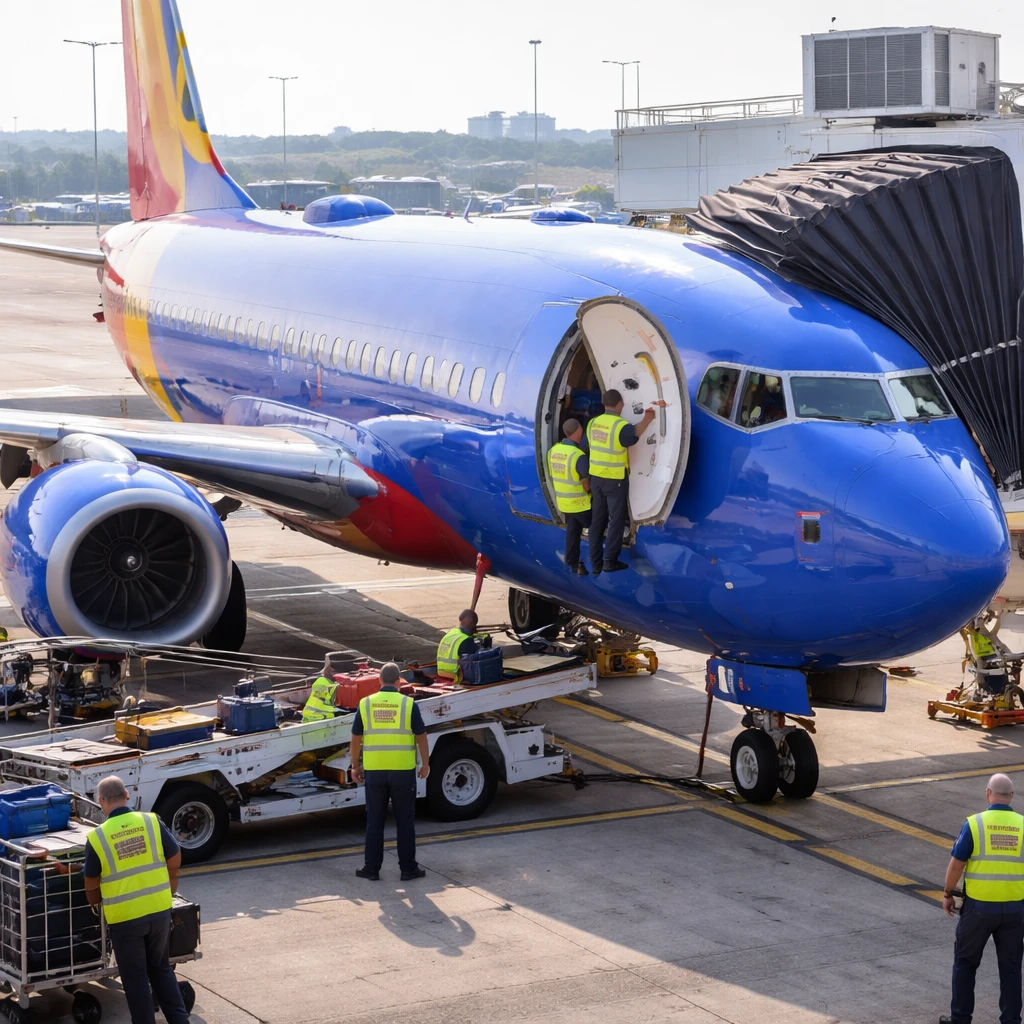
Jefferies raised its price objective for Southwest Airlines (NYSE: LUV) to $45.00 from $42.00 but left its recommendation unchanged at Hold. The new target implies only modest upside from the stock's most recent trade near $42.01, even as Southwest has delivered a 27.58% total return over the past six months, according to InvestingPro data.
At the center of Jefferies' update is the completion of Southwest's fleetwide seating retrofit. The airline finished work on roughly 300 Boeing 737-700 aircraft in January, concluding a program that reconfigured the carrier's full narrowbody lineup ahead of flights scheduled to begin on January 27, 2026.
Southwest's current fleet composition now includes 737-800s and MAX-8s fitted with 46 Extended Leg Room seats - representing 26% of capacity on those types - and 737-700s with 40 Extended Leg Room seats, representing 29% of capacity on that aircraft type. Management has quantified the expected earnings contribution from the new seating and assigned-seat options, forecasting $1.0 billion of EBIT in 2026 tied to those products and a $1.5 billion run-rate in 2027.
Jefferies' own model pegs Southwest's 2026 EBIT at $2.03 billion, slightly below consensus estimates of $2.06 billion. The firm highlights an explicit $1.5 billion opportunity stemming from seat bundles and differentiated fare classes, where management expects an average upsell of $50 and assumes a 20% buy-up rate. Those inputs form part of Jefferies' rationale for its revised target while still leaving room for execution risk and competitive pressures.
Investors will note Southwest's valuation on a trailing-price-to-earnings basis stands at 63.62, which InvestingPro flags as an elevated multiple. The company has earnings scheduled for January 29, three days after the start of the newly configured flight schedule; investors seeking deeper analysis can consult Southwest's comprehensive Pro Research Report and related coverage among more than 1,400 U.S. equities in the InvestingPro universe.
Broker activity beyond Jefferies has been notable. JPMorgan upgraded the stock from Neutral to Overweight and raised its target substantially to $60.00, projecting the possibility that Southwest could guide to $5.00 of EPS by 2026 - well above the current consensus EPS estimate of $2.98. By contrast, Wells Fargo initiated coverage with an Equal Weight rating and set a $45.00 price target, acknowledging the airline's transformation while warning of ongoing competitive pressures.
Operational concerns have also factored into the near-term backdrop. Transportation Secretary Sean Duffy indicated that disruptions from a winter storm - which produced more than 1,300 flight cancellations in the U.S. and affected post-holiday travel - were expected to normalize by midweek. Those service interruptions have been a meaningful short-term challenge for carriers, including Southwest.
Separately, Goldman Sachs cited a set of companies that could benefit from upward earnings revisions; named examples in that note included Allstate and Meta Platforms. While those calls do not directly concern Southwest, they form part of a broader market backdrop of select stocks that analysts view as positioned for positive earnings revisions.
Context for investors
The combination of a completed fleet retrofit, explicit management guidance for incremental EBIT from seat bundles and differing broker assessments has created a mixed picture for Southwest. Jefferies' move raises the target modestly but keeps a cautious stance; other firms have issued more optimistic upside scenarios while also acknowledging potential headwinds.
With earnings imminent and a relatively rich P/E multiple, investors and analysts will be watching execution on the seat-bundle initiative, actual buy-up rates and any guidance updates closely.