
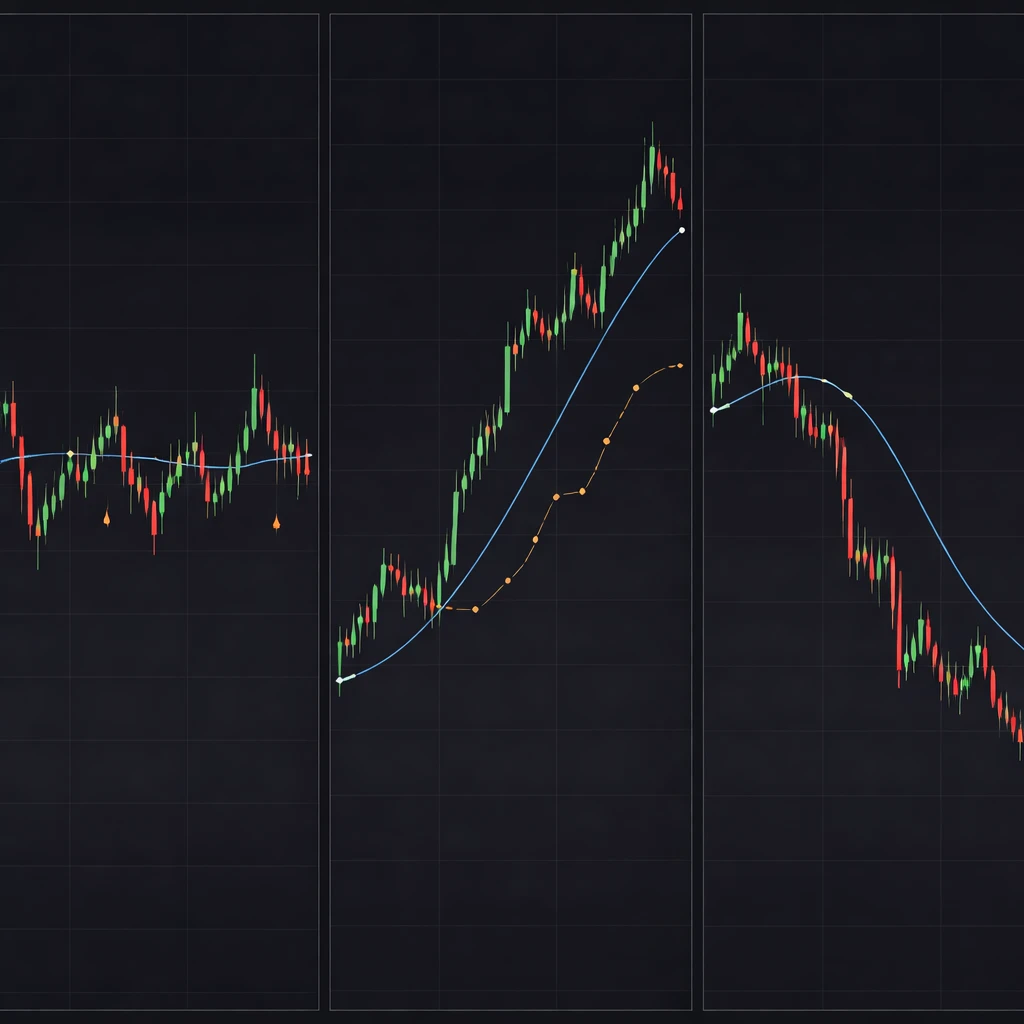
Trend following is built on a simple proposition: large price moves occasionally persist long enough to outweigh many small losses. In practice, the path to those large moves is uneven. Two recurring features shape the results of any trend-based approach. The first is the occurrence of whipsaws, a series of small losses caused by choppy, mean-reverting price action. The second is trend failure, where an apparent new trend reverses before delivering meaningful follow-through. A robust, repeatable trading system must anticipate both phenomena, encode clear rules for handling them, and allocate risk accordingly.
Defining Whipsaws and Trend Failure
Whipsaws. A whipsaw is a loss or a cluster of losses that occurs when price action alternates around a trend trigger, such as a breakout zone or a moving average signal. The system enters in the direction of an apparent move, only to be forced out shortly after because the move does not continue. The hallmark of whipsaws is frequency and small magnitude. They often arise in range-bound markets where volatility is present but directional persistence is absent.
Trend failure. Trend failure refers to an initially successful trend initiation that later reverses and invalidates the directional thesis. Unlike a single whipsaw, which is usually a brief, small loss, trend failure can occur after some unrealized gains have accrued. The system may be holding a profitable position, then price retraces and negates the trend structure. The hallmark of trend failure is reversal after partial progress rather than immediate rejection.
Why distinguish them. The distinction matters because each has different implications for system design and risk. Whipsaws test the tolerance for frequent, controlled losses. Trend failure tests the mechanism for protecting open profits and the discipline to exit when the trend structure breaks. Systems that treat the two phenomena identically risk overcutting winners or undercutting losses.
The Core Logic of Trend Following
Trend following assumes that markets periodically exhibit serial correlation in returns. When such correlation exists, buying strength or selling weakness can have a positive expected value if losses are limited while winners are allowed room to develop. Statistically, successful trend following tends to create positively skewed returns. Many trades are flat or small losers, and a minority generate outsized gains. The long right tail of the distribution is the source of profitability.
Whipsaws reflect periods when the serial correlation assumption does not hold. Prices fluctuate around a threshold, producing false starts. Trend failure reflects a change in regime or the exhaustion of the initial impulse. Both are integral to the distributional shape of trend following. Attempts to remove them entirely usually come at the cost of missing the very moves that drive long-term results.
In a structured, repeatable system, the core logic can be expressed in a few principles:
- Use a consistent rule to define trend initiation, such as a price breakout or a slope-based directional filter.
- Place an objective loss control mechanism so that adverse moves are capped.
- Allow profitable trades to continue until an objective rule indicates trend deterioration or end-of-move conditions.
- Accept that edges materialize over sequences, not single trades, and that small losses are a recurring cost of participation.
Where Whipsaws Fit in a Repeatable System
Whipsaws are not merely nuisances. They are informative tests of whether the system adheres to its logic. A trend system that never incurs whipsaws likely filters so aggressively that it participates in too few trends. Conversely, one that triggers incessantly with no filtering may overtrade in noise.
A structured approach treats whipsaws as a manageable expense. This perspective influences several design choices:
- Signal sensitivity. More sensitive triggers capture trends earlier but invite more whipsaws. Less sensitive triggers reduce trade frequency and whipsaws but enter trends later. The choice depends on the time horizon, diversification, and the system’s tolerance for missed early gains.
- Timeframe alignment. A strategy anchored to intermediate horizons often performs differently from one anchored to short-term horizons. Short horizons usually face more whipsaws because microstructure noise dominates. Longer horizons whipsaw less frequently but can tolerate larger fluctuations within trades.
- Execution discipline. Consistent execution of entries and exits is crucial. Slippage and delays can convert a controlled whipsaw into a larger-than-intended loss. A repeatable process includes realistic assumptions about transaction costs and execution speed.
Understanding Trend Failure Within the System Logic
Trend failure is a different stress test. It probes whether the exit logic protects capital and open profit when a trend thesis weakens. A system that rides trends needs a rule that defines when a trend has ceased to exist. Examples include a loss of structural features like higher lows in an up move or lower highs in a down move, a decisive breach of a trailing risk marker, or a regime signal indicating a shift in volatility or correlation.
Importantly, exit logic should be coherent with entry logic. If entries respond to breakouts, exits often mirror that philosophy by responding to breakdowns in the trend structure rather than fixed time limits. If entries use directional filters, exits similarly use loss of direction or momentum cues. Coherence preserves the probabilistic edge and reduces parameter fragility.
Risk Management Considerations
Risk management is the anchor that keeps whipsaws and trend failure within acceptable bounds. Several dimensions are central in trend-following design:
Per-Trade Risk and Loss Control
A structured system budgets a maximum loss per trade, expressed as a fraction of total capital or as a function of volatility. The intention is to cap the damage from both whipsaws and sudden reversals. A stop mechanism or a preplanned exit condition implements this cap. The precise method varies, but the governing principle is invariant. Losses are expected and limited, not negotiated after the fact.
Position Sizing
Position size often scales with recent volatility. Higher volatility environments imply smaller unit sizes to maintain a stable risk profile. Lower volatility environments allow larger sizes within the same risk budget. This dynamic sizing helps normalize the impact of whipsaws across different market states and reduces the chance that a trend failure in a high-volatility period overwhelms the system.
Portfolio Construction
Diversification across instruments, sectors, and timeframes can reduce the clustering of whipsaws. When one market ranges, another may trend. Correlation analysis informs position limits by grouping exposures that tend to move together. A portfolio-level risk cap prevents an unusual cluster of whipsaws from escalating into a significant drawdown.
Drawdown Tolerance and Recovery Planning
Every trend-following system should have a drawdown policy that anticipates a normal range of equity fluctuations. Whipsaws typically produce shallow but extended drawdowns, while trend failure can cause sharper drops if several positions reverse together. The policy sets thresholds for risk scaling, trade frequency adjustments, or temporary de-risking rules that are consistent with the system’s philosophy and testing.
Re-entry Protocols
After a whipsaw or a trend failure, a robust system specifies how and when it can attempt again. Markets that trend often do so in waves. An exit that preserves capital should not preclude participation in a subsequent valid setup. A clear re-entry rule prevents emotional decisions, such as avoiding a good opportunity because of a recent loss or chasing a move due to fear of missing out.
Statistical Profile: What Whipsaws and Failures Do to the Numbers
Whipsaws and trend failures shape the empirical profile of trend following. Several statistics are informative for monitoring the health of a system that encounters them regularly:
- Win rate and payoff ratio. Trend following commonly exhibits a modest win rate offset by a larger average win than average loss. Whipsaws depress the win rate, while the few sustained trends elevate the payoff ratio. Monitoring both helps detect undesirable drift, such as increasing losses without a compensating rise in the size of winners.
- Drawdown depth and duration. Whipsaw clusters often lengthen drawdown duration without deepening it dramatically. Trend failures can deepen drawdowns when reversals occur across correlated positions. Tracking both dimensions clarifies whether the system’s recent behavior fits tested expectations.
- Trade distribution skewness. Positive skew is a signature of effective trend following. If skew erodes, it may indicate overfiltering of large moves or poor exit logic during trend failure.
- Whipsaw density and streak length. Recording the frequency of back-to-back small losses helps quantify regime conditions. Elevated density may warrant preplanned adjustments if these are part of the design, such as temporary trade reduction consistent with testing.
- Slippage and cost footprint. Whipsaws increase turnover. A system must confirm that expected edge remains after costs, especially during active, choppy periods.
High-Level Example: How a Trend System Encounters Whipsaws and Failure
Consider a generic trend-following framework that identifies directional bias using a combination of price relative to a smoothing reference and recent breakout behavior. Loss control is applied through a trailing mechanism that responds to adverse moves, and position size scales inversely with recent volatility.
Phase 1: Range-bound quarter. Over several weeks, price oscillates around the trend reference without persistent direction. The system alternates between small long and short exposures, each time exiting shortly after entry as prices retreat to the midpoint. The equity curve drifts sideways to slightly down due to transaction costs and small losses. Whipsaws dominate. Despite the frustration, position size is modest because volatility is elevated, and portfolio-level limits prevent overconcentration in correlated assets that display the same behavior.
Phase 2: Emerging trend. A strong directional expansion begins. The system participates, initially with modest confidence due to the recent whipsaws. As the trend extends, trailing risk markers are gradually adjusted, allowing room for normal pullbacks. Some unrealized profit is surrendered during consolidations, but the exit logic holds until clear evidence of trend deterioration appears. A few strong trades offset the prior whipsaw losses and generate net gains over the quarter.
Phase 3: Trend failure. After a period of ascent, price transitions into a complex pullback that breaks the trend structure. The system exits according to its predefined rule. If a secondary attempt triggers shortly after, the system allows a re-entry following the same logic. Sometimes the second attempt gains traction, other times it becomes another controlled loss. Over a sequence, the net effect aligns with the tested expectancy.
Throughout these phases, portfolio-level rules throttle risk. If several markets exhibit similar choppy behavior, position limits reduce exposure. If a handful of markets trend well, gains accrue while the system still respects correlation caps. The experience illustrates the essential dynamic: whipsaws are frequent and small, trend failures are less frequent but can be larger, and a few sustained trends supply the asymmetry that powers the long-run outcome.
Design Choices That Influence Whipsaws and Failures
Several levers in system design shape the frequency and cost of whipsaws and the resilience to trend failure. Each lever involves trade-offs that must be validated through testing and monitored in production:
- Trigger selection. Breakout-based triggers are responsive to sudden expansions but can whipsaw in noisy ranges. Slope or momentum filters reduce false starts but may enter later. Combining elements can balance responsiveness and selectivity, albeit with the risk of overcomplication if not tested robustly.
- Regime filters. Some systems include a regime component that de-emphasizes trading during low directional conviction environments, such as very low trend strength or highly compressive volatility states. Filters can reduce whipsaws but also risk missing the early stages of strong trends, which often emerge from compression.
- Exit architecture. Exit rules can be price-based, time-based, or structure-based. Price-based exits cut losses at predefined adverse moves or trail profits with adaptive buffers. Time-based exits close trades after a certain duration if no progress occurs, limiting capital tie-up. Structure-based exits respond to breaks in trend features. The best choice depends on horizon and asset behavior and should be consistent with the entry logic.
- Sizing and pyramiding rules. Fixed fractional sizing provides stability. Volatility scaling adjusts size to maintain risk parity across assets. Pyramiding into strength can magnify winners and reduce the proportion of equity risk taken during early, higher-uncertainty phases of a trend. However, pyramiding increases sensitivity to trend failure if additional units are added late in a move.
- Data and execution quality. Noisy quotes, illiquid instruments, and wide spreads magnify whipsaw costs. A system with clean data, realistic slippage assumptions, and careful instrument selection experiences fewer implementation shortfalls.
Testing and Robustness for Repeatability
A trend-following approach that addresses whipsaws and trend failure persuasively relies on empirical validation. The process emphasizes clarity and restraint rather than elaborate rule stacking.
Hypothesis and scope. Define the behavioral premise, such as persistence after directional expansion. Specify the assets, time horizons, and risk constraints. Clarity at this stage limits later curve fitting.
Backtesting and out-of-sample verification. Test the rules across multiple markets and time periods. Reserve a portion of data for validation. If performance depends excessively on a narrow window, the system may have exploited idiosyncrasies rather than persistent dynamics.
Parameter stability and sensitivity. Examine performance across a range of plausible parameter choices. Robust systems do not rely on a single, razor-thin setting. Whipsaw frequency and trend failure cost should vary smoothly rather than catastrophically as parameters change.
Transaction cost modeling. Include realistic assumptions for commissions, spreads, and slippage. Whipsaws inflate turnover, so cost accuracy is essential. Stress test with higher costs to ensure the edge is not fragile.
Walk-forward or live-simulation checks. Apply the system in a forward-stepping manner or simulate live execution to assess adaptability. Monitor whether whipsaw clusters and trend failures match the historical character. Deviations invite review, but avoid ad hoc changes that compromise the original thesis.
Operational Discipline and Review
Even a well-designed system can falter if operational discipline is weak. Documentation and measurement turn the handling of whipsaws and trend failure into a routine rather than a surprise.
- Playbook and checklists. Codify signal criteria, risk limits, execution steps, and contingency actions. Consistency reduces discretionary variability during stressful periods.
- Post-trade tagging. Label trades as whipsaw, trend continuation, or trend failure exit based on predefined criteria. Over time, these labels support diagnostic studies about where losses concentrate and which mitigations help without sacrificing participation.
- Rolling metrics. Track rolling hit rate, average loss, average win, skewness, and drawdown duration. Compare to expectations from testing. A surge in whipsaw density may be a normal regime phase or a sign that filters require review, depending on the evidence.
- Error control. Separate system losses from operational errors, such as delayed execution or data glitches. Whipsaws are acceptable by design. Errors are not.
Psychological Dimensions
Whipsaws and trend failure exert a psychological toll. Frequent small losses can feel demoralizing, and the reversal of a once-profitable position can feel unfair. A structured system mitigates these reactions by defining expectations in advance. If the plan states that several small losses in a row are normal, the experience is less likely to provoke impulsive adjustments. If the plan requires exiting when a trend structure breaks, adherence protects capital even when hope tempts otherwise. Discipline is easier when the operator accepts that the system’s job is not to be right often, but to align capital with asymmetry when it appears.
Common Misconceptions
“Whipsaws can be engineered away.” Aggressive filtering can reduce whipsaws, but usually at the cost of fewer big winners. The objective is not elimination, but controlled exposure consistent with the system’s horizon and risk budget.
“Trend failure means the signal was flawed.” Failure often reflects new information, regime change, or simply randomness. A system’s quality is revealed by how it exits failure and reallocates capital to better opportunities, not by an absence of reversals.
“Higher accuracy is always better.” For trend following, higher accuracy can be a red herring if it comes at the expense of the payoff ratio. Systems with modest accuracy can outperform if winners are sufficiently large and protected from premature exits.
Integrating Whipsaws and Failure Into System Governance
Trend following benefits from explicit governance rules that set expectations and boundaries around losses and reversals:
- Loss and streak limits. Define maximum per-trade loss and acceptable streak length before review. The intent is not to halt a system for normal variance, but to trigger analysis if behavior exceeds tested norms.
- Exposure throttles. Set caps by asset class, sector, and factor exposure so that a wave of trend failures does not unduly damage the portfolio.
- Documentation of edge drivers. Maintain a concise statement of the system’s edge and the role of whipsaws in that edge. This document cautions against reactive changes when short-term noise challenges convictions.
Putting It Together: A Repeatable Workflow
A practical workflow ties the concepts into a daily and weekly routine:
- Daily. Execute signals according to rules, log trades with tags, and update risk metrics. Verify that position sizes respect volatility scaling and portfolio caps.
- Weekly. Review recent trade distribution. Evaluate whether whipsaw density and trend failure exits align with expectations for the current volatility regime. Adjust nothing unless predefined triggers warrant it.
- Monthly or quarterly. Conduct performance attribution by asset and by trade type. Reassess cost assumptions, data quality, and parameter stability. Refresh walk-forward validation if appropriate.
High-Level Illustration Without Trade Signals
Imagine a rules-based approach in a diversified futures portfolio. Over a six-month span, the system experiences a string of small losses in energy and metals as prices oscillate without directional follow-through. Whipsaws accumulate, but the risk budget keeps each loss small. Meanwhile, agricultural contracts begin trending. The system participates and allows room for pullbacks. Gains in agriculture begin to offset the prior losses.
Later, a pronounced move in currencies starts and then stalls, reversing sharply. The system exits as the trend structure breaks. This is a trend failure. The exit protects the bulk of accumulated gains in that segment. Over the full period, profitability is modest but positive. The pattern is typical of trend following. Frequent minor setbacks, occasional reversals, and periodic strong moves that define the outcome.
Concluding Perspective
Whipsaws and trend failure are essential, not accidental, features of trend following. They are the price paid for access to the right tail of returns. A structured, repeatable system welcomes this reality by constraining losses, admitting frequent small setbacks, and preserving the potential for large winners. The design challenge is not to eliminate whipsaws or failure, but to manage them coherently within a tested process that aligns entries, exits, and risk with the underlying statistical logic of trends.
Key Takeaways
- Whipsaws are frequent, small losses in choppy markets, while trend failure is a reversal after partial progress that breaks the trend structure.
- Trend following relies on positive skew, where a few large winners offset many small losses created by whipsaws and occasional failures.
- Risk management anchors the process through capped per-trade losses, volatility-adjusted sizing, portfolio limits, and clear drawdown policies.
- Design levers, such as trigger selection, regime filters, and exit architecture, balance responsiveness against the cost of false starts.
- Robust testing, disciplined execution, and consistent review embed whipsaws and trend failure into a repeatable, evidence-based workflow.