
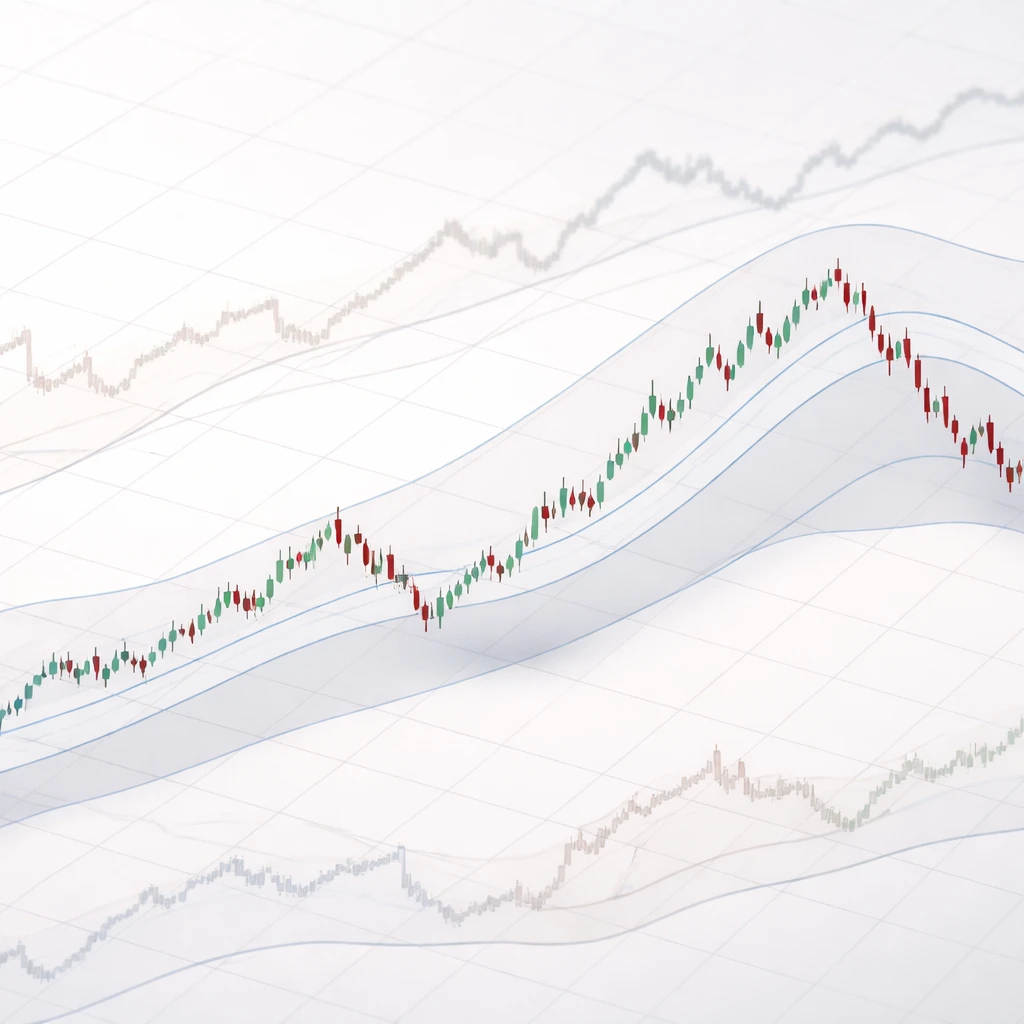
Trend following is a systematic trading approach that aims to participate in persistent directional moves in prices. It is grounded in the observation that markets can exhibit extended periods of upward or downward drift. The strategy does not attempt to forecast when such moves will begin or end. Instead, it sets rules to identify when a trend appears to be present and then maintains exposure while that trend persists. When the evidence of trend weakens, exposure is reduced or removed. The method seeks to align positions with prevailing price behavior, not to predict turning points.
Because trend following is typically rules-based, it fits naturally into structured, repeatable trading systems. The core logic emphasizes consistency and risk control rather than discretion or timing. The approach is widely used across liquid futures, equities, exchange-traded funds, and currencies, though it can be adapted to other instruments where reliable prices and feasible execution exist.
Defining a Trend
In trading practice, a trend is a directional bias that persists for long enough to be distinguished from random price fluctuations. A rising trend often coincides with a pattern of higher highs and higher lows, while a falling trend often shows lower highs and lower lows. Trend following focuses on recognizing and participating in these patterns after they have begun. The goal is not to capture the exact bottom or top. Instead, the method prioritizes being on the right side of a move for the central portion of its life.
The definition of a trend depends on timeframe. A daily trend can be embedded within a weekly range, while an intraday trend can be noise within a broader multi-month advance. Trend following systems are explicit about the timeframe of interest and use consistent rules to evaluate the state of the trend at that horizon. This keeps the strategy from mixing signals across incompatible timeframes, which can lead to inconsistent decisions.
Core Logic Behind Trend Following
The underlying logic is pragmatic. Trend followers assume that if prices have already moved materially in one direction, they may continue in that direction for a time because of investor behavior, information diffusion, capital flows, and institutional constraints. The strategy is reactive. It requires evidence in the form of price movement before committing capital. This reactive nature creates an asymmetry in outcomes. Many small losses and short-lived trades can be offset by occasional large gains when trends persist.
From a statistical perspective, trend following tends to generate positively skewed return distributions. The hit rate can be low compared to other strategies because false starts and whipsaws are common. However, when a trend develops strongly enough, gains can outweigh the sequence of small losses. This payoff profile is a central feature. It also explains why risk management is integral to the method. The system must tolerate sequences of small losses without compromising the ability to participate when a lasting move emerges.
Importantly, the logic does not depend on forecasting macroeconomic variables or company fundamentals. Price itself is treated as the summary of all available information and expectations. This design keeps decision rules transparent and testable. It also makes the approach portable across markets, provided that liquidity and cost structures are adequate.
Where Trend Following Fits in a Structured Trading System
A structured trading system organizes decision-making into modular components. This structure reduces discretion and makes the process auditable. A typical framework for a trend following system includes:
- Universe selection: Identifying which instruments qualify based on liquidity, data quality, and cost considerations.
- Signal definition: Setting rules that indicate when price action is consistent with a trend at the chosen timeframe.
- Position sizing: Scaling exposure by risk so that no single trade dominates portfolio outcomes.
- Risk controls: Defining exits for adverse moves and managing portfolio-level drawdowns.
- Portfolio construction: Combining positions across instruments and sectors with attention to correlation and concentration.
- Execution and monitoring: Turning signals into orders and tracking slippage, fills, and ongoing compliance with the rules.
Each block is encoded in advance to reduce impulsive changes. The documentation of these elements, along with version control and performance attribution, creates a system that can be evaluated on its merits rather than personal judgment.
Measuring Trend Without Predicting
Trend followers measure direction and persistence with rules that reference price history. Common approaches include:
- Breakout logic: Comparing the current price to a prior high or low over a lookback window.
- Moving-average logic: Comparing price to a smoothed reference, or comparing a fast reference to a slow one.
- Channel or band logic: Evaluating whether price has moved outside a range defined by recent volatility or price extremes.
- Slope-based logic: Estimating the slope of a smoothed price series and using its sign or magnitude as a trend proxy.
These methods are not predictions. They are filters that describe where price stands relative to its own history. The chosen method should align with the target timeframe. For example, a system intended to hold positions for months will use longer lookbacks and slower references than a system built for days. Each design choice influences the frequency of trades, sensitivity to noise, and transaction costs.
A secondary set of filters can be used to avoid taking marginal signals. For instance, a system might require that volatility is above or below a threshold, that trading volume meets a minimum, or that the signal has persisted for multiple observations. Such filters can reduce false starts but can also delay entry and reduce participation in early parts of a move. The trade-off is design-specific and should be evaluated with careful testing.
Risk Management Considerations
Risk management is central to trend following because the strategy accepts many small losses in pursuit of occasional large gains. Several layers of control typically appear in robust systems:
- Position sizing by volatility: Position sizes are scaled so that higher-volatility instruments receive smaller notional allocations and lower-volatility instruments receive larger allocations. A common implementation uses a volatility estimate to normalize expected risk per position.
- Capital allocation limits: The system can set maximum exposure per instrument, sector, or asset class to avoid concentration.
- Stop logic: Trailing exits reduce exposure when price moves against the position by a predefined amount or relative to a reference. The objective is to cut losses and relinquish stale positions. This logic is often rule-based rather than discretionary.
- Portfolio drawdown rules: A cap on the allowable peak-to-trough decline can trigger de-risking, slower re-entry, or smaller position sizes.
- Liquidity and capacity limits: Minimum average daily volume and limits on order size relative to market volume help manage execution risk. Capacity considerations are important for realistic backtests and live trading.
Transaction costs and slippage can materially affect performance, especially for shorter-horizon systems. Cost-aware design includes realistic assumptions about spreads, fees, and market impact. Execution tactics can include using limit orders, staggering orders, or trading at specific times of day, but the details must remain consistent with the system’s rules and with the market’s microstructure.
Correlation among positions can undermine diversification. When multiple instruments respond to the same macro driver, a trend signal can appear across the portfolio at once. Risk controls that aggregate exposures by factor or sector can prevent unintended concentration. Conversely, some positive correlation is expected in trend following, particularly during strong market moves. The objective is to avoid concentrations that overwhelm portfolio risk tolerance.
What To Expect From Trend Following
Trend following frequently experiences whipsaws, which are sequences of small losses when prices oscillate without commitment. Long flat periods and drawdowns are part of the strategy’s profile. Returns can be lumpy. Gains often arrive in an irregular and clustered fashion during sustained directional moves. A system designed with this reality in mind will emphasize persistence of process over short-term comfort.
Because trend following seeks large moves, it can sometimes perform well during market stress when trends become directional across asset classes. That pattern is not guaranteed and depends on the nature of the stress and on the instruments traded. There will also be extended intervals when markets are range-bound and mean-reverting, during which trend systems can underperform. Understanding these cycles helps set realistic expectations and prevents ad hoc changes to a tested methodology.
High-Level Example of a Trend Following System
The following example outlines how a trend following approach can be embedded in a structured, repeatable system without specifying exact signals or parameters:
- Universe: A defined list of liquid instruments with reliable historical data. Examples include major equity indices, liquid single stocks, developed-market currencies, and exchange-traded futures in equity, fixed income, commodity, and currency markets.
- Signal concept: Price is considered to be in an uptrend if it is persistently above a chosen reference derived from its past values. A downtrend is the inverse. The reference can be a smoothed average, a breakout threshold, or a channel boundary. The method is selected to match the desired holding period.
- Entry logic: The system enters only when the signal indicates alignment with the trend and ancillary filters confirm sufficient liquidity and acceptable volatility conditions. No attempt is made to anticipate the signal. All decisions occur after the conditions are observed.
- Position sizing: Exposure is set so that the expected risk contribution of each position is similar. This can be achieved by scaling the notional amount using a volatility estimate or a range-based risk proxy. Positions may be capped to prevent outsized bets in any single instrument.
- Exit logic: If the trend degrades according to the signal or price moves adversely by more than a defined tolerance, exposure is reduced or closed. A trailing exit can be applied to protect gains as the trend evolves.
- Portfolio construction: Positions are combined across instruments with attention to correlation. A portfolio-level risk budget limits overall exposure, and sector caps prevent concentration.
- Execution: Orders follow a consistent tactic that fits the liquidity profile of each instrument. Slippage assumptions are built into performance evaluation. Execution choices remain consistent with the rules and do not override signals.
- Monitoring and review: Performance metrics, drawdowns, and slippage are tracked against expectations. If behavior departs from historical ranges, investigation focuses on whether market structure, data quality, or execution practices have shifted.
This example illustrates the architecture of a rules-based trend following process. The specifics of the signal, lookbacks, and thresholds are design choices that should be tested for robustness rather than optimized for the best historical outcome.
Designing for Robustness
A robust trend following system is less sensitive to small changes in parameters and maintains performance across related markets and timeframes. Several practices support robustness:
- Parameter ranges: Rather than relying on a single lookback or filter setting, the system is tested across a range of values. Performance that survives modest variations is more likely to persist.
- Out-of-sample testing: After initial development, the method is validated on data not used for design. Walk-forward procedures and rolling windows help mimic live conditions.
- Cost and slippage realism: Backtests include conservative assumptions about fees, spreads, and market impact. Higher-frequency variants are especially sensitive to these inputs.
- Stress testing: The system is evaluated under adverse conditions, such as price gaps, volatility spikes, and liquidity dry-ups. Position limits and stop logic are checked for practicality.
- Multiple markets: Applying the same rules across a diversified set of instruments can reveal whether the effect is strategy-based or sample-specific.
Measuring Performance and Risk
Trend following strategies should be evaluated with metrics that reflect their distinctive profile:
- Maximum drawdown and time under water: These characterize the depth and duration of declines, which are central to the experience of running the strategy.
- Hit rate and payoff ratio: Trend systems can have a low hit rate but a high average win relative to the average loss. Both metrics matter in context.
- Volatility and downside volatility: Standard deviation and downside deviation provide different perspectives on variability. Trend strategies often display asymmetric variability across regimes.
- Sharpe and Sortino ratios: These summarize risk-adjusted returns but should be interpreted with care given the lumpy nature of trend returns and the presence of fat tails.
- Skewness and tail behavior: Positive skew is common, and tail sensitivity should be assessed with scenario analysis and nonparametric methods.
Beyond summary metrics, attribution analysis can identify which instruments, timeframes, and signals contribute to results. This information supports incremental improvements and helps diagnose whether changes in performance arise from market conditions or from implementation issues.
Implementation Nuances
Turning a backtested concept into a live system requires attention to practical details:
- Data integrity: Price histories must be free of survivorship bias and adjusted appropriately. For equities, corporate actions such as splits and dividends need correct handling. For futures, the construction of continuous price series and roll methodology can influence signals and risk estimates.
- Execution quality: Realistic slippage assumptions should be informed by spread statistics, depth, and typical order sizes. Partial fills and queues affect realized prices. Execution logs help reconcile expected and realized performance.
- Overnight and weekend gaps: Gaps can jump over stops or thresholds. Systems should define how to act when prices open beyond the planned exit or entry criteria.
- Capacity and scalability: Position sizes should be consistent with market capacity. As capital scales, the system may need to adjust participation rates or diversify into additional instruments.
- Operational controls: Version control, audit trails, and alerting for data or execution anomalies are integral to a professional process. Fail-safes should handle connectivity issues and order re-submission logic.
Variations and Extensions
Trend following is a family of approaches rather than a single formula. Variants differ by timeframe, signal construction, and portfolio design:
- Timeframe: Long-term variants trade infrequently and pursue multi-month or multi-quarter moves. Shorter-term variants react faster but face higher costs and more whipsaws.
- Signal construction: Breakout rules, moving averages, and slope filters are common families. Some systems combine them to reduce model risk, for example by averaging signals from different methods.
- State filters: Filters based on volatility, trend strength, or market regime can help calibrate aggressiveness. The trade-off is the risk of filtering out early portions of valid trends.
- Portfolio overlays: Volatility targeting at the portfolio level, correlation-aware scaling, and dynamic risk budgets are often layered on top of the basic signal.
- Integration with other effects: Some practitioners combine trend following with carry, seasonality, or mean reversion at different horizons to smooth the equity curve. The design must remain disciplined to avoid unintended complexity.
Common Misconceptions
Several misunderstandings often surround trend following:
- It does not forecast: Trend systems react to price evidence. They do not claim to know when trends will start or stop.
- It is not a guarantee of protection: Trend strategies can sometimes mitigate losses during market declines if downtrends develop, but this is not assured and depends on the nature and speed of market moves.
- It is not limited to futures: Although widely used in managed futures, the logic applies to many liquid markets where costs and data quality are adequate.
- High win rates are not essential: Positive expectancy can arise from a small number of large winners among many small losses.
- Complexity is not a requirement: Well-specified, simple systems can be effective if they are robust and risk-aware.
When Trend Following May Struggle
Trend following can face periods of weak performance in several environments:
- Range-bound markets: Persistent oscillation around a mean generates frequent false signals and whipsaws.
- Rapid reversals: Sudden changes in direction can lead to late entries and exits that realize losses before the trend re-establishes.
- Low volatility with noise: Slight price movements around flat references do not provide enough separation to validate a trend.
- High transaction costs: For shorter-term systems, costs can dominate expected edge.
- Elevated correlations: If many instruments move together, diversification benefits diminish, and drawdowns can deepen.
Recognizing these conditions does not imply switching off a strategy without evidence. Rather, it supports realistic expectations and careful risk budgeting at the portfolio level.
How Trend Following Builds Discipline
One of the chief benefits of trend following is the discipline it imposes. By committing to explicit rules for identifying trends, sizing positions, and exiting, the system reduces opportunity for discretionary decisions influenced by recency bias or loss aversion. Documentation of rules, independent monitoring, and periodic reviews help sustain that discipline. This discipline is also valuable for research. Because the process is explicit, it can be tested, audited, and improved incrementally.
Integrating Trend Following Into a Broader Process
In practice, trend following is often one component within a larger portfolio construction framework. It offers diversification across styles because its return profile differs from that of mean reversion, value, or carry. Integration requires clear definitions of risk budgets, correlation assumptions, and interaction with other signals. For example, trend exposure might be reduced when other independent indicators suggest elevated risk of reversal, or it might be maintained as a distinct sleeve with its own constraints. The key point is that the role of trend following is defined in advance, and the rules for interaction are tested and documented.
Testing Discipline and Avoiding Overfitting
Overfitting is a central risk in systematic strategy design. It occurs when rules are tuned to idiosyncrasies of historical data rather than genuine effects. Several practices reduce this risk:
- Economy of rules: Use as few degrees of freedom as necessary to capture the phenomenon.
- Cross-validation: Test the same rules across different markets and periods.
- Holdout evaluation: Reserve data for final validation and do not modify the method based on holdout results.
- Transparency: Keep a clear record of all tests performed to control the false discovery rate.
- Performance monotonicity: Prefer parameter regions with broad plateaus rather than narrow spikes of historical outperformance.
The Behavioral Foundation
Although trend following relies on price rather than narratives, it is often rationalized by behavioral dynamics. Slow diffusion of information, herding, anchoring, and the reluctance to realize losses can allow trends to persist. Institutional frictions such as mandates and risk constraints can also slow adjustments. These mechanisms do not guarantee trends, but they provide a plausible explanation for why momentum-like effects have been observed across different markets and eras.
Concluding Perspective
Trend following is a disciplined, rules-based approach that seeks to participate in persistent directional moves. It favors clarity over prediction, risk management over conviction, and repeatability over discretion. When implemented thoughtfully, it becomes a modular component of a structured trading system, complete with explicit rules, testing protocols, and portfolio-level controls. Results will vary across regimes, and drawdowns are part of the method’s character. The focus on process, however, makes the approach tractable, auditable, and adaptable as market structure evolves.
Key Takeaways
- Trend following reacts to price behavior to participate in persistent moves rather than forecasting turning points.
- The strategy’s edge relies on asymmetry, with many small losses offset by occasional large gains.
- Risk management is foundational and includes volatility-based sizing, trailing exits, and portfolio-level limits.
- Robust design favors parameter stability, conservative cost assumptions, and out-of-sample validation.
- Expect periods of whipsaws and drawdowns, with performance that can vary significantly across market regimes.