
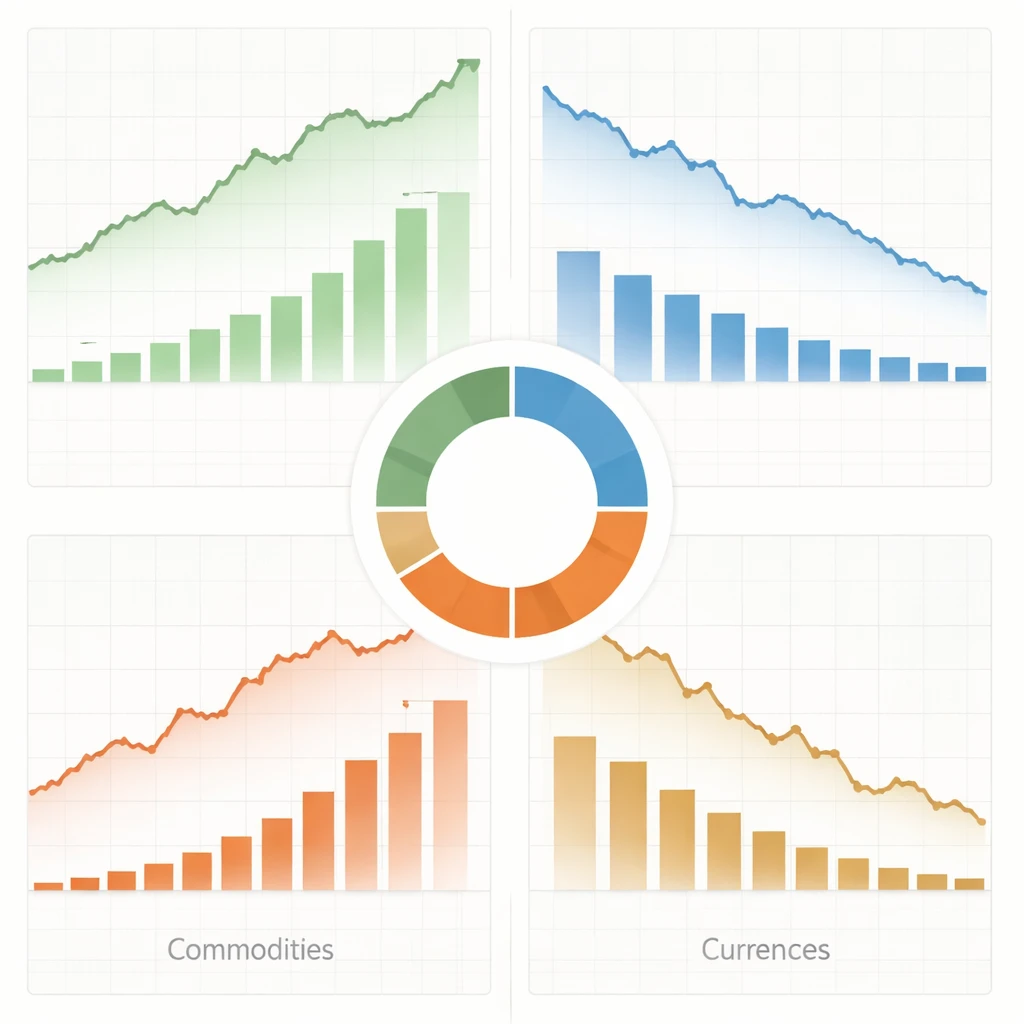
Trend following rewards discipline, patience, and consistency. While the entry and exit logic often attracts the most attention, the durability of a trend following approach depends critically on how much capital is put at risk in each position. Position sizing is the rule set that converts abstract signals into concrete portfolio weights, aligning risk with the strategy’s objectives and constraints. This article develops a structured view of position sizing for trend following, explains why it is central to robustness, and illustrates how it fits inside a repeatable trading process without prescribing exact signals or prices.
What Position Sizing Means in Trend Following
Position sizing is the set of rules that determine the number of shares, contracts, or units allocated to a trade once a valid trend following signal exists. In trend following, the sizing logic is typically risk based rather than nominal. The goal is not to equalize dollar amounts, but to control the portfolio’s exposure to adverse moves across heterogeneous markets whose volatilities and correlations vary over time.
Two features distinguish position sizing in trend following from simpler allocation schemes. First, volatility adjustments scale positions so that high volatility markets receive smaller allocations and low volatility markets receive larger allocations, holding risk constant. Second, risk is usually expressed as a fraction of account equity that can be lost if the trade is invalidated according to the system’s stop logic. Neither feature implies a prediction. Both are engineering choices that stabilize outcomes across regimes.
Why Sizing Often Matters More Than Direction
Trend following edges are usually modest and realized over many trades. If position size varies wildly, realized results become dominated by a handful of overlarge positions rather than by the ensemble of signals. Sizing rules aim to keep each position’s risk contribution within a stable band, so that the law of large numbers can operate on the system’s expectancy.
Several practical benefits flow from this orientation:
- Risk normalization. A 2 percent daily volatility market and a 0.5 percent daily volatility market do not warrant the same nominal allocation if risk is to be balanced. Sizing translates this into a stable, comparable unit of exposure.
- Drawdown control. By capping risk per trade and total portfolio heat, the system can endure sequences of losing trades without catastrophic loss of capital.
- Portfolio diversification. When positions are sized by risk, adding markets that are weakly correlated can reduce total variance and improve the reliability of outcomes.
Building Blocks of a Sizing Rule
Although implementations differ, most trend following position sizing frameworks share a common structure. The following components are typical.
1. Define risk per trade as a fraction of equity
A fixed fraction of equity, often denoted as R, sets the maximum loss tolerated if a single position is invalidated. For example, a system might allow 0.5 percent of current account equity to be lost on any one trade. This creates a self-correcting mechanism as equity rises or falls, and it prevents a single outcome from dominating the equity curve.
2. Estimate per-unit risk using volatility
Per-unit risk translates market movement into monetary terms. A common proxy is the Average True Range or a volatility estimate such as the standard deviation of returns. If one standard unit move corresponds to V in price terms, and each unit (share or contract) changes position value by a known amount per price unit, then per-unit risk is straightforward to compute.
In words, a typical relation is: position size equals risk per trade divided by risk per unit. This formula aligns the position’s maximum planned loss with the chosen fraction of equity. It also allows apples-to-apples sizing across instruments.
3. Link stop distance to the volatility estimate
Trend following stops are often placed to accommodate normal noise while protecting capital if the trend degenerates. When stops are set as multiples of a volatility measure, the stop distance becomes proportional to the per-unit risk estimate. The sizing rule then allocates fewer units in more volatile conditions and more units when volatility is subdued, holding risk per trade fixed by design.
4. Incorporate execution and slippage assumptions
Per-unit risk should be enlarged to reflect realistic worst-case fills, especially for instruments prone to gaps or thin liquidity. The larger the slippage allowance, the smaller the final position size for the same risk budget. This conservatism reduces the chance that realized losses exceed planned losses.
5. Convert to tradable units
Sizing formulas often yield non-integer results. A final conversion step rounds to whole shares or contracts and applies lot-size constraints. Rounding rules, such as always rounding down to remain within risk limits, are part of a disciplined process.
Common Position Sizing Frameworks in Trend Following
Fixed fractional risk per trade
This framework allocates a constant fraction of equity to the maximum permissible loss for each new position. The number of units is the risk fraction divided by the per-unit risk implied by the stop distance and volatility estimate. Fixed fractional rules preserve proportionality as the account grows or contracts and are simple to implement and monitor.
Volatility targeting
Rather than target a fixed loss per position, some systems aim for a target annualized volatility for each position or for the overall portfolio. The position weight is scaled so that the expected contribution to volatility matches a preset level given the instrument’s estimated volatility. When markets become calmer, weights expand. When markets become turbulent, weights contract. The same logic can be applied at the portfolio level by solving for weights that achieve a target overall volatility subject to constraints.
Equal risk contribution across markets
In diversified trend following, a popular approach is to size positions so that each market contributes equally to portfolio risk. This involves computing marginal risk contributions using the covariance matrix of returns, then solving for weights that equalize those contributions. It is a multivariate extension of volatility targeting and requires estimates of correlations, not only volatilities.
Kelly-style frameworks, applied cautiously
Kelly theory determines the fraction of capital that maximizes expected logarithmic growth, based on edge and variance. In practice, estimates of edge and variance are uncertain, and full Kelly sizing can be aggressive. Some practitioners consider fractional Kelly as a conceptual reference, then scale down substantially to account for estimation error, model drift, and tail risks. The broader lesson is that sizing depends on both the magnitude of the edge and the variability of outcomes, and that overconfident sizing is fragile.
Pyramiding within trends
Trend following systems sometimes add units as the trend progresses and unrealized gains accumulate. Pyramiding rules usually maintain a cap on total risk by sizing each add-on based on the latest stop structure and by using open profit as a cushion. Well designed pyramids avoid increasing the total dollar risk beyond a specified limit while seeking to increase exposure to a strong, realized trend.
Risk Management Considerations
Portfolio heat and concentration
Portfolio heat is the sum of planned losses across all open positions, expressed as a fraction of equity. Capping portfolio heat prevents aggregation of many small risk allocations into a large and unstable exposure. Systems often implement caps at both the portfolio level and by cluster, for example across highly correlated markets such as energy contracts.
Correlations and regime dependence
Correlations are not static. During stress, instruments that are normally uncorrelated can move together. Sizing methods that rely only on individual volatilities can underestimate joint risk. A practical response is to adjust position sizes using rolling covariance estimates, stress scenarios, or conservative correlation floors that assume higher co-movement in stressed regimes.
Liquidity, slippage, and gap risk
Realized position risk depends on execution quality. Thin markets, wide spreads, and overnight gaps can produce losses larger than model assumptions. Position sizing should incorporate realistic slippage allowances and an understanding of how order types behave during gaps. For highly gappy instruments, smaller per-trade risk limits may be warranted to maintain alignment with the system’s tolerance for loss variability.
Leverage, margin, and financing costs
Many trend followers trade marginable instruments. Margin requirements and financing costs affect feasible position sizes and holding power during adverse moves. Sizing rules should keep ample margin buffers to avoid forced liquidation during drawdowns, particularly when volatility expands and margin requirements increase.
Transaction costs and turnover
Frequent rescaling to maintain a volatility target or equal risk contribution can increase turnover. Higher turnover increases slippage and can degrade the effective edge. Position sizing policies often include minimum trade size thresholds and rebalance bands, so that small fluctuations in volatility or equity do not trigger costly micro-adjustments.
Parameter stability and robustness
Sizing rules contain parameters such as lookback windows for volatility, risk fractions, and rebalance thresholds. Parameters should be stable across reasonable ranges and not tuned to maximize past performance. Robustness checks include out-of-sample tests, rolling window validations, and stress testing with heavy-tailed return assumptions.
High-Level Operating Examples
Single-position sizing with volatility and a risk cap
Assume a trend following system has validated an entry in a futures contract. The system risk policy permits a maximum loss of 0.5 percent of equity if the protective stop is reached. Suppose the estimated per-unit risk, derived from a volatility measure and the stop distance, is an amount that translates into a specific monetary risk per contract. The number of contracts is the allowed loss divided by the per-contract risk, rounded down to the nearest whole number. If volatility rises, per-contract risk increases and the allowable number of contracts falls. If volatility falls, the position size increases, holding risk constant.
This simple rule aligns the trade with the system’s loss tolerance while respecting variability in market conditions. It requires no prediction, only consistent measurement and translation of risk into units.
Diversified portfolio with equal risk contribution
Consider a basket including equity index, government bond, commodity, and currency futures. A volatility vector and a correlation matrix are estimated from recent returns. The sizing problem is to find weights so that each instrument contributes the same share to the portfolio’s predicted variance, subject to a cap on total portfolio volatility and instrument-level weight limits. If two commodities are tightly correlated, the optimizer naturally reduces their combined allocation to maintain the equal risk contribution target. A heat cap ensures that the sum of planned losses across all positions does not exceed a specified fraction of equity.
As new data arrive, volatilities and correlations update, which may change the risk contributions. Rebalance bands can reduce turnover by allowing contributions to drift within a tolerance before adjusting positions.
Pyramiding while preserving risk discipline
Suppose a trend has advanced and the open profit is substantial. A pyramiding rule adds a second unit only if, after adjusting the protective stop on the combined position, the total planned loss does not exceed the per-trade risk cap and the portfolio heat limit. If the added unit would push risk beyond the cap, the system either adds less or delays the addition. In strong trends, this policy increases exposure using unrealized gains as a buffer. In choppy conditions, add-ons are rare because the system’s risk constraints are binding.
Integrating Sizing into a Repeatable Trend Following System
Position sizing does not exist in isolation. It interacts with signal generation, risk estimation, execution, and monitoring. A reproducible process typically includes the following steps.
- Signal validation. A trade is considered only if it satisfies the trend criteria defined by the system. The sizing engine does not evaluate the signal, it only measures risk and translates the signal into units.
- Risk estimation. Compute volatility and, if relevant, correlations using predetermined windows. Use conservative assumptions for slippage and gap risk. Store these estimates in a reproducible way.
- Position calculation. Convert the risk budget into units using the chosen sizing framework. Apply rounding, lot-size constraints, margin checks, and any per-instrument limits.
- Order execution. Place orders consistent with liquidity conditions and the execution plan, recognizing that fills may deviate from assumptions. Incorporate feedback loops that adjust slippage parameters when realized execution costs change.
- Monitoring and rebalancing. Update volatility, correlations, and equity. Recalculate risk contributions and compare them to target bands. Rebalance only when deviations exceed thresholds designed to control turnover.
Documentation is essential. Each parameter, limit, and exception rule should be recorded. When market regimes change, the team can diagnose performance by examining whether the sizing rules behaved as designed or whether parameters need reconsideration based on evidence rather than outcome bias.
Practical Pitfalls and Diagnostics
Overfitting sizing parameters
It is tempting to read history and select the volatility window, risk fraction, and heat cap that produced the highest past Sharpe ratio. Such aggressiveness often fails out of sample. A more reliable path is to choose parameter ranges that reflect economic reasoning, verify that performance is not excessively sensitive to small changes, and accept slightly lower backtested metrics in exchange for robustness.
Excessive rescaling
Daily rescaling to maintain exact risk targets can produce churn. Micro-adjustments may crowd signals with cost and noise. Rebalance bands, such as allowing a risk contribution to drift within a small range around its target, can reduce turnover while preserving the benefits of risk targeting.
Ignoring tails and gaps
Volatility measures summarize typical variation, not extreme events. Heavy tails and overnight gaps can overwhelm assumed risk budgets. Position sizing should be paired with conservative slippage cushions, wider stop assumptions in instruments prone to discontinuous moves, and portfolio heat limits that contemplate clustered losses.
Misinterpreting volatility estimates
ATR and standard deviation respond differently to market conditions and lookback choices. Short windows react quickly but are noisy. Long windows are stable but may lag during regime shifts. Blended or robust estimators can stabilize sizing without being blind to change. Whatever the choice, the estimator must be defined in advance and applied consistently.
Assuming constant correlations
Equal risk contribution and other multivariate methods depend on correlation estimates that can shift abruptly. Sensitivity testing and conservative bounds can prevent over-concentration that appears diversified in calm periods but collapses during stress.
Metrics for Evaluating Sizing Quality
Good position sizing improves the character of the equity curve more than it improves headline return figures. The following diagnostics help assess whether the sizing component is functioning as intended.
- Equity curve volatility. Compare realized portfolio volatility to the targeted range. Large and persistent deviations indicate that volatility estimates, rebalance rules, or leverage settings need attention.
- Drawdown profile. Examine maximum drawdown, average drawdown, and recovery times. Healthy sizing tends to produce drawdowns consistent with the risk policy, with recoveries that are not overly dependent on a single market or sector.
- Trade-level loss distribution. Check whether realized losses cluster near the per-trade risk cap or frequently exceed it. Frequent breaches suggest that slippage allowances or stop assumptions are too optimistic.
- Risk contribution dispersion. In multi-asset portfolios, review how far individual positions deviate from equal or target risk contributions. Persistent outliers may reflect parameter drift or changing correlation structures.
- Utilization and heat. Track the proportion of time the portfolio is near its heat limit. Constantly running at maximum heat can reduce flexibility and increase vulnerability during volatility spikes.
How Position Sizing Supports the Strategy’s Edge
Trend following edges emerge slowly, often through a large sample of trades with modest per-trade expectancy. Position sizing ensures that the system remains present in many independent opportunities while keeping individual outcomes bounded. By stabilizing risk across markets and over time, sizing allows the structural features that underpin the edge behavioral flows, diversification across markets, and occasional strong directional moves to express themselves without being overwhelmed by a small number of oversized bets.
Moreover, position sizing creates a language for trade-offs. If a system seeks lower volatility of returns, it can reduce per-trade risk, lower the portfolio heat cap, or increase the target number of concurrent positions. If a system seeks to concentrate more in strong, realized trends, it can adjust pyramiding rules while preserving the same overall heat. Each adjustment is explicit and testable.
Implementation Notes Without Prescribing Signals
Although entries and exits are outside the scope here, the following implementation notes help position sizing play its intended role.
- Data hygiene. Use consistent, survivorship-bias free data and clearly define session boundaries, roll conventions for futures, and handling of corporate actions for equities. Clean inputs prevent spurious volatility shifts that can destabilize sizing.
- Time alignment. Compute volatility and positions with a consistent timestamp policy. Apply a one-bar lag between updated risk estimates and new position sizes to avoid look-ahead bias.
- Rounding and minimum increments. Define rules for rounding and for minimum position changes that justify a rebalance. Small dust trades often add cost without improving risk alignment.
- Limits and overrides. Document hard limits on instrument-level exposure, sector exposure, and leverage. Define how the system behaves when a limit is hit, for example by scaling all affected positions proportionally.
- Auditability. Log the components of each sizing decision, including equity, volatility estimates, stop distances, per-unit risk, and rounding results. This enables post-trade analysis and continuous improvement.
Concluding Perspective
Position sizing is the control system inside a trend following methodology. It translates qualitative beliefs about trend persistence into a portfolio that accepts many opportunities while keeping downside variability within planned bounds. Through risk based sizing, volatility adjustment, heat control, and measured pyramiding, a trend following system achieves a balance between participation and protection. The parameters are design choices, but the principles are universal: quantify risk, standardize exposure across markets, and let the ensemble of trades, not any single trade, carry the strategy forward.
Key Takeaways
- Position sizing in trend following is risk based, converting a fixed fraction of equity and a volatility estimate into tradable units that keep losses bounded.
- Volatility targeting and equal risk contribution stabilize exposure across heterogeneous markets, while portfolio heat limits prevent excessive aggregate risk.
- Pyramiding can increase exposure to realized trends if total risk remains capped, using unrealized gains as a buffer rather than expanding downside.
- Robust sizing requires conservative assumptions about slippage, gaps, leverage, and correlations, with rebalance bands to limit turnover.
- The quality of sizing is judged by equity curve stability, drawdown behavior, risk contribution dispersion, and adherence to documented limits, not by headline return alone.