
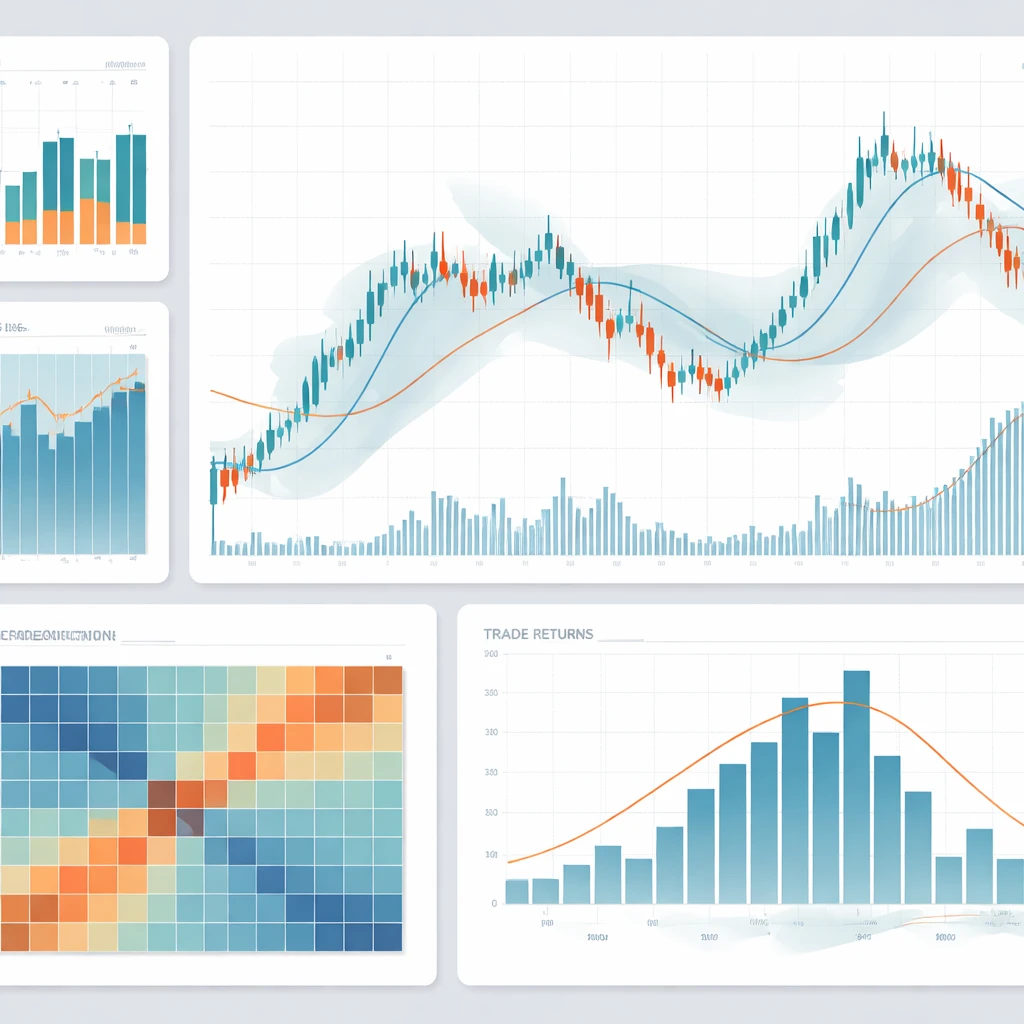
Trend following is one of the oldest systematic trading approaches. It seeks to participate in sustained directional moves by entering after a trend is established and exiting when that trend weakens. The concept appears simple, yet it is repeatedly undermined by avoidable errors in design, execution, and risk management. This article maps the most common mistakes and situates them within a structured, repeatable process so that readers can understand how to build discipline around a trend following framework. No trade signals or recommendations are offered, only general principles for sound system construction.
Trend Following in a Structured System
A trend following system attempts to define a directional move using observable price data, then translates that observation into a set of rules for entries, exits, and position sizing. The core logic is agnostic about the underlying asset’s fundamental value. It assumes that persistent price changes can reflect slow information diffusion, behavioral herding, or structural supply and demand imbalances. Because trends do not occur all the time, the approach typically experiences sequences of small losses or modest gains during choppy periods, punctuated by larger gains during persistent moves. The distribution of returns is often asymmetric, with a low win rate but a larger average win than average loss.
In a structured and repeatable system, the trader specifies the universe, the trend definition, the risk normalization method, portfolio construction rules, execution logic, and monitoring procedures. The quality of the process matters as much as the rules themselves. Common mistakes usually arise from misalignment between the strategy logic and the implementation details, or from human interference with predefined rules.
What Counts as a Mistake?
In systematic trading a mistake is not a loss on a single position. A mistake is a process error. Examples include using an indicator in a way that contradicts the strategy’s logic, underestimating trading costs, or changing parameters during a drawdown without evidence. The sections below highlight recurring errors that disrupt the transfer of trend following theory into consistent practice.
Mistake 1: Confusing Trend Definition with Prediction
Trend following is descriptive, not predictive. It reacts to observed price persistence. A common mistake is to blend predictive views into a reactive framework. For example, a trader might override a valid trend signal because of a valuation opinion or a news headline. Another version is shaping the rules to guess turning points rather than to follow established direction. This undermines the statistical basis of the method, which relies on letting price confirm momentum before acting.
The remedy is conceptual clarity. A trend rule should unambiguously define what it means for price to be trending and what constitutes a trend weakening. The rule does not need to forecast. It needs to translate an observed pattern into consistent action. When prediction is desired, it belongs in a different strategy class with different evaluation criteria.
Mistake 2: Overfitting Parameters to the Past
Overfitting occurs when parameters are selected primarily because they maximize historical performance. Trend definitions are often adjustable through lookback lengths, breakout horizons, or filter thresholds. With enough flexibility, nearly any backtest can be made to look strong in-sample. The problem is that the fitted parameters may be capturing noise rather than a robust feature of market behavior.
Symptoms include performance that collapses out-of-sample, sensitivity to minor parameter changes, and reliance on a handful of historical episodes. Overfitting is amplified when multiple components are tuned simultaneously, such as entry, exit, and position sizing rules that all depend on many thresholds.
A process-oriented approach treats parameters as ranges rather than single magic values. Robustness checks include out-of-sample testing, walk-forward analysis, parameter stability grids, and stress scenarios. The goal is not to find the best backtest, but to find a reasonable configuration that remains effective across different samples, markets, and volatility regimes.
Mistake 3: Ignoring Volatility and Regimes
Trends occur under varied volatility conditions. Using fixed stop distances or fixed position sizes without reference to current volatility can distort the risk profile. In a low-volatility environment a fixed stop may be too wide, leading to weak risk control. In a high-volatility environment the same fixed stop may be too tight, leading to repeated exits that are simply noise relative to the prevailing variability.
Regimes also differ in correlation and liquidity. During periods of stress, correlations across assets often rise. A trend signal that works when markets are segmented may behave differently when everything moves together. Ignoring this dynamic can result in a portfolio that is more concentrated than it appears. Regime-aware risk normalization, while still systematic, aligns position sizing and stop logic with the current variability of returns without making forecasts about the future.
Mistake 4: Inconsistent Position Sizing and Leverage
Even a sound trend signal can fail if position sizing is inconsistent. Common errors include sizing positions in raw dollars rather than risk units, allowing highly volatile assets to dominate, or using leverage without an explicit risk budget. Another mistake is compounding exposure by adding new positions that are highly correlated, effectively increasing the same underlying bet while thinking the portfolio is diversified.
Trend following systems benefit from explicit definitions of risk per position and risk at the portfolio level. Volatility or range-based normalization can prevent outliers from dominating. Leverage, if used at all, should serve the purpose of scaling the portfolio to a defined risk target rather than amplifying returns without reference to drawdown tolerance. Basic risk-of-ruin arithmetic shows that small differences in per-trade risk or correlation can have large effects on the probability of a severe loss sequence.
Mistake 5: Late Exits and Early Exits
Exits are central to trend following, since profits arise from allowing winners to run while capping losses. Two symmetric errors recur. The first is exiting late, after much of the trend has already reversed, because the exit rule demands too much confirmation. The second is exiting early out of discomfort during normal pullbacks, which removes the asymmetry the system depends on.
A structured approach defines exit criteria that match the entry logic. If the entry requires a substantial trend confirmation, the exit can be designed to detect weakening without waiting for a full reversal. Conversely, if the entry is permissive and reacts quickly, the exit may require more tolerance to avoid overtrading. Mixing a slow entry with a slow exit often means large giveback, while mixing a fast entry with a fast exit often means too many small losses. The balance should be explicit, tested, and consistent.
Mistake 6: Neglecting Portfolio Construction and Correlation
Many practitioners build a trend rule for a single asset and then apply it broadly without considering portfolio interactions. If multiple assets share a common driver, their trends may align, creating concentration. The portfolio can then experience large swings that are not apparent when analyzing each position in isolation. Another oversight is ignoring diversification across trend speeds. Some markets trend in slow arcs, others in fast bursts. A single-speed system can miss material opportunities across the cross section.
Systematic portfolio construction uses risk budgets, correlation estimates, and, when appropriate, diversification across instruments, sectors, or geographies. The objective is not to eliminate correlation but to understand and manage it. In a diversified trend following portfolio, the edge often arises from capturing trends in different places at different times, rather than from any single dominant position.
Mistake 7: Underestimating Trading Costs and Slippage
Backtests that ignore realistic costs can turn a fragile edge into a mirage. Costs include commissions, spreads, market impact, exchange fees, and slippage from partial or delayed fills. Trend following can be higher turnover than it appears, particularly when the system responds to volatility spikes. Costs rise further in less liquid instruments, at certain times of day, or during crowded moves.
A disciplined process incorporates conservative cost assumptions, tests sensitivity to wider spreads, and includes market impact models appropriate for the execution size. Capacity limits are part of the design. There is no value in a rule set that performs well at small scale but decays when scaled to a practical size. Sound execution logic aligns order type, participation rate, and urgency with the expected edge and liquidity conditions.
Mistake 8: Poor Execution and Data Hygiene
Execution errors and data problems can dominate strategy performance. Data issues include incorrect prices, missing corporate action adjustments, survivorship bias in equity universes, lookahead bias in signals that use information not available at decision time, and mis-specified futures rolls. Even a well-designed system can fail when implemented on flawed data.
Execution errors include using order types that leak information, sending market orders in thin books, and trading at times with low depth. For futures or forwards, misunderstanding the roll mechanics can introduce unintended exposure to carry or seasonality. A robust process includes data validation, audit trails, and clear execution protocols that match the liquidity profile of each instrument.
Mistake 9: Lack of Clear Exit Logic
Some implementations give great attention to entries but treat exits as an afterthought. Without explicit exit rules, traders improvise under stress, leading to inconsistent decisions. Mixing mean reversion concepts into a trend framework during exits is particularly damaging, for example by adding to a losing position because it looks temporarily cheap while the trend rule signals deterioration.
Trend following exits can be based on price breaks of the trend definition, trailing mechanisms that adjust with favorable movement, or time-based rules that close positions after a defined period of inactivity. The chosen exit logic should be coherent with the entry, tested for stability, and documented so that the system can be audited over time.
Mistake 10: Emotional Overrides and Process Drift
Rules exist to remove discretion at decision time. Yet many systems are overridden in response to news, social narratives, or discomfort with drawdowns. The result is a hybrid approach that keeps the disadvantages of both discretion and rules without the benefits of either. Another path to drift is incremental rule changes made after a few bad trades, which creates a moving target that never receives proper evaluation.
Process governance reduces drift. This includes version control for code and parameters, change logs that require justification, and pre-scheduled review cycles. If the system is modified, the change should be supported by evidence from out-of-sample testing or live pilot results, not short-term outcomes.
Mistake 11: Misjudging Drawdowns and Expectation Management
Trend following returns are lumpy. The edge is realized in a minority of time, while costs and small losses accumulate more regularly. Underestimating the depth and length of drawdowns leads to parameter changes, premature shutdowns, or risk expansion at the wrong time. Expectations should be grounded in distributional properties, not on isolated historical highlights.
Empirical evaluation should include maximum historical drawdown, rolling drawdown distributions, and the probability of extended flat periods. Basic statistics can show that even with a positive long-term edge, multi-month or multi-quarter stagnation is plausible. Plans for capital allocation, leverage, and risk budgets must be compatible with such intervals, or the system will likely be abandoned when it is simply behaving within its normal range of outcomes.
High-Level Example of How a Trend Following System Operates
The following example describes components of a generic, rules-based trend follower without specific signals or parameter values. It illustrates how a well-defined process reduces the likelihood of the mistakes described above.
- Universe selection: Choose a set of liquid instruments across multiple sectors or asset classes. Ensure data quality, corporate action adjustments where relevant, and well-defined futures roll schedules if using derivatives.
- Signal construction: Define a price-based mechanism that identifies sustained direction. The signal reacts to observed persistence rather than predicting reversals. Filters may adjust for recent volatility so that a trend designation is not overly sensitive to noise.
- Risk normalization: Translate a signal into units of risk by scaling the position relative to recent variability. This makes the contribution to portfolio risk more consistent across instruments and market conditions.
- Portfolio construction: Allocate risk across instruments while considering correlation. Apply risk caps to the aggregate exposure to any single factor or cluster of related markets. Position limits and gross and net exposure limits are defined in advance.
- Entry and exit implementation: Enter when the trend definition is satisfied. Exit when the trend weakens according to predefined rules. A trailing mechanism may be used to retain a portion of gains as the trend matures. Time-based exits can clear stale positions that no longer exhibit directional conviction.
- Execution policy: Use order types and schedules appropriate for the instrument’s liquidity and for the size of the trade. Incorporate conservative cost and slippage assumptions into the backtest and live monitoring.
- Monitoring and governance: Track realized versus expected slippage, turnover, exposure by asset and factor, drawdowns, and risk metrics. Maintain change logs for any system modification and run periodic, pre-scheduled reviews.
Consider how this architecture handles a hypothetical sequence. A set of markets begins to trend after a period of consolidation. The signal recognizes a rising pattern and scales positions according to volatility, preventing overexposure. As price continues to move favorably, trailing logic adjusts, locking in some gains without forcing premature exits. When a pullback occurs, the system tolerates noise within its volatility-adjusted thresholds. If the pullback evolves into a trend reversal, the exit rule triggers, and the position is closed. During this entire sequence, execution policies limit impact, and cost monitoring confirms that assumed frictions remain realistic.
In a different scenario, the markets are choppy. The system triggers a few entries that soon reverse, producing small losses. Because risk per trade is capped and position sizes are normalized, the losses remain manageable. Portfolio construction prevents correlated positions from compounding the drawdown. Over time, this consistency allows the system to be present for the sustained trends when they emerge, which is the primary source of long-run performance.
Risk Management Considerations
Risk management is the binding element that turns a collection of rules into a resilient strategy. Without it, even a robust signal can experience unacceptable volatility of outcomes.
- Risk budget and sizing: Define per-position and portfolio-level risk targets. Use volatility or range-based scaling to create comparability across instruments. Avoid allowing any single position to dominate the portfolio’s variance.
- Drawdown controls: Establish expectations for drawdowns and create systematic responses. Responses might include reducing gross exposure when drawdowns exceed predefined thresholds or pausing parameter changes until a scheduled review to avoid chasing recent outcomes.
- Cost control: Monitor realized trading costs and compare them with assumptions. Adjust execution style when liquidity conditions change. Terminate or downsize instruments where the cost-to-edge ratio becomes unfavorable.
- Scenario analysis and stress testing: Simulate adverse conditions such as volatility spikes, liquidity dry-ups, correlation surges, and gaps. Observe the impact on exits, slippage, and portfolio concentration. Use these results to calibrate limits rather than to predict specific events.
- Operational risk: Audit data pipelines, ensure redundancy for execution systems, and document emergency procedures. Many trading losses stem from operational failures rather than market moves.
Building Repeatability and Measuring What Matters
A repeatable process is auditable. It produces records that allow you to distinguish luck from design. Clear documentation enables consistent training and maintenance, while measurement provides the feedback loop for improvement.
- Documentation: Maintain specification documents for signals, risk normalization, and execution. Include the rationale, assumptions, and known limitations of each component.
- Validation and monitoring: Track live performance versus backtest expectations. Key metrics include hit rate, average win and loss, payoff ratio, return-to-drawdown measures, volatility, turnover, and realized costs. Persistent deviations can reveal model drift, data issues, or changes in market structure.
- Error tracking: Maintain a log of exceptions, overrides, and operational incidents. Analyze their frequency and impact. Many common mistakes repeat until they are measured and addressed directly.
- Change control: Introduce any modification through a staged process, such as paper testing, limited capital allocation, and full deployment only after a review period. This imposes discipline and protects the integrity of performance attribution.
Conclusion
Trend following rewards clarity, patience, and operational discipline. The most damaging mistakes are not typically about identifying the perfect signal. They arise when design decisions contradict the strategy’s logic, when risk is not normalized, when costs and execution are neglected, or when human discretion overrides the rules in periods of discomfort. A structured process that integrates robust parameter choices, coherent exits, conservative cost assumptions, and portfolio-aware risk management is better positioned to capture the asymmetry that trend following seeks.
Key Takeaways
- Trend following is reactive, not predictive, so rules should describe observed persistence rather than forecast reversals.
- Overfitting, weak exit design, and inconsistent sizing are common process errors that erode edge despite good signals.
- Volatility, regimes, and correlation shape risk; ignoring them leads to concentration and unstable outcomes.
- Costs, execution quality, and data hygiene materially affect realized performance and must be modeled conservatively.
- Repeatability depends on documentation, monitoring, and change control that align day-to-day decisions with the system’s logic.