
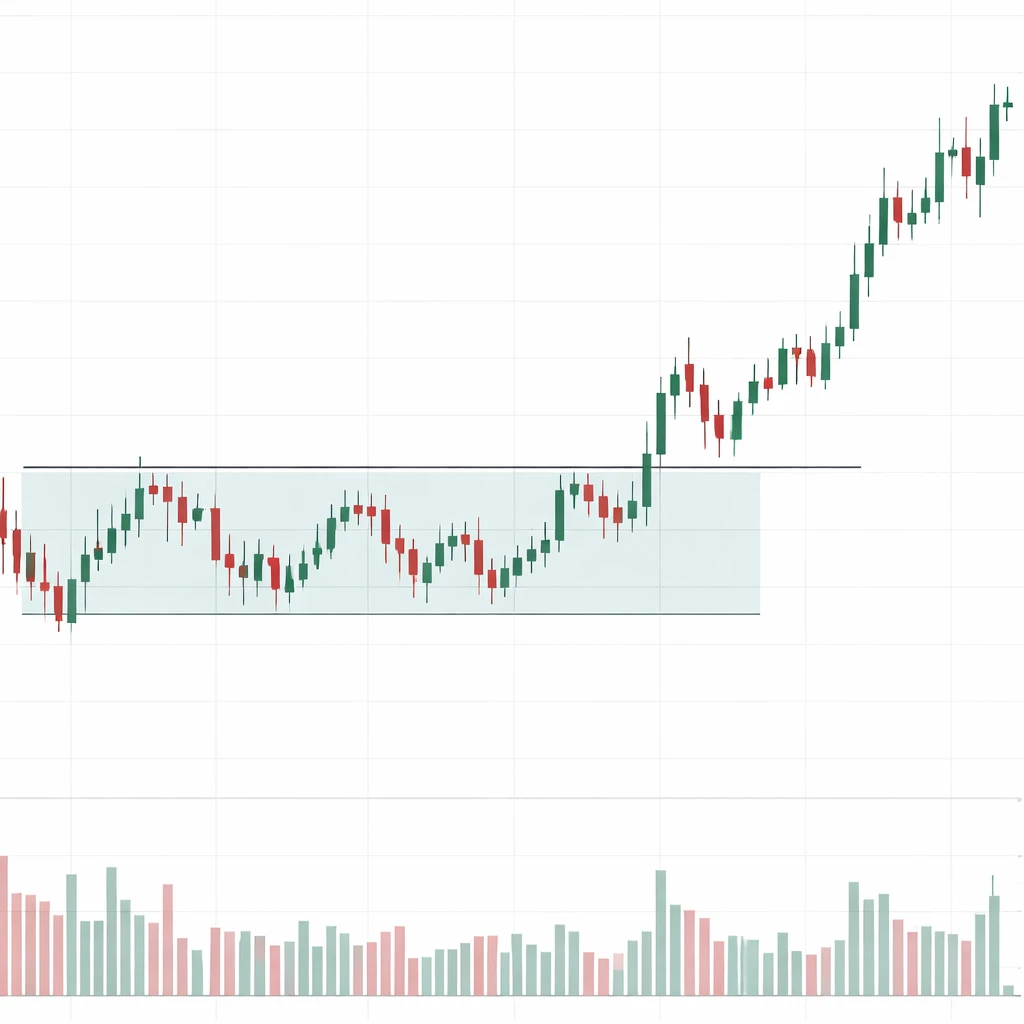
Breakout retests describe a recurring market behavior in which price breaks through a defined level, pauses or extends, and then returns to test that same level from the other side. The concept is simple, but its effectiveness depends on precise definitions, consistent process, and disciplined risk management. This article frames breakout retests as one building block within structured trading systems, focusing on logic and design rather than prescriptions or recommendations.
What Is a Breakout Retest
A breakout occurs when price exceeds a boundary that has repeatedly contained it. The boundary might be a range high or low, a prior swing, or the edge of a consolidation. A retest happens when price comes back toward the broken boundary and interacts with it again. Market participants often infer information from whether the boundary holds or fails on that return.
At a high level, a breakout retest offers an observational test of whether the market accepts the new price area. If the market has truly shifted its supply and demand balance, the prior boundary can switch roles. A broken ceiling can function as a floor, and a broken floor can function as a ceiling. This is a descriptive principle sometimes called polarity. It is not a prediction, only a way to organize what often appears on charts.
Core Logic Behind the Strategy Type
The logic behind breakout retests rests on several interacting ideas:
- Latent liquidity around boundaries. Traders cluster orders around obvious ranges and swings. When price breaks, residual orders and newly placed orders tend to concentrate at the old level, inviting a retest.
- Position adjustment by trapped traders. Breakouts can leave some traders offside. On the retest, they may reduce risk or exit, adding liquidity that stabilizes the level.
- Price discovery and acceptance. Markets probe to find areas where two-sided trade can occur. A retest is part of that discovery. If trade is accepted near the broken level, it supports the notion of a sustained shift in value.
- Regime and volatility interaction. Volatility contraction often precedes breakouts, while expanded volatility follows. Retests can coincide with the transition from impulsive to balanced conditions.
These ideas support a structured hypothesis: after a significant break of a well-observed boundary, a return to the boundary is common. The behavior of price and volume during that return may provide information about the sustainability of the breakout.
Market Structure and the Anatomy of a Retest
Not all breakouts are alike. A repeatable process begins with defining the structure that precedes the event:
- Range or consolidation. Multiple touches of a boundary indicate that market participants recognize it. The cleaner the boundary, the more crowded the orders may be.
- Transition. A decisive push through the boundary constitutes the breakout. Decisiveness can be framed by range expansion, heavier participation, or both.
- Retracement. After the initial expansion, price often retraces toward the breached level. This move can be shallow or deep, immediate or delayed.
- Decision point. The retest either holds and transitions into continuation, or it fails and reenters the prior range. Both outcomes carry information for system design.
Retests can take several forms:
- Immediate retest. Price breaks and quickly returns within the same session or bar cluster. Liquidity is dense and reactive.
- Delayed retest. Price trends away for a period before cycling back. By the time of the retest, sentiment and positioning may have evolved.
- Shallow retest. Price approaches the level but turns before touching it. Some systems count proximity; others require contact.
- Deep retest. Price overshoots the level on the return, sometimes testing the opposite side before resolving.
Defining Levels with Consistency
The credibility of any breakout retest approach depends on how levels are defined. Ambiguity in levels creates ambiguity in results. Consider adopting objective definitions, for example:
- Range boundaries. Identify a consolidation with a minimum bar count and maximum allowed excursions, then use the extreme closes or highs and lows as boundaries.
- Swing points. Define a swing high or low using a fixed lookback and lookforward window to avoid ad hoc labeling.
- Volatility filters. Require that the pre-breakout range meet a volatility contraction criterion, such as realized volatility below a rolling percentile.
- Multi-timeframe alignment. A breakout on a lower timeframe that coincides with a higher timeframe structure may convey more information than an isolated move.
No single definition is universally superior. What matters is that the definition is explicit, testable, and applied without discretion drift.
How Breakout Retests Fit a Repeatable System
A structured system that incorporates retests benefits from a clear workflow. The following components help transform the concept into a process without implying any recommendation:
- Screening. Identify instruments that exhibit established ranges or recent consolidations with sufficient liquidity to limit slippage and gaps.
- Event detection. Monitor for breakouts that meet pre-specified conditions. Conditions might combine range expansion and participation metrics.
- Retest window. Define the time or bar window after the breakout during which a retest is considered valid. This reduces ambiguity from late or unrelated pullbacks.
- Interaction criteria. Specify what constitutes a retest. Direct touch, intraday trade within a zone, or a statistically calibrated proximity can each be used, but the choice should be consistent.
- Validation and invalidation logic. Decide what post-retest behavior qualifies as acceptance or failure. This can involve structure, volatility, or participation thresholds rather than exact prices.
- Risk template. Predefine the maximum risk per position, the allowed number of concurrent positions, and the protocol for halting activity after adverse sequences.
These elements translate the general idea into a framework that can be tested and refined.
Risk Management Considerations
Because retests occur near a well-watched level, outcomes can change quickly. Specific risk methods will vary by practitioner, but the main considerations tend to include:
- Location risk. If the retest occurs during wider volatility, the level can be pierced more deeply. Designs often include a buffer concept to account for normal noise.
- Gap and session risk. In instruments subject to session breaks, overnight gaps can jump over predefined levels. Plans should acknowledge that gap risk can exceed typical intraday noise.
- Slippage and liquidity. Retests can attract crowded participation, which raises slippage risk. Instruments with thin depth are more vulnerable to erratic ticks around the level.
- Correlation and clustering. Breakouts often cluster by theme or sector. If a system tracks many related instruments, correlations can rise during stress, magnifying drawdowns.
- Event risk. Earnings, macro releases, or policy announcements can invalidate technical structures by abruptly shifting liquidity and priorities.
- Stop placement logic without prices. Systems typically link risk limits to the structure being tested. When the structure is invalidated by objective criteria, the risk limit is reached. This is a rules-design problem rather than a price target problem.
Risk management is not merely the placement of a protective threshold. It is the interplay of instrument choice, timeframe, volatility, execution method, and position sizing rules that remain consistent across trades.
Measuring Participation and Confirmation
Many breakout retest frameworks incorporate participation metrics to evaluate whether the market acknowledges the new price area. Without prescribing signals, typical dimensions include:
- Volume or tick activity. Relative increases during the breakout can indicate broader involvement. On a retest, a shift in participation can be informative.
- Spread and depth. Narrower spreads and stable depth during the retest suggest orderly trade. Widening spreads may reflect uncertainty.
- Volatility behavior. Some systems prefer a compression during the retest followed by directional expansion. Others track realized volatility reversion toward a long-run average.
- Time at price. Acceptance can be approximated by the time spent trading near the level, not just the number of trades executed.
These elements can be quantified and backtested. Their purpose is to turn vague judgment into testable inputs.
Timeframe and Instrument Context
Breakout retests behave differently across markets and timeframes:
- Equities. Session opens and closes, auctions, and earnings cycles create unique gap dynamics. Retests can be influenced by index flows and sector rotation.
- Futures. Nearly continuous trading in many contracts reduces gap prevalence but introduces roll considerations and calendar effects.
- Foreign exchange. Market structure is decentralized with varying liquidity by session. Retests often occur around session overlaps when liquidity is deeper.
- Digital assets. Continuous trading with heterogeneous liquidity across venues can lead to swift overshoots and pronounced whipsaws at well-known levels.
Timeframe choice interacts with these characteristics. Very short timeframes may capture immediate retests with tighter structural tolerance. Higher timeframes may experience delayed retests and larger excursions around the level.
Statistical Validation and Research Design
A breakout retest concept becomes useful only after disciplined testing. A research protocol might include the following elements:
- Objective event definition. Encode range identification, breakout criteria, and retest rules so they can be applied to historical data consistently.
- Sample construction. Use a broad, representative universe and a sufficiently long history to capture different regimes. Avoid survivorship bias by including delisted or inactive instruments where relevant.
- Cross-validation. Reserve out-of-sample periods and conduct walk-forward analysis to reduce overfitting. Refrain from tuning parameters to past extremes.
- Performance metrics. Track hit rate, average gain or loss per trade, payoff ratio, time in trade, maximum adverse excursion, and maximum favorable excursion. These give a nuanced picture of behavior.
- Transaction costs and slippage. Model realistic costs, including the impact of volatility spikes around retests.
- Robustness tests. Vary parameter choices within reasonable ranges. Look for stability in directional conclusions rather than perfection in any single configuration.
- Sensitivity to regime. Segment results by volatility regimes, liquidity conditions, and market trends to identify when the concept behaves differently.
This process does not guarantee an advantage. It clarifies conditions under which the design may or may not add value in a systematic framework.
High-Level Example
The following example illustrates the mechanics without specifying signals or price instructions:
Assume a liquid stock trades between two well-observed boundaries for several weeks. Participation gradually declines as the range matures. One day, price expands beyond the upper boundary on elevated activity, closing above it. The next session begins with orderly trading above the boundary, then price retraces into the old range perimeter.
During the retracement, spreads remain stable and volume is moderate. Price trades in the vicinity of the boundary for a period, indicating that two-sided flows are present. Later, price moves away from the boundary in the direction of the breakout and transitions into a new balancing area at higher levels. From a structural standpoint, this sequence reflects a breakout, a retest of the broken level, and acceptance above it.
In a system that tracks such sequences, the rules might specify how close price must come to the boundary to count as a retest, how long it can spend there, and what participation threshold defines acceptance. The risk template might tie the invalidation of the idea to behavior that reenters the prior range and persists, rather than to a single tick or arbitrary number. The objective is internal consistency so that historical testing and live application match.
Variations and Enhancements
Practitioners often explore variations around the core idea. Examples include:
- Volume expansion filter. Require that breakout activity exceed a rolling benchmark, such as a percentile of recent sessions.
- Volatility contraction filter. Prior contraction may reflect stored energy that can fuel a sustained move after breakout acceptance.
- Relative strength context. Instruments outperforming a relevant benchmark may display cleaner retests because flows already favor the direction of the breakout.
- Market regime filter. Trend persistence tends to vary with macro and volatility regimes. Systems can condition retest logic on regime classification.
- Alternative reference anchors. Some designs use volume-weighted average price or anchored concepts to define the retest zone rather than a single price level.
Enhancements should be tested incrementally. Adding filters that are not robust across samples can increase overfitting while offering little practical improvement.
Failed Retests and Information Value
When a retest fails and price returns to the prior range, the failure itself carries information. It indicates that the breakout did not achieve acceptance and that the earlier boundary still dominates behavior. Systems that incorporate both outcomes can harvest information either way, for example by tagging the event as a failed acceptance and adjusting subsequent expectations or risk templates accordingly.
In some cases, price overshoots the level during the retest and snaps back quickly. This can result from thin liquidity or aggressive attempts to trigger pending orders around obvious levels. A ruleset might treat rapid overshoots differently from orderly tests, but any differentiation must be defined in advance.
Common Pitfalls
Several recurring mistakes reduce the integrity of breakout retest approaches:
- Ambiguous level selection. Redefining ranges after the fact undermines research and live discipline.
- Confirmation bias. Highlighting successful examples while ignoring failed ones leads to overstated confidence.
- Ignoring costs. Execution slippage often increases exactly where retests occur, eroding apparent edge.
- Timeframe mismatch. A retest on a lower timeframe may be noise relative to a higher timeframe trend. Mixed signals arise without a clearly defined primary timeframe.
- Over-optimization. Excessive parameter tuning to historical idiosyncrasies weakens forward performance.
Implementation Notes
Translating the concept into a routine benefits from practical planning:
- Pre-trade preparation. Maintain watchlists of instruments with developing ranges. Annotate levels and note upcoming events that could affect price behavior.
- Alerts and automation. Use objective triggers to flag potential breakouts and subsequent retest conditions. Automation reduces discretion drift.
- Execution method. Decide in advance how to interact with the market during a retest. The plan might vary by instrument liquidity and expected volatility.
- Record keeping. Journal events that meet retest definitions, regardless of outcome. Include context, volatility, spreads, depth, and how closely behavior matched the design.
- Periodic review. Reevaluate definitions and filters with new data. Adjustments should be infrequent and driven by evidence rather than short-term outcomes.
Connecting Breakout Retests to Broader Systems
A breakout retest module can sit within a larger process that includes universe selection, regime classification, position sizing, and portfolio risk constraints. The module triggers attention when pre-specified conditions occur, and the broader system determines how that attention translates into exposure and risk. This separation of roles strengthens consistency and keeps the retest idea from dominating decisions it should only inform.
Finally, breakout retests are most informative when combined with a well-articulated hypothesis about why they should work under certain conditions. Liquidity clustering, behavioral anchoring at prior boundaries, and the economics of trapped positions are plausible drivers. The goal is not to find a pattern but to encode a market story in rules that can be tested and updated with new evidence.
Key Takeaways
- Breakout retests examine whether a market accepts a new price area by observing behavior when price revisits a breached boundary.
- Credible application depends on explicit definitions of ranges, breakouts, and retests that are consistent across instruments and timeframes.
- Risk management around retests must account for volatility, gaps, slippage, and correlation clustering, not only a single protective threshold.
- Validation requires objective event coding, robust sampling, realistic costs, and sensitivity analysis across regimes.
- Breakout retests function best as a module within a broader, rule-driven system rather than as a stand-alone idea.