
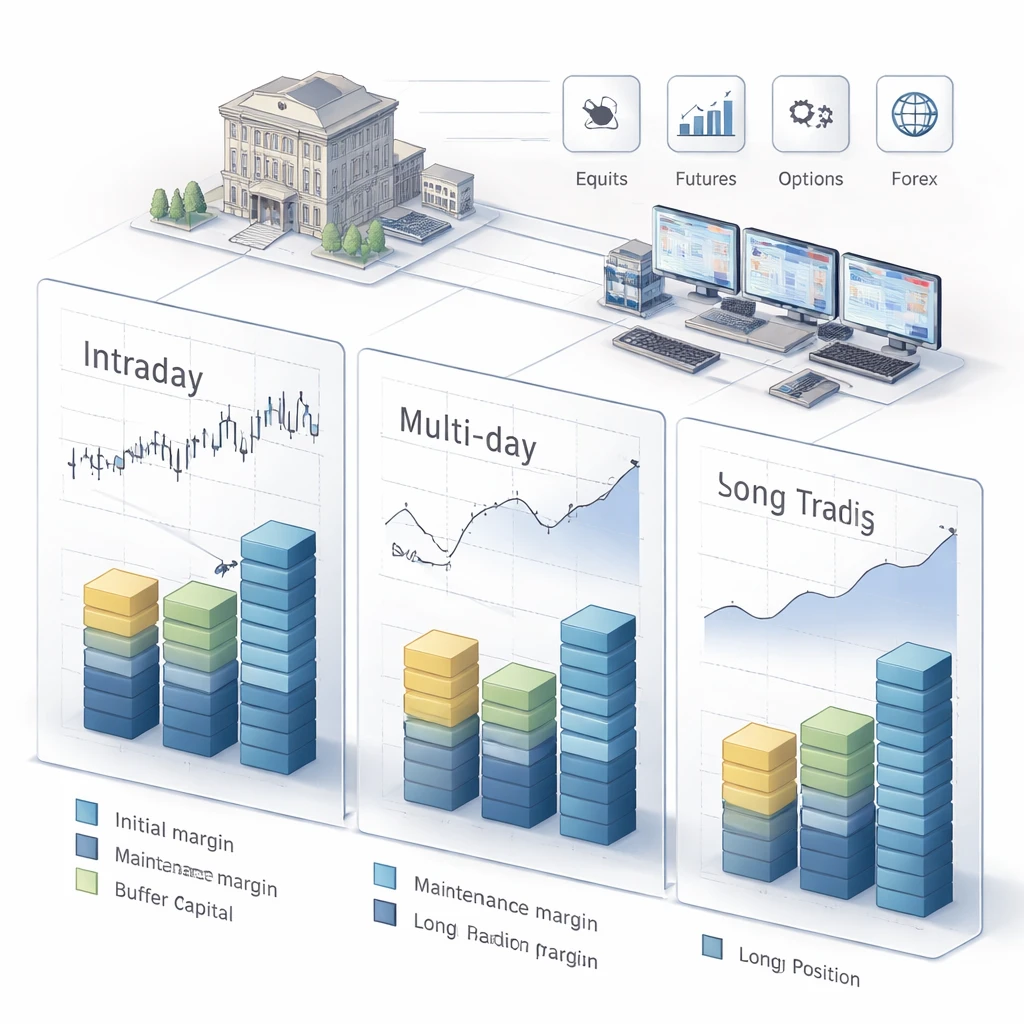
Capital requirements by style refers to the amount and quality of capital a trader needs to initiate, maintain, and exit positions given a particular trading style and timeframe. It is not a single number. It is a composite of regulatory rules, broker policies, exchange margining systems, product microstructure, volatility, liquidity, and the trader’s intended holding period. Understanding these requirements is essential for planning trade execution, monitoring risk while positions are open, and avoiding forced liquidations or unexpected financing costs.
What Capital Requirements by Style Means
A trading style embeds a time horizon, an expected turnover rate, and a typical risk profile. Capital requirements are the constraints that arise from those choices. They include initial and maintenance margin, borrowing and financing costs, settlement timing, collateral eligibility, and buffers demanded by brokers and clearinghouses. The same notional exposure can require very different amounts of capital depending on the product and the style used to hold it.
Consider two positions with similar economic exposure to an index: one is a cash equity basket held for several weeks, the other is a single equity index futures contract held intraday. The futures position may require a smaller cash margin but exposes the trader to daily mark to market and potential intraday margin calls. The equity basket may require larger initial capital outlay and carries overnight gap risk and settlement timing constraints. Both positions express market exposure, yet the capital is organized differently around them.
Why Requirements Differ Across Styles
Risk exposure and time
Timeframe changes the risk a position is likely to experience before it can be adjusted or closed. Shorter holding periods compress exposure to overnight gaps and macro announcements but concentrate risk in execution quality and intraday volatility. Longer holding periods introduce gap risk, earnings or policy events, and the possibility that margin or financing terms change while the position is open. Clearinghouses and brokers design margin frameworks to span plausible adverse moves over the period during which positions might not be easily closed.
Product microstructure
Each market has its own conventions. Equities in the United States typically follow Regulation T margin for retail margin accounts, with additional rules such as the Pattern Day Trader minimum equity requirement. Futures use risk based systems at the clearinghouse level that set initial and maintenance margin per contract, with daily variation margin that credits or debits cash as prices move. Options concentrate risk nonlinearly, so capital can be the premium paid for long options or a larger risk based margin for short options. Retail forex uses leverage caps set by regulators and applies overnight financing or roll costs. Crypto derivatives add funding payments that exchange longs and shorts periodically.
Liquidity and impact costs
Styles that depend on frequent entry and exit face higher cumulative transaction costs and a greater chance of slippage. Liquidity varies by time of day and product. Capital planning must account for the possibility that more cash than expected will be consumed by spreads, commissions, fees, and adverse fills, especially in fast markets. Longer holding styles may transact less often, but liquidity at the eventual exit still matters, particularly for concentrated positions or smaller-cap instruments.
Regulation and systemic risk control
Capital rules exist to limit the transmission of losses across the financial system. Brokers are required to collect margin to protect themselves and the clearing system from customer defaults. When volatility increases, exchanges and brokers may raise margin requirements. These changes can occur during the life of a trade, which is one reason the same position can require more capital tomorrow than it did today.
Core Building Blocks of Capital Requirements
Initial margin and maintenance margin
Initial margin is the capital required to open a position. Maintenance margin is the level that must be preserved to keep a position open. If equity in the account falls below maintenance, a margin call can force additional deposits or position reductions. The gap between current equity and maintenance is practical buffer capital. A style that operates close to maintenance margin tolerances is more vulnerable to forced liquidations during abrupt price moves.
Leverage and notional exposure
Leverage allows a trader to control exposure that exceeds cash on hand. That exposure amplifies profits and losses. Capital requirements are typically framed as a fraction of the notional value of the position. For equities using Regulation T in the United States, initial margin is often 50 percent of notional for eligible securities, with maintenance levels set by regulators and brokers. For futures, clearinghouses set a fixed dollar margin per contract that reflects risk in the underlying. For retail forex, regulators cap leverage as a ratio, with majors often permitted more leverage than minors. The precise numbers vary by jurisdiction and broker.
Volatility and sizing
The more an instrument moves in a typical day, the larger the capital cushion required to hold the same number of units. A trader who chooses a high-volatility instrument for a slow, multi-day style must plan for larger swings and potentially higher margin consumption. The same instrument might be held intraday with a smaller buffer if the plan is to avoid overnight exposure. Even without specifying a sizing method, the link between expected price range and capital buffer is direct.
Correlation and concentration
Capital must be considered at the portfolio level. Five positions in highly correlated securities can behave like one large position during stress. That increases the probability of simultaneous margin pressure and reduces diversification benefits. Portfolio margin systems attempt to recognize offsetting risks across positions, which can reduce capital requirements, but those systems can also raise margin quickly when correlations converge in volatile periods.
Financing, borrow, and other carrying costs
Short sales require locating shares and may incur borrow fees that vary with supply and demand. Options writers may face higher margin when implied volatility increases. Retail forex and many contracts for difference apply overnight financing charges for positions held past a cutoff time. Crypto perpetual futures apply funding rates that exchange payments between longs and shorts. These costs draw on cash and affect how long a position can be carried without injecting additional capital.
Liquidity buffers and operational frictions
Capital is not only a number on a margin calculation. Sound practice allocates additional cash for pending orders, partial fills, fees, taxes, and settlement timing. In the United States, standard equity settlement moved to T+1 in 2024, which accelerates the recycling of capital after sales. Other markets differ. Until proceeds settle, some brokers restrict the use of funds for additional purchases, which can limit a style that depends on rapid capital reuse.
How Capital Requirements Manifest by Style and Timeframe
Very short-term intraday trading
Intraday traders attempt to avoid overnight risk and operate within the day’s liquidity. In U.S. equities, accounts classified as pattern day traders must maintain at least 25,000 dollars of equity to access day trading buying power, which can be a multiple of account equity during the session and lower after the close. Brokers can impose stricter rules. Capital for this style is shaped by three forces: the minimum equity threshold, intraday leverage limits, and the cumulative cost of frequent execution. A trader relying on many small trades may need more capital than the gross exposure suggests, because buffers are required to absorb slippage, fees, and mark to market swings without triggering a margin call before positions are closed.
Intraday futures traders face exchange and broker intraday margin policies that can be lower than overnight levels, but positions held into the close convert to the higher requirement. Daily variation margin means realized profits can raise available cash during the day, and losses can reduce it. A sudden move that pushes equity below maintenance can trigger forced reductions even if the position might have recovered later.
Multi-day swing trading
Holding positions across nights and weekends introduces gaps and scheduled event risk. Capital requirements therefore emphasize overnight margin, borrow availability for shorts, and the ability to absorb adverse price jumps without forced liquidation. Transaction frequency drops compared with intraday styles, so commissions may be a smaller share of total capital needs, but buffer capital usually increases to manage gap risk and potential increases in broker or exchange margin during volatile periods.
Position trading and longer horizons
Longer holding periods typically face larger peak to trough swings. The capital plan must tolerate multi-week drawdowns, changes in financing costs, corporate actions, and evolving margin parameters. For concentrated positions, liquidity at exit becomes critical. If the position is large relative to average daily volume, capital may be tied up for longer to execute an orderly exit.
Options focused styles
Long options require capital equal to premiums plus commissions and fees. The maximum loss is defined by the premium paid. Short options can require substantially more capital, because margin must cover potential adverse moves consistent with risk models and regulatory formulas. If implied volatility rises, margin requirements for short options may increase even if the underlying price is unchanged. Assignment and exercise timing adds operational demands: capital must be available to take delivery or provide shares if positions convert into the underlying.
Retail forex styles
Retail forex uses leverage caps that vary by jurisdiction, often higher for major currency pairs than for others. Margin is a function of notional size and leverage limits, with swaps or rollover rates debited or credited on positions held overnight. Because FX trades 24 hours on most business days, gap risk can be lower than in instruments that pause overnight, although weekend gaps still occur. Capital planning must include the possibility of rapid leverage compression if a regulator or broker reduces maximum leverage during market stress.
Futures and crypto derivatives
Futures margin is set in dollars per contract and is subject to change. Clearinghouses employ risk models that respond to volatility. Losses are settled daily through variation margin. Crypto derivatives often resemble futures but add funding rates for perpetual contracts, frequent mark to market, and exchange specific leverage caps. Outages and liquidity fragmentation across venues can create additional capital demands, because traders may need extra collateral on multiple platforms to maintain hedges or reduce positions during stress.
Illustrative Real-World Scenarios
Equity day trader operating under U.S. rules
Assume a margin account with 30,000 dollars in equity that meets the Pattern Day Trader minimum. Many brokers permit intraday buying power up to four times equity for eligible securities, which would be 120,000 dollars of notional during the session, with overnight buying power typically half that amount. Suppose the trader enters two intraday positions totaling 90,000 dollars notional. A 1 percent adverse intraday move would reduce equity by 900 dollars, not counting fees or slippage. If another order is entered while equity is reduced, the account could approach maintenance thresholds. If the positions remain open into the close, the overnight requirement might exceed available equity, forcing reductions before the session ends. In practice, headroom is essential to avoid end of day forced selling and to accommodate temporary losses during active trading.
Futures swing position
Consider a trader who holds a single equity index futures contract overnight. The exchange sets initial and maintenance margin per contract, which can be adjusted during volatile periods. If the market moves against the position by an amount that generates a 2,000 dollar loss in one session, that loss is debited as variation margin. The trader must hold sufficient cash to absorb that debit and still remain above maintenance. If margin is increased by the exchange while the position is open, the required capital rises immediately. The style’s capital plan therefore includes both the contract’s risk and the possibility of rule changes that occur mid-trade.
Short selling an equity for several days
A trader who shorts shares secures a locate and pays a borrow fee that can change daily. Suppose the borrow fee rises from 5 percent to 20 percent annualized while the position is open. The higher fee reduces cash in the account more quickly and may reduce effective headroom for margin. If a buy-in occurs because shares become unavailable, the position may be closed at the market, regardless of price. Capital planning for short selling must therefore include borrow availability risk and the possibility that costs spike during corporate events or speculative episodes.
Long option held through an earnings event
Buying a call option requires paying the premium up front. If implied volatility falls after earnings, the option’s market value can decline even if the underlying price is near the same level. The capital requirement may be limited to the premium, but the expected holding period must be funded with the understanding that time decay and implied volatility changes can erode value. For short options, margin may increase into the event as the market anticipates wider price ranges, so additional capital might be required to keep the position open through the announcement.
Retail forex position across a weekend
Assume a position sized so that required margin is 2,000 dollars at current leverage. If the broker reduces maximum leverage ahead of a weekend due to expected news, required margin could double, instantly consuming 4,000 dollars of equity. If the account does not have that headroom, the broker may reduce the position or reject new orders. Funding considerations also apply: swaps paid or received over the weekend can be larger because multiple days are booked at once, which changes available cash on Monday.
Execution and Lifecycle Management
Pre-trade checks
Before entering a position, capital planning addresses several items:
- Whether initial margin, commissions, taxes, and fees are covered by available cash.
- Whether liquidity under stress could absorb the order size without excessive slippage.
- Whether pending orders and partial fills could temporarily increase margin consumption.
- Whether the calendar includes events that may change margin requirements or borrowing costs.
Monitoring during the trade
Once a position is live, capital management shifts to headroom monitoring. Price moves affect equity and margin utilization. Exchange or broker notices can alter requirements quickly. For futures, daily settlement changes the cash balance even if the position is unchanged. For options, changes in implied volatility can raise margin for short positions without any price move in the underlying. For shorts, borrow fees can rise during a squeeze, consuming cash faster than planned. Effective practice keeps unused collateral available to absorb these shocks.
Portfolio level coherence
Styles that hold multiple positions must reconcile instrument level margin with portfolio effects. Correlated positions can stress capital simultaneously. Offsetting positions held at different venues cannot always be netted for margin purposes, which raises the total cash required. When a hedge is placed in a different account or on a different exchange, both legs require separate capital, which can be material during a volatility spike.
Exit, settlement, and capital recycling
Capital requirements do not end at exit. Settlement cycles determine when cash becomes available for reuse. In U.S. equities, T+1 accelerates this process, but corporate actions, dividends, or exercised options can delay availability. For futures, closing a position stops variation margin but does not immediately release initial margin until the clearing cycle completes. In crypto, withdrawals can be delayed by blockchain congestion or exchange policies, which affects how quickly capital can be redeployed elsewhere.
Why Markets Impose These Requirements
Capital requirements protect the stability of trading venues and the broader financial system. Exchanges and clearinghouses model plausible worst-case moves over the period they might need to close positions after a participant defaults. Brokers add their own buffers to meet their regulatory obligations and to account for internal risk tolerances. Because volatility and liquidity conditions change, margin is adaptive. During stress, requirements rise to reduce leverage and preserve solvency across the network of brokers, clearing members, and customers. For the individual trader, this reality means that capital is a dynamic input to every style, not a static number set at position entry.
Common Misconceptions
- Leverage reduces capital needs without cost. In reality, leverage replaces capital with risk and financing obligations. The ability to open a position does not imply the ability to keep it open through adverse moves.
- Day trading always requires minimal capital. Intraday styles can demand substantial capital because of regulatory thresholds, intraday leverage constraints, and the need for buffers to absorb slippage and mark to market swings.
- Options require little capital. Long options do, but short options can consume significant margin, and that margin can increase when volatility rises.
- Portfolio margin always lowers requirements. It can, but it can also increase quickly when correlations spike or when risk models update. Benefits depend on the actual risk of the combined positions.
- Short borrow costs are negligible. Borrow fees can rise sharply and shares can be recalled, forcing a buy-in. Capital plans that ignore borrow dynamics are fragile.
A Practical Framework Without Strategy Prescription
Different traders choose different styles for many reasons. Regardless of style, a capital framework benefits from a clear mapping of product rules to the intended holding period. The following checklist focuses on mechanics rather than strategy:
- Identify the margin regime for the product: regulation, exchange, and broker overlays.
- Quantify notional exposure and how equity and maintenance change with price moves.
- Estimate non-price drains on capital: spreads, commissions, financing, borrow, and taxes.
- Assess correlation across positions and whether netting is recognized for margin purposes.
- Plan for parameter changes: volatility spikes, margin increases, leverage reductions, or borrow scarcity.
- Account for settlement timing and any restrictions on using unsettled proceeds.
- Maintain operational flexibility across venues if hedges or exits must be staged.
Putting the Concept Into Real-World Context
Institutional trading desks, proprietary firms, and retail traders all face the same underlying structure: capital supplies resilience, and requirements are shaped by style. An intraday futures trader may keep cash in reserve to meet intraday variation margin without closing positions prematurely. A multi-day equity trader may hold a larger cash buffer to handle gap risk and avoid forced sales if maintenance thresholds are raised. An options writer may calibrate position size so that even a volatility spike does not trigger an unplanned assignment or a margin call. Each of these choices is a response to rules and market mechanics that exist to manage risk in a shared marketplace.
Capital requirements by style therefore function as both constraint and guide. They constrain leverage and holding period risk, and they guide practical decisions about order size, number of concurrent positions, and whether capital is best held as cash or collateral. Treated thoughtfully, these requirements help align a trading style with the realities of market infrastructure, so that execution and position management remain feasible when conditions change.
Key Takeaways
- Capital requirements are shaped by style and timeframe, not just by the instrument, and include margin, financing, settlement, and buffer needs.
- Regulators, exchanges, and brokers set adaptive rules that can change during a trade, which makes capital a dynamic constraint.
- Shorter timeframes emphasize intraday leverage limits and execution frictions, while longer horizons emphasize overnight risk and financing stability.
- Product microstructure matters: equities, futures, options, forex, and crypto impose distinct margin, variation, and funding conditions.
- Practical trade management relies on headroom, portfolio awareness, and planning for parameter shifts such as volatility spikes or borrow scarcity.