
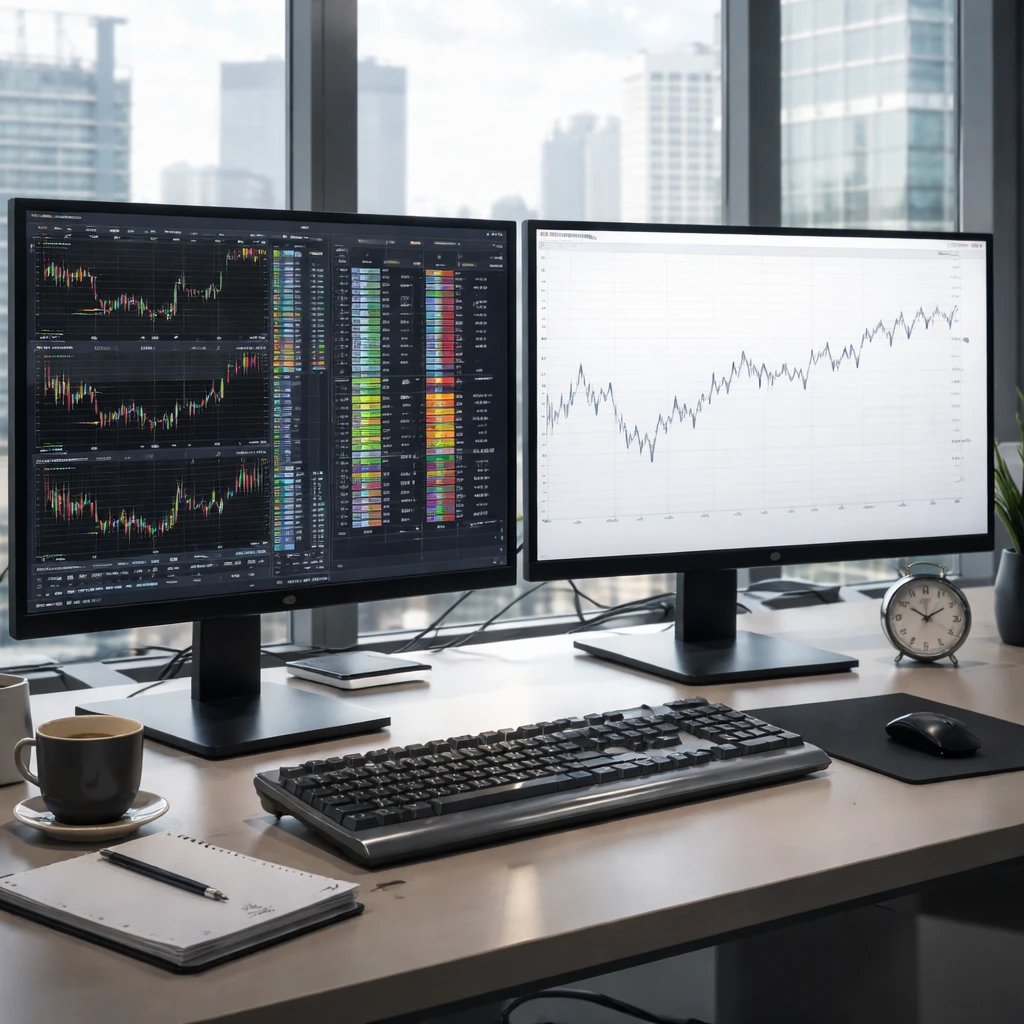
Market data is the raw information that shows what is trading, at what price, and in what size. Trading platforms display this information in different forms, from a simple quote to the full limit order book. A fundamental distinction shapes how this information is perceived and used: real-time data versus delayed data. Understanding this distinction is essential for interpreting quotes, evaluating fills, monitoring positions, and setting appropriate expectations for how a platform behaves during fast markets.
What Real-Time and Delayed Data Mean
Real-time market data refers to quotes and trades delivered with minimal transmission and processing delay. In practical terms, this usually means data arrives within milliseconds to a few hundred milliseconds of the event at the exchange or trading venue. No data is literally instantaneous. Even the fastest direct feeds travel through networks, are processed by vendors and platforms, and appear on a user interface after some latency.
Delayed market data is intentionally held back by a fixed time interval before distribution. A common delay for publicly available U.S. equity quotes is 15 minutes. Some venues apply different delays, and certain feeds offer snapshots at intervals rather than a continuous stream. Delayed data often appears on free websites and certain platform modes that have not enabled exchange entitlements for real-time display.
What a Quote Contains
A standard top-of-book quote includes the best bid price, best ask price, and associated sizes. The last traded price and volume are often shown alongside. Many platforms also display the National Best Bid and Offer for U.S. equities, which is the consolidated best quote across protected venues. Real-time data means these fields update quickly as venues update. Delayed data means the same fields update on a lag. If the last trade occurred at 10:00:05 but the display is delayed by 15 minutes, the screen will show that trade at 10:15:05.
Depth, Trades, and Derived Values
Beyond the top of book, real-time data may include market depth, which shows additional price levels with aggregated sizes. Time and sales provides an event stream of individual trades. Platforms often compute derived values from these inputs, such as mid price, spread, implied volatility for options, or indicative index levels. If the underlying data is delayed, all derived values are delayed as well.
Latency in Practice
Even so-called real-time data reflects a latency budget. The path includes venue publication, vendor reception and normalization, platform processing, and client display. Latency is measured in milliseconds for efficient systems, but jitter can occur during spikes or network congestion. High precision time stamps on quotes and trades help users and systems verify how fresh the information is. Platform clocks are typically synchronized using network time protocols so that displayed time stamps accurately reflect event sequencing.
Why Delayed Data Exists
Delayed data is not a technical accident. It serves economic, legal, and operational purposes in market infrastructure.
Licensing and Intellectual Property
Exchanges and trading venues treat market data as licensed intellectual property. They invest in matching engines, network distribution, and compliance frameworks. Real-time access incurs per-user fees, and sometimes device or display fees, which fund these services. Delayed data is commonly made available at low or no cost as a public good that supports broad transparency, research, and education.
Consolidation and Scalability
Many markets rely on consolidated feeds that merge updates from multiple venues into a single stream. Consolidation adds processing steps that require quality controls and sequencing rules. Providing delayed feeds helps venues and data vendors scale distribution broadly without the operational complexity of supporting millions of real-time connections at peak loads. Delayed streams can also be cached and broadcast efficiently compared with individualized entitlements for real-time viewers.
Regulatory and Governance Structures
In U.S. equities, the Securities Information Processor consolidates trades and quotes for the consolidated tapes under plans such as CTA and UTP. Options quotes are governed by OPRA. Futures exchanges manage their own distribution. Each framework has licensing rules that distinguish professional and non-professional subscribers and define redistribution thresholds. Delayed variants reduce administrative overhead while preserving broad access to reference information.
How Data Reaches Your Platform
Trading platforms obtain data from direct exchange feeds, consolidated feeds, or vendor-aggregated services. The path affects speed, completeness, and cost.
Direct Feeds vs Consolidated Feeds
Direct feeds come from individual venues and typically arrive faster with more granular content such as full depth and order-level messages. Using multiple direct feeds introduces complexity because the platform must handle symbol mapping, sequence alignment, and de-duplication. Consolidated feeds combine multiple venues into a single stream of best bids and offers and prints. Consolidation simplifies access but adds processing time and can be slower than the fastest direct feed from a single exchange.
Streaming vs Snapshots
Platforms present data as continuous streams or snapshots. Streaming updates push every change to the screen and to programmatic listeners. Snapshot quotes query the latest known value at an interval, such as once per second. Delayed data is often delivered as snapshots to reduce bandwidth and server load. Streaming real-time data gives the highest temporal fidelity but requires more network capacity and careful throttling during fast markets.
User Entitlements and Declarations
Exchanges require platforms to verify subscriber status and to collect attestations. Users agree to exchange terms and declare whether they qualify as non-professional or professional subscribers. Entitlements are applied per account and per venue. If entitlements are not enabled, the platform may show delayed data. Many platforms support mixed modes where a user has real-time equities data but receives delayed options or futures, depending on which agreements are accepted and paid.
Asset Class and Venue Differences
Equities and Options
For U.S. equities, free public sources often provide 15-minute delayed top-of-book quotes and last trades. Real-time consolidated NBBO and last sale require exchange plan entitlements. Depth-of-book beyond the top level usually requires separate licensing per venue. Options data follows a similar pattern but with high message rates and separate fees under OPRA. In both cases, off-exchange trading and odd lots influence what is consolidated and how protected quotes are defined. Historical policies excluded odd lots from protected quotes, although many platforms now display odd-lot bests in addition to the protected NBBO to improve transparency.
Futures
Futures exchanges distribute their own real-time feeds and charge entitlements per exchange. Delayed futures quotes are common on public sites. Real-time depth and trade data typically require a paid subscription. Futures have centralized primary venues, which simplifies consolidation relative to fragmented equities, but message rates can be high around economic releases.
Foreign Exchange
Spot foreign exchange is a decentralized market without a single consolidated tape. Data quality depends on the liquidity providers and venues aggregated by the platform. Many retail platforms stream real-time quotes from their liquidity pool. The quote reflects that ecosystem rather than a universal market price. Delayed data has less meaning in forex compared with exchange-traded products, but historical or indicative prices may still be distributed with lags for reference.
Cryptoassets
Crypto exchanges often provide real-time streams via public APIs. The challenge is fragmentation across venues with different liquidity, fee tiers, and latency. A platform that aggregates multiple exchanges can compute a composite price, but it is only as current as the slowest contributing feed. Delayed crypto data is common on analytics sites that do not maintain full-time streaming connections.
Practical Implications for Trade Execution
Data timing affects expectations, not the actual mechanism of order matching. Orders are executed on venues based on the venue’s order book. The order fills according to the venue price and time priority regardless of what a user’s screen shows. Real-time or delayed display changes how a trader perceives the market and chooses parameters but does not change how the matching engine operates.
Market Orders and Delayed Quotes
A market order executes against available liquidity at the time it arrives at the venue. If a screen displays delayed quotes, the visible price is not the current one. The fill may differ significantly from the displayed delayed price during volatile periods or for thinly traded instruments. This is not slippage caused by the platform ignoring real-time data. It reflects that the order matched against the current live book while the user was viewing delayed information.
Limit Orders and Reference Points
A limit order specifies a maximum buy or minimum sell price. With delayed quotes, the reference best bid or ask on the screen may no longer be near the live book. A buy limit set just below a delayed last price might be far away from the current market and may not execute. Conversely, a limit set aggressively relative to stale information might immediately execute at a price that is less favorable than expected. Real-time display helps align expectations with the true order book, but the order routing and execution would proceed the same way regardless.
Depth and Potential Fill Quality
Real-time depth provides a view of potential liquidity across price levels before the order is sent. It is not a guarantee because displayed sizes can change, and hidden liquidity may exist. Delayed depth offers a historical snapshot that is mainly educational. Using delayed depth to infer current potential fill is unreliable because queue positions and available sizes change continuously.
Portfolio Valuation and Risk Controls
Many platforms compute open profit and loss, margin usage, and risk metrics from the latest available prices. If the feed is delayed, portfolio values reflect stale marks. This can lead to discrepancies between what the platform shows and what would be calculated using live marks. Some brokers maintain internal real-time marks for risk management even when a user interface displays delayed quotes, so the account may be risk-managed on fresher prices than those shown on the screen. Understanding which price source drives risk checks, margin calls, or stop triggers is important for interpreting account updates.
Alerts and Automation
Price alerts, conditional orders, and automated logic depend on trigger prices. If triggers are evaluated using delayed data, they will activate late relative to the live market. Many systems evaluate triggers server-side using real-time feeds even if the user’s screen is delayed. Others rely on the same feed the user sees. Platform documentation typically specifies which data source drives triggers and how often conditions are checked.
Platform Tools and Settings That Matter
Time Stamps and Latency Indicators
Interfaces can display time stamps for last quote and last trade along with indicators of data freshness. Some platforms show the exact age of the last update in seconds or milliseconds. These indicators help users determine whether they are viewing live data, a delayed stream, or a paused connection.
Quote Scope and Venue Selection
For multi-venue markets, users may see choices such as consolidated best, venue-specific best, or a proprietary composite. The scope determines whether the displayed price reflects a single exchange or a broader view. A consolidated top-of-book offers a general reference across venues. A direct-venue quote can be faster and provide details like deeper book levels but only for that venue.
Snapshots on Mobile vs Streaming on Desktop
Mobile applications may prefer snapshot delivery to conserve bandwidth and battery life. Desktop platforms often support full streaming with higher update rates. The same account can therefore display slightly different prices at the same moment on different devices if one device is using snapshots and the other is receiving continuous updates.
Regular Session vs Extended Hours
Some instruments trade outside regular session hours in pre-market or after-hours sessions. Quotes and depth can behave differently in thin extended sessions, with wider spreads and less displayed size. Platforms may display delayed or indicative values during these periods or may require separate entitlements for extended-hours data. When a market closes, the last trade of the session can remain on the screen for hours until the next session produces a new print.
Real-World Scenarios
Scenario 1: Delayed Equity Quotes and a Market Order
Consider a user watching a 15-minute delayed quote for a U.S. stock. At 10:45 local time, the screen shows a last price of 40.00 and a spread of 39.99 by 40.01. In the live market at 10:45, the stock has already moved to 40.60 by 40.62 after a news item. The user submits a market buy order. The order routes to a venue and executes around 40.61. The fill is sensible relative to the live book even though it looks high compared with the delayed last trade on the screen. The difference arises from the delay, not from execution quality at the venue.
Scenario 2: Limit Order with Stale Reference
Suppose a user sees a delayed last trade of 100.00 for a futures contract with a visible spread of 99.95 by 100.05. In real time, the contract is trading at 99.20 by 99.25 after a macro release. The user places a buy limit at 99.90 expecting to get filled near the delayed view. The order sits well above the live ask and may execute immediately at the best available price, which is near 99.25. The trade confirms at a level that seems unexpectedly favorable compared with the screen, because the screen was 15 minutes behind. The outcome makes sense relative to the live order book.
Scenario 3: Alerts Driven by Different Feeds
A platform allows the user to set price alerts and to view quotes without paying for real-time entitlements. The platform evaluates alerts server-side using real-time data. The user’s phone displays delayed quotes. An alert fires for a price threshold that has been breached. The phone still shows a price below the threshold because the display is delayed. The apparent discrepancy is resolved once the delayed feed catches up to the real-time event that triggered the alert.
Scenario 4: Portfolio Marking and End-of-Day Prints
A portfolio is valued intraday using delayed quotes for broad market indices and real-time quotes for a subset of holdings. During a volatile session, the account’s total value seems inconsistent with price moves seen on news outlets. Later in the day, once delayed index values update, the displayed portfolio value realigns with the expected direction. The platform had coherent internal marks, but the user interface mixed data sources with different delays.
Selecting Data Fidelity for the Task
Different tasks require different levels of temporal precision. Real-time depth helps in contexts where small changes in spread and queue size matter to decision timing. Snapshot quotes can be sufficient for longer-horizon monitoring and general reference. Many educational workflows rely on delayed data that is freely available and consistent enough to demonstrate mechanics without the administrative steps of real-time entitlements. Institutional workflows and time-sensitive monitoring typically use real-time feeds with depth from multiple venues. Matching the fidelity of data to the purpose reduces confusion about what the screen represents.
Common Misconceptions
- Misconception: Real-time means zero latency. Reality: All data has transport and processing delay. Real-time means low and consistent latency relative to the event.
- Misconception: A fast platform ensures the best fills. Reality: The matching engine determines fills based on live book conditions. A fast display helps align expectations but does not change venue priority rules.
- Misconception: Delayed data is inaccurate. Reality: It is accurate within the defined delay interval. It represents past states of the market, not current conditions.
- Misconception: All instruments share the same delay rules. Reality: Each venue and asset class has its own licensing, distribution, and timing policies.
- Misconception: Consolidated quotes capture every market nuance. Reality: Consolidation focuses on best prices and last sales across venues. It can mask depth differences and venue-specific microstructure.
Costs and Compliance Basics
Real-time data often involves per-user fees that vary by venue and by whether the subscriber is classified as professional or non-professional. Some fees are assessed per device or per display. Vendors and platforms enforce these rules using user agreements, audits, and activity checks. Redistribution of real-time data, such as streaming it to another system or sharing screenshots for commercial purposes, typically requires additional licensing.
Delayed data is generally free to view and easy to redistribute within defined limits, which is why it is widely available on public websites. The lower barrier aligns with the goal of broad transparency while preserving a revenue model for real-time services that fund infrastructure and governance.
Interpreting What You See on Screen
When a display and a trade confirmation seem out of alignment, the difference often traces back to data timing. Key diagnostics include the time stamp of the last quote, the session status, whether the instrument is consolidated across venues, and the scope of the quoted venue. Knowing whether an alert engine or risk model uses a different data source than the on-screen widget also resolves many apparent inconsistencies.
Platform status pages and documentation usually specify whether quotes are real-time, delayed, or indicative, and whether depth and trade prints come from consolidated plans, direct venues, or vendor composites. Reviewing these details helps set expectations for how often numbers update and how to interpret short-lived gaps between the screen and the confirmation report.
Key Takeaways
- Real-time data updates within milliseconds to seconds of the venue event, while delayed data is intentionally held back, commonly by 15 minutes for public equity feeds.
- Delayed data exists for economic, legal, and operational reasons, including exchange licensing, consolidation overhead, and distribution scalability.
- Execution quality is determined at the venue, not by what appears on a user’s delayed or real-time display, although display timing shapes expectations and parameter choices.
- Asset classes and venues apply different timing and licensing rules, so mixed feeds on a platform can produce apparent discrepancies in quotes, alerts, and portfolio marks.
- Time stamps, venue scope, and clarity about which feed drives alerts and risk checks are critical for interpreting platform behavior during fast markets.