
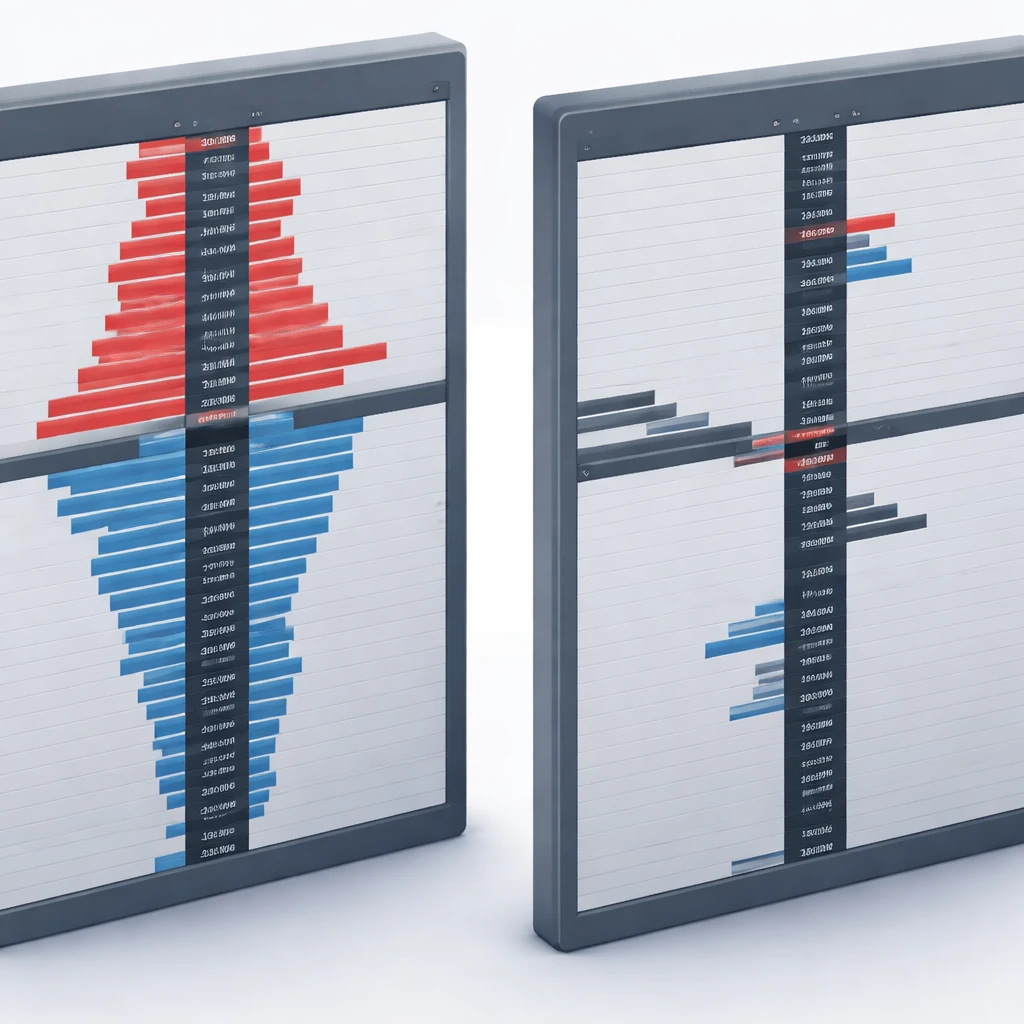
Overview
Liquidity is the capacity of a market to absorb buy and sell orders quickly and with minimal price disturbance. Illiquidity is the lack of that capacity. These conditions are not binary. They vary across assets, venues, and time. Understanding how liquidity works in practice is essential for planning how orders are placed, how fills occur, and how execution quality is measured. The concept sits at the center of trade execution mechanics because it determines spreads, depth, slippage, and the likelihood of partial or delayed fills.
Liquidity is often described through four practical dimensions: tightness, depth, immediacy, and resiliency. Tightness refers to the bid ask spread. Depth refers to the number of shares or contracts available at each price level. Immediacy is how quickly an order can be executed. Resiliency is how fast the order book returns to prior conditions after a large trade. Illiquidity appears as wider spreads, thinner quoted sizes, longer wait times for fills, and larger price moves for a given order size.
Why Liquidity Exists and Why It Varies
Liquidity is supplied by participants who are willing to stand ready to buy and sell. In many markets these participants are electronic market makers or dealers. They quote prices and sizes, monitor inventory risk, and adjust quotes as information arrives. They manage two fundamental risks: inventory risk and adverse selection.
Inventory risk arises because a liquidity provider accumulates positions while filling incoming orders. If volatility rises or news breaks, the inventory may lose value before it can be hedged or offset. To compensate, quotes may widen or sizes may shrink, producing less tightness and less depth.
Adverse selection occurs when a counterparty is better informed. If a liquidity provider believes that incoming orders are informed, the provider widens quotes or pulls displayed size. Illiquidity often appears suddenly around news events, economic releases, or unexpected order flow. Markets then reprice and gradually rebuild depth as uncertainty declines.
Other structural drivers matter as well:
- Tick size and lot size. A larger minimum price increment can force spreads to be wider than they would be in a continuous setting, which may concentrate depth at fewer price points. Minimum lot sizes can also limit how precisely participants supply or demand liquidity.
- Venue structure and fragmentation. Equities often trade across many venues. Liquidity can be scattered, with some displayed on exchanges and some non displayed in alternative trading systems. Futures tend to have a single central limit order book, which can concentrate liquidity. Bond markets often rely on dealers and request for quote protocols, so depth is not always displayed.
- Asset characteristics. Securities with larger free float and broad index inclusion tend to exhibit tighter spreads and larger depth. Thinly traded small capitalization equities and bespoke corporate bonds typically display illiquidity. Options exhibit a wide range of liquidity across strikes and expiries.
- Time of day and calendar effects. Liquidity is commonly lower at the open and near market close, and during after hours sessions. Holidays, earnings, and macroeconomic releases can alter depth and spreads.
Liquidity in the Order Book
The core mechanism for many markets is the limit order book. Buy and sell limit orders queue at price levels, governed by price time priority. The best bid is the highest buy price, and the best ask is the lowest sell price. The bid ask spread compensates liquidity providers for the risks noted above and for operational costs. The quantity available at each level is the displayed depth. Some orders may be hidden or partially hidden, such as reserve or iceberg orders. Hidden liquidity will not show in the quoted size but can still interact with marketable orders.
A market order consumes liquidity by matching against resting orders on the opposite side. A larger market order can sweep multiple price levels, producing a volume weighted execution price that may be worse than the top of book quote. A limit order provides liquidity if it rests in the book, or demands liquidity if it is priced to cross the spread. In illiquid conditions, the difference between a top of book quote and the average execution price for a marketable order can be significant.
Order Types Through the Lens of Liquidity
Order types express trade offs between price control, execution certainty, and timing. Liquidity and illiquidity shape those trade offs in predictable ways.
Market Orders
Market orders aim for immediate execution at the best available prices. In liquid markets with tight spreads and large depth, the execution price typically aligns closely with displayed quotes. In thin markets, the same instruction can sweep several price levels, leading to slippage and a higher average purchase price for buys or a lower average sale price for sells. Market orders prioritize immediacy and accept the prevailing liquidity conditions, whatever they are at the moment of arrival.
Two features complicate this in practice. First, displayed quotes may change between order submission and matching, especially during rapid markets. Second, the visible book does not always reflect all executable liquidity. Some venues internalize orders, and some participants post hidden size. The effective execution therefore depends on a combination of displayed depth, non displayed liquidity, and matching rules across venues.
Limit Orders
Limit orders specify a maximum purchase price or minimum sale price. They provide price protection but offer no guarantee of execution. In liquid conditions, a limit order placed near the touch can fill quickly. In illiquid conditions, a similar order may sit for a long time or not fill at all. Queue position matters. Arriving earlier at a given price level gives priority over later orders. Hidden or reserve orders may have different priority depending on venue rules, which can influence fill probability.
Limit orders can also take liquidity if priced aggressively enough to cross the spread. In that case they execute up to the price limit and leave any unfilled quantity resting at the limit price. For example, a buy limit order placed above the best ask executes immediately at the best available ask prices up to the limit, then any remainder posts as a bid. The average price depends on depth across the price path. Illiquidity amplifies the difference between the top of book quote and the realized average price.
Stop and Stop Limit Orders
Stop orders convert into market orders once a trigger price occurs. In illiquid markets or during gaps, the fill price after the trigger can be far from the stop price because there may be little or no liquidity at intermediate levels. A stop limit order converts into a limit order after the stop price is triggered. It protects against large price jumps by not executing beyond the specified limit, but it can go unfilled entirely if the market gaps past the limit and does not trade back. These outcomes depend on the relationship between the stop trigger, the available depth at each level, and the pace of price changes.
Time in Force and Conditional Instructions
Time in force parameters condition how an order interacts with liquidity over time. Immediate or cancel orders fill what is available instantly and cancel the remainder. Fill or kill requires the entire order to execute immediately or cancel. All or none, if supported, requires complete fill but not necessarily instantly. In thin markets, these conditions frequently lead to partial or no fills. Good till canceled or day orders can rest and potentially interact with later arriving liquidity.
Pegged orders tie prices to a reference such as the midpoint, the best bid, or the best offer. They can help maintain relative positioning as quotes move. Reserve or iceberg orders display a portion of the size while keeping the rest hidden. These tools influence how other participants perceive and interact with the available liquidity.
How Liquidity Shapes Execution Outcomes
Several measurable components of execution are directly linked to liquidity.
Quoted spread is the difference between the best ask and best bid. Effective spread measures how far an execution price deviates from the midpoint at the time of the trade. In liquid markets, effective spreads tend to be close to quoted spreads. In illiquid conditions, executions often occur deeper in the book, which can increase the effective spread significantly.
Slippage is the difference between an expected price benchmark and the realized execution price. Benchmarks vary, such as last trade, midpoint, or arrival price. Slippage emerges from both market impact and price movements during the execution window. Thinner depth and wider spreads typically mean more slippage for a given order size and urgency.
Market impact is the price change caused by the act of trading. A buy order tends to push prices up as it consumes offers. A sell order tends to push prices down as it consumes bids. The shape of the order book and the behavior of other participants determine the size and persistence of that impact. In resilient markets, prices often revert part of the impact as liquidity providers rebalance. In illiquid markets, the impact can be larger and more persistent.
Fill probability and partial fills are also tied to liquidity. Resting limit orders in thin names may fill only when opposing interest arrives, which is unpredictable and may be sparse. This leads to partial fills spread over time, or no execution at all. The operational consequence is that the notional exposure changes in fragments, which affects how positions are managed operationally.
Intraday and Event Driven Liquidity Variation
Liquidity is not constant through the trading day. At the open, many markets use auction mechanisms to match accumulated overnight interest. Spreads can be wide and quotes change rapidly just before the uncrossing. During the day, quotes usually stabilize and depth accumulates at popular price points. Near the close, another auction aggregates liquidity. Participation increases, but displayed spreads may still widen as resting quotes are pulled and interest concentrates in the auction.
Scheduled news such as economic releases or earnings often prompt temporary illiquidity. Quotes widen and displayed size shrinks as participants reduce risk. After the event, markets commonly rebuild depth and tighten spreads as uncertainty resolves. Trading halts represent another extreme. During a halt, visible liquidity disappears. When trading resumes, the reopening auction reestablishes prices and depth.
Examples: Liquidity in Action
Consider two listed equities. The first is a large capitalization name with tight quotes and substantial depth. The second is a small capitalization name with wide quotes and thin depth. Assume a trader wishes to buy 8,000 shares.
LiquidCo displays a best bid of 49.99 for 5,000 shares and a best ask of 50.00 for 6,000 shares. The next levels are 50.01 for 8,000 shares and 49.98 for 9,000 shares. A market buy order for 8,000 shares would likely fill 6,000 at 50.00 and 2,000 at 50.01, producing an average price slightly above 50.00. The effective spread relative to the midpoint is modest because the spread is one cent and depth is ample at the touch.
ThinCo shows a best bid of 9.70 for 400 shares and a best ask of 9.90 for 500 shares. The next offers are 10.10 for 700 shares and 10.50 for 1,200 shares. A market buy for 8,000 shares would sweep multiple levels: 500 at 9.90, 700 at 10.10, 1,200 at 10.50, and then continue to higher levels where the displayed sizes may be small or absent. The volume weighted average price could be meaningfully higher than the initial best ask. The outcome reflects illiquidity through both a wide starting spread and thin depth at each level.
Now consider a buy limit order for 8,000 shares in ThinCo at 9.95. None of the resting offers are at or below 9.95. The order would rest at 9.95 as the new best bid. Fill probability depends on whether sellers are willing to meet 9.95, how the book evolves, and whether other buyers improve the bid and join the queue. Execution might occur in increments over hours or days, or not at all, depending on the supply of shares at or near that price.
A stop order highlights trigger effects. Suppose a stop market sell is set at 9.60 in ThinCo. If the last trade is 9.70 and a negative news event pushes the next trade to 9.20 with little intervening liquidity, the stop triggers and sells at available bids near 9.20 rather than the stop price. A stop limit at 9.60 with a 9.55 limit would trigger but might not execute in the absence of bids at or above 9.55, leaving the position unchanged but with a conditional order resting in the book.
Measuring and Monitoring Liquidity
Traders and risk managers monitor liquidity using several observable metrics:
- Quoted spread and quoted depth. Narrower spreads and larger sizes at the best bid and ask suggest higher instantaneous liquidity.
- Depth across multiple levels. A book with substantial size a few ticks away can absorb moderate orders with limited price impact.
- Turnover and participation. Higher average daily volume and active participation across venues often align with stronger liquidity conditions.
- Price response to trade size. Observing how much prices move in response to known order sizes provides a practical gauge of impact.
- Realized and effective spread. Comparing execution prices to prevailing midpoints or arrival prices helps quantify implementation costs.
Academic measures exist as well. One example is to relate absolute price changes to trading volume over time to infer a market’s price sensitivity to order flow. Higher sensitivity implies greater illiquidity. In practice, many desks rely on real time indicators and recent execution outcomes rather than abstract measures, since conditions shift throughout the day.
Liquidity Across Asset Classes
Equities trade across multiple exchanges and alternative venues. Displayed liquidity is only part of the picture, as a share of volume interacts off exchange. Odd lots may not be displayed on consolidated quote feeds in some jurisdictions, although they still execute. Closing auctions can be extremely liquid, with significant price discovery concentrated in a single print.
ETFs exhibit both displayed secondary market liquidity and a creation redemption process that links the fund to its underlying basket. Apparent thinness in displayed quotes can understate the capacity to trade if the underlying basket is liquid and authorized participants can assemble or deliver shares. Conversely, if the underlying components are illiquid, the ETF’s effective liquidity may be limited during stress.
Futures generally consolidate liquidity in a central limit order book. The tick size and standardized contract specifications affect tightness and depth. Expiration cycles and roll periods can shift liquidity toward the front contract and away from deferred months.
Options present a wide range of liquidity profiles. At the money options in popular names often have tight markets, while far out of the money strikes or long dated expirations tend to be much wider with sparse depth. Market makers hedge dynamically across strikes and maturities, so changes in implied volatility and underlying price can alter quotes quickly. Order types such as complex, multi leg orders interact with specialized books and routing rules.
Corporate bonds and many fixed income instruments trade in dealer intermediated markets. Liquidity depends on dealer inventory, client interest, and the willingness of participants to take balance sheet risk. Quotes may be indicative rather than firm. Request for quote protocols and electronic platforms help source liquidity, but depth is often not visible in the same way as an exchange order book.
Operational Considerations in Illiquid Conditions
Illiquidity introduces several operational issues that affect how orders behave and how positions are managed after orders are sent.
- Partial fills and exposure drift. Orders may fill in stages. The exposure in the account changes incrementally, which requires careful monitoring for margin and risk controls.
- Cancel and replace effects. Replacing a resting limit order typically sacrifices queue priority at that price level. In thin markets, this can materially reduce fill probability.
- Trade rejections and venue routing. Some venues do not accept certain order conditions or sizes. In fragmented markets, routing choices affect which liquidity pools the order can access and in what sequence.
- Halt and auction mechanics. If a security enters a limit up limit down pause or a regulatory halt, resting orders can be carried into the reopening auction or canceled according to venue rules. Executions then occur at the auction price, which can differ from prior quotes.
- Short sale restrictions. In some jurisdictions, price test rules limit the ability to execute short sales on downticks. This can reduce displayed liquidity on the offer side when prices are falling.
Case Study: Large Order in Two Markets
Assume a need to purchase 15,000 shares in two different equities within normal market hours, without using any special algorithms. The aim here is to illustrate how liquidity conditions, not strategy, shape outcomes.
In Equity A, the top of book is 25.00 by 25.01 with 20,000 shares offered at 25.01 and additional 30,000 at 25.02. Submitting a marketable buy sufficient to fill 15,000 shares would likely execute entirely at 25.01, with some chance of drawing from 25.02 if other buyers arrive simultaneously. Slippage versus the arrival midpoint is minimal. Effective spread is roughly one cent per share given the tight market and ample depth.
In Equity B, the top of book is 4.80 by 5.10 with 1,000 shares offered at 5.10 and 2,500 at 5.40. The next levels are 5.80 with 3,000 shares and 6.20 with 4,000 shares. A single marketable order for 15,000 shares would sweep several levels with rapidly increasing prices. The average execution price could land far above 5.10 because depth is thin and the starting spread is wide. If instead a buy limit at 5.15 is submitted, it would fill only if sellers meet that price. It might capture a small portion of the desired size and then rest in the queue. The practical lesson is that both the spread and the depth profile determine execution price, timing, and fill risk.
Note the role of resiliency. In Equity A, after the 15,000 share trade, the book likely refills quickly near the same levels as liquidity providers repost quotes. In Equity B, the book may take longer to rebuild, and subsequent buyers may face higher offers for a period of time.
Liquidity Risk and Position Management
Liquidity risk is the possibility that a position cannot be transacted in the desired size or time without moving the price materially. In volatile or stressed conditions, liquidity can deteriorate faster than expected. Prices may gap with few or no intervening trades. Stop orders can trigger at prices far from intended levels. For leveraged positions, margin calls can coincide with illiquidity, which compounds the difficulty of reducing exposure. Funding conditions can also interact with market liquidity as lenders and dealers reduce balance sheet capacity during stress.
After hours and premarket sessions typically offer less liquidity than regular hours. Spreads are wider, depth is lower, and price moves can be larger for a given order. Scheduled auctions concentrate liquidity at specific times, while continuous trading spreads it throughout the day. Recognizing these patterns helps set expectations for execution mechanics, queue dynamics, and the likelihood of slippage.
Putting Liquidity and Illiquidity Into Context
Liquidity means more than high trading volume. It is the combined behavior of spreads, depth, immediacy, and resiliency. Illiquidity is not simply the absence of these features but a pattern where price reacts strongly to order flow and where execution may be delayed or fragmented. In practice, this framework guides how market orders, limit orders, stops, and time in force instructions are expected to perform under different conditions.
The practical context is not about predicting where prices will go. It is about understanding how the market will respond to the act of trading itself. A small order in a highly liquid instrument can execute near the displayed quote with negligible impact. The same notional order in a thin instrument can experience wide effective spreads, partial fills, and material slippage. Venue rules, tick sizes, and the presence or absence of internalization and hidden liquidity all contribute to these outcomes.
Key Takeaways
- Liquidity is the market’s ability to absorb orders with minimal price impact, summarized by tightness, depth, immediacy, and resiliency.
- Illiquidity appears as wider spreads, thinner depth, slower fills, larger slippage, and more persistent market impact.
- Order type choices trade off price control and execution certainty, and their behavior is shaped by the order book and venue rules.
- Liquidity varies by asset class, venue, time of day, and news, with auctions and halts creating distinct execution conditions.
- Monitoring spreads, depth, and realized execution prices helps set expectations for fills and implementation costs in real time.