
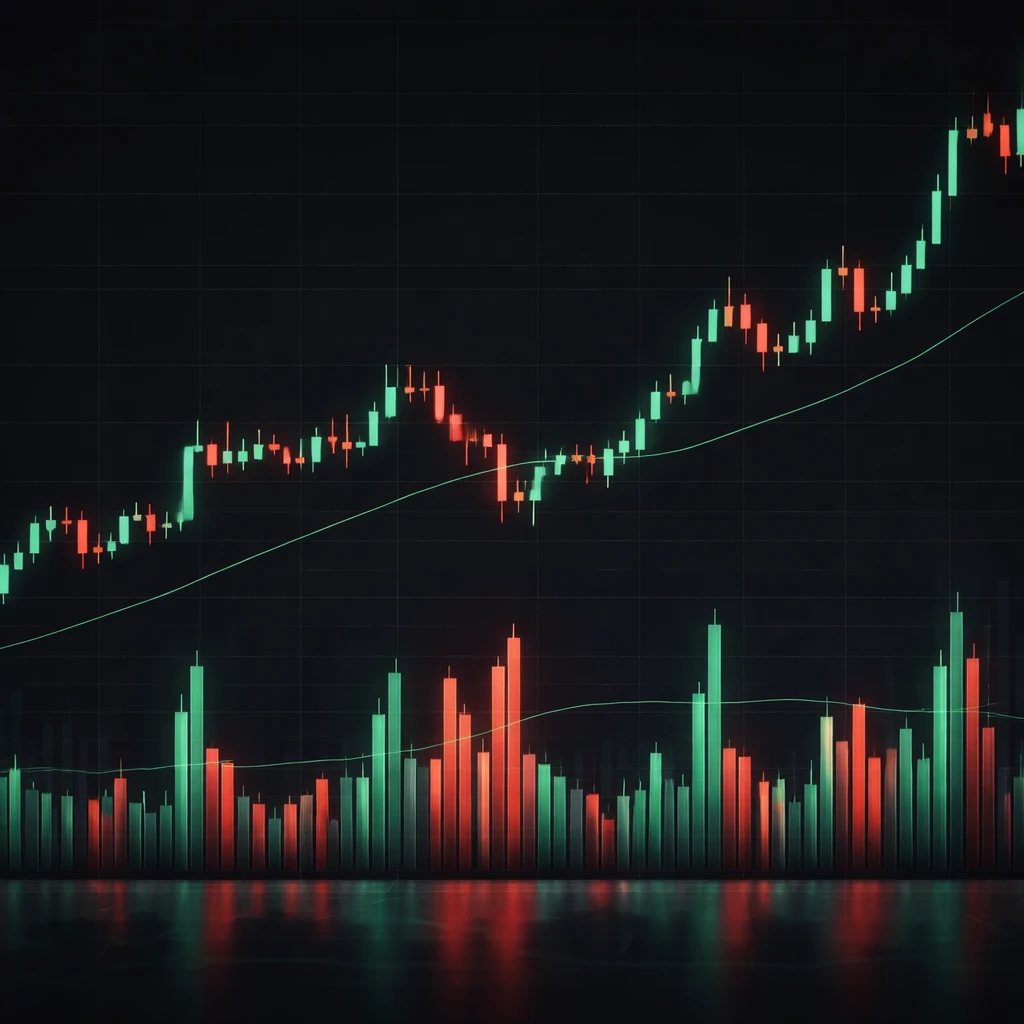
Volume sits at the center of how markets transfer risk. When traded volume surges far above its usual baseline, the chart records a volume spike. These episodes often coincide with rapid changes in price, altered liquidity conditions, and an influx of new information. Understanding what volume spikes are, how to recognize them on charts, and how to interpret their context can improve one’s ability to read market behavior without venturing into prescriptive strategies.
Defining a Volume Spike
A volume spike is an unusually large traded volume bar relative to a chosen benchmark for that instrument and timeframe. The benchmark can be statistical or heuristic. Several definitions are common in practice:
- Moving-average comparison: The current bar’s volume exceeds a multiple of its recent average, for example greater than 2 times the 20-bar average volume.
- Percentile threshold: The current bar’s volume falls in the top decile or top 5 percent of observations over a lookback window.
- Z-score method: The current bar’s volume is a certain number of standard deviations above the mean of recent volume, for example a Z-score above 2.
- Relative volume ratio (RVOL): The ratio of current volume to the expected volume for this clock time, adjusted for intraday seasonality. An RVOL above 3 is typically considered elevated.
- Event-relative baselines: On days with scheduled events, the baseline may be defined against similar historical event days to avoid misclassification.
Each definition attempts to normalize for an instrument’s usual activity so that “unusual” stands out. There is no universal threshold that works across all markets. Thinly traded assets can exhibit noisy volume bars that look extreme by percentage change but carry limited information. Highly liquid assets may require larger absolute increases to qualify as spikes.
How Volume Spikes Appear on Charts
On most charting platforms, volume is displayed as a histogram beneath the price chart. Spikes appear as single or clustered bars that tower above recent history. The bars are often color-coded by whether price closed up or down for the period. Some platforms overlay a moving average of volume to provide a visual baseline that makes spikes easier to judge.
On daily charts, spikes are tied to sessions with earnings releases, macroeconomic news, index rebalances, or company-specific developments. On intraday charts, spikes often cluster near the open and close, because the opening and closing auctions and schedule-driven order flows compress activity into those windows. Without a time-of-day adjustment, these structural peaks can be mistaken for information-rich events.
Two aids make spikes clearer:
- Volume moving average: A simple 20-bar volume average helps the eye detect deviations.
- Relative volume by time-slot: A plot of current cumulative intraday volume against typical cumulative volume for that exact clock time. This controls for the common U-shaped intraday volume pattern.
Spikes also manifest in price bars through range expansion. Wide-body candlesticks with extended ranges or gaps often align with high volume bars. That said, not every spike leads to large net price displacement. Some spikes show pronounced two-sided trade with limited close-to-close movement, a pattern discussed later as absorption.
Why Traders Pay Attention
Although preferences differ across methodologies, many market participants monitor volume spikes for four broad reasons:
- Information arrival: Spikes often accompany new information. Earnings surprises, guidance updates, macro data releases, regulatory headlines, or sudden changes in funding conditions can drive a rush of orders.
- Liquidity regime change: Spikes can flag a temporary increase in available liquidity. During a spike, more counterparties participate, which can change slippage characteristics and the capacity to enter or exit positions at quoted prices.
- Volatility linkage: High volume and high realized volatility often travel together. Spikes raise the probability of larger ranges, more gap risk, and faster order book repricing.
- Behavioral transitions: Price that has drifted on light participation may behave differently once large numbers of participants engage. Spikes can mark places where a prior trend loses or gains broad participation.
These points describe interpretation, not prescription. A spike is a signal that participation and attention have changed. It does not tell you what to trade or when.
Statistical and Contextual Classification
Volume spikes are not homogeneous. Several distinctions help frame their meaning:
Structural vs information-driven spikes
Structural spikes stem from market plumbing. The open, the close, month-end and quarter-end rebalancing, index inclusion and deletion, and options expiration can mechanically produce high volume. These may not convey fresh information about value; they reflect scheduled flows. Information-driven spikes follow unscheduled or outcome-uncertain events such as earnings surprises, guidance changes, product launches, regulatory decisions, or unanticipated macro news. The distinction matters for interpretation.
Initiating interest vs absorption
A spike accompanied by steady directional price change suggests initiating interest, meaning one side is more aggressive and is moving price through resting liquidity. A spike with little net price progress, wide intrabar tails, and repeated reversion suggests absorption, where the opposing side is meeting aggressive orders with concentrated resting supply or demand. In the latter case, the high volume marks a transfer of risk at a relatively stable price zone.
Event proximity
Spikes can occur pre-event, during, or post-event. For example, on the morning of a central bank decision, volume may rise as participants rebalance exposures. The decision itself can produce a larger spike that compresses minutes of price discovery into seconds. Post-event, a secondary spike sometimes appears as analysts publish notes and as hedging flows adjust to new volatility.
Interplay Between Volume Spikes and Volatility
Volume and volatility are linked but not interchangeable. Spikes in volume often correlate with larger price ranges, measured by intraday high-low ranges, true range, or realized volatility estimates. Average True Range (ATR) frequently rises after sessions with high volume. The relationship is not symmetric, however:
- High volume with low net movement: Two-sided trade inside a range can produce very high turnover without pushing the close far from the open. Order books refill quickly, and price oscillates within a zone. The chart shows a tall volume bar with a relatively small close-to-close change.
- Low volume with large movement: Thin conditions can allow price to travel far on little volume. Overnight sessions in futures or holiday-thinned markets sometimes display this pattern. The chart shows a big range with a modest volume bar relative to active sessions.
Recognizing which of these regimes is present helps interpret the quality of the price move. Range expansion with volume expansion signals broad participation. Range expansion without volume expansion signals more fragile conditions where price may have moved through sparse liquidity.
Practical Chart-Based Examples
Daily chart around an earnings gap
Consider a large-cap company that reports results after the close. The next day, the daily candle opens with a gap relative to the prior close and travels a wide intraday range before finishing near the upper half of the candle. The volume histogram prints at 4.5 times the 20-day average. On the chart, the spike dwarfs prior bars and coincides with visible range expansion. Interpreting this spike revolves around whether the gap was in line with the surprise, whether liquidity concentrated near the open, and whether subsequent days show retention or mean reversion of the gap.
Intraday opening auction surge
On a 5-minute chart of a broad equity index ETF, the first two bars of the session often show concentrated volume as the opening auction pairs overnight interest with market orders waiting for the open. The histogram prints two tall bars, then volume decays into mid-session. Without intraday normalization, those initial bars can look like information events when they primarily reflect auction mechanics. A time-of-day RVOL lens separates structural from exceptional activity.
Macro release in foreign exchange
Spot FX does not have centralized true volume across all venues, so practitioners use tick volume as a proxy. On a major payrolls release, tick count surges within seconds. Price whips across a wide range, then stabilizes. The tick-volume spike is visible as several tall histogram bars on a 1-minute chart. The interpretation focuses on the nature of the surprise, the persistence of directional follow-through, and the speed at which spreads normalize.
Crypto liquidation cascade
Perpetual futures can display chain reactions when funding, leverage, and liquidation engines combine. The chart shows a sharp downward price move accompanied by towering volume bars across several consecutive minutes. Open interest declines, and the tape shows forced executions. The volume spike here is entangled with leverage mechanics rather than a typical information event. Interpreting the aftermath often requires attention to funding rates, order book depth recovery, and heat maps of cumulative volume at price.
Measurement Choices and Their Consequences
The definition chosen for a spike influences what gets flagged:
- Moving-average multiples: Intuitive and easy to compute, but sensitive to the chosen window. A longer window smooths noise but can lag structural changes in baseline activity.
- Percentiles: Robust to outliers if you clip extreme history, but sensitive to the lookback horizon if the instrument’s participation trend shifts over time.
- Z-scores: Comparable across instruments if distributions are similar, but volume distributions are often skewed, which reduces the appeal of mean-variance assumptions.
- Time-of-day RVOL: Superior for intraday work because it controls for seasonality, but it requires reliable intraday historical data and careful handling of event days and halts.
For equities, some analysts also contextualize daily volume as a percent of free float or shares outstanding to gauge participation breadth. For futures, open interest changes around spikes can help distinguish new position building from short-term churn. For ETFs, creation and redemption flows can affect print volume in ways that do not fully map to underlying cash market activity.
Data Nuances Across Asset Classes
Equities: Consolidated tape volume aggregates across venues and dark pools but can report late prints and off-exchange trades that distort intraday patterns. Corporate actions like splits can reset typical volume baselines. Index rebalances and ETF flows can create spikes that are structural rather than informational.
Futures: Exchange-reported volume is centralized for each contract. Roll periods concentrate activity as participants shift exposure to the next maturity, often causing spikes that reflect mechanical repositioning.
Foreign exchange: There is no single consolidated volume measure. Many charting packages use tick volume, the count of price changes, as a proxy. While imperfect, tick volume tends to correlate with true volume on active pairs. Spikes in tick counts often align with major macroeconomic releases.
Crypto assets: Volume is fragmented across venues with varying reporting standards. Wash trading concerns and inconsistent lot sizes can blur interpretation. Cross-venue aggregation can help, but data quality varies. Spikes around funding resets or liquidation cascades can be mechanical.
Reading Spikes With Price Structure
Context from price structure matters. A spike at a multi-month reference level such as a prior high, low, or consolidation boundary can mean something different from a spike in the middle of a noisy range. Three recurring patterns illustrate the idea:
- Range expansion near reference levels: A spike that coincides with a decisive range break suggests a change in participation density near that boundary. The magnitude of the spike relative to history helps judge breadth.
- Failed excursion with high volume: Price pushes through a reference level on high volume but closes back inside the prior range. The footprint shows effort with limited net result, hinting at absorption by the opposing side.
- Climactic churn: Very high volume arrives after an extended directional move, yet intrabar ranges widen and closes become indecisive. The combination can mark a transition in who holds inventory, even if trend narratives persist.
These examples remain descriptive. They illustrate how the same spike can mean different things depending on where it occurs and how price behaves during and after the spike.
Accounting for Intraday Seasonality
Intraday volume typically follows a U-shaped pattern, with peaks near the open and close and a lull in mid-session. A naive spike detector may flag the same first 5-minute bars every day. To avoid this, many analysts build an expected volume curve by averaging historical volume for each minute or 5-minute slot, optionally conditioned on day-of-week and event calendars.
Relative volume at time, defined as the ratio of current cumulative volume to the expected cumulative volume at the same clock time, is a common normalization. Values substantially above 1.0 imply participation that is unusual for that time of day. This approach helps distinguish routine opening activity from truly elevated interest.
What High Volume With Little Price Movement Suggests
Absorption occurs when aggressive market orders hit resting orders and price does not travel far. The chart prints high volume with relatively small net change but with long intrabar tails as both sides test liquidity. In auction terms, inventory transfers from weak to strong hands or vice versa without significant price displacement. This can be important around well-known reference zones where larger participants prefer to execute without chasing price.
In contrast, a spike with clean directional progress signals that resting liquidity was insufficient to absorb the flow. Price moves through levels quickly as participants cancel or step back. The footprint is a large range candle aligned with a towering volume bar and relatively short tails.
Event Days, Halts, and Market Microstructure
Scheduled macro releases concentrate uncertainty into precise timestamps. Spikes can compress into a handful of minutes or even seconds. Exchange-level volatility safeguards such as limit up or limit down and trading halts interrupt natural price discovery and can fragment the volume record. When trading resumes, pent-up orders may produce a secondary spike that requires separate interpretation from the initial burst.
Index rebalances and options expiration introduce predictable, non-informational spikes tied to benchmark tracking and hedging flows. These spikes are often largest in the closing minutes. Treating them as information events can lead to misreading the day’s narrative.
Risk and Liquidity Conditions During Spikes
Spikes affect execution quality and realized transaction costs. As participation surges, quoted depth can either increase or vanish depending on the nature of the order flow. During news shocks, spreads often widen and order books may thin despite high turnover. During scheduled rebalances, displayed depth can rise as passive participants step in, although the flow can still be one-sided. Recognizing this duality helps set expectations for slippage, queue positioning, and the reliability of resting orders.
Common Pitfalls When Interpreting Volume Spikes
- Ignoring time-of-day effects: Mistaking routine open and close activity for information-rich spikes.
- Inadequate normalization: Using a short or unrepresentative lookback window that inflates or suppresses what counts as a spike.
- Data artifacts: Late prints, corrected trades, or block prints can generate isolated tall bars that do not reflect genuine intrabar flow.
- Cross-asset differences: Applying equity-style volume logic to FX tick volume or crypto exchange-reported volume without adjusting for data quality and market structure.
- Outcome bias: Looking only at spikes that preceded large moves and ignoring the many spikes that marked absorption or mean reversion.
Annotating and Monitoring Spikes on Your Charts
Analysts often mark a reference line for the 90th or 95th percentile of volume over a relevant lookback to highlight statistically unusual bars. A moving average of volume provides a smooth baseline. For intraday work, plotting RVOL by time-of-day helps turn raw histograms into context-aware signals. Together, these annotations make it easier to categorize a spike at a glance as structural or informational, initiating or absorbing, and aligned or misaligned with range expansion.
Beyond the histogram, pairing volume with realized volatility measures such as intraday true range or rolling ATR helps reveal when participation and price dispersion rise in tandem. When the two indicators diverge, it is a prompt to consider liquidity conditions and the nature of the flow.
Connecting Volume Spikes to Broader Market Narratives
High volume is a transfer of risk among participants with different horizons, constraints, and information sets. Whether the spike marks discovery of a new consensus value, redistribution of positions without price change, or a structural calendar effect depends on context. Charts provide that context through the relationship between the spike and price structure, through subsequent follow-on activity, and through cross-asset confirmation when relevant.
Interpreting spikes is ultimately about understanding participation. Who showed up, when, and with what degree of urgency. The histogram is a compact record of that participation, and careful normalization and classification prevent misreading the record.
Key Takeaways
- A volume spike is a trade volume bar that stands far above a normalized baseline, which can be defined by moving averages, percentiles, Z-scores, or relative volume by time-of-day.
- Spikes appear as tall histogram bars that often align with range expansion, but high volume can also coincide with limited net price change due to absorption.
- Not all spikes are information-driven. Structural flows at the open, the close, rebalances, and expirations frequently produce non-informational spikes.
- Volume spikes and volatility are related but distinct. Their alignment suggests broad participation, while divergence points to either thin liquidity or two-sided churn.
- Reliable interpretation requires context: normalization for seasonality, awareness of event calendars, data quality checks, and attention to price structure around reference levels.