
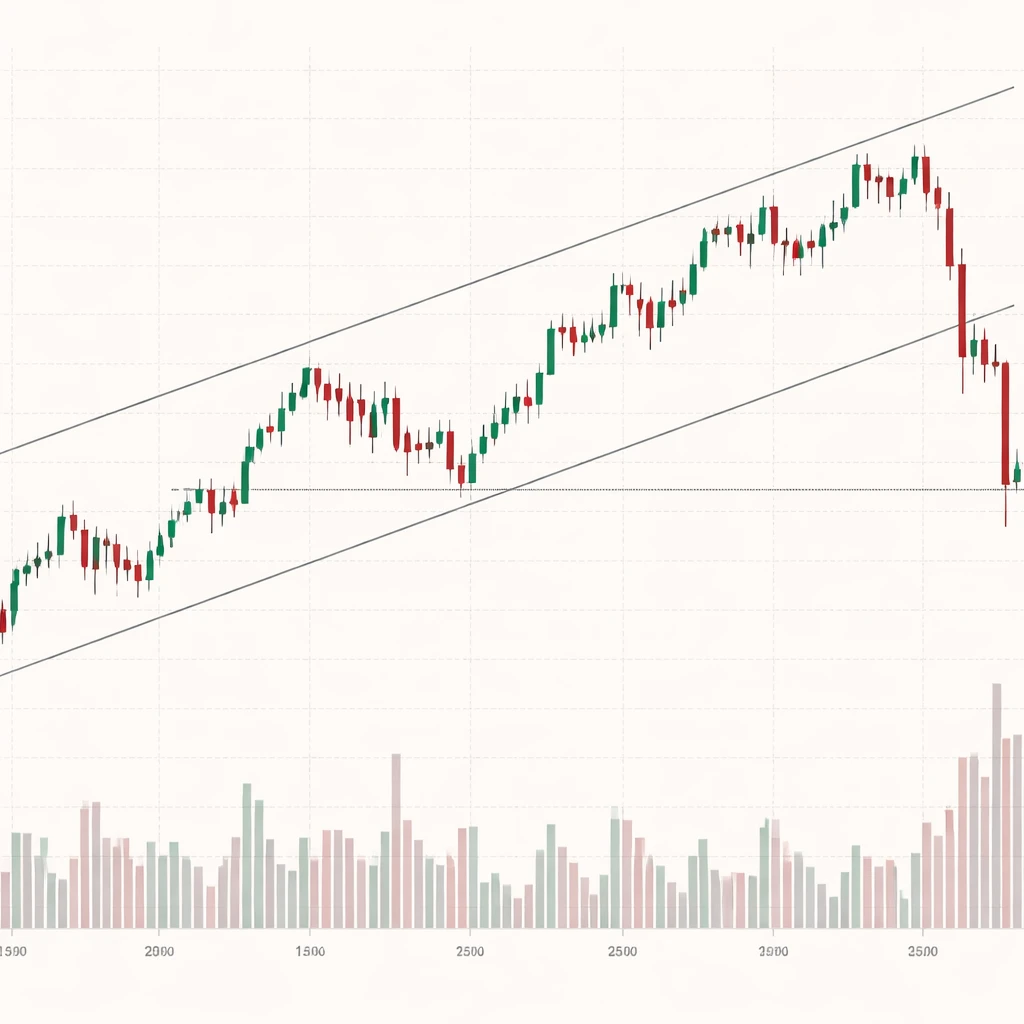
Why Trends Fail
In technical analysis, a trend is a directional sequence of price swings. An uptrend is typically defined by a pattern of higher highs and higher lows, while a downtrend is defined by lower lows and lower highs. Trends persist when that sequence continues. They fail when that sequence is violated and cannot quickly reassert itself. The concept of why trends fail provides a framework for interpreting market behavior at turning points, within consolidations, and during regime transitions.
Understanding failure is not about forecasting tops or bottoms. It is about observing the structural conditions under which continuation becomes less probable and a different state of market organization emerges. By studying how failure manifests on charts, one can describe market context more precisely and adjust expectations about volatility, path dependency, and the likelihood of range formation or reversal.
Defining Trend Failure Precisely
A trend fails when the defining sequence of swings is broken and price acceptance occurs beyond the prior structural boundary. In an uptrend, the most direct signal is a break below a prior higher low that is followed by inability to reclaim that level. In a downtrend, the mirror condition applies: a break above a prior lower high that holds. This structural break is often accompanied by other features, such as a change in volatility regime or a loss of momentum, but the structure itself is primary.
Two related ideas help formalize this view:
Break of structure: price trades through a key swing point that previously defined the trend. The market prints, for example, a lower low relative to an important higher low in an uptrend.
Change of character: the nature of swings alters in a way that differs from prior pullbacks. For instance, a sequence of shallow, brief retracements gives way to a deeper, faster decline with more overlap between bars or candles.
These terms are descriptive, not predictive. They summarize how order flow has reorganized around visible reference points and help distinguish routine pullbacks from structural change.
How Trend Failure Appears on Charts
Trend failure is multi-faceted on charts. Several recurring visual signatures are commonly observed, often in combination.
1. Violation of the swing sequence
In an uptrend with higher highs and higher lows, a typical failure sequence unfolds as follows: price makes a marginal new high that lacks follow-through, stalls, and then declines through the most recent higher low. If price then retests that broken low from below and fails to get back above it, the market has accepted a new regime. The same logic applies in reverse to a downtrend.
2. Failed breakouts and failed retests
Breakouts that immediately reverse and trade back through the prior range boundary signal insufficient participation in the direction of the prior trend. A failed retest occurs when price briefly regains a broken level only to reject it again. On many charts, failed tests cluster near the end of mature trends as liquidity becomes thin in the direction of travel.
3. Range compression followed by expansion against the trend
Trends can narrow into tight channels or wedges. Compression alone does not imply failure. The critical feature is the subsequent expansion in volatility that resolves against the prevailing direction. A sudden wide-range move that closes beyond the channel boundary often marks the first leg of a regime change.
4. Trendline or channel break with acceptance
Trendlines and channels are auxiliary tools that visualize the path of least resistance. A break is informative only when price accepts beyond the line, meaning it spends time and transacts volume outside the prior boundary. A single intraday breach that reverses can simply be noise, whereas repeated closes and retests away from the channel carry more weight.
5. Momentum and breadth deterioration
Momentum indicators and breadth measures are ancillary evidence that the internal strength of a trend is waning. Lower highs in momentum, fewer advancing components in an index, or sector-level divergence provide context. Structure still governs, but these elements can explain why follow-through has degraded.
Why Traders Pay Attention
The failure of a trend alters the distribution of likely paths. Path dependency matters in markets because liquidity, volatility, and positioning are not constant. When a trend fails, several practical implications for interpretation arise:
Risk context. Structural failure relocates the reference points that many participants monitor, such as prior highs and lows. This relocation changes where stops are clustered and where counter-moves may accelerate.
Volatility expectations. Trend failure often coincides with volatility expansion. A market that transitions from directional behavior to two-way trade can produce larger swings and more overlap.
Regime identification. A failed trend may lead to a range, a complex top or bottom, or a sustained reversal. Recognizing the transition early helps frame the market as a different regime with distinct behavior and time characteristics.
Narrative alignment. When price rejects prior structure, the market has repriced the balance of opinions and inventories. Observing this shift prevents the naive extrapolation of a past trend into a new environment.
Mechanisms Behind Trend Failure
Trend failure is the visible outcome of evolving order flow. Several mechanisms commonly contribute.
Exhaustion of directional participation
As a trend matures, the pool of participants willing to transact in the direction of the trend at increasingly unfavorable prices can diminish. New highs or lows that do not attract additional activity are vulnerable to reversal. Price may push beyond a prior extreme, uncover few new participants, and then retreat back into the prior range. This dynamic produces failed breakouts or breakdowns.
Liquidity pockets and stop-loss cascades
Stops tend to cluster around recognizable levels such as swing highs, swing lows, and channel boundaries. When price reaches these areas, triggering stops can create a sudden burst of orders that move price quickly, often beyond fair value in the short run. In late-stage trends, a push that exhausts stops in the trend direction can be followed by a sharp move the other way as the market finds little liquidity to absorb the reversal.
Timeframe conflict
A weekly or monthly structure can dominate a daily or intraday trend. For example, a daily uptrend may approach a multi-month lower high. Sellers aligned with the higher timeframe respond at that reference, and the lower timeframe uptrend fails as the larger structure reasserts itself. Timeframe interaction explains why trends can fail abruptly at levels that appear arbitrary on a single chart scale.
Information arrival and repricing
New information, whether macroeconomic or firm-specific, can reset expectations. A repricing event that contradicts the assumptions behind a trend often produces a decisive structural break with heightened volatility. The technical signature is not unique, but the speed and magnitude of the move can exceed prior pullbacks, signaling a different balance of risk.
Asymmetry after parabolic moves
Parabolic legs feature rapid gains in one direction and thin liquidity on the opposite side. When such a move stalls, even modest supply or demand can trigger an outsized retracement. The first lower low after a parabolic up leg, for instance, is often larger in size and faster in time than prior pullbacks, reflecting the fragile state of the move.
Distinguishing Pullback from Failure
Not every retracement constitutes failure. Trends breathe. The challenge is to separate healthy corrections from structural change without relying on hindsight.
Depth and duration. Pullbacks during healthy trends are typically smaller and shorter than the impulse legs that precede them. When a decline consumes more time, traverses a greater portion of the prior upswing, or overlaps multiple earlier bars, the character has shifted.
Sequence integrity. As long as higher lows in an uptrend or lower highs in a downtrend remain intact, the trend remains valid by definition. A breach of those levels, with acceptance beyond them, is the decisive element.
Retest behavior. After a boundary is broken, the first attempt to reclaim it is revealing. Quick re-acceptance suggests a false break. Persistent rejection suggests a genuine regime shift.
Volatility regime. Healthy trends often exhibit relatively even volatility. A sudden surge in range size and gap frequency after a long, orderly move suggests a different state of play.
Practical Chart-Based Context
The following examples describe how failure typically looks without implying any particular course of action.
Daily uptrend entering maturity
Consider a stock that has advanced for three months. The daily chart shows a staircase of higher highs and higher lows. Pullbacks have been shallow, with little overlap between bars, and closes near the highs of weekly ranges. Price forms a fresh high that is only marginally above the prior one. The next day, instead of building on that breakout, the market gaps down and closes below the midpoint of the prior week. Two sessions later, price trades through the most recent higher low. Subsequent rallies cannot reclaim that broken low, and bars begin to overlap. This is a textbook failure sequence: a marginal high, a decisive break of the last higher low, rejection on retest, and increased overlap as the market reorganizes.
Intraday trend failing at a higher timeframe reference
Imagine an index future trending upward during the European session. As New York opens, price approaches a weekly lower high visible on a multi-month chart. The first attempt over that level is immediately rejected, printing a long upper wick. Sellers push price back into the prior intraday range. A second attempt stalls below the earlier high and volume increases on the decline. When price breaks the prior intraday higher low and accelerates, the intraday uptrend fails in the face of the weekly reference. The lower timeframe structure yields to the higher timeframe control.
Downtrend exhaustion and reversal process
Consider a commodity in a well-defined downtrend. A persistent pattern of lower highs and lower lows continues for weeks. Eventually, a breakdown below a widely watched support level fails to follow through. Price quickly returns inside the prior range and closes near the top of the day. Over the next sessions, selling attempts are absorbed, and the market stops making new lows. A rally exceeds the last lower high, and price accepts above that level. The downtrend has failed structurally, initially transitioning to a range and potentially into a new trend if higher lows form subsequently.
Reading Failure Through Market Structure
Trend failure rarely produces an immediate and tidy reversal. Market structure often evolves through intermediate states.
Trend to range. After the first structural break, price can oscillate within a newly defined box. This state reflects disagreement between participants with different time horizons. The new range provides future reference points where acceptance or rejection will indicate the next phase.
Distribution or accumulation. Extended ranges sometimes present as distribution after an uptrend or accumulation after a downtrend. Without invoking any specific schematic, the practical observation is that rallies or breaks within these ranges begin to fail more frequently. Such failure within the range signals that initiative participation is weakening and responsive participation is strengthening.
Trend transition. A sustained reversal requires a new sequence of swings in the opposite direction. For an uptrend failure, that would be the development of lower highs and lower lows after the initial structural break. The early stages can be noisy, with frequent retests of the broken levels and false starts. Time is a crucial ingredient in confirming that the market has reorganized.
Common Misconceptions
Several pitfalls can obscure the interpretation of trend failure.
Every trendline break signals failure. A line on a chart is only as meaningful as the behavior around it. One print through a line without time or acceptance beyond it is often inconsequential.
One divergence settles the case. Divergence between price and an oscillator can occur repeatedly during a strong trend. Divergence is context, not confirmation. Structure decides.
Volume must confirm. Volume signatures vary across assets, sessions, and venues. Rising volume on a failure can add confidence to the structural read, but low-volume failures occur as well, especially in thinly traded instruments or at off-peak times.
All failures lead to reversals. Some failures lead to ranges or choppy conditions rather than a sustained move in the opposite direction. Recognizing the range state is as important as recognizing a new trend.
Analytical References Without Prescribing Strategy
The following references support the study of trend failure in a neutral way. They are tools for description and post-event analysis rather than specific trade instructions.
Swing points and pivots. Marking obvious swing highs and lows creates an objective map. Structural failure is defined with respect to these points.
Volatility measures. Observing average true range or simple range expansion highlights changes in the distribution of daily or intraday moves. A shift in volatility often accompanies failure.
Timeframe alignment. Comparing intraday, daily, and weekly structures reduces surprises at major references. When lower timeframe trends collide with higher timeframe levels, failure risk increases.
Market internals and breadth. In index products, the participation rate across components can contextualize whether a trend is broad or narrow. Narrow leadership often precedes fragile breakouts.
Gap behavior. Mature trends sometimes end with exhaustion gaps that reverse quickly or with breakaway gaps the other way. Tracking how price behaves after a gap provides information about participation and acceptance.
Observational Practice on Charts
Developing fluency with failure requires deliberate chart review rather than real-time reaction. A structured approach to observation is helpful.
Annotate swing structure. Identify the last three to five swing highs and lows that define the current trend. Note which levels, if breached, would violate the sequence.
Count pushes within legs. Many trends unfold in a series of pushes or drives. Late in a move, a third or fourth push that extends marginally beyond the prior high or low often lacks follow-through. Document how often such late pushes fail.
Assess overlap and time. Pullbacks that begin to overlap multiple prior bars or that consume more time than prior corrections often precede failure. This information is visible without indicators.
Note reaction to prior extremes. Watch how price behaves when revisiting prior highs or lows. Aggressive rejection, long wicks, or immediate reversal back through the level suggest fragile participation at the extremes.
Limitations and Uncertainty
Trend failure is easier to identify after the fact than in real time. False breaks, whipsaws, and conflicting signals are part of market behavior. Structural reference points can be drawn differently by different observers, especially in congested price action. Some assets trade with unique microstructure characteristics that change how levels behave. These limitations counsel caution in interpretation and a willingness to revise views as new information arrives.
Putting the Concept in Context
Prices reflect a continuous process of discovery. Trends are the footprints of that process when one side of the market has the initiative. Failure marks a transfer of initiative or a pause while the market refines value. The core contribution of the concept of why trends fail is interpretive clarity. Instead of treating every pullback as a threat or every breakout as confirmation, one can ground analysis in swing structure, acceptance or rejection at key references, and the character of volatility. The goal is not to predict precisely where a trend will end, but to recognize when the conditions that supported it no longer dominate.
Key Takeaways
- Trends fail when the defining sequence of swings is broken and price accepts beyond the prior structural boundary.
- Chart signatures of failure include marginal new extremes, breaks of key swing points, failed retests, and volatility expansion against the prior direction.
- Mechanisms behind failure involve exhaustion of directional participation, liquidity dynamics around stops, timeframe conflicts, and information-driven repricing.
- Distinguishing pullbacks from failure relies on depth, duration, sequence integrity, retest behavior, and changes in volatility character.
- Recognizing trend failure is an interpretive tool for understanding regime shifts, not a trading signal or recommendation.