
Introduction
Price action analysis is built on an effort to infer the balance of buying and selling interest from the raw record of trades. Among the visual elements on a candlestick chart, few are as discussed as wicks, also known as shadows or tails. Wicks often accompany the idea of market rejection, which describes price excursions that fail to gain acceptance and are pushed back by opposing order flow. Understanding what wicks represent, how they form, and when they carry informational weight can sharpen one’s interpretation of market behavior without relying on mechanical rules or signals.
This article defines wicks and market rejection, shows how the concept appears on charts, explains why analysts pay attention to it, and places the idea in practical context through examples. The goal is interpretation, not prescription. The emphasis remains on reading market behavior rather than recommending any specific course of action.
What Are Wicks?
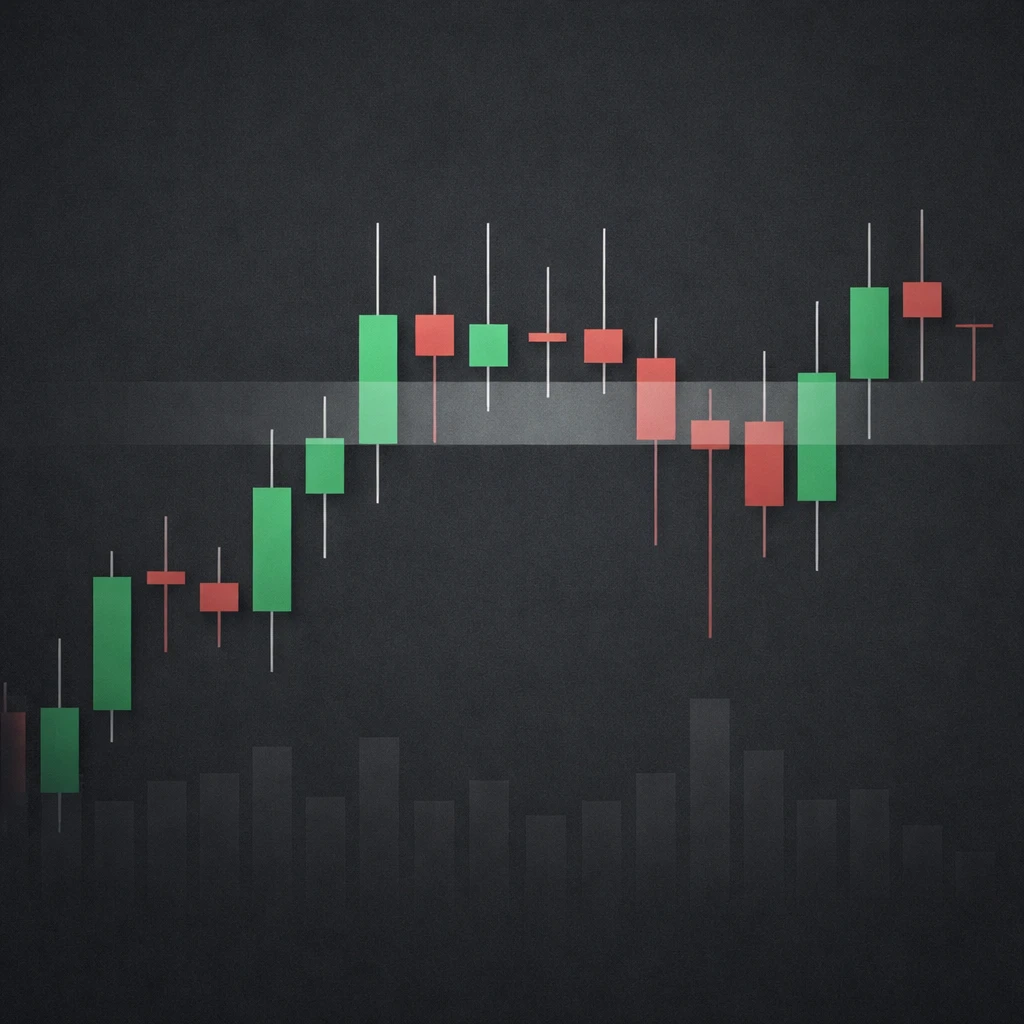
On a candlestick, the rectangular body represents the distance between the open and the close of the chosen time period. The thin lines extending above and below the body are the upper and lower wicks. They mark the intraperiod extremes. The upper wick extends from the top of the body to the high of the period. The lower wick extends from the bottom of the body to the low.
Wicks capture an essential fact about trading: during the interval, price explored beyond the open-to-close range, but it did not sustain those extremes by the close of that period. A long upper wick indicates that buyers pushed price higher at some point, yet selling interest emerged that drove the close back below the high. A long lower wick indicates that sellers pushed price lower, yet buying interest absorbed that pressure and lifted the close above the low. In both cases, the wick visualizes a failed excursion.
Defining Market Rejection
Market rejection is a descriptive term for price levels or areas where the market probes, finds insufficient acceptance, and moves away. Acceptance refers to price trading and remaining in a region with ongoing participation. Rejection refers to price testing a level and then retreating as opposing orders overpower the initial push. On a candlestick, rejection often manifests as a prominent wick that shows where price could not hold.
Rejection is a process, not a single tick. The market discovers where counterparties are willing to trade. If trading at a new high is met with concentrated selling that quickly forces price back down, the upper portion of the candle records that test as a wick. Likewise, a probe below prior levels that is met with demand will leave a lower wick. The wick is the footprint of the failed test.
How Wicks Appear on Charts
Wicks are typically most noticeable on candlestick charts, but the same information exists in any OHLC plot. On bar charts, the thin vertical line from low to high serves the same function, with the horizontal markers showing the open and close. The visual emphasis differs, but the intraperiod extremes tell the same story.
Wicks can be short or long relative to the body of the candle and the candle’s total range. A short wick may signal that the period’s high and low were never far from the open and close. A long wick suggests there was considerable effort in one direction that failed to persist. The combination of body size and wick lengths provides clues to the tug-of-war during the interval.
Interpreting Wick Information
Wick length and location
Length and placement matter. A long upper wick that occupies most of the candle’s total range indicates substantial rejection of higher prices during that interval. A long lower wick does the same for lower prices. When both wicks are long and the body is small, the period reflects broad indecision or a volatile test of both extremes with little net progress. Position relative to recent structure also matters. A long upper wick that forms as price tests a previously active area can reflect rejection of that known zone, while the same wick in open space carries fewer contextual cues.
Body-to-range ratio
The body-to-range ratio compares the absolute difference between open and close to the total high-low range. A small ratio with a large wick indicates much of the period was spent away from the closing level. Analysts often read this as evidence that the market explored and then withdrew. A large body with small wicks suggests directional conviction that carried through to the close with little retreat.
Single wick versus cluster
A solitary long wick may be an isolated event triggered by a headline, a temporary liquidity pocket, or a stop sweep. A cluster of long wicks that repeatedly appear near the same price area often signals recurring rejection. The repetition suggests that attempts to transact meaningfully beyond that area continue to fail, at least for the time being. Clusters can be consecutive candles or separated across sessions, but the shared feature is repeated failure to gain acceptance beyond a level or zone.
Timeframe interaction
Timeframes interact in subtle ways. A daily candle with a long upper wick might conceal several intraday rallies and reversals. Conversely, a series of intraday rejections can aggregate into a daily candle with a modest wick if the final push holds into the close. Analysts therefore compare the wick’s message within the chosen timeframe and, when useful, inspect a higher or lower timeframe to understand the path of trading that produced it.
Why Analysts Pay Attention to Wicks and Rejection
Wicks are signals about price discovery. They reveal where the market tried to go and failed to stay. This is not a prediction that price will reverse or continue. It is information about what the market did not accept during that particular interval. Several reasons motivate the attention given to these details.
First, rejection marks the boundary of recent conviction. If multiple attempts fail at a certain area, that area has proven to be a place where opposing orders reliably meet and counteract pressure. Second, rejections often coincide with liquidity dynamics. Tests into thin liquidity can overshoot before snapping back, while tests into thick resting interest can stall and reverse quickly. Third, the placement of rejections relative to prior structure helps map the market’s most and least accepted regions, which can guide interpretation of future tests.
Acceptance versus rejection in price discovery
Markets balance exploration and acceptance. Acceptance shows up as price spending time and volume in a region. Rejection shows up as quick traversals with failure to remain. Wicks form a visual shorthand for that second behavior. An extensive upper wick can mark a high that was explored but not adopted. An extensive lower wick can mark a low that did not find ongoing supply willing to distribute at those prices. In both cases, the wick is a trace of the market’s attempt to expand its range and the response it met.
Liquidity, order flow, and auction logic
Behind every wick is a sequence of orders. A long upper wick often indicates that aggressive buyers lifted offers until they reached concentrated sell interest or the exhaustion of buying, after which sellers were able to press price back down. A long lower wick often indicates that aggressive sellers hit bids until they reached concentrated buy interest or sellers exhausted, after which buyers restored price. This interaction fits the auction perspective in which the market advertises price to seek counterparty. The wick marks the boundary where that search found resistance from the other side.
Practical Chart Context and Examples
The following examples illustrate how wicks and market rejection can appear in varied conditions. They aim to build intuition for interpretation rather than prescribe specific actions.
Example 1: Daily chart test near a prior high
Consider an equity index that rallied over several weeks to retest a high made earlier in the year. On the first test, the daily candle prints a long upper wick and closes back within the prior range. The wick shows that price explored higher, likely triggering buy stops and late momentum, but encountered enough sell interest to send the close back below the day’s high. Over the next few sessions, two more daily candles show upper wicks near the same area, one of them after an intraday gap up that also faded. The cluster suggests that, at least for this period, higher prices did not attract sustained acceptance. Whether price later resolves higher or lower is a separate question. The immediate message is that the tests above the prior high were pushed back during those sessions.
Example 2: Intraday futures around a round-number area
On a 5-minute chart of a liquid futures contract, price runs to a round number that has recently served as a focal point. Three consecutive candles print prominent upper wicks with closes below the round number. The intraday order book likely contained resting sell interest near that price, or responsive sellers stepped in as buy orders thinned. The repeated intraperiod failures leave a visible series of wicks. Later in the session, the market returns to the area with increased volume. This time the candle closes near its high with a small upper wick, suggesting that earlier rejection may have weakened. The contrast between the initial rejections and the later, smaller wick illustrates how the wick conveys changing acceptance.
Example 3: Foreign exchange during a policy announcement
On a 1-minute chart of a currency pair during a central bank announcement, volatility spikes and several candles display long wicks in both directions. The first impulse upward is met with a swift counter move that leaves a large upper wick. Moments later, a downward impulse produces a large lower wick. In this setting, wicks signal abrupt, event-driven rejection in both directions as participants recalibrate to new information. The interpretation is not that one side dominated, but that the market probed widely and struggled to immediately anchor on a new consensus price.
Example 4: Crypto market during a low-liquidity interval
On a weekend hourly chart of a cryptocurrency, an isolated candle prints an extreme lower wick after a sudden drop, followed by a recovery to within the prior range. Exchange depth at that hour is thin, so a relatively small wave of market sell orders travels far before hitting sizable bids, then price snaps back as liquidity reappears. The wick highlights the failed exploration into exceptionally thin conditions. The context suggests caution in generalizing from that single candle, since the wick may reflect liquidity mechanics more than a robust shift in valuation.
Example 5: Weekly chart showing clustered rejections
On a weekly chart of a commodity, price approaches a multi-year area that has repeatedly capped advances. Over six weeks, multiple candles display long upper wicks with closes below the area, even when intraperiod news temporarily lifts prices. The repetition hints at persistent supply or hedging interest absorbing attempts to reprice higher. From a price discovery standpoint, the market advertised the higher prices several times and found limited acceptance. Whether the eventual outcome is continuation or reversal is unknowable from the wicks alone. The weekly record simply shows an upper boundary where acceptance has been difficult to achieve.
Nuances, Pitfalls, and Misinterpretations
Volatility regimes and relative scale
Wick length should be evaluated relative to the recent volatility regime. A 10-point wick in a quiet market can be significant, while the same 10 points may be routine during a high-volatility period. Using average true range or a comparable measure as a yardstick can help place wicks on a sensible relative scale. Without that context, an observer may overstate or understate the importance of a wick simply because of changing background volatility.
Thin liquidity and session effects
Wicks can be amplified in thin conditions. Overnight sessions, holidays, and premarket or postmarket trading often exhibit lighter depth and fewer participants. Price can jump across levels and then retrace once fuller liquidity returns, producing exaggerated wicks. Session boundaries also matter. An instrument that closes poorly late in the day can show a long wick if the final auction differs from the continuous trading that preceded it. Understanding the session microstructure helps avoid misreading wicks born of technical settlement dynamics.
News and event-driven spikes
Data releases and corporate announcements can produce rapid excursions and swift rejections. In these intervals, wicks often reflect fast repositioning and algorithmic responses rather than a steady two-sided negotiation. The informational content of such wicks is not zero, but it should be calibrated to the event. A large upper wick during an earnings surprise or rate decision may tell a different story than the same wick on a routine day.
Stop runs and liquidity hunts
Markets frequently probe beyond obvious swing points or round numbers to trigger protective orders. The resulting flows can push price into areas with limited resting liquidity, after which price returns quickly. The candle will register a wick that looks like rejection. While the rejection is genuine in the sense that price did not stay there, the driver may be structural rather than a broad-based shift in valuation. Recognizing the possibility of stop-driven excursions helps temper overconfident conclusions from a single wick.
Gaps and wickless candles
Not all rejections produce wicks. A gap that opens above a prior range and never trades back to the low of the day will show little or no lower wick on the opening candle. Yet the market might still be rejecting lower prices by refusing to trade there. Conversely, a session can gap down, fail to trade above the open, and close near the low, producing a candle with little or no upper wick. Understanding that rejection can occur through lack of trading, not only through intraperiod reversals, gives a fuller picture.
Measuring Wicks with Simple Metrics
Although chart reading is often qualitative, a few simple measurements clarify what the eye sees. Define the following for any candle:
- Total range = high minus low.
- Body size = absolute value of close minus open.
- Upper wick length = high minus the maximum of open and close.
- Lower wick length = the minimum of open and close minus low.
With these quantities, one can compute ratios:
- Upper wick ratio = upper wick length divided by total range.
- Lower wick ratio = lower wick length divided by total range.
- Body ratio = body size divided by total range.
If the upper wick ratio is near 0.6 or higher in a quiet regime, the candle spent most of its span failing to hold the highs. If both wick ratios are large and the body ratio is small, the candle reflects pronounced intraperiod rejection at both extremes. None of these numbers prescribe outcomes, but they provide a standardized lens for comparing candles across time.
Analysts sometimes also track the close location value, defined as close minus low divided by high minus low. A close location value near 1 indicates a close near the high, near 0 indicates a close near the low, and near 0.5 indicates a mid-range close. When a candle has a large upper wick, the close location value tends to be lower, reflecting the failure to hold the high. In contrast, a large lower wick often coincides with a higher close location value, reflecting the failure to hold the low.
Contextual Factors That Shape Wick Meaning
The meaning of a wick is rarely absolute. Several contextual factors refine interpretation.
- Trend background: A long upper wick in a persistent up move can reflect healthy back-and-fill or profit-taking, while the same wick after a prolonged advance into known supply may hint at fatigue. A long lower wick in a persistent down move can reflect short-covering or responsive buying. Trend context shapes the narrative without guaranteeing outcomes.
- Location relative to structure: Wicks that form at prior highs, lows, balance areas, or congestion zones often carry more informational weight than those that form in the middle of open territory. The structure offers a reference for where acceptance has been strong or weak.
- Volume and participation: High-volume rejections can reflect broader participation and firmer conviction than rejections on light volume. Volume is not a requirement but adds color to the story of acceptance and rejection.
- Time spent: Quick rejections that traverse a price area once and leave are different from drawn-out battles with many re-tests. Time at price, when available, complements the wick by showing whether the market could actually transact there.
- Instrument and session rules: Products with daily limit rules, auction-style opens, or fragmented venues can display wicks that owe as much to mechanics as to valuation. Awareness of these mechanics makes interpretation more grounded.
Relating Wicks to Volume and Order Book Concepts
Although candlestick charts do not show the order book, wicks can be interpreted through auction logic. A long upper wick implies that as price moved up, either sell limits were dense above or buyer aggression waned. The reversal suggests that sellers could trade size and absorb further buyers. A long lower wick implies that as price moved down, either buy limits were dense below or seller aggression waned. The reversal suggests that buyers could trade size and absorb further sellers.
Volume profiles or time-price studies, when used, sometimes show low volume in the wick area if the excursion was fast, or high volume if there was heavy two-sided trade before a push back. Neither outcome invalidates the idea of rejection. The essence is that the market tried to remain at those prices and failed within the period observed.
What Wicks Do Not Guarantee
Wicks are not promises of reversal or continuation. A market can display a strong upper wick and still push higher in the next session if incoming orders change the balance. Likewise, a strong lower wick does not ensure a sustained advance. Wicks report what happened inside a period. They are historical observations that can inform expectations about acceptance, but they do not determine the next step.
It is also important to avoid circular reasoning. Seeing a wick and concluding that rejection occurred because the wick exists can miss the underlying drivers. The wick is evidence that price did not hold an extreme during that interval. The reasons can range from structural liquidity to shifts in sentiment to event-driven noise. A careful interpretation acknowledges these possibilities.
Putting It All Together: A Structured Reading Process
A disciplined reading of wicks and market rejection often follows a simple progression of questions:
- How large are the wicks relative to the candle’s total range and the recent volatility regime?
- Where did the wicks occur relative to prior highs, lows, balance areas, or notable reference points?
- Was the rejection a one-off event or part of a cluster of similar responses in the same area?
- What was the level of participation, when volume or liquidity proxies are available?
- Do higher or lower timeframes confirm, contradict, or dilute the message of the wick?
This process avoids treating a wick as a standalone signal. It frames the wick as one piece of evidence within a broader analysis of acceptance, rejection, structure, and participation.
Additional Illustrative Scenarios
Two brief scenarios further highlight the diversity of wick behavior:
Rejection inside a range: A market oscillating within a well-defined rectangle often shows alternating upper and lower wicks near the boundaries. The upper boundary wicks reflect rejection of higher prices, and the lower boundary wicks reflect rejection of lower prices. The interior of the range tends to show shorter wicks and larger bodies as price trades more comfortably within accepted territory.
Rejection after a climactic move: After a rapid directional run, a daily candle with a long wick against the direction of travel may mark near-term exhaustion. The wick indicates that continuation attempts failed to hold. Whether that exhaustion leads to consolidation or a larger turning point depends on the subsequent flow of orders, which the next candles will reveal.
Caveats for Comparative Use Across Markets
Different asset classes and venues can produce wicks with distinct character. Equity indices with centralized closing auctions may show end-of-day wicks shaped by auction imbalances. Single stocks can show premarket and postmarket wicks that did not trade on the primary venue. Futures can display overnight wicks from global sessions with different participants. Foreign exchange trades continuously but exhibits pronounced activity around regional opens that can create wicks at handoffs between time zones. Digital assets can show pronounced wicks during off-peak hours. A consistent interpretation accounts for each market’s microstructure.
Summary Perspective
Wicks and market rejection provide a compact visual summary of failed price exploration. They are most informative when read in relation to structure, volatility, and participation. A long wick signals that a test in one direction met meaningful opposing flow during the period, pushing the close away from the extreme. Clusters of similar wicks near the same price area point to persistent difficulty in gaining acceptance there. At the same time, wicks do not forecast outcomes on their own. They contribute to a richer map of where the market has been welcomed or turned away, which is the core of price discovery.
Key Takeaways
- Wicks represent intraperiod extremes that failed to hold, offering a visual record of attempted but rejected price exploration.
- Market rejection describes areas where price probed, found insufficient acceptance, and moved away, often leaving prominent wicks.
- The informational value of a wick depends on length, location, clustering, timeframe, volatility regime, and participation.
- Event risk, thin liquidity, and stop-driven moves can produce wicks that reflect structural mechanics rather than durable valuation shifts.
- Wicks refine interpretation of price discovery but do not, by themselves, imply specific future outcomes or actions.