
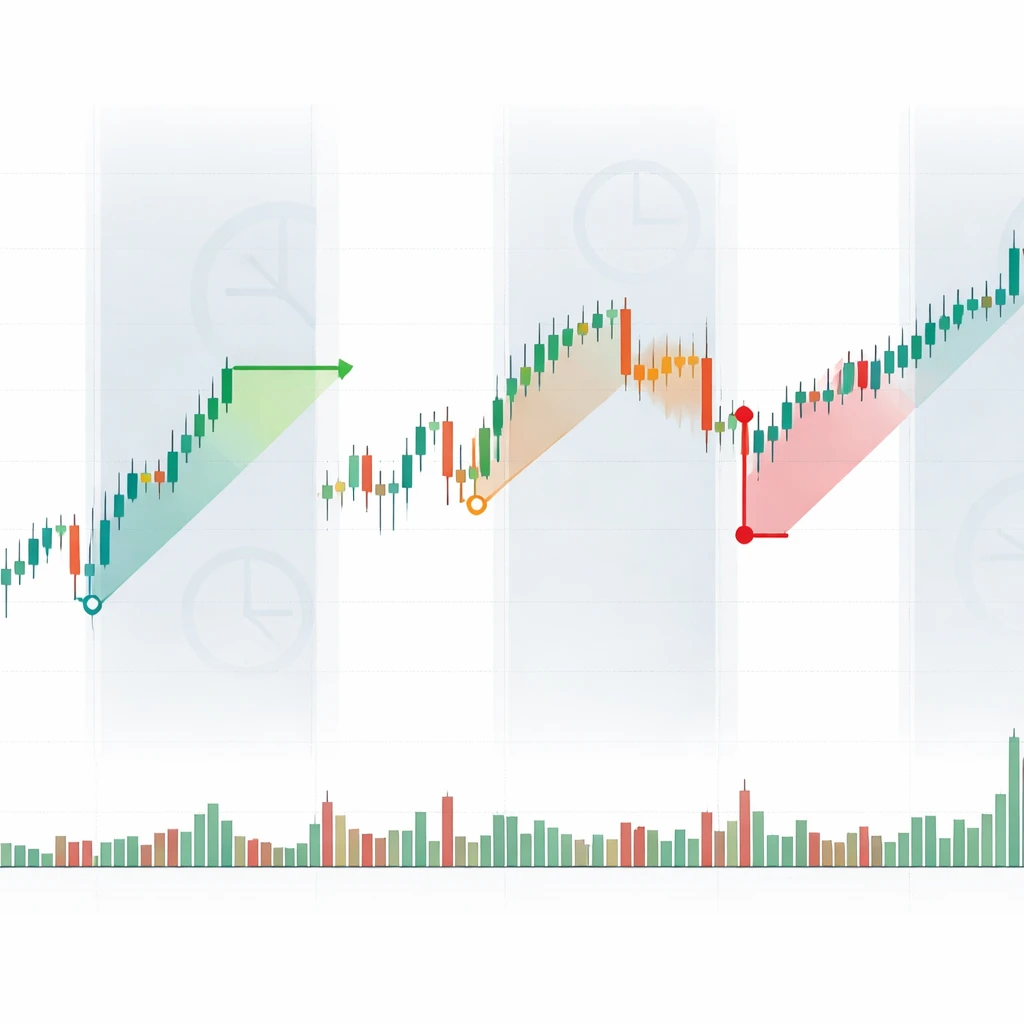
What Are Time-Based Exits
Time-based exits impose a predefined limit on how long a position can remain open. When the clock runs out, the position is closed in whole or in part, regardless of whether a price target or stop-loss has been reached. The rule can be simple, such as closing after two sessions, or more structured, such as exiting at the next market close following ten 5-minute bars if no new high or low has been printed.
Time limits do not attempt to predict direction. They manage exposure. The premise is that every trading thesis has a half-life. If the anticipated move has not materialized within a reasonable window, continuing to hold increases opportunity cost and may expose the account to unwanted risks that accumulate with time, such as news shocks or liquidity deterioration.
Time-based exits usually complement price-based stops and profit targets. A common design pairs a protective stop with either a target or a maximum holding period, creating a bounded risk window in both price and time. The time boundary converts open-ended uncertainty into a scheduled decision point.
Why Time Limits Matter for Risk Control
1. Limiting exposure to unpriced risks
Market risk is not constant across time. Overnight gaps, weekend news, and event announcements change the distribution of returns. A position that stagnates invites additional event risk without compensating progress. A time exit caps that exposure by enforcing a maximum duration.
2. Volatility clustering and drift
Volatility tends to cluster. Periods of consolidation often precede regime shifts. A trade that fails to move during its expected window may be sitting in low-volatility noise, after which volatility can expand unpredictably. The time limit prevents an accidental transition from a controlled bet into an open-ended regime risk.
3. Edge decay and thesis half-life
Many edges are conditional on timing. For example, short-term reactions to order flow, liquidity imbalances, or event-related dislocations typically fade quickly. Holding past the statistical half-life converts a defined tactic into a different position with different drivers. Time exits avoid unintentional drift in the underlying thesis.
4. Capital recycling
Capital tied in stagnant positions cannot be allocated to better opportunities. Even if opportunity cost is hard to quantify ex ante, a portfolio with bounded holding times will typically recycle capital more efficiently, which can matter for long-term survivability when capacity and margin are finite.
5. Psychological discipline
Time limits counter the tendency to rationalize holding because a trade is close to breakeven or because exiting would realize a small loss. The rule externalizes the decision and reduces discretionary bias. This is as much a risk control benefit as it is a behavioral one.
Defining the Clock: Variants of Time-Based Exits
Time exit rules can be specified in several ways. The choice should reflect the time scale of the thesis, the instrument’s microstructure, and operational constraints.
Bar-based horizons
A maximum number of bars or candles on the relevant timeframe. Example: close after 20 5-minute bars if the trade has neither hit the stop nor the target.
Session-based horizons
A limit based on market sessions. Example: hold for at most one full session and exit at the closing auction if still open.
Calendar windows
A ceiling defined in calendar time. Example: exit before a scheduled macro announcement or before the weekend regardless of price.
Event-linked deadlines
A time limit tied to an event boundary such as earnings release, futures rollover, or index rebalancing. The exit occurs before the event if price targets have not been met.
Volatility-adjusted time
The time window scales with current volatility. One approach is to map expected time-to-target as a function of realized volatility and to set a limit at a multiple of that expectation.
Liquidity-aware timing
For instruments with pronounced liquidity cycles, the limit may align with periods of deeper liquidity such as the primary session close or the opening cross, in order to reduce slippage at exit.
How Time-Based Exits Operate in Practice
The mechanics of time exits are straightforward, yet details matter for both performance and risk.
Order handling at the deadline
At the time limit, traders must translate the rule into operational steps. Choices include market orders at the next available tick, limit orders placed slightly inside the spread, or participation in a scheduled auction. Each choice changes slippage and fill risk. For example, using a limit order may reduce adverse fills but could result in a partial exit if the order is not fully executed before the time boundary passes.
Partial exits
Some practitioners close a fraction at the time limit and allow the remainder to continue under a trailing stop. This hybrid approach attempts to harvest information gained during the holding period while still capping exposure. Partial exits should be specified in advance to avoid discretionary drift.
Overnight considerations
If the time limit expires when the market is closed, the exit must be scheduled for the next open. That introduces gap risk. Rules should state whether to exit at the open price, use a marketable limit, or wait for a defined liquidity condition such as a minimum opening volume.
Intraday versus multiday
On intraday horizons, microstructure frictions dominate. Time exits close trades before liquidity thins, or before transaction costs rise into the close. For multiday positions, the clock often aligns with event calendars, borrow availability in short selling, or margin cycles.
Example: A breakout that stalls
Suppose a trader buys an equity breakout during the morning session based on momentum in the order book. The plan sets a protective stop 1 percent below the entry and a time limit at the session close if neither stop nor target is reached. If the equity trades sideways into late afternoon without new highs, the time exit closes the trade near the close. The rule limits overnight gap risk from company news and recycles capital for the next session.
Example: Futures held into low liquidity
A futures position initiated during the primary session faces thin liquidity in the after-hours market. A time exit that closes before the end of the primary session prevents adverse fills during illiquid periods and reduces the risk of overnight price jumps that bypass stops.
Example: Options and time decay
Option positions experience theta decay. If a thesis relies on a short-term move, a time limit that precedes a theta acceleration zone can cap the decay risk when the anticipated move does not occur.
Quantifying and Designing Time Exits
Time exits can be as evidence-based as price stops. The design process benefits from explicit measurement.
Distributions of time-to-target and time-to-stop
For a given setup archetype, estimate the empirical distribution of time until hitting a stop, a target, or neither. The mass of observations that neither hit stop nor target within a certain window suggests a natural time limit. If the conditional probability of achieving the target falls materially after a specific horizon, the additional holding time may not be justified.
Hazard rates
Borrowing from survival analysis, the hazard rate is the conditional probability that a trade reaches a desired exit in the next unit of time given that it has not already. If the hazard of reaching the profit target decays as time passes without progress, a time exit placed near the inflection reduces exposure during the low-odds tail.
MAE and MFE curves by bar count
Maximum adverse excursion and maximum favorable excursion can be plotted against the number of bars held. If MAE grows while MFE plateaus after a certain bar count, it indicates diminishing reward relative to risk with time.
Conditional performance slicing
Segment historical trades by the time they took to begin moving. Trades that do not advance within a threshold often exhibit lower expectancy afterward. That threshold can inform a time limit for the initial hold before moving to a tighter management regime.
Robustness tests
Vary the time limit around the candidate value and assess how sensitive results are. Large changes in performance from small tweaks may indicate overfitting. Prefer ranges that yield stable outcomes across subsamples, market regimes, and instruments.
Transaction cost modeling
Time exits change turnover and therefore commission, fees, and slippage. Backtests should include realistic cost assumptions, including the microstructure conditions likely at the exit time. If the exit occurs at the close, use close-specific slippage parameters rather than generic ones.
Integrating Time Exits With Other Risk Controls
Time-based exits do not replace price stops. They set a complementary boundary. Thoughtful integration avoids contradictory signals.
Stop first, clock second
Generally, protective stops protect against severe adverse moves, while time exits protect against extended stagnation and event risk. The stop takes priority when hit; otherwise the clock governs the decision.
Targets and scaling
If profit targets are used, the time limit can act as a trailing decision point for residual size. For example, if half a position is closed at a target, the remaining half may be subject to a strictly enforced time limit to prevent open-ended drift.
Volatility regimes
In higher volatility regimes, price can reach extremes faster. The time window may be shortened or lengthened according to measured volatility, not discretion, to maintain similar exposure profiles.
Portfolio constraints
At the portfolio level, synchronized time exits can inadvertently concentrate execution risk, for example when many positions close at the same auction. Staggered limits or diversified horizons can spread the execution load. Liquidity plans should be explicit for peak exit times.
Common Misconceptions
“Time exits are arbitrary.”
They become arbitrary when unmeasured. With data on time-to-target distributions, hazard rates, and MAE/MFE by bar count, the time limit is a statistical boundary, not a guess.
“Time exits kill big winners.”
Without a target or trailing method, any exit can truncate a trend. The purpose of a time exit is to prevent long exposure to low-probability states. If the strategy relies on outliers, design the time limit to activate only when the thesis has not begun to work within its expected window. Combining time limits with trailing mechanisms can maintain participation in established moves while still capping stale positions.
“Price stops already cover the risk.”
Price stops bound loss size at a price level but do not address long periods of dead money or risk that accumulates with time, such as overnight surprises. A time exit handles a different dimension of risk.
“Time exits are only for intraday traders.”
Event calendars, funding costs, borrow availability, and weekend gaps affect multiday positions. Time limits can be aligned with those realities just as they are with intraday liquidity cycles.
“Time exits simply increase churn.”
Turnover may rise, but churn is not a meaningful metric in isolation. The relevant question is whether the distribution of outcomes improves after accounting for costs and risk. If time limits reduce tail risk or opportunity cost, modestly higher turnover may be justified.
Frequent Pitfalls
Overfitting the holding period
Choosing a time limit that optimizes historical performance to the minute can be misleading. Markets change. Prefer a range of acceptable limits and document the rationale that ties the limit to structural features, not just historical optimization.
Ignoring calendar effects
Holidays, shortened sessions, and scheduled announcements alter liquidity and volatility. If the time limit aligns with these events by accident, exits may occur into poor liquidity or avoidable gap risk. Maintain a calendar-aware rule set.
Mismatch between calendar time and trading time
Counting bars versus counting calendar minutes can create unexpected behavior on instruments that trade around the clock. Specify whether the rule uses trading bars, active session time, or pure clock time.
Unrealistic execution assumptions
Assuming frictionless exits at the limit leads to rosy backtests. Include realistic slippage models for the chosen exit venue, whether the open, the close, or continuous trading. If the plan relies on auction liquidity, verify historical participation rates.
Conflicts with other rules
Unclear precedence among stops, targets, and time exits can lead to inconsistent behavior. Establish an order of operations and test it explicitly.
Data snooping through regime selection
Choosing a time limit after viewing conditional performance across many overlapping windows increases the risk of false discovery. Use out-of-sample validation and avoid repeated peeking at the data.
Neglecting position size interaction
Time exits that concentrate many closures at the same time can cause crowding in portfolio execution. Position sizing and exit schedules should be coordinated to avoid internal liquidity stress.
Evaluating Effectiveness
To judge whether time limits improve risk-adjusted outcomes, focus on distributional changes rather than single metrics.
Tail behavior
Examine whether extreme adverse outcomes diminish in frequency or magnitude when time limits are active. Reduced tail risk directly supports survivability.
Dwell time of losing trades
Measure how long losing trades remain open. Time exits should reduce the average dwell time and the variability of dwell time in losers, which improves capital efficiency.
Hit rate and payoff ratio
Time limits may change the ratio of small losses to gains. That is not inherently bad if the net expectancy improves and variance decreases. Look at the joint behavior of hit rate, average win, average loss, and their volatility.
Turnover and cost impact
Quantify the change in commissions, fees, and slippage. Gains in risk control must outweigh any additional costs.
State dependence
Assess whether time exits help more in certain regimes, such as range-bound periods. If benefits are highly state-dependent, consider regime-sensitive application supported by measurable triggers, not discretion.
Documentation and Governance
Well-designed risk controls are explicit and auditable. Time exits should be documented with clear rules.
Rule specification
Define the time horizon, timekeeping basis, precedence among exit types, and execution method at the deadline. Include exceptions and how they are triggered. For instance, an exception might apply during declared trading halts.
Automation and monitoring
Automating the time exit reduces slippage from delayed reactions and minimizes discretion. Logs should record scheduled exit times, actual execution times, and any deviations. Monitoring enables post-trade analysis of adherence and effectiveness.
Change control
Any adjustment to time limits should follow a change policy with testing, rationale, and an implementation date. This avoids ad hoc changes in response to recent outcomes.
Illustrative Analytical Frameworks
Survival analysis framing
Label each trade with three possible terminal events: hit stop, hit target, or time expiry. Use Kaplan-Meier curves to estimate survival probabilities out to various horizons and compare hazard rates for targets before and after candidate time limits. This framework highlights whether the probability of achieving favorable exits declines materially after a certain time.
MAE control charts
Plot MAE by bar count and add control limits. If MAE accelerates beyond a threshold after a given number of bars without offsetting MFE gains, a time limit at or before that point is defensible.
Opportunity cost proxies
When alternative opportunities cannot be modeled directly, use proxies such as average realized volatility or signal strength available in the portfolio during the holding window. If the opportunity proxy consistently increases while the open trade remains static, the implicit cost of holding may be nontrivial.
Behavioral Dimensions
Time exits help counter several biases.
Disposition effect
Traders often hold losers too long and realize winners too quickly. A time exit forces the evaluation of a stagnant loser at a predetermined point and reduces the temptation to wait indefinitely for a reversal.
Anchoring and hope
Anchoring to entry price and hoping for a move back to breakeven can keep a position open far past its thesis window. The clock removes hope as a decision driver.
Decision fatigue
Repeated intraday choices erode discipline. A time limit precommits a decision, reducing cognitive load during stressful periods.
Special Cases and Instruments
Options with fixed expiry
Since options carry time decay and hard expirations, time-based exits often align with theta profiles, earnings dates, or liquidity windows near expiration. The exit may precede the steep portion of the decay curve or avoid settlement mechanics.
Futures and roll calendars
Futures contracts have roll dates where liquidity migrates. Time limits can enforce exit or roll before open interest collapses, reducing execution risk and basis volatility.
Illiquid equities and microcaps
Exiting on schedule in illiquid names requires careful planning. The time exit may need to trigger earlier to allow scaling out over time rather than at a single moment.
FX and around-the-clock markets
In markets without a daily close, define time limits relative to liquidity cycles, such as the London fix or the overlap between major sessions. This avoids exits in thin periods.
From Principle to Practice Without Prescription
Time-based exits are a structural risk control that place bounds on how long a thesis is allowed to remain unproven. They do not dictate when to enter or what assets to trade. Their value lies in reducing unbounded exposure to time-driven risks, improving capital recycling, and fostering discipline. Whether applied intraday or across multiple sessions, the design benefits from measurable relationships between time and outcome, explicit operational rules, and careful monitoring of real costs.
Key Takeaways
- Time-based exits cap the duration of exposure and convert open-ended waiting into a scheduled decision, independent of price targets or stops.
- They address risks that accumulate with time, including event risk, liquidity changes, edge decay, and behavioral drift.
- Design should be grounded in data such as hazard rates and MAE/MFE by bar count, with explicit execution rules and precedence among exits.
- Benefits and costs are portfolio-specific, so evaluation should focus on distributional changes, tail risk, and capital efficiency after realistic costs.
- Common pitfalls include overfitting the time limit, ignoring calendar and liquidity effects, and creating conflicts with other exit rules.