
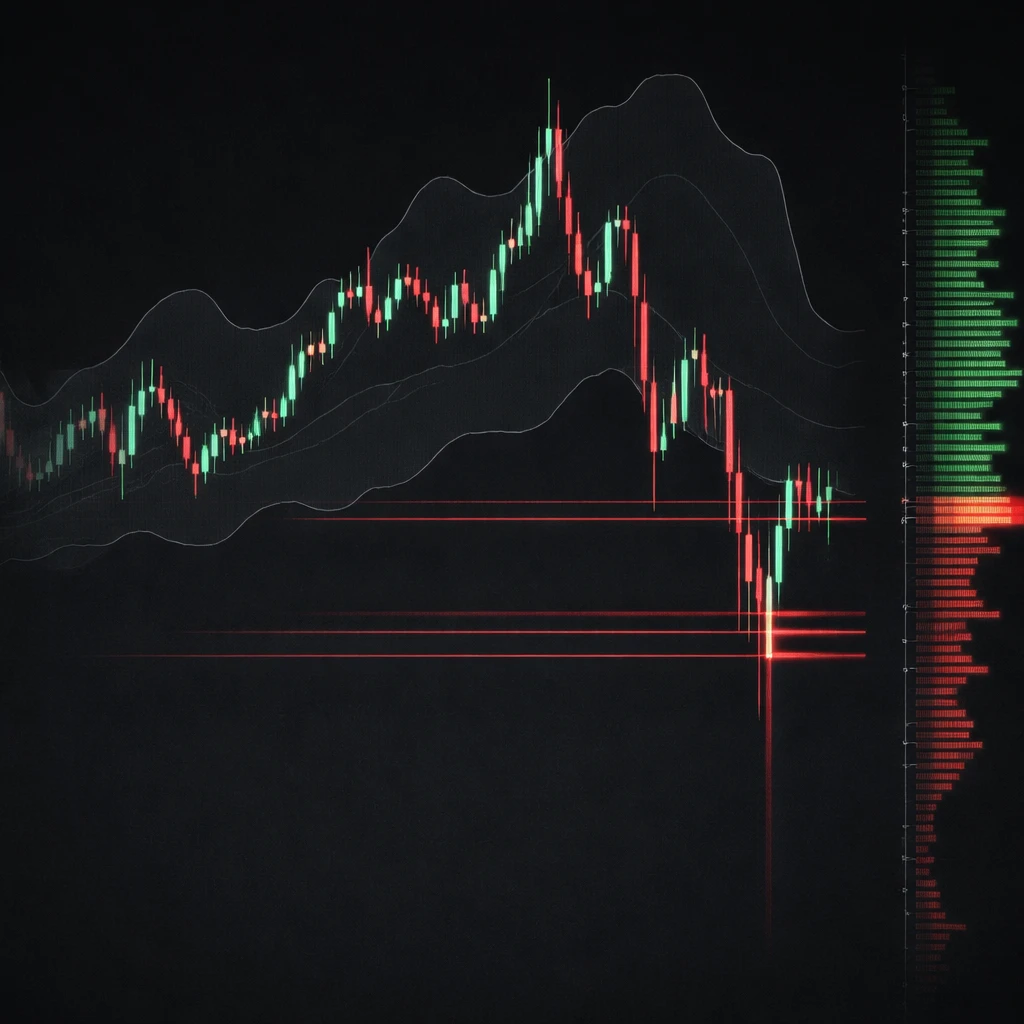
Volatile markets compress time. Price moves travel farther and faster, spreads widen, liquidity thins, and uncertainty about the next print increases. In such conditions, the function of a stop loss is not simply to close a losing position. It is to bound downside exposure within a reasonable tolerance so that a trader can survive to participate in the next opportunity. The objective is capital preservation and control of tail risk, not perfect trade outcomes.
Defining Stop Losses in Volatile Markets
A stop loss is a pre-defined exit rule that closes a position when price or another condition reaches a specified threshold. In a quiet market, a stop can often be placed near a structural level or at a fixed distance. In a volatile market, the same distance can become irrelevant because typical swings are larger and faster. A stop that would rarely be touched in a calm regime may be hit repeatedly during turbulent periods.
Stop losses in volatile markets refers to the design and execution of exit rules that explicitly incorporate larger and less predictable price movements, wider spreads, jump risk, and changing correlations. The goal is not to avoid being stopped out. It is to make the loss distribution more tolerable and to reduce the probability of catastrophic drawdowns.
Why Volatility Changes the Stop-Loss Problem
Volatility is not only larger standard deviation. It also brings fatter tails, intermittent liquidity, and a greater frequency of jumps. These features alter how stops behave in the real world.
- Jump risk and gaps: Stops do not guarantee the exact exit price. A stop that triggers during a gap becomes a market order at the next available price. The realized loss can exceed the planned threshold.
- Spread and depth variability: Bid-ask spreads widen and displayed depth thins during stress. A stop order consumes available liquidity as it executes, which increases slippage relative to calm conditions.
- Velocity of moves: Rapid swings can trigger clustered stops near obvious levels. Price may overshoot, fill stops, then revert, creating whipsaws that feel arbitrary.
- Correlation spikes: Instrument-level and portfolio-level losses can synchronise. Multiple positions may hit stops at once, amplifying drawdowns and slippage.
The implication is structural. A stop loss is an ex-ante constraint on loss size, but volatile markets introduce execution uncertainty. The design must acknowledge both the intent and the frictions around achieving it.
Stop Orders and Execution Mechanics
Order type selection matters more when volatility is high. The same trigger can produce very different realized exits depending on how the order interacts with the book.
- Stop-market order: Converts to a market order once the trigger is reached. It prioritizes execution certainty, but the fill may be far from the trigger when liquidity is thin or the market is gapping.
- Stop-limit order: Converts to a limit order after the trigger. It prioritizes price control but introduces non-fill risk. In a fast drop, the order can remain unexecuted while the market trades through the limit.
- Trailing stop: The stop level ratchets as price moves favorably. In volatile conditions, trailing distances that work in calm periods can be too tight. Frequent reversals can convert open profits into noise-triggered exits.
- Broker and venue nuances: Some venues do not support native stop orders. Brokers may simulate stops using market data. Trigger logic can differ by broker and asset class, for example last trade versus bid or ask. During extreme volatility or halts, simulated stops may be exposed to connectivity and data risks.
These trade-offs are not academic details. They determine whether a planned stop produces a timely exit, produces slippage, or fails to execute.
Placement Frameworks That Account for Volatility
There is no single correct placement method. Different frameworks emphasize different sources of risk control. The important point is internal consistency between stop distance, position size, and the market environment.
Volatility-adjusted distances
One approach ties stop distance to recent variability so that the stop is wide enough to avoid typical noise while still bounding losses. Practitioners often use a multiple of an average range measure, such as the average true range, or a standard deviation estimate. When volatility rises, the stop distance increases, and the position size can be reduced to keep the monetary risk similar. If volatility falls, the opposite occurs.
This approach accepts that larger swings are routine in turbulent periods. It tries to align the stop with that expanded distribution. It does not eliminate whipsaws or jump risk, but it reduces the probability that ordinary noise triggers exits.
Structure-based levels
Another approach sets stops beyond recent swing highs or lows, or outside consolidation ranges. The idea is that if price violates a key structural point, the original trade thesis is likely invalidated. In volatile markets, however, levels attract liquidity and stop clustering. A stop placed just beyond an obvious level may be swept during a transient liquidity event. Placing the stop a meaningful distance beyond the structure can reduce the likelihood of being caught in a short-lived flush, though the larger distance implies smaller position size if monetary risk is to remain stable.
Time-based exits
Time stops exit a trade after a specified duration if the market has not moved favorably. The rationale is exposure control. In highly uncertain conditions, remaining in a trade that is not progressing increases the chance of an adverse shock. Time stops convert uncertainty about magnitude into a bounded exposure in time.
Event-aware rules
Scheduled announcements, index rebalances, and earnings releases can produce discontinuities. An event-aware framework reduces exposure around these periods by exiting early, reducing size, or using alternative order types. The intent is to limit gap risk rather than predict the direction of the move.
Liquidity-aware placement
Stop levels placed at round numbers, recent extremes, or widely watched indicators often sit alongside many other stops. Liquidity-seeking flows may sweep those areas. A liquidity-aware approach considers the concentration of resting orders and attempts to avoid placing stops where transient dislocations are common. This is not to imply a deterministic outcome. It is a probabilistic consideration of where liquidity is likely to be thin just before it becomes abundant.
Practical Examples
Example 1: Intraday range expansion
Consider a stock that typically trades with a 1 percent intraday range. On a high-volatility day, the range expands to 4 percent and the 1-minute realized variance spikes. A stop calibrated to the quiet regime sits only a fraction of the new typical swing away from entry. It is repeatedly hit even when the broader move ultimately aligns with the initial direction. A volatility-adjusted stop set several times wider has a lower probability of being triggered by noise. If monetary risk per trade is kept constant, the wider stop requires a smaller position size. The distribution of outcomes changes: fewer but larger losses when the stop is hit, fewer premature exits on noise, and lower trade frequency because setups take longer to reach either target or stop.
Example 2: Overnight gap and slippage
A futures position remains open into the close. Overnight, an exogenous shock occurs. The market opens well below the previous settlement. A stop-market order resting at a price inside the overnight gap becomes executable at the open, but fills near the first tradable print. The realized loss exceeds the intended amount. A stop-limit order in the same scenario might not fill immediately and could remain unfilled if price never retraces to the limit. The risk is transformed from slippage to non-execution. In both cases, the gap altered the effectiveness of the planned stop. The ex-ante plan constrained risk, but market mechanics defined how much risk was actually realized.
Example 3: Spread widening in a news release
In a major currency pair, a scheduled macro announcement hits. The quoted spread widens and depth disappears temporarily. A trailing stop based on a tight pip distance triggers on a wide quote, converting to a market order that fills poorly relative to the pre-announcement price. In this kind of event, priority of execution over price can be costly. The example illustrates how stop behavior is tied to microstructure. The same trailing distance that works during routine hours can be inappropriate during an announcement window.
Position Size, Stop Distance, and Risk per Trade
Stop placement cannot be separated from position sizing. Monetary risk per trade is approximately the product of position size and stop distance, adjusted for contract value and slippage. If volatility increases and the stop is widened to avoid noise, position size must fall to keep the risk per trade constant. If size is not adjusted, the trade-level risk increases with volatility, which compounds drawdown risk during turbulent periods.
Two related statistics help diagnose whether stops are sized and placed coherently:
- Maximum adverse excursion: The worst unrealized loss experienced before a trade is closed. Comparing the distribution of adverse excursions to stop distances indicates whether stops are consistently inside normal noise or unusually wide.
- Win and loss severity: The average size of gains relative to losses after costs. A stop that is too tight can degrade the win rate without improving the gain-to-loss ratio. A stop that is too wide may reduce the frequency of wins if it allows adverse drift to persist.
In volatile markets, both statistics tend to worsen unless the framework adapts. Normalizing stop distances to recent variability and scaling size accordingly keeps risk metrics more stable across regimes, even if returns remain noisy.
Portfolio-Level Considerations
Stop losses act at the position level, but volatility clusters across instruments. During stress, correlations rise. Several long positions can decline together and hit stops simultaneously. The realized portfolio drawdown can be larger than the sum of isolated expectations because slippage increases when many exits compete for limited liquidity.
Some practitioners incorporate portfolio-level constraints that complement position stops. Examples include a daily loss threshold that suspends further trading, or a rule that scales gross exposure down when a volatility index breaches a threshold. The rationale is survivability. If the portfolio is losing faster than anticipated, slowing or halting activity can preserve capital for a time when conditions are more tractable. The same logic applies to concentration. If multiple positions share a common driver, even in different symbols, their stops can be triggered by a single macro shock. Exposure limits by sector, theme, or factor can reduce that clustering risk.
Behavioral and Process Pitfalls
Execution rules fail most often because they are overridden under stress. Volatility intensifies several behavioral biases:
- Moving stops wider after entry: Expanding risk in response to discomfort converts a bounded risk plan into an unbounded one. The loss profile can quickly exceed what the account can tolerate.
- Cancelling stops during a drawdown: Temporarily removing constraints may feel like flexibility, but it replaces a known maximum with an unknown tail.
- Averaging into losers to avoid being stopped: Increasing size into adverse momentum concentrates risk and can cause nonlinear losses if liquidity weakens further.
- Anchoring to entry price: Focusing on getting back to break-even often delays exits. In a volatile tape, drawdowns can deepen faster than anticipated.
- Recency bias and noise-chasing: After several whipsaws, there is a tendency to place stops too wide or too tight relative to the actual distribution. Parameter swings can degrade performance more than the original volatility.
These pitfalls can be mitigated by pre-commitment. Documenting stop rules, acceptable slippage assumptions, and conditions for de-risking reduces the temptation to improvise under pressure.
Microstructure Realities: Stop Clustering and Liquidity
The idea that markets hunt stops is a loaded phrase. What can be observed is that many traders choose similar levels, often near round numbers or recent highs and lows. Liquidity-seeking algorithms and large participants know where liquidity is likely to concentrate. When they execute large orders, they may push price through these areas to access pools of resting orders. The resulting sweep is not personal. It is a byproduct of how liquidity aggregates.
Two microstructure features are particularly relevant in volatile markets:
- Trigger logic: Some stops trigger on last trade price, others on bid or ask. In fast markets, the difference matters. A flicker in the bid can trigger a stop for a long position even if the last trade has not reached that price. Knowing the trigger condition affects where to place the stop relative to volatile quotes.
- Halt and auction mechanics: Equity markets can enter limit-up or limit-down states, or symbols can be halted. Opening and closing auctions concentrate liquidity but can also produce price jumps. Stops do not execute during halts and will often fill at the next auction print, which may be far away from the trigger.
Volatility does not only change price. It changes the execution environment. Stop design that ignores the environment risks surprises that are mislabeled as bad luck.
Testing Stop Logic Under Regime Shifts
Backtests calibrated on low-volatility periods often overstate the effectiveness of tight stops, understate slippage, and underestimate the frequency of clustered drawdowns. Testing a stop framework across multiple regimes is essential for understanding its behavior.
Key elements of a robust test include:
- Realistic transaction costs: Commissions, fees, and spreads that widen during stress must be modeled. Using fixed spreads in a volatile regime test produces optimistic results.
- Slippage and market impact: Slippage increases with speed and size. Rules that rely on stop-limit orders can show survivorship bias if non-execution is not penalized in the model.
- Regime segmentation: Separate evaluation for calm, transitional, and turbulent periods helps identify parameter sensitivity. A stop rule that performs well only in one regime is fragile.
- Out-of-sample validation: Parameters chosen from an in-sample fit often degrade out of sample. Stability across unseen data is a more important indicator than peak in-sample performance.
Even the best test cannot fully replicate execution reality. The purpose is to approximate how stop rules interact with volatility, not to guarantee outcomes.
Documentation and Ongoing Review
Stop losses are part of a broader risk process, not a one-time configuration. Maintaining a structured review improves consistency.
- Define tolerances: Specify acceptable slippage ranges, maximum trade risk, and permissible deviations under special conditions.
- Record outcomes: Track stop-triggered exits, adverse excursion before exit, realized versus intended loss, and whether the stop was executed as designed.
- Analyze distributions: Review the shape of loss distributions, drawdown depth and duration, and the frequency of multi-stop events on the same day.
- Update with discipline: Adjust parameters in measured increments and revalidate. Large reactive changes based on a small number of observations often degrade performance.
This ongoing process gradually aligns stop behavior with the evolving market environment without chasing every fluctuation.
Broker, Venue, and Regulatory Considerations
Stop effectiveness depends partly on where and how you trade. Not all venues accept native stop orders. Some brokers simulate stops client-side, which introduces operational risks during outages. Margin policies can change during volatile periods, which affects forced liquidation risk. Certain products have specific halt rules or limit states that delay execution.
Understanding these mechanics ahead of time helps interpret outcomes correctly. A stop that failed to execute may reflect venue rules rather than a flaw in the strategy. Conversely, a stop that executed with extreme slippage may reflect the best available liquidity given the state of the order book at that moment.
The Strategic Role of Stops in Survivability
Stop losses do not make a trade correct. They make a loss tolerable. In volatile markets, that role expands from simple position-level discipline to portfolio survivability. A well-considered stop framework narrows the set of possible losses, reduces the chance of a ruinous outlier, and stabilizes the risk profile across changing conditions. Outcomes will still vary. There will be slippage, whipsaws, and missed reversals. What changes is the shape of the loss distribution and the ability to continue operating through stress.
Key Takeaways
- Stop losses in volatile markets are designed to bound downside risk amid larger, faster, and less predictable price moves, not to optimize trade accuracy.
- Order type and microstructure matter: stop-market improves fill certainty with slippage risk, while stop-limit controls price with non-execution risk.
- Placement frameworks that adapt to volatility, structure, time, and events work best when position size is scaled to keep monetary risk consistent.
- Portfolio-level controls mitigate correlation spikes and clustered stop-outs that amplify drawdowns during turbulence.
- Process discipline, realistic testing, and ongoing review reduce behavioral errors and align stop behavior with changing market conditions.