
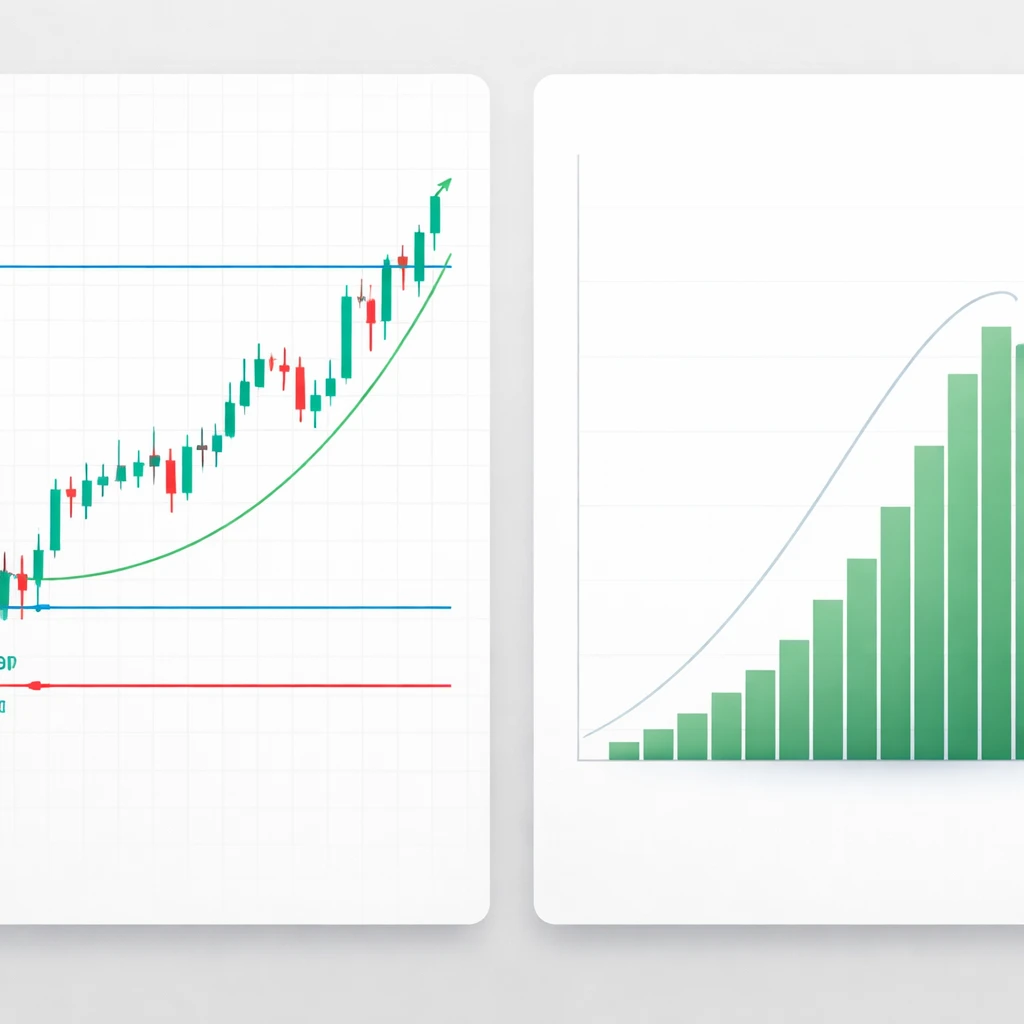
Risk management begins with a precise understanding of the relationship between potential loss and potential gain on each decision. Risk/reward is the foundational lens for comparing opportunities on equal terms, while trade selection is the filtering process that decides which opportunities meet a defined risk standard. Together they form a coherent framework for protecting capital and improving long-run survivability. The focus is not on forecasting where a market will go, but on structuring decisions so that unfavorable scenarios are limited and favorable scenarios are meaningfully larger than the risk incurred.
Defining Risk, Reward, and the Risk/Reward Ratio
Risk, at the single-trade level, is the amount of capital that can be lost if the position is exited at the predefined stop price. Reward is the planned gain if the position reaches the predefined profit-taking price. The risk/reward ratio compares these two figures. A ratio of 1 to 3 means risking 1 unit of loss to target 3 units of gain. Many practitioners normalize outcomes in units of risk, often called R. One R represents the initial risk per trade. A profit of 3 R indicates a gain three times the initial risk. A loss of 1 R indicates a full stop-out.
Using R enables clean comparisons across instruments, time frames, and position sizes. It also clarifies whether a decision process tends to generate small, frequent losses with occasional large gains, or frequent small gains with rare large losses. This characterization matters because two approaches can have similar average returns but very different risk of ruin and drawdown characteristics.
Trade Selection as a Risk Filter
Trade selection is the process of accepting or rejecting potential trades based on the alignment between risk and reward under realistic assumptions. It is not a prediction mechanism. Instead, it prioritizes opportunities that present a favorable payoff structure, clear exit conditions, manageable liquidity and costs, and an outcome distribution consistent with the trader’s capital base and tolerance for drawdowns.
At minimum, trade selection addresses four questions: How much can be lost if the trade fails as defined. How much can be gained under the defined exit logic. How likely each outcome appears given historical behavior and current conditions. Whether costs, slippage, liquidity, and correlation with existing positions distort the apparent reward.
Why Risk/Reward Matters for Capital Preservation
Capital preservation relies on asymmetry. If average gains are larger than average losses in R terms, the system can survive periods of poor accuracy. If losses are truncated and winners are allowed to realize a multiple of risk, the account can compound through a sequence of independent opportunities. The opposite structure is fragile. A series that wins often but earns less than 1 R per win while losing 1 R or more on failures can be undone by a few adverse outcomes or a rare tail event.
Risk/reward also influences drawdown depth. When losses are bounded at 1 R, the worst-case per-trade impact is known in advance. The aggregation of such bounded losses across a streak still hurts, but is more manageable than unbounded downside. Drawdowns are not linear to percentage recovery. A 20 percent loss requires a 25 percent gain to return to the starting point. A 50 percent loss requires a 100 percent gain. Risk/reward discipline seeks to avoid the level of adverse compounding that drives these costly recoveries.
Expected Value and the Role of R-Multiples
Expected value, or expectancy, translates risk/reward and win rate into an average R outcome per trade. In R terms, a simple formulation is: expectancy equals win rate multiplied by average R on wins, minus loss rate multiplied by average R on losses. With a fixed stop, average loss is near 1 R. Average win depends on how positions are exited.
Consider an example that risks 1 R to target 3 R, with an estimated 35 percent win rate. The expectancy is 0.35 times 3 minus 0.65 times 1. That equals 1.05 minus 0.65, or 0.40 R per trade before costs. Another structure risks 1 R to target 1.5 R with a 55 percent win rate. Expectancy is 0.55 times 1.5 minus 0.45 times 1, which equals 0.375 R per trade before costs. Both are positive on average, but their outcome distributions differ. The first relies on fewer but larger winners. The second relies on a higher win rate and smaller average wins.
Transaction costs and slippage reduce expectancy. If round-trip costs average 0.10 R per trade, subtract that from any expectancy estimate. The 0.40 R example becomes 0.30 R net. If slippage adds another 0.05 R on average, the net falls to 0.25 R. Precise measurement of these frictions is crucial, especially for shorter holding periods and less liquid markets.
Distribution, Variability, and Skew
Positive expectancy is necessary but not sufficient. Two systems with the same mean can have very different variance. The path matters. A process with high dispersion may experience long losing streaks, which interact poorly with large position sizes. Skew also matters. Some approaches accept many small losses and occasional large gains. For example, a structure with a 20 percent win rate at 5 R has expectancy 0.20 times 5 minus 0.80 times 1, equal to 0.20 R. The average is acceptable, but the clustering of losses tests emotional and financial resilience. Other approaches show a high win rate with small gains and occasional large losses. An 80 percent win rate at 0.5 R yields 0.8 times 0.5 minus 0.2 times 1, equal to 0.20 R. The average is similar, but tail risk is concentrated in the rare large loss that can erase many small gains.
Trade selection should respect the distributional shape implied by entry and exit rules. A system that trims profits quickly will not produce many high R winners. A system that targets larger moves will accept higher variance. Neither is inherently superior. The critical point is alignment with capital constraints and tolerance for volatility of outcomes.
Position Size, Loss Streaks, and Survivability
Risk per trade interacts with losing streaks. The probability of k consecutive losses for a system with win probability p is approximately the probability of loss to the power k. For p equal to 0.40, the loss probability is 0.60. The probability of 8 losses in a row is about 0.60 to the eighth power, near 1.7 percent for any given sequence. Over a long series of trades the chance of observing such a streak becomes material. Position sizes that are benign under isolated losses can become damaging when a streak occurs.
Leverage does not change expectancy in R terms, but it amplifies drawdown and risk of ruin. If each loss removes a large fraction of equity, the account may be unable to continue before the statistical edge plays out. High variance systems combined with aggressive sizing are especially exposed to this dynamic. The Kelly criterion from information theory illustrates this trade-off by connecting optimal growth to edge and variance. In practice, parameter uncertainty and non-stationarity make full Kelly sizing unstable. Many practitioners operate at a fraction of any theoretical optimum to reduce sensitivity to errors in the estimated edge.
Trade Selection in Realistic Scenarios
Consider two hypothetical opportunities with similar entry logic but different exit structures. In the first, the stop is clearly defined at a technical level where the trade thesis is invalidated, and the logical target is three times farther than the stop. Liquidity is deep, spreads are tight, and estimated slippage is small. The effective ratio after costs might be near 1 to 2.8. In the second, the stop falls in a region of noise where price action regularly fluctuates, and the target is close, perhaps 1.2 times the risk. Liquidity is thinner, spreads widen at certain times, and slippage is more likely. After costs, the effective ratio might fall below 1 to 1. The first structure offers more protective asymmetry, even if both are based on the same signal strength.
Another scenario highlights time and capital usage. Suppose two trades each have a net expectancy of 0.25 R. The first typically resolves within two days, while the second often requires two weeks. If the second ties up margin and reduces the ability to take other uncorrelated opportunities, the opportunity cost may justify stricter selection criteria. Risk/reward per unit time and per unit of capital committed can be considered when choices are mutually exclusive.
Costs can change the narrative. A structure that appears to offer 2 R winners with a 45 percent win rate looks favorable on paper. If the average round-trip cost is 0.2 R due to fees and slippage during volatile periods, the net expectancy falls from 0.90 minus 0.55 equals 0.35 R to 0.15 R. If adverse selection is common near the stop, average loss may exceed 1 R in practice, further reducing the edge. Measured slippage and realistic stop execution should be baked into selection decisions rather than assumed away.
Correlation and Portfolio-Level Risk/Reward
Trade selection often occurs at the portfolio level. Multiple positions with attractive individual ratios can still create concentrated risk if they are positively correlated. If two trades depend on the same macro driver, a single event can trigger simultaneous losses. Correlation inflates effective risk by increasing the chance of multiple stop-outs in the same window.
From a risk/reward perspective, selection criteria can consider the marginal impact of adding a new position to the existing book. Questions include whether the new trade is directionally similar to holdings already at risk, whether it adds diversification, and whether it increases exposure to a known volatility regime. The goal is not to avoid correlation entirely, but to avoid underestimating total risk when several positions can fail together.
Common Misconceptions and Pitfalls
- Chasing the highest numerical ratio without regard to probability. A target of 10 R with a very low likelihood of being reached may have poor expectancy when measured honestly.
- Ignoring transactions costs and slippage. Even modest frictions compound. On short-horizon trades where average winners are small, costs can consume most of the edge.
- Relocating stops or widening them after entry. This behavior increases average loss above 1 R and distorts expected value. Moving profit targets closer while leaving stops unchanged has the opposite effect on the win rate and win size, and can collapse expectancy.
- Overfitting to historical results. Optimizing targets and stops to maximize backtest expectancy often picks noise. Selection rules should remain stable across regimes and be validated out of sample.
- Confusing win rate with profitability. A high win rate does not guarantee positive expectancy. The size of winners relative to losers is essential.
- Ignoring tail risk. Structures that earn small gains with tight targets can harbor the occasional outsized loss due to gaps, forced liquidations, or liquidity vacuums.
- Overlooking time as a dimension of risk. Long holding periods expose trades to more news cycles and potential gaps. Equal ratios with different time footprints can imply different risks.
Building Realistic Estimates
Risk/reward estimation is only as good as the inputs. Several practices improve realism. First, define stops and targets based on the logic of the thesis rather than arbitrary distances. A stop should correspond to a clear invalidation point. A target should reflect a plausible move given volatility and structure, not an aspirational number. Second, measure slippage and fees over a representative sample, including stressed periods. Third, evaluate liquidity. If the expected size cannot be transacted near the observed depth, widen assumed slippage.
Fourth, analyze outcome distributions in R. Record the frequency of partial losses, full losses, partial wins, and large wins. Measure the standard deviation of R outcomes, not just the mean. Fifth, incorporate regime awareness. Volatility shifts change both the size and the frequency of opportunities. The same stop and target distances can imply very different probabilities across regimes.
Position Sizing Boundaries and Drawdown Control
Risk/reward interacts with sizing through drawdown arithmetic. If the sizing is such that a 1 R loss equals a large percentage of equity, then even a modest losing streak can impose a deep drawdown that takes a long time to recover. A sequence of 6 to 10 losses is not unusual for many systems. Expected losing streak length grows with the number of trades and declines with higher win rates, but it should be anticipated regardless.
Position sizing boundaries can be expressed in terms of maximum percentage of equity at risk per trade, or maximum total risk when positions are correlated. A strict cap on total concurrent risk can prevent multiple stop-outs from compounding excessively in a single session. While the optimal boundary depends on the system’s variance, keeping losses comfortably small relative to equity is consistent with long-term survivability when estimates of edge are uncertain.
Time, Opportunity Cost, and Capital Efficiency
Two trades with identical expectancy per trade can differ in throughput. Throughput refers to how many independent opportunities can be taken in a given period without crowding the book or creating excessive correlation. Trade selection criteria can prioritize higher expectancy per unit time or per unit of capital locked. A slow-moving opportunity that ties up capital may be acceptable if it has very high asymmetry. If not, the opportunity cost of holding may exceed its contribution to the overall process.
There is also the dimension of overnight and weekend gap risk for positions held across sessions. If the stop cannot be reliably executed at the intended level due to gaps, the practical average loss can exceed 1 R. Selection criteria can embed a cushion for gap risk in assets and time windows where such jumps are common.
From Design to Measurement: Journaling in R
Effective trade selection operates in a feedback loop. Before entry, the risk, reward, and expected R distribution are estimated. After exit, the realized R is recorded. Over time, the journal reveals whether typical winners achieve the projected multiples, whether average losses drift above 1 R due to slippage or behavior, and whether the win rate is aligned with the historical profile. This closes the gap between planned and realized risk/reward.
Useful journal metrics include average R, win rate, average win in R, average loss in R, standard deviation of R, and the distribution of maximum favorable excursion and maximum adverse excursion. Monte Carlo resampling of recorded R outcomes can show plausible drawdown paths. This does not predict the future but clarifies how variance and streaks may impact capital given the current process.
Adapting Selection to Conditions Without Predicting
Risk/reward analysis adapts to changing conditions through parameters rather than predictions. If realized volatility rises, stops and targets widen to maintain similar R calibration. If liquidity thins, slippage assumptions increase, which can reduce net expectancy and lead to stricter selection. If correlation among candidate trades rises, portfolio-level risk caps may bind earlier. These adjustments keep the process grounded in measurable features rather than speculative outlooks.
Putting It Together: A Practical Selection Framework
A coherent framework integrates pre-trade definition, conservative estimation, and post-trade measurement. A typical flow is as follows. First, define the thesis and the price level that invalidates it. That price level sets the initial risk and converts all outcomes to R. Second, identify the logical exit context that defines a plausible reward. Third, estimate win rate using relevant historical samples, with awareness of sample size and regime differences. Fourth, subtract costs and slippage from projected outcomes to obtain net expectancy.
Fifth, evaluate position sizing within agreed boundaries, considering the probability of streaks and the proximity of portfolio limits. Sixth, check correlation with existing or planned positions. Seventh, incorporate time considerations, including holding period, number of overlapping positions, and gap risk. Eighth, decide whether the opportunity meets the process threshold for acceptance. Over time, thresholds can be updated based on realized performance rather than intuition.
Illustrative Calculations and Sensitivity
Simple sensitivity checks prevent overconfidence. Suppose a structure appears to have a 45 percent win rate with 2.5 R average wins. Gross expectancy equals 0.45 times 2.5 minus 0.55 times 1, which is 1.125 minus 0.55 equals 0.575 R. If costs total 0.15 R, net expectancy is 0.425 R. Now test adverse slippage and win rate error. If actual costs average 0.25 R and the true win rate is 40 percent with 2.3 R winners, net expectancy becomes 0.40 times 2.3 minus 0.60 times 1 minus 0.25, which is 0.92 minus 0.60 minus 0.25 equals 0.07 R. A small change in inputs can compress the edge dramatically. Trade selection that includes sensitivity analysis is less likely to overstate opportunity quality.
Another sensitivity test examines average loss. Many processes assume 1.0 R loss on stops, but gaps and partial fills can inflate losses to 1.1 or 1.2 R. Taking the earlier 0.425 R net example and increasing average loss to 1.1 R reduces net expectancy to 0.45 times 2.5 minus 0.55 times 1.1 minus 0.15, which equals 1.125 minus 0.605 minus 0.15, or 0.37 R. The edge survives but is lower than expected. For thin markets or high-volatility windows, the effect can be larger.
Long-Term Survivability
Survivability is the ability to continue participating in opportunity sets despite variance, regime shifts, and errors in estimation. Risk/reward and careful trade selection contribute to survivability by limiting downside per decision, favoring asymmetric outcomes, and reducing exposure to clustered failures through correlation control. They also temper the urge to trade marginal opportunities that do not carry sufficient reward for the risk and variance they introduce.
Survivability has a psychological dimension. Processes with pronounced streaks or large negative outliers can be abandoned at the worst possible time if they do not match the operator’s tolerance. Matching the outcome distribution to realistic preferences increases the likelihood that the process will be executed consistently. Consistency is a practical edge in itself because it allows the statistical properties of the process to manifest over many independent trials.
Conclusion
Risk/reward and trade selection reframe trading from a question of prediction to a question of structure. By defining risk in advance, targeting realistic rewards, measuring expectancy in R, and judging each opportunity within a portfolio context, traders can align decisions with capital preservation and steady compounding. The tools are simple to state but require discipline to implement: define, estimate, measure, and adjust. The central idea is not to maximize any single trade’s outcome but to enforce favorable asymmetry over a large sample while avoiding the pitfalls that erode edge.
Key Takeaways
- Risk/reward compares predefined loss to realistic gain and is best tracked in R-multiples for clarity across trades.
- Trade selection acts as a risk filter that accepts only opportunities with credible expectancy after accounting for costs, liquidity, time, and correlation.
- Positive expectancy alone is not enough. Variance, skew, and drawdown dynamics determine survivability and position size boundaries.
- Sensitivity to input errors is large. Small changes in win rate, average win size, or slippage can compress or eliminate the edge.
- Long-term survivability depends on consistent application of defined risk, conservative estimation, and ongoing measurement of realized outcomes.