
Overview and Motivation
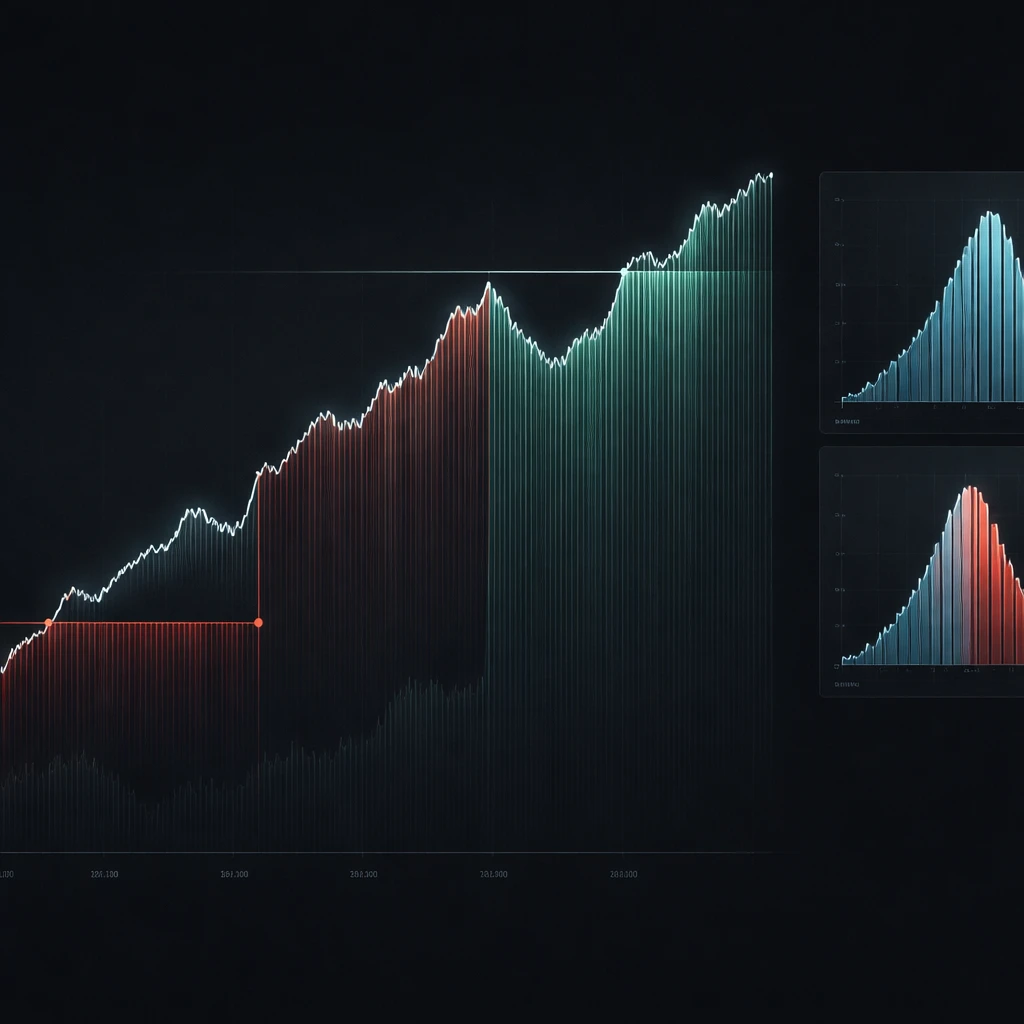
Risk management often begins with volatility, yet survival in markets is more directly challenged by drawdowns. Volatility summarizes the dispersion of returns around an average. Drawdown measures the depth and duration of losses from a previous equity peak. These are related but different ideas. Conflating them leads to weak risk control, fragile position sizing, and avoidable capital impairment.
This article clarifies what each metric captures, why the distinction matters for preserving capital, and how practitioners examine both in live trading. The focus is not on recommending strategies, but on understanding how the two metrics behave and how they inform constraints, monitoring, and evaluation.
Definitions and Core Differences
Volatility: Dispersion Around an Average
Volatility is a summary measure of variability in returns. In practice, realized volatility is often computed as the standard deviation of periodic returns over a defined window. Annualized volatility scales these observations by the square root of time under assumptions of independent returns. Volatility answers a narrow question: how widely and frequently do returns vary around their mean.
Several features deserve attention:
- Horizon dependence. Daily volatility and monthly volatility are not directly comparable without a scaling model. The classic square root rule is convenient but can be inaccurate when returns are autocorrelated or when volatility clusters.
- Distributional assumptions. Standard deviation summarizes variability symmetrically. It does not distinguish upside jumps from downside jumps. In fat-tailed or skewed distributions, volatility can be a blunt indicator of downside risk.
- Conditional nature. Volatility changes over time. It clusters in regimes. A low-volatility period can be followed by an abrupt spike that was not evident in a trailing average.
Drawdown: Path-Dependent Capital Loss
Drawdown is the decline from a historical peak in the value of a trading account or strategy equity curve. It is path dependent and capital-centric. If equity reaches a high-water mark of 100 and then falls to 80, the drawdown is 20 percent. The maximum drawdown over a sample is the largest such peak-to-trough decline. Analysts also track time under water (duration until recovery), average drawdown, and distribution of drawdown depths.
Drawdown answers a different set of questions than volatility. It captures the magnitude and duration of losses that an account experiences along a realized path. It incorporates compounding and the order of returns, which volatility explicitly ignores.
Why They Diverge
Two strategies can exhibit similar volatility but very different drawdown risk. A strategy with frequent small gains and occasional large losses may show low daily volatility for long stretches, then produce a deep drawdown when a tail event arrives. Another strategy with noisy day-to-day variation can keep losses shallow by cutting exposure during adverse moves. Volatility characterizes typical fluctuation. Drawdown is dominated by extreme sequences and the recovery path.
Why the Distinction Matters for Risk Control
Capital preservation depends on the depth and duration of losses, not just on average variability. A focus on volatility alone neglects several dimensions that affect survivability:
- Compounding asymmetry. After a 20 percent drawdown, the required gain to recover is 25 percent. After a 50 percent drawdown, the required gain is 100 percent. The recovery requirement grows nonlinearly with drawdown size.
- Path dependence and cash flow needs. Strategies that must meet withdrawals, funding obligations, or margin constraints may be disabled by drawdowns even if long-run expected returns remain positive.
- Behavioral and governance constraints. Allocators, risk committees, and individual traders typically tolerate deeper losses for shorter periods than models imply. Time under water matters because it strains decision making and can lead to premature termination.
- Model fragility under regime shifts. Volatility estimates can be stale when regimes change. Drawdown metrics reveal damage in real time and bound worst-case realized loss in sample, which anchors risk discussion.
In short, volatility tells you how bumpy the ride is on average. Drawdown tells you how close you came to breaking the vehicle.
Statistical and Structural Nuances
Distribution Shape Matters
Standard deviation treats upside and downside deviations symmetrically. Realized drawdowns are driven by downside tails and negative skew. Two return streams with equal volatility can have different tail risk. Strategies with short volatility exposure, carry trades, or yield harvesting often exhibit low volatility punctuated by large, sudden losses. Conversely, some convex strategies may show higher day-to-day volatility but control tail losses better by reducing exposure during adverse trends.
Related risk measures such as Value at Risk (VaR) and Expected Shortfall attempt to focus on tails. Drawdown complements these by accounting for sequencing. Even if daily VaR looks contained, several days of losses in succession can still produce a large drawdown.
Volatility Clustering and Autocorrelation
Financial returns often display clustered volatility and short-term autocorrelation. The square root of time rule for scaling volatility holds exactly only when returns are independent and identically distributed with finite variance. In practice, volatility tends to rise after shocks and can remain elevated. Under clustering, realized drawdowns can grow faster than naive volatility scaling would suggest because losses are not randomly scattered but arrive in streaks.
Sequencing and Path Dependence
Consider two sequences of monthly returns that compound to the same annual result. Sequence A produces alternating small gains and losses ending flat. Sequence B posts several gains followed by a cluster of losses before regaining ground late in the year. Volatility averages across these movements and can be similar for both sequences. Drawdown will be materially larger for Sequence B because of the concentrated loss cluster and the time required to recover to the prior peak.
Path dependence is why backtests that summarize only annualized return and volatility are incomplete. The underwater curve, which plots percentage below the high-water mark at each time, reveals the stress path that capital experienced.
Measurement: From Returns to Underwater Curves
Volatility Estimation
Realized volatility is commonly computed as the standard deviation of periodic returns over a rolling window. Practical choices include the return frequency, window length, and whether to use close-to-close, high-low range-based estimators, or intraday data. Annualization multiplies by the square root of the number of periods, subject to the caveats about dependence and regime shifts.
Drawdown Computation
Drawdown measurement begins with the equity curve or cumulative net asset value. At each time t, compute the running maximum of the equity series. The drawdown is the percentage gap between the current equity and the running maximum. The maximum drawdown is the largest observed gap over the sample. Duration metrics track how long it takes to recover to the high-water mark after a trough.
Analysts often review:
- Maximum drawdown. A single worst-case depth in the sample. It is intuitive but sample dependent.
- Average and median drawdown. Typical loss depth across all drawdown episodes, which reduces sensitivity to outliers.
- Conditional drawdown at risk (CDaR). Average of drawdowns beyond a chosen quantile, which focuses attention on the severe tail of the drawdown distribution.
- Time under water. Distribution of durations required to recover, which captures persistence of loss episodes.
Data and Estimation Pitfalls
Several measurement choices affect conclusions:
- Sampling frequency. Daily closing prices can miss intraday drawdowns that matter for leveraged or margin-constrained trading. Intraday data provide a clearer picture of peak-to-trough risk during the day.
- Survivorship and selection bias. Excluding strategies that failed or merged away produces flattering drawdown statistics. A representative dataset should include delisted and defunct histories where relevant.
- Stale pricing and smoothing. Illiquid assets often display smoothed returns, which lowers reported volatility and maximum drawdown mechanically. When prices update, latent drawdowns can surface abruptly.
- Lookback sensitivity. Maximum drawdown shrinks or grows with the window inspected. Comparing strategies requires consistent windows and awareness that out-of-sample behavior can differ.
Implications for Capital Preservation
Capital preservation is shaped by the interaction between drawdown depth and recovery math. Because losses compound asymmetrically, avoiding deep troughs often matters more for long-run survivability than eliminating day-to-day noise.
The recovery requirement highlights the asymmetry. A 10 percent drawdown requires approximately 11.1 percent to recover. A 20 percent drawdown requires 25 percent to recover. A 30 percent drawdown requires about 42.9 percent to recover. At 50 percent, recovery requires 100 percent, and at 80 percent, it requires 400 percent. The deeper the drawdown, the more the account becomes sensitive to future variance, because the base from which returns compound is smaller.
This math interacts with leverage and margin rules. Even if a strategy has favorable expected return, a sufficiently deep drawdown can trigger margin calls or reduction in allowable exposure, forcing deleveraging into weakness. Drawdown metrics help identify whether a strategy’s typical loss episodes are compatible with its structural constraints and with the risk tolerance of the capital supporting it.
Real Trading Scenarios
Two Strategies With Similar Volatility
Consider Strategy A and Strategy B, each with an annualized volatility near 10 percent in backtests. Strategy A realizes most of its variability as frequent small gains and losses with little serial correlation. Strategy B realizes low day-to-day variability punctuated by occasional large losses associated with rapid market moves. Over a calm year, both show similar volatility. During a stress period that includes a gap move, Strategy B experiences a 25 percent drawdown because losses arrive in a cluster that exceeds typical daily variability. Strategy A experiences a 12 percent drawdown because its loss control mechanisms reduce exposure during the move. The volatility estimates do not differentiate them well, but the drawdown profiles do.
Short-Dated Options Writing
Writing short-dated options often produces smooth return profiles for extended periods as premium decays. The daily return volatility can be modest. The strategy, however, is exposed to tail events when the underlying price jumps sharply. During such events, drawdowns can be abrupt and deep because losses realize before hedges or adjustments can be implemented. A drawdown-aware assessment emphasizes risk from gap moves and the possibility that recovery time after a sudden loss may be long, even if typical daily variability is small.
Trend-Following Example
A simple trend-following process may exhibit higher realized volatility during normal times because it chases price changes and can switch positions. In prolonged adverse environments, it may reduce exposure and cap losses, resulting in shallower maximum drawdowns than a buy-and-hold exposure with similar volatility. The point is not that one approach is superior, but that volatility alone cannot reveal the realized capital path. Drawdown analysis captures the protective effect of de-risking during sustained price moves.
Leveraged Exposure and Volatility Drag
Leveraged instruments compound daily. Even if daily volatility is symmetric, compounding can lead to path-dependent outcomes. A sequence of alternating plus and minus returns can result in a net loss because the base keeps shifting. The resulting equity path can experience drawdowns inconsistent with what a simple volatility estimate would suggest. Monitoring underwater curves highlights how compounding interacts with variability to affect capital preservation.
Common Misconceptions and Pitfalls
- Equating low volatility with safety. Low daily volatility can coexist with severe tail risk. Strategies that accrue small gains steadily may be vulnerable to rare but large losses.
- Ignoring recovery time. Focusing on maximum drawdown depth while overlooking the duration required to recover underestimates the operational strain on a strategy.
- Relying solely on Sharpe ratio. A high Sharpe ratio focuses on mean and standard deviation. It does not describe path-dependent risk or tail behavior that drives drawdowns.
- Assuming square root of time scaling always applies. During clustered volatility or serial correlation, scaling daily volatility to longer horizons can materially understate risk.
- Overfitting to a benign sample. Backtests that end before a stress event or that exclude severe regimes will report flattering drawdown statistics that may not be repeatable out of sample.
- Neglecting liquidity and execution. Drawdowns measured on mid prices can understate realized losses when liquidity evaporates. Slippage and gaps can dominate during stress.
- Smoothing via stale marks. Illiquid positions that are not marked to market can mask latent drawdowns. When marks update, volatility and drawdown can appear suddenly.
Integrating Both Metrics in Risk Evaluation
Thoughtful risk evaluation treats volatility and drawdown as complementary. Volatility describes typical variability and helps set expectations about day-to-day fluctuations. Drawdown quantifies how severe and persistent losses have been under stress paths. A robust framework for capital preservation studies both simultaneously across several dimensions:
- Horizon and frequency. Compare daily and intraday drawdown behavior, especially for leveraged or gap-sensitive strategies, alongside rolling realized volatility.
- Regime analysis. Segment history into different market environments and examine how volatility and drawdown metrics behaved in each. Strategies that maintain shallow drawdowns across regimes demonstrate more robust capital preservation.
- Distributional diagnostics. Examine skewness, kurtosis, and tail metrics. If downside tails are heavy, summarize drawdown risk using CDaR and time-under-water distributions, not just a single maximum drawdown value.
- Scenario and stress testing. Apply historical stress windows and synthetic shocks to understand how volatility could spike and how deep drawdowns could become under adverse paths.
- Compounding sensitivity. Evaluate how sequence of returns affects ending wealth and recovery requirements. Even unchanged average volatility can produce different outcomes under alternative sequences.
Interpreting Risk in Practice Without Prescribing Strategy
Practitioners commonly monitor a set of risk limits grounded in both volatility and drawdown. For example, a manager may track realized volatility against a targeted range and simultaneously monitor maximum observed drawdown and time under water. Breaches inform whether exposure, leverage, or market participation warrants review. The important point is not the specific thresholds chosen, but the recognition that volatility and drawdown control different aspects of capital risk.
Performance attribution can incorporate drawdown analysis. During loss periods, attribution that separates losses caused by spread widening, gaps, or correlations converging toward one helps explain why drawdowns occurred and whether they reflect model limits or market structure. This diagnostic is more aligned with drawdown analysis than with volatility alone because it focuses on the realized path of losses, not just their dispersion.
Communication with stakeholders also relies on drawdown framing. Volatility numbers are abstract for many decision makers, whereas the statement that an approach has historically experienced a specific depth of loss and required a certain number of months to recover is immediately interpretable.
A Note on Correlation and Hidden Concentration
Diversification aims to reduce volatility, yet correlations tend to rise in stress environments. During such periods, volatility spikes and drawdowns deepen together. Strategies that appear diversified under normal correlations can be concentrated in a single latent risk factor that reveals itself during stress. Drawdown analysis can expose this concentration by highlighting simultaneous losses across positions or sub-strategies.
Concentration can also appear through leverage applied to low-volatility assets. While leverage can equalize volatility across holdings, it can magnify drawdowns when volatility regimes shift or when liquidity recedes. The underwater curve makes this effect visible by showing whether losses grow disproportionately during stress despite stable volatility in normal times.
Choosing Metrics for Evaluation and Reporting
There is no single metric that fully captures risk. Reporting often includes annualized return, volatility, Sharpe ratio, maximum drawdown, average drawdown, time under water, and tail-focused measures such as Expected Shortfall or CDaR. The choice depends on the structure of the strategy and the risks that most threaten capital. For path-sensitive strategies, drawdown metrics deserve prominence because they align with the questions allocators and risk committees ask first: how deep did losses become, and how long did recovery require.
Putting Drawdown and Volatility Into Context
Neither volatility nor drawdown is inherently good or bad. Each must be judged relative to the process that generates returns and the capital that supports it. A strategy with intermittent losses but quick recoveries may tolerate higher day-to-day volatility if drawdowns remain bounded. A strategy with low daily variability may still be fragile if rare losses are very large or if recoveries take too long. The analytical task is to connect the return-generation mechanism to the shape of the drawdown distribution and to its interaction with volatility across regimes.
Key Takeaways
- Volatility measures dispersion of returns around an average, while drawdown measures peak-to-trough capital loss and its duration.
- Capital preservation depends more on drawdown depth and recovery time than on average day-to-day variability.
- Low volatility does not guarantee shallow drawdowns, especially in strategies exposed to tail risk or liquidity gaps.
- Robust risk evaluation combines volatility, drawdown distributions, and regime-aware stress testing rather than relying on a single metric.
- Under compounding, drawdowns impose nonlinear recovery requirements, which directly affect long-term survivability.