
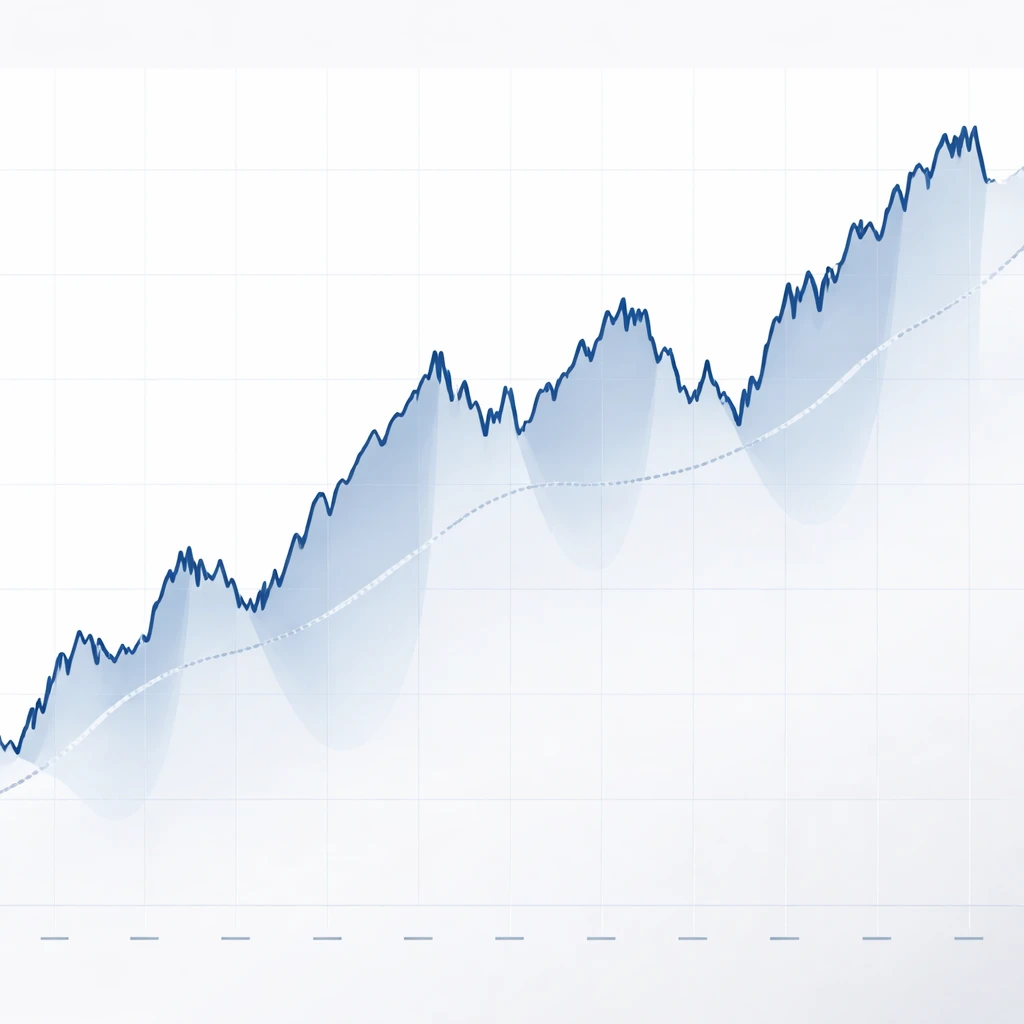
Compounding sits at the heart of wealth accumulation in markets, while drawdowns measure the path of losses that can interrupt or reverse that growth. The two are inseparable. Compounding rewards consistency and capital preservation, because gains scale with the size of the capital base. Drawdowns do the opposite, shrinking the base from which future percentage returns are earned. Understanding how these forces interact is fundamental to risk management and to the practical challenge of staying solvent through variable market conditions.
Compounding and Drawdowns: Definitions and Core Mechanics
Compounding is the process by which returns are earned on a growing or shrinking capital base over time. If capital is C0 and period returns are r1, r2, ..., rn, then end capital is Cn = C0 × Π(1 + rt). The order of returns matters because losses reduce the base on which subsequent returns accrue. This is why two sequences with the same average return can produce different ending values.
Drawdown is a measure of decline from a previous equity peak. Maximum drawdown is the largest peak-to-trough percentage loss observed over a period. Drawdown depth captures how far the decline goes. Drawdown duration captures how long it takes to return to the prior peak. Both shape the lived experience of risk, not just the final outcome.
Compounding is geometric, not arithmetic. The key implication is that volatility and losses generate a wedge between arithmetic average return and the geometric return that actually compounds wealth. This wedge is often called volatility drag. The more volatile the path of returns, the more the geometric rate falls below the arithmetic average, even if the average looks attractive on paper.
The Asymmetry of Losses
A loss requires a larger percentage gain to recover to the prior peak. If a portfolio loses L percent, the required gain g satisfies (1 − L)(1 + g) = 1. Solving yields g = L ÷ (1 − L). This asymmetry is not intuitive at first but dominates practical risk control.
- Lose 10 percent, require about 11.1 percent to break even.
- Lose 20 percent, require 25 percent to break even.
- Lose 50 percent, require 100 percent to break even.
- Lose 70 percent, require 233 percent to break even.
As drawdowns deepen, the recovery burden rises nonlinearly. Because future gains compound on a smaller base, the time to recovery lengthens unless subsequent returns are unusually high. For the same expected return, larger drawdowns imply longer expected recovery times. This is central to capital preservation. The ability to continue compounding depends on avoiding large capital impairments.
Compounding, Volatility Drag, and Survivability
Suppose two traders each target an annual arithmetic average return of 12 percent. Trader A realizes yearly returns of 12 percent with low variability. Trader B experiences large swings around the 12 percent average, sometimes far above, sometimes far below. Even if their arithmetic averages match, Trader B’s geometric return will typically be lower because of volatility drag. The product Π(1 + rt) is sensitive to dispersion. Big negatives shrink the base so much that later positives contribute less in dollar terms.
Survivability enters when volatility is combined with leverage, liquidity constraints, or capital requirements. A deep drawdown can trigger margin calls, forced deleveraging, or behavioral abandonment of a process. Surviving to the point where the arithmetic edge can express itself is often the primary hurdle. The path matters at least as much as the endpoint, because compounding only helps if capital remains in play.
Why Drawdowns Dominate Risk Control
Risk control is not primarily about avoiding any single loss. It is about bounding the sequence of losses so that compounding can continue. Several features make drawdowns central to this task.
- Path dependency. The order of returns changes realized wealth, even with identical averages. Protecting capital during adverse sequences preserves the base for later gains.
- Capital constraints. Real portfolios face margin rules, collateral requirements, and investor withdrawal risk. Deep drawdowns can force position reductions at unfavorable times.
- Behavioral thresholds. Large drawdowns increase stress and the likelihood of abandoning a method. The human element is a real constraint on sustained compounding.
- Volatility drag. Higher dispersion of returns lowers the geometric growth rate for a given mean, which means that unmanaged variability erodes compounding.
- Time cost. Recovery from large drawdowns consumes time that could have compounded at positive rates. Time spent climbing out of a hole is time not spent building new equity highs.
Measuring Drawdowns and the Equity Path
Several metrics help describe the drawdown experience of a process. Each focuses on a different aspect of path risk.
- Maximum drawdown (MDD). Largest peak-to-trough percentage decline observed over the period. Captures the worst historical capital impairment.
- Average drawdown. Mean depth across all drawdowns. Summarizes typical loss magnitude, which can matter more than a single extreme event in shorter horizons.
- Drawdown duration. Number of periods from the start of a drawdown to the recovery back to the previous high. Lengthy durations are costly even at moderate depths.
- Ulcer-like measures. Indices that overweight sustained drawdowns, not only extremes, to reflect the stress of time spent under water.
- High-water mark tracking. Ongoing record of equity peaks that allows clear identification of drawdown phases and their resolution.
These metrics should be interpreted in context. A low maximum drawdown paired with very long durations may still be problematic. A process with occasional severe drawdowns but rapid recoveries has different implications than one with frequent moderate declines that linger.
Practical Examples of Compounding in the Presence of Drawdowns
Example 1: Two Return Paths with the Same Average
Consider two five-year paths, each with a 10 percent arithmetic average return.
Path A: +10 percent each year. The ending value on 100 grows to about 161 after five years, since 100 × 1.1^5 ≈ 161.
Path B: +40 percent, −30 percent, +40 percent, −30 percent, +40 percent. The arithmetic average is 10 percent. The ending value is 100 × 1.4 × 0.7 × 1.4 × 0.7 × 1.4. Despite the same average, the final wealth is materially lower than Path A because the 30 percent losses repeatedly compress the base. The compounding penalty from volatility is visible in the product of returns.
Example 2: Recovery Time and Drawdown Depth
If a process suffers a 30 percent drawdown, it needs about 42.9 percent to return to the high. Suppose the expected annual geometric return from that point onward is 8 percent. Ignoring path variability, a constant 8 percent would require roughly five years to recover. Under real volatility, the duration could be longer. The depth of the drawdown sets a minimum recovery hurdle. Dispersion in the path extends the timeline.
Example 3: Fees, Slippage, and Compounding Headwinds
Transaction costs and management fees compound in a manner similar to returns. A strategy that earns 12 percent gross but pays 2 percent in expenses has a lower geometric growth rate than the same strategy with 0.5 percent expenses. During drawdowns, fees and frictions continue to accrue, which further slows recovery. In heavily traded approaches, slippage can rise in stressed markets, increasing the effective drawdown even if headline price moves are the same.
Position Sizing, Leverage, and the Drawdown Surface
In many processes, drawdown characteristics scale with position size and leverage. Larger sizing increases both upside and downside variability. The distribution of outcomes widens, and the left tail becomes more threatening. While desired long-term growth may tempt larger exposure, the drawdown surface across sizing levels is not linear. Beyond a point, incremental exposure tends to increase drawdown risk faster than it improves geometric growth, because volatility drag accelerates and capital impairment risk rises.
Position concentration interacts with correlation. If exposures are highly correlated, apparent diversification can break down exactly when it is needed most. In those environments, drawdowns across positions co-move, accelerating the descent from the peak and extending duration. Correlations are not static through time. Risk management that relies on average correlations from calm periods can understate drawdown risk during stress regimes.
Sequence Risk and Path-aware Thinking
Sequence risk is the dependence of outcomes on the order of returns. Early losses reduce the base for later gains, while early gains amplify later compounding. For traders who add or withdraw capital through time, money-weighted outcomes diverge from time-weighted statistics. A sequence of gains before capital additions will compound differently than gains after additions. Similarly, withdrawals during drawdowns lock in realized losses and lower the base for recovery.
Risk management that is sensitive to sequence effects avoids evaluating performance by annual average alone. It weighs the impact of clustering losses, the potential for multiple adverse periods in a row, and the limits imposed by financing or psychological tolerance. The robustness of a process is often visible in how it behaves under unfavorable sequences rather than in its average year.
Why Compounding Favors Capital Preservation
Capital preservation is not only about avoiding ruin. It is also about maximizing the opportunity for compounding to operate across many periods. Several mechanisms explain why protecting the downside enhances long-horizon outcomes.
- Optionality of capital. Intact capital allows future decisions. Once capital is impaired, future opportunities contribute less in dollar terms even when percentage returns are similar.
- Convex penalty of losses. The nonlinear recovery function magnifies the effect of large losses. Reducing the tail of the loss distribution often improves geometric growth even if the mean return falls slightly.
- Continuity of process. Lower drawdowns reduce the odds of forced exits, margin calls, or structural constraints that stop the process from operating during favorable periods.
- Compounding of prudence. Small, repeated protections accumulate. Over long horizons, the avoided deep losses contribute more than occasional outsized gains of similar probability.
Common Misconceptions and Pitfalls
Misconception 1: Averages Tell the Whole Story
Arithmetic averages hide volatility drag and the sequence of returns. A process with a high average but lumpy outcomes can underperform one with a modest average and stable outcomes when measured by geometric growth. Evaluating risk only through average return invites drawdowns that are larger and more persistent than anticipated.
Misconception 2: High Win Rate Implies Fast Compounding
Win rate does not determine geometric growth. The distribution of wins and losses, along with their sizes, matters more. Strategies that exhibit many small gains and occasional very large losses can have high win rates but poor compounding once large losses arrive. The tail must be considered alongside the center of the distribution.
Misconception 3: Losses Can Be Recovered With a Few Big Wins
The asymmetry of losses makes this unreliable. While a single outsized gain can restore equity after a drawdown, reliance on rare positive events introduces additional path risk. If the next few periods are adverse instead, the capital base can fall below the level where recovery remains practical under real constraints.
Misconception 4: Averaging Down Always Improves Recovery Odds
Adding exposure as prices fall can deepen drawdowns if the adverse move persists. This increases the probability of capital impairment, particularly under leverage or financing constraints. The practice also concentrates exposure to a single thesis, increasing correlation to a single risk factor at the exact moment diversification would be valuable.
Misconception 5: Leverage Is a Free Accelerator of Compounding
Leverage magnifies both return and drawdown. Volatility drag rises with leverage. For a given edge, there exists a leverage level beyond which geometric growth falls because the left tail dominates. Constraints such as margin rules and liquidity can force liquidation near troughs, locking in losses and reducing the chance for recovery.
Misconception 6: All Drawdowns Are Acceptable If Long-run Return Is Positive
Some drawdowns cannot be endured in practice. The combination of human tolerance, institutional constraints, and obligations makes certain loss profiles untenable. Survival is a condition for compounding. Processes that require extraordinary fortitude to endure deep and long drawdowns may fail before the averages materialize.
Applying the Concepts in Real Trading Contexts
Real trading introduces frictions and constraints that shape compounding paths.
- Liquidity shocks. During stress, bid-ask spreads widen and market depth falls. Executing exits or rebalancing can produce larger realized losses than indicated by mid prices. This raises drawdown depth and sometimes duration.
- Funding and margin dynamics. Leverage requires collateral that fluctuates with equity. Adverse moves can trigger calls when liquidity is scarce. The forced nature of these decisions magnifies realized drawdowns.
- Capacity limits. Strategies that require significant market impact see costs rise with scale, especially during downtrends. The compounded effect of slippage can turn small theoretical drawdowns into large realized ones.
- Behavioral leakage. Stress near drawdown troughs tends to coincide with uncertainty about model validity. Deviating from a tested process during these periods often crystallizes losses and interrupts compounding just before recovery phases.
- Tax and fee friction. Realized losses and gains occur within tax regimes and fee structures. The net compounding rate after taxes and fees can differ materially from gross statistics, and drawdowns amplify the dispersion of outcomes across investors with different timing.
Estimating Recovery and Assessing Tolerance
Although future returns are uncertain, a few simple calculations help frame what a drawdown implies for capital and time.
- Required gain. For a drawdown of L percent, required gain g equals L ÷ (1 − L). This provides a clear threshold for recovery to the high-water mark.
- Time to recovery under a baseline rate. If one assumes a plausible geometric rate r for planning purposes, the notional time N to recover a drawdown L satisfies (1 − L)(1 + r)^N = 1, which yields N = ln[1 ÷ (1 − L)] ÷ ln(1 + r). While r is uncertain, this calculation clarifies why deeper drawdowns lengthen expected recovery time sharply.
- Drawdown frequency. Historical studies of a process can estimate how often drawdowns of given sizes occur. Frequency informs expectations about the typical waiting time between equity highs and the endurance required to realize long-run statistics.
- Scenario clustering. Simulations that incorporate regime changes and correlation spikes can reveal how drawdowns might cluster. Scenarios emphasize that tail events often arrive together, not in isolation.
These calculations are not forecasts. They are tools to understand the contours of risk. They help align exposure with realistic tolerance for depth and duration, so that compounding is not interrupted by forced actions that lock in losses.
Connecting Drawdowns to Process Quality
Drawdown behavior reflects the underlying process quality in several ways. Processes with an identifiable edge but weak risk controls often exhibit attractive averages alongside sporadic severe losses. In contrast, processes designed with explicit attention to dispersion, correlation, and capital constraints may show slightly lower averages but better geometric growth and survivability. The shape of the equity curve, not only the endpoint, is diagnostic of robustness.
When evaluating a process, one can examine the relationship between drawdown depth and subsequent recovery speed. Rapid recovery after moderate drawdowns suggests that adverse outcomes tend to be reversible within the process mechanics. Very slow recovery may indicate that losses are associated with structural breaks or environmental shifts that are not quickly mean-reverting. Neither pattern is inherently better in all contexts, but the link between drawdown and recovery reveals how the process interacts with market regimes.
Long-horizon Thinking
Compounding unfolds over many independent periods. To participate in that unfolding, capital must survive a wide range of conditions. The most influential decisions often concern how to bound losses rather than how to maximize single-period returns. The opportunity cost of avoiding deep drawdowns can appear high in placid markets, yet when volatility returns, the value of preserved capital becomes obvious in the speed of subsequent compounding.
In institutional contexts, survivability has additional dimensions. Stakeholders evaluate track records under pressure, and assets under management can contract during drawdowns due to redemptions. These flows change the capital base and thus the realized compounding rate. A path that contains fewer severe drawdowns helps stabilize capital and allows the process to compound in line with its design, rather than in line with forced external actions.
Integrating Compounding and Drawdown Awareness
An integrated view treats compounding and drawdowns as two sides of the same coin. The aim is not to eliminate drawdowns, which is impossible, but to recognize their cost to the compounding path. Preferring processes that reduce the left tail of outcomes and shorten drawdown durations often improves long-run wealth formation even when it sacrifices some short-run upside. In effect, the geometric mean rewards steadiness and penalizes lumpy paths with large losses.
Finally, clarity about measurement and expectations matters. Reporting both maximum and typical drawdowns, along with durations and the conditions under which they occurred, equips decision-makers to judge whether a process fits their tolerance. A realistic appreciation of the asymmetry of losses and the mechanics of volatility drag leads to choices that are compatible with enduring the path required to achieve long-horizon goals.
Key Takeaways
- Compounding is geometric, so volatility and losses reduce the effective growth rate relative to arithmetic averages.
- Drawdowns impose a nonlinear recovery burden, making capital preservation central to long-term survivability.
- The path of returns matters because funding, liquidity, and behavioral constraints interact with drawdown depth and duration.
- Metrics such as maximum drawdown, average drawdown, and duration provide complementary views of path risk.
- Processes that limit large losses often compound more reliably than higher-volatility alternatives with similar average returns.