
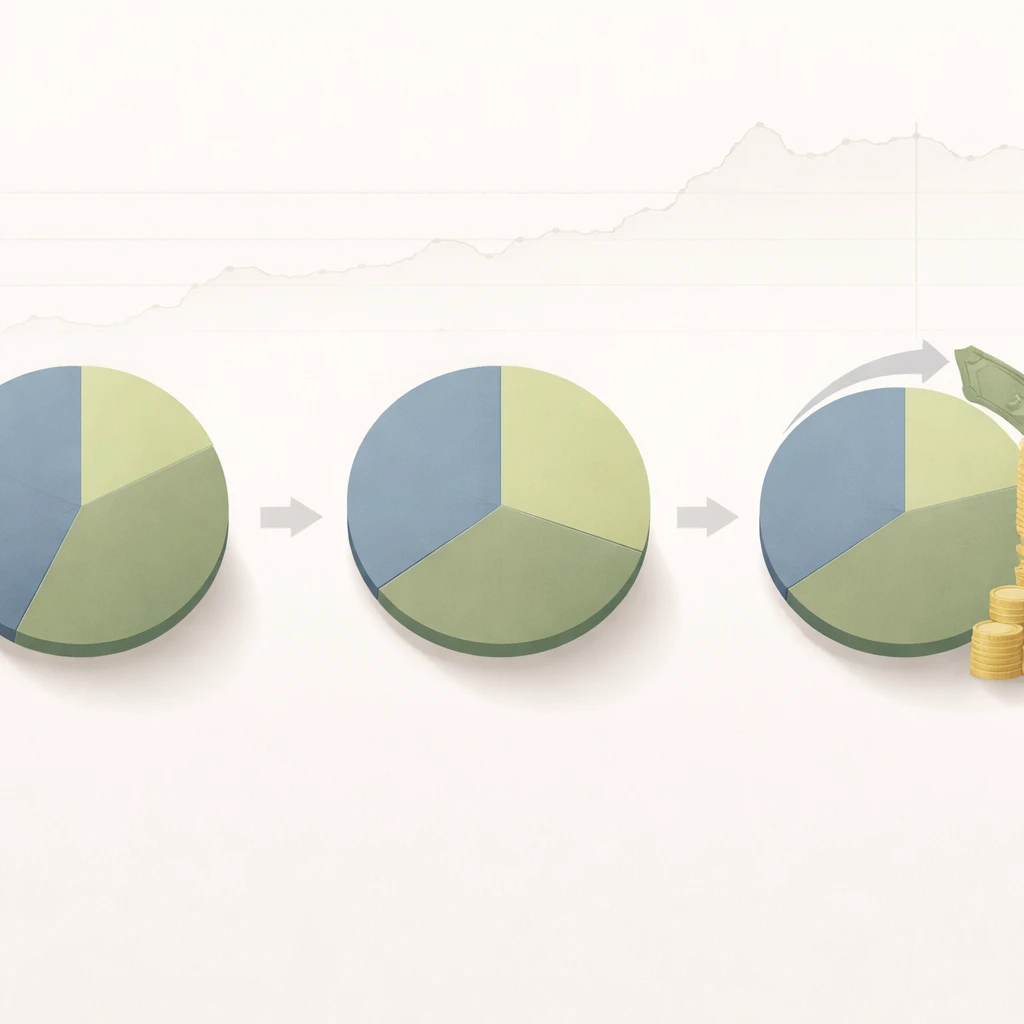
Rebalancing with new contributions is a portfolio construction technique that uses incoming cash flows to move a portfolio back toward its policy allocations. Instead of selling assets that have grown overweight, the investor directs new money to the underweight parts of the portfolio. The method reduces turnover, may limit taxable gains realization, and preserves compounding by avoiding unnecessary trades. It does not eliminate the need for periodic rebalancing via sales, but it often delays or reduces it.
Concept and Definition
Every diversified portfolio is built on a policy allocation, for example 60 percent global equities and 40 percent high-quality bonds. Market prices move continuously, so the actual weights drift away from policy targets. Traditional rebalancing restores target weights by selling the overweight assets and buying the underweight ones. Rebalancing with new contributions adjusts in one direction only. Incoming cash is allocated preferentially to the underweight assets until the drift narrows or disappears. If cash flows are sufficiently large relative to the deviation, the portfolio can return to target without any sales.
This approach uses natural cash inflows as the rebalance engine. Examples include monthly payroll savings into retirement accounts, periodic capital calls for institutional pools, or irregular windfalls such as bonuses. The policy focus remains the same: maintain the risk profile implied by the target mix with a disciplined process. The distinctive element is the priority given to cash inflow allocation as the first line of defense against drift.
Why It Matters for Long-Horizon Planning
Rebalancing is a risk-control mechanism that keeps the portfolio aligned with long-run objectives. Using new contributions as the primary tool influences long-horizon planning in several important ways.
- Turnover management. Allocating inflows to underweight assets avoids selling appreciated positions solely for rebalancing, which can reduce explicit transaction costs and implicit costs from bid-ask spreads.
- Tax awareness. In taxable accounts, realized capital gains often arise from rebalancing sales. New-contribution rebalancing can defer or reduce realized gains while still managing risk exposures.
- Behavioral discipline. Directing cash to underperforming or fallen assets is mechanically contrarian. A rules-based method can help maintain consistency through cycles, independent of short-term sentiment.
- Liquidity preservation. By avoiding sales, the portfolio may maintain positions that are costly to trade or have settlement constraints. This can be especially relevant for multi-asset portfolios with funds, ETFs, and individual securities.
- Compounding continuity. Fewer trades can reduce the drag from frictions, allowing the return of the underlying investments to compound with less interruption.
Allocation Drift at the Portfolio Level
Consider a policy portfolio of 60 percent equities and 40 percent bonds. After a period of equity strength, the portfolio drifts to 70 percent equities and 30 percent bonds. The equity risk now dominates more than intended, and fixed income ballast is lower.
With traditional rebalancing, a portion of equities would be sold and bonds purchased. With rebalancing using new contributions, incoming cash is directed to bonds first. If the cash infusion is large enough, the weights move toward policy without any sale of equities.
Portfolio-level rebalancing occurs across the entire universe of accounts and holdings. If a household has multiple accounts, some tax-advantaged and some taxable, the aggregate weights across accounts define the policy compliance. New contributions might be possible only in certain accounts, so the implementation considers where the portfolio can actually add to positions. The aim is to move the total household portfolio closer to its targets, even if individual accounts temporarily deviate from their own sub-targets.
Mechanics: A Practical Allocation Procedure
A simple procedure can operationalize the idea:
- Compute current weights and compare them with policy weights for each asset class or sleeve.
- Rank asset classes by relative underweight, expressed as current weight minus target weight.
- Allocate the next contribution to the most underweight sleeve first.
- If that sleeve would exceed its target with the full contribution, allocate only the amount required to reach target, then move to the next most underweight sleeve with the remainder.
- Repeat until the contribution is fully allocated.
This process is compatible with tolerance bands around targets. For example, a portfolio might permit a 5 percentage point deviation before considering sales. New contributions are used continuously to reduce deviations. If drift remains outside tolerance for a specified period, a secondary rule may trigger trades to restore target weights. The tolerance design is a risk management choice that balances tracking error to the policy mix against trading costs.
Numerical Examples
Example 1: Monthly Contributions in a Two-Asset Portfolio
Suppose a portfolio totals 100 units of value with a 60 equity and 40 bond policy. After market movements, equities are 70 and bonds are 30.
A new contribution of 5 units arrives. Direct the entire 5 to bonds. New values: equities 70, bonds 35, total 105. The new weights are 66.7 percent equities and 33.3 percent bonds. The drift narrows from a 10-point overweight in equities to 6.7 points. No assets were sold.
A second monthly contribution of 5 units arrives, and markets are flat in the interim. Allocate again to bonds. Values become equities 70, bonds 40, total 110. The portfolio has returned to the 60-40 target with no sales.
Example 2: Insufficient Contribution Size
Assume the same starting point, but contributions are only 2 units per period. After one contribution, bonds rise from 30 to 32, and the weights become 68.6 percent equities and 31.4 percent bonds. Several periods may be required to restore balance. The process still reduces risk drift over time with minimal trading.
Example 3: Multi-Asset Portfolio with Tiers
Consider a policy of 40 percent domestic equities, 20 percent international equities, 30 percent investment-grade bonds, and 10 percent real assets. After a year with domestic equity outperformance and real-asset underperformance, the actual weights stand at 48, 18, 29, and 5 percent, respectively.
An incoming contribution of 6 units is allocated by underweight ranking. The most underweight sleeve is real assets at minus 5 points. Allocate 5 units to real assets to restore to 10 percent if that sleeve accepts the full increment. The next underweight is international equities at minus 2 points. The remaining 1 unit goes there. The portfolio ends at 48, 19, 29, and 10 percent. Subsequent contributions continue the process until all sleeves converge toward target, subject to minimum purchase sizes and trading constraints.
Portfolio Context and Constraints
Implementation depends on account structure and instrument rules.
- Account types. Tax-advantaged accounts may be the primary venues for contributions and can be used to absorb rebalancing flows. Taxable accounts can be left undisturbed unless tolerance bands are breached.
- Instrument minimums and increments. Some mutual funds require minimum purchase amounts, while ETFs allow fractional shares at certain brokers. The rebalancing queue may need to skip an underweight sleeve temporarily if the contribution is too small for that instrument’s minimum.
- Settlement and timing. Funds often settle at end-of-day NAVs, while ETFs trade intraday. Contributions posted late in the day may miss execution windows. Operational calendars and cutoffs should be considered when sequencing orders across sleeves.
- Cash buffers. Portfolios that hold a strategic cash buffer can source part of the rebalance from cash rather than waiting for the next contribution. This is not a recommendation to hold cash, but an acknowledgement of how some policies manage liquidity and risk.
- Multiple custodians. When contributions land at different institutions, the aggregate portfolio view should guide allocation, even if it leads to temporary tracking error within individual accounts.
Risk and Tracking Error Considerations
The policy allocation encodes the intended risk level. Drift changes the expected volatility and correlation structure of the portfolio. Rebalancing with contributions reduces tracking error to the policy benchmark with minimal trading. The rate at which tracking error declines depends on contribution size relative to portfolio value and on market volatility.
If contributions are small and markets trend, drift can persist. Some institutions combine contribution-based rebalancing with a secondary rule that triggers trades only when deviations cross specified thresholds or durations. This hybrid approach preserves the cost advantages of contribution flows while capping risk drift.
Behavioral Context
Allocating new money to assets that have struggled can feel uncomfortable. The contribution mechanism routinizes this contrarian act. The process does not attempt to forecast turning points. It aligns the allocation with pre-stated policy weights. By anchoring to the policy rather than short-term narratives, it helps maintain consistency through drawdowns and recoveries.
Taxes and Cost Mechanics
In taxable accounts, realized gains from rebalancing sales can create tax liabilities. Using new contributions to correct imbalances may defer gains realization. It is not tax advice to say that fewer sales usually mean fewer taxable events. The magnitude of any benefit depends on local tax law, holding periods, loss carryforwards, and the sequence of returns. Explicit trading costs, such as commissions and spreads, also decline when sales are avoided. For some assets, the largest cost is not the explicit fee but the market impact from trading size. Contribution-based rebalancing helps by keeping trades one-sided and smaller.
Frequency and Workflow
Contribution schedules vary. Payroll contributions often arrive monthly or biweekly. Bonus cycles and irregular inflows create lumpy cash events. A consistent workflow ties each inflow to an updated drift calculation and an allocation decision. A common pattern is:
- Calculate updated market values and weights on contribution posting date.
- Run the underweight ranking and determine the target increments by sleeve.
- Respect minimum lot sizes, trading windows, and settlement rules.
- Record the post-trade weights and the remaining deviation from policy.
For teams managing multiple portfolios, this process can be standardized with checklists that ensure each incoming cash event is handled consistently. The record of decisions becomes part of the evidence that the portfolio is managed according to its policy.
Integration with Tolerance Bands
Tolerance bands set allowable deviations from target weights. For instance, a policy might permit equities to vary by plus or minus 5 percentage points relative to target. As long as the deviation remains inside the band, only new contributions are used. If the deviation exceeds the band and persists beyond a specified time window, sales or larger reallocations are considered. The sequencing is straightforward: contributions first, then trades if needed. The band widths reflect a trade-off. Wider bands reduce turnover but accept more tracking error. Narrower bands keep weights close to targets but may require more trading if contributions are insufficient.
Irregular Contributions and Stress Periods
Stress periods bring large price moves that can push allocations far from target. If contributions are small or suspended, the drift may persist. In such conditions, a contribution-only approach may not return weights to policy within a reasonable timeframe. Some policies respond by allowing a one-time rebalance trade, then returning to contribution-based maintenance. Others temporarily widen tolerance bands if liquidity is constrained. These are policy design choices rather than forecasts about market behavior.
When contributions are lumpy, the allocation rule benefits from prioritization. A simple method is to allocate to the largest percentage deviations first. An alternative is to use a risk-aware approach, prioritizing asset classes that most improve the portfolio’s overall risk alignment per unit of cash added. Either method can be documented in the investment policy to guide consistent decisions.
Household and Institutional Examples
Household Retirement Saver
A household accumulates assets in a workplace retirement plan and a taxable brokerage account. The policy calls for 60 percent equities and 40 percent bonds at the household level. New contributions occur exclusively in the retirement plan. The retirement plan assets may be tilted more toward bonds than the household aggregate policy to offset an overweight in equities held in the taxable account. The household monitors total weights quarterly. As contributions flow into the plan, they are directed to the underweight sleeves to pull the aggregate back toward policy. If the aggregate deviation crosses a band, a small trade in the taxable account may be used, mindful of potential tax implications.
Endowment with Capital Calls
An endowment maintains a policy across public equities, fixed income, and diversifiers. Contributions arrive as gifts and as returned capital from private investments. Public market sleeves can usually absorb the flows quickly. The endowment uses each inflow to lower deviations from policy targets. During years when private assets distribute more than expected, public market exposures may be temporarily reduced in anticipation, keeping aggregate risk aligned with the policy. The contribution-based rule simplifies decision-making by ensuring each new dollar helps correct drift.
Sequence Risk and Time Horizon
Rebalancing with contributions interacts with sequence risk, which is the sensitivity of outcomes to the order of returns. When markets decline early in the accumulation period, new contributions typically purchase more shares of the underperforming assets, increasing the pace of recovery if future returns normalize. When markets rise strongly, contribution-based rebalancing directs new cash to the laggards, preventing the portfolio from becoming dominated by the winners. The intention is not to forecast reversals but to adhere to the intended risk mix through varying conditions.
Data and Monitoring
Accurate implementation depends on timely data. Key elements include current market values by sleeve, policy targets, contribution amounts and dates, and constraints such as instrument minimums. A simple dashboard can display current vs. target weights, percentage deviations, and the allocation plan for the next contribution. Maintaining an audit trail of decisions and outcomes supports governance and accountability.
When Sales Still Occur
Rebalancing with contributions does not eliminate rebalancing trades completely. Situations that often trigger sales include:
- Large market moves that exceed tolerance bands before sufficient contributions arrive.
- Policy changes, such as a revised equity-bond mix following a formal review.
- Funding needs that require raising cash, which can be coordinated with allocation targets to minimize additional drift.
- Instrument changes, such as replacing a fund or ETF, that require selling and buying regardless of drift.
Even in these cases, the contribution-based approach reduces the frequency and size of sales over time.
Comparisons with Alternative Rebalance Methods
Several methods coexist in practice:
- Calendar rebalancing. Trades occur on a preset schedule regardless of market moves or contributions. Contribution-based rebalancing, by contrast, acts opportunistically when cash arrives.
- Tolerance band rebalancing. Trades are triggered only when deviations exceed a threshold. Contribution flows can be layered on top as a first step, reducing the chance of crossing thresholds.
- Drift-per-dollar prioritization. This method ranks sleeves by improvement in deviation per unit of cash allocated, akin to allocating to the most underweight sleeves first. It is essentially the operative logic of contribution-based rebalancing at each inflow.
No single method dominates in all environments. The selection reflects preferences around turnover, taxes, tracking error, and operational capacity.
Operational Notes and Edge Cases
- Fractional trading. If allowed, fractional shares increase precision in reaching targets with small contributions.
- Price slippage during allocation. Target calculations are based on pre-trade prices. Subsequent price movement can lead to slight over- or under-corrections. This is normal and corrected by future contributions.
- Cash drag. If contributions sit in cash awaiting allocation, the drift persists. Timely deployment reduces tracking error to policy.
- Multiple tiers. Within equities, the same principle applies to regional or factor sleeves. New cash is allocated to underweight sub-sleeves before overweight ones.
Putting It in a Policy Framework
A clear investment policy statement can specify how contributions are used to rebalance:
- The definition of the policy allocation and permissible tolerance bands.
- The decision rule for allocating each new contribution across sleeves.
- Constraints such as minimum trade sizes and account-level restrictions.
- The escalation rule when contribution-based corrections are insufficient.
- Documentation and monitoring procedures.
Codifying the process supports consistency through diverse market conditions and organizational changes.
Illustrative Timeline
Imagine a calendar year for a portfolio with monthly contributions equal to 0.8 percent of starting portfolio value. In the first quarter, equities rise and bonds fall, increasing the equity weight above target. Each monthly contribution is directed to bonds, slowing the drift. Mid-year, markets stabilize and the cumulative contributions restore the 60-40 mix. In the third quarter, equities decline sharply, pushing the portfolio below the equity target. Subsequent contributions route to equities. The annual path shows how disciplined allocation of inflows modulates drift without repeated trades.
Limitations and Realistic Expectations
Contribution-based rebalancing reduces but does not eliminate deviations from desired risk exposures. It relies on the presence and size of inflows. During periods without contributions, or when markets move faster than contributions can offset, the portfolio can remain off-target. The method also assumes that the policy allocation remains appropriate for the objectives and constraints. If the policy is outdated, mechanically returning to it may not be desirable from a planning perspective. Regular policy reviews and careful documentation help keep the implementation aligned with objectives.
Conclusion
Rebalancing with new contributions is a pragmatic portfolio construction tool. It directs the inevitable flow of new cash to the parts of the portfolio that most need it, controlling drift, managing costs, and supporting long-term discipline. It interacts naturally with tolerance bands and other rebalancing frameworks. Its effectiveness rises with the size and frequency of contributions relative to portfolio value and with consistent execution. Within a coherent policy, it can be a durable component of a resilient, long-horizon investment process.
Key Takeaways
- Rebalancing with new contributions allocates incoming cash to underweight assets, reducing drift without selling.
- The method manages turnover and can reduce realized tax events while maintaining the portfolio’s intended risk mix.
- Effectiveness depends on the size and frequency of contributions relative to portfolio value and market volatility.
- It complements tolerance bands and other rebalancing rules, often serving as the first step before any sales.
- Clear procedures, data accuracy, and documentation support consistent implementation across accounts and market conditions.