
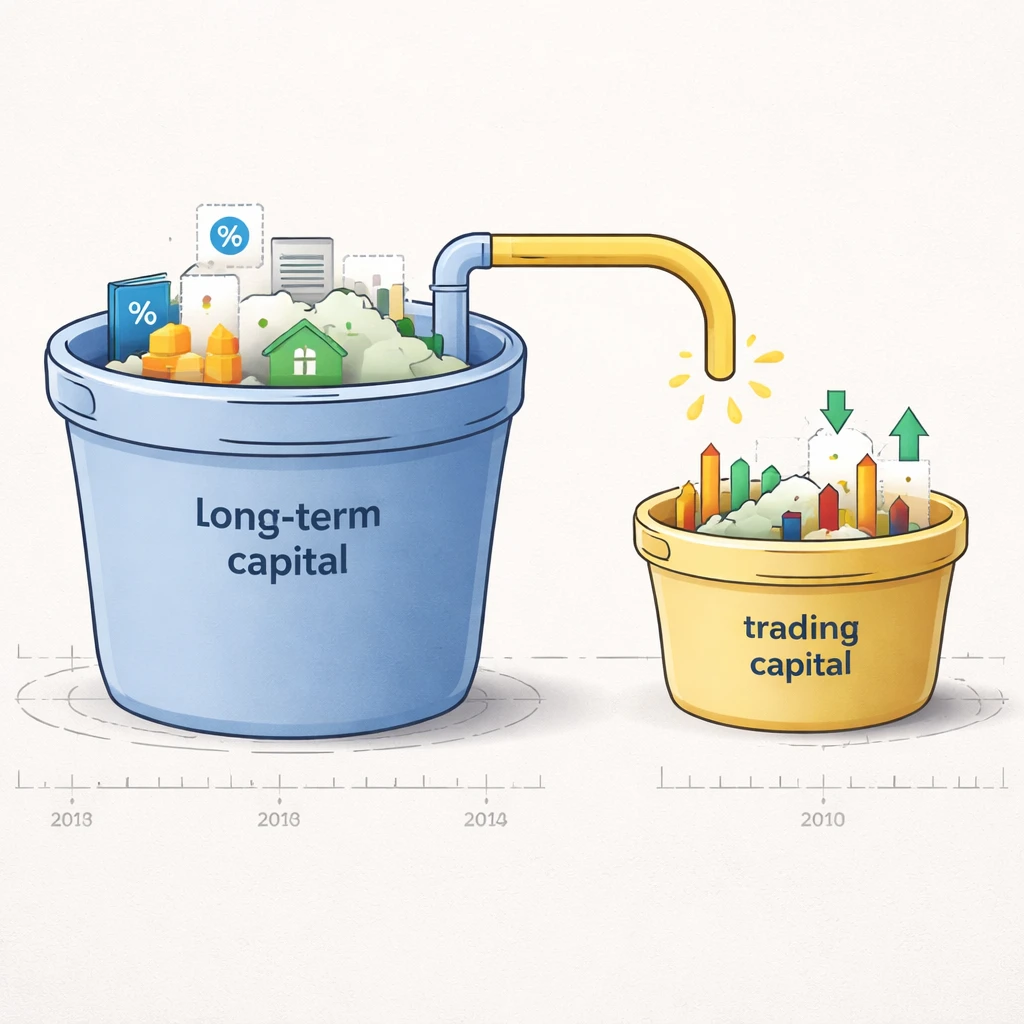
Capital segmentation is a simple structural idea that supports disciplined portfolio construction. It divides total investable funds into distinct segments that are each assigned a purpose, time horizon, and risk budget. For beginners, the most useful distinction is between long-term capital and trading capital. These two segments serve different goals, move on different time scales, and operate under different risk and governance constraints. Keeping them separate is not about chasing higher returns. It is about building a portfolio architecture that can tolerate setbacks without derailing long-term plans.
What Capital Segmentation Means
Capital segmentation is the assignment of money to clearly defined buckets that each have their own objectives and rules. The segments are not merely mental accounts. They are operationally distinct, with separate tracking, evaluation, and risk limits. In the beginner framework, two segments dominate:
- Long-term capital supports multi-year or multi-decade goals such as retirement or education funding. Its success is judged by its ability to fund future liabilities while staying within acceptable risk parameters.
- Trading capital is reserved for short-horizon, active opportunities where decisions are made and evaluated more frequently. Its success is judged by skill-based metrics and loss containment rather than by alignment with future liabilities.
This separation clarifies purpose and improves accountability. Rather than one pool doing everything, each segment is measured against its own benchmark and constraints.
Why Segmentation Matters for Long-Term Planning
Portfolio construction is not only about selecting assets. It is also about designing a system that remains robust under stress. Segmentation matters for several reasons:
- Risk containment. Losses in trading activity do not mechanically force changes to long-term holdings when the segments are segregated. This reduces the chance of liquidating long-horizon assets at unfavorable times.
- Behavioral discipline. Clear boundaries reduce the temptation to rescue a losing trade with funds meant for retirement, or to raid long-term assets for short-term experimentation.
- Liquidity protection. Long-term portfolios often carry assets that are less liquid. Keeping trading activity in a separate, liquid pool reduces the risk of forced sales.
- Measurement clarity. Performance and risk attribution become more informative when each segment is evaluated against its own mission.
- Governance and planning. Segmentation supports consistent rules for contributions, withdrawals, and rebalancing at the portfolio level.
How Segmentation Operates at the Portfolio Level
At the portfolio level, segmentation shows up in four design elements:
- Purpose statements. Each segment has a written purpose and time horizon. Long-term capital prioritizes capital preservation in real terms over long periods. Trading capital prioritizes controlled experimentation and learning within predefined risk limits.
- Risk budgets. Each segment receives an explicit allocation to risk, not just to dollars. For example, the trading segment might accept higher volatility but with a strict drawdown limit, while the long-term segment aims for steadier compounding within a moderate risk range.
- Operational boundaries. Separate accounts or sub-accounts, independent cash management, and distinct brokerage permissions can enforce separation.
- Evaluation methods. Long-term results are evaluated using multi-year metrics and alignment with goals. Trading results are evaluated using more granular statistics, such as win rate, payoff ratio, and drawdown control, all tracked independently of long-term outcomes.
The Long-Term Capital Segment
The long-term segment is designed around multi-year objectives. It typically emphasizes diversification across asset classes, prudent rebalancing, and tolerance for cyclical fluctuations. The defining features are time horizon and risk capacity. Because the money is intended to fund future needs, the segment values resilience more than rapid short-term gains.
In practice, long-term capital often benefits from rules that reduce turnover. Rebalancing is deliberate and infrequent, guided by pre-stated bands or time schedules. Measurement uses metrics that align with the horizon, such as multi-year returns, volatility, and the likelihood of meeting future funding targets. The long-term segment can incorporate a broad set of assets, provided they fit the risk and liquidity constraints appropriate for distant goals.
The Trading Capital Segment
The trading segment serves a different mission. Its intent is to accommodate active decision making within clearly defined limits. The focus is on process quality, strict containment of losses, and evaluation through repeatable statistics. Capital here is sized so that drawdowns do not impair the total portfolio’s ability to meet long-term goals.
Trading activity often requires higher liquidity, faster decision cycles, and sharper risk controls. The segment typically operates with a firm maximum drawdown threshold, daily risk checks, and a clear stop-loss methodology. Trades are recorded with entry and exit rationales, and post-trade reviews examine whether the process was followed. Gains and losses in this segment do not trigger changes to long-term holdings, which protects the larger plan from short-horizon noise.
A Basic Example of Portfolio-Level Segmentation
Consider a beginner investor with total investable funds of 120,000 units of currency. They document two segments and ring-fence them operationally.
- Long-term capital: 96,000 dedicated to multi-year goals. The segment uses diversified holdings and a periodic rebalancing rule that does not depend on trading outcomes.
- Trading capital: 24,000 devoted to active decisions. The segment is capped at a 20 percent peak-to-trough drawdown. A drawdown beyond that threshold triggers a cooling-off period and a reduction in position sizes until the process is reviewed.
Assume that during a period of market volatility the trading segment declines by 15 percent. The long-term segment remains invested according to its policy. No funds move from long-term holdings to bail out trading losses. Later, a market recovery lifts the long-term holdings. The trading segment is still in review mode, and its position sizes remain reduced. The key point is that long-term progress was not disrupted by short-term volatility in the trading segment.
Now consider the opposite case. The trading segment produces a gain that lifts it above its policy cap relative to the total portfolio. Rather than letting the trading bucket sprawl, the excess is transferred out and recorded as a realized contribution to long-term funds. This preserves the intended risk structure.
Risk Budgeting Across Segments
Dollar allocation and risk allocation are different concepts. A simple way to think about risk budgeting is to estimate the volatility or drawdown tolerance for each segment and check their combined effect. For instance, imagine that the long-term segment has an expected annualized volatility of 8 percent, and the trading segment has an expected volatility of 20 percent. If the portfolio weights are 80 percent and 20 percent respectively, the combined volatility will reflect both the individual volatilities and the correlation between segments.
While precise estimates require statistical modeling, beginners can use directional reasoning. If the trading segment is more volatile and only loosely correlated with the long-term segment, it might contribute a larger share of total portfolio variability than its dollar weight suggests. That is acceptable if it is planned, monitored, and capped. The important step is to articulate a limit for total portfolio risk, then size the trading segment so that this limit is respected under plausible scenarios.
Liquidity, Leverage, and Margin Considerations
Trading activity often uses margin or instruments that introduce leverage. Segmentation helps ensure that any margin calls affect only the trading segment. Long-term holdings can remain unencumbered, which avoids forced liquidations that could lock in losses during market stress. Clear rules about the use of leverage belong in the trading segment’s policy, including maximum allowable exposure and procedures for reducing risk in adverse conditions.
Liquidity is equally important. The trading segment should hold assets that can be exited quickly when risk limits are hit. The long-term segment can tolerate less frequent trading and may include assets with longer settlement times, provided they match the horizon and do not compromise the ability to rebalance within policy bands.
Behavioral Benefits and Governance
Segmentation supports better decision making by removing ambiguity. When a losing trade occurs, the trader does not need to decide whether to move money from long-term holdings to recover losses. The rule is already written. Similarly, when the long-term portfolio experiences a decline, there is no compulsion to speculate in the trading segment to compensate. Each segment follows its own governance plan.
Governance can be as simple as a one-page policy for each segment. The policy states purpose, horizon, allowable instruments, risk limits, rebalancing frequency, and rules for adding or removing funds. Policies are reviewed on a fixed schedule or after a significant deviation from plan. If the plan allows it, gains from the trading segment can be periodically skimmed and assigned to long-term capital. Losses are absorbed within the trading segment up to the precommitted limit. Clear documentation reduces the impact of emotion during stressful periods.
Measurement and Reporting
Performance should be tracked separately. The long-term segment is best evaluated with time-weighted returns, multi-year volatility, and tracking relative to a policy benchmark. The trading segment benefits from more granular measurements such as hit rate, average win and loss, expectancy per trade, and drawdown severity. Risk-adjusted statistics such as Sharpe ratio or Sortino ratio can be informative when calculated consistently.
Aggregated results can be misleading if the segments are not evaluated on their own terms. A strong year in the trading segment may mask a growing gap in long-term funding needs. Conversely, a temporary decline in trading results should not obscure healthy progress in the long-term segment. Separate reporting keeps attention on the correct objectives.
Funding Flows, Rebalancing, and Thresholds
Capital flows are handled by policy rather than by ad hoc reaction. Additions from income or windfalls are assigned according to written guidelines, such as maintaining the long-term segment at or above a target share of the total. Withdrawals occur according to the purpose of each segment. Rebalancing between segments is governed by thresholds. For instance, if the trading segment exceeds a stated percentage of total assets due to gains, transfers can reduce it to the policy level. If the trading segment falls below a minimum viable size due to losses, trading may pause until the scheduled review.
Inside each segment, rebalancing follows its own rules that match the segment’s design. Long-term portfolios commonly use calendar-based or band-based rebalancing. Trading activity relies on position sizing rules and risk limits that reset with account equity. The point is structural clarity. Each segment has its own logic, and the interactions are scripted in advance.
Common Pitfalls in Segmentation
- Blurring the boundaries. Moving money between segments without following the policy undermines the entire purpose of segmentation.
- Overestimating risk capacity. Assigning too large a share to the trading segment can raise total portfolio volatility to uncomfortable levels.
- Ignoring correlation. If trading positions mirror the long-term portfolio’s risk exposures, the intended diversification may not materialize.
- Leveraging long-term assets. Using long-term holdings as collateral for trading can introduce cross-contamination of risk.
- Neglecting measurement. Without separate performance and risk tracking, it is hard to learn which segment is fulfilling its mission and which needs adjustment.
Illustrative Real-World Contexts
Segmentation is common in institutional settings and can be adapted to personal portfolios.
- Endowment or foundation. A policy portfolio funds long-term spending while an opportunistic sleeve pursues targeted ideas within tight risk limits. The sleeves are reported separately to the investment committee.
- Family portfolio. A multi-decade core supports retirement, education, and major future expenses. A small trading account allows active learning without endangering the core plan.
- Professional with variable income. A stable long-term base supports future financial independence, while a trading segment offers a structured outlet for short-horizon decisions during periods of lighter workload.
- Emerging trader. A capped trading account is used to test hypotheses and improve execution. Profits above the cap flow to long-term savings. Losses are limited by a defined stop on total drawdown.
These contexts share a common structure. The long-term segment is mission critical and protected. The trading segment is intentionally sized and monitored so it cannot compromise the core plan.
Designing a Beginner-Friendly Segmentation Policy
A concise policy reduces uncertainty during stressful moments. The following checklist helps beginners outline a workable structure without prescribing specific trades or assets.
- Define purpose and horizon. State the long-term goals and the distinct purpose for trading capital.
- Set sizing ranges. Establish target and maximum sizes for each segment as a share of total assets.
- Specify risk limits. For the trading segment, set a maximum drawdown and daily risk cap. For the long-term segment, define an acceptable volatility range or loss tolerance over a multi-year window.
- Formalize rebalancing. Write the triggers for shifting funds between segments and the frequency of review.
- Protect liquidity. Separate margin, collateral, and borrowing so that stress in one segment does not force action in the other.
- Track and report. Maintain separate performance and risk reports for each segment with a consistent schedule.
Learning from Outcomes
The value of segmentation grows with deliberate review. Beginners often learn that trading results vary considerably across market regimes, while long-term results accumulate more slowly but with greater persistence. Documenting both helps identify which activities add value after accounting for risk and opportunity cost. Adjustments to segment sizes and rules are best made on a planned schedule, using accumulated evidence rather than reaction to recent performance.
Integrating Segmentation with Broader Financial Planning
Capital segmentation interacts with other elements of financial planning, such as emergency reserves, debt management, and tax considerations. While these topics lie beyond the scope of this article, the integration principle remains the same. The long-term segment should be insulated from short-term volatility in other domains, and the trading segment should be structurally unable to compromise essential obligations. Clear boundaries and documentation create that insulation.
Summary of the Concept
Capital segmentation for beginners distills portfolio construction to a practical framework. Assign money to a long-term segment that targets durable compounding within defined risk, and a trading segment that enables active decision making under strict limits. Keep the segments operationally separate, measure them independently, and rebalance according to prewritten rules. The aim is not to maximize short-term return. It is to maintain a resilient architecture that can absorb shocks and continue serving long-term objectives.
Key Takeaways
- Capital segmentation separates long-term and trading funds by purpose, time horizon, and risk budget to improve discipline and resilience.
- Long-term capital prioritizes multi-year goals, measured against policy benchmarks and risk limits that match those horizons.
- Trading capital allows active decisions within strict drawdown and liquidity constraints, with results tracked independently.
- Operational separation, clear governance, and scheduled rebalancing prevent cross-contamination between segments.
- Consistent measurement of performance and risk in each segment supports learning and helps maintain a robust overall portfolio structure.