
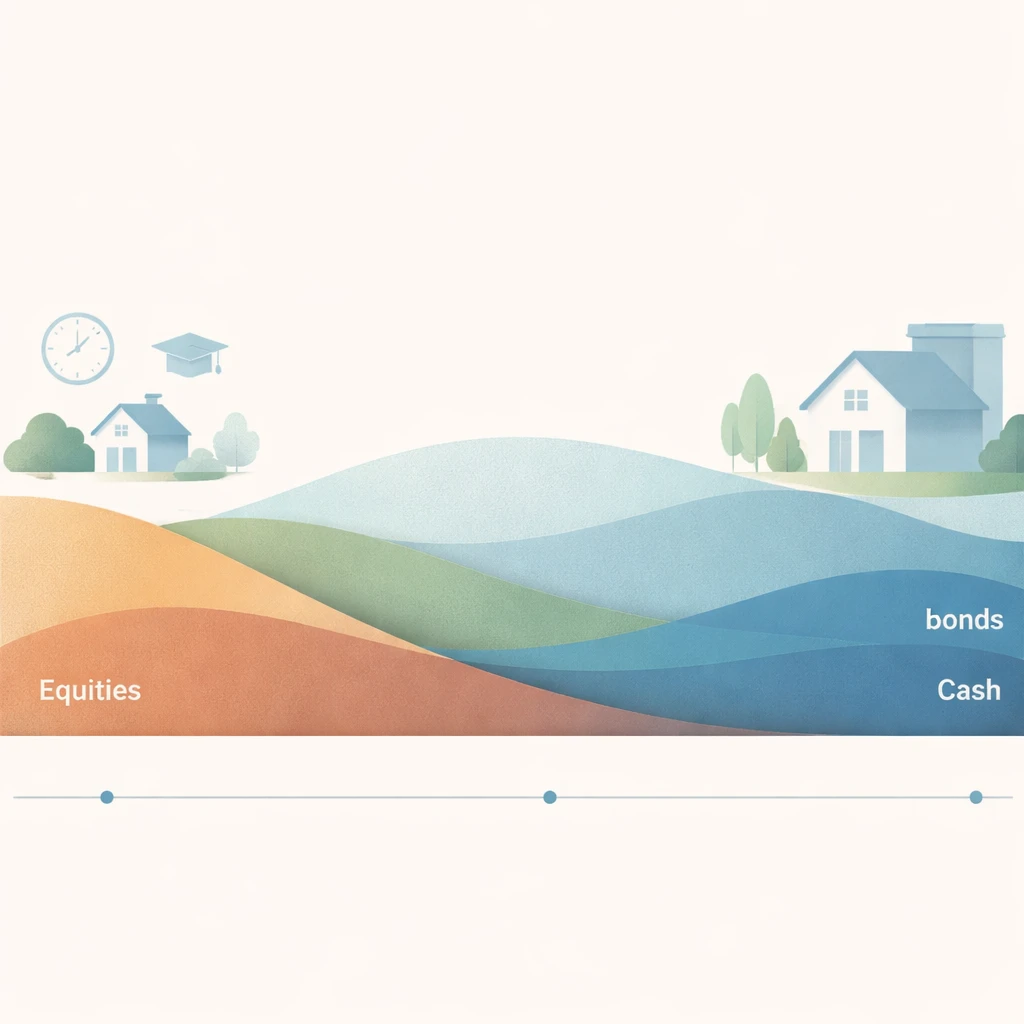
Asset allocation by age is a lifecycle framework that links the mix of assets in a portfolio to the investor’s stage of life. The central idea is straightforward: an individual’s capacity to bear investment risk changes over time as human capital, savings, spending needs, and financial obligations evolve. Portfolios that recognize these shifts tend to be more resilient to sequence-of-returns risk, better aligned with long-term spending plans, and more coherent from a household balance sheet perspective.
In practice, the concept is implemented through a policy that gradually adjusts the share of growth-oriented assets relative to defensive assets as age increases. The implementation can be highly structured, as in a target-date glide path, or it can be principles-based, reflecting household-specific income profiles, liabilities, and preferences. The final allocation is not a prediction about markets. It is a mapping between an investor’s lifecycle position and the portfolio’s risk profile.
Defining Asset Allocation by Age
Asset allocation by age is a rule or policy that specifies how the proportion of asset classes in a portfolio evolves as the investor ages. Growth assets such as equities and certain real assets typically carry higher expected return and higher volatility. Defensive assets such as high-quality bonds and cash typically carry lower volatility and lower expected return, along with liquidity and, at times, diversification benefits. Age-based allocation frameworks adjust the relative weights of these building blocks over the life cycle to reflect changing risk capacity and objectives.
The concept differs from stock picking or short-term market timing. It addresses the top layer of portfolio construction: the strategic mix across broad asset classes. Tactics and security selection, if used, occur within this policy envelope. That separation helps preserve discipline and reduces the risk that short-term signals override long-term planning.
Why Age Matters for Long-Term Capital Planning
Several economic mechanisms tie age to portfolio design. Understanding these linkages clarifies why age-based allocation can be a useful organizing principle.
Human Capital and Financial Capital
Early in life, most household wealth resides in human capital, the present value of future labor income. Human capital is often bond-like if earnings are stable and uncorrelated with equity markets. It can be equity-like if compensation is volatile or tied to economic cycles. As individuals age, human capital is consumed and financial capital grows. The household balance sheet tilts from human capital to financial capital. The portfolio must absorb more of the total risk-bearing role previously carried by labor income, which makes drawdown risk more consequential later in life.
Risk Capacity, Not Only Risk Tolerance
Risk tolerance reflects personal preferences and psychology. Risk capacity reflects the ability to withstand adverse outcomes without jeopardizing long-term goals. Age affects risk capacity through the horizon for recovery, the ratio of savings to accumulated wealth, and the sensitivity of future consumption to portfolio losses. Even if two investors have equal tolerance, their age and income profiles can imply very different capacities for risk.
Sequence-of-Returns Risk
Average returns over decades are not the only driver of outcomes. The sequence of returns matters. Losses just before or during the early years of withdrawals can have outsized effects on the sustainability of spending. Age-based allocation seeks to mitigate this by gradually increasing the weight of defensive assets when the financial plan becomes sensitive to sequence risk.
Consumption Smoothing and Liabilities
Households generally aim to smooth consumption over time. As retirement approaches, planned withdrawals become a central liability. Framing the portfolio as a source of future spending clarifies why the mix of assets should evolve as those liabilities draw closer. The allocation is part of a liability-aware plan, even when it does not adopt formal liability-driven investing techniques.
Core Portfolio Building Blocks
Age-based frameworks operate at the level of major asset categories. The labels are broad; within each are many implementation choices.
Equities represent ownership in businesses and are typically the main driver of long-horizon growth. They carry higher volatility and drawdown risk.
Fixed income spans high-quality government and investment-grade bonds, among others. These assets often provide income, may diversify equity risk in many environments, and introduce interest rate exposure through duration.
Cash and cash equivalents deliver liquidity and short-duration stability. They can buffer near-term spending needs and reduce the need to sell risk assets after declines.
Real assets and diversifiers include real estate exposure, commodities, and inflation-linked securities. Their roles vary from inflation hedging to diversification. Their inclusion and weight depend on objectives and constraints.
From Rule of Thumb to Portfolio Policy
Popular rules such as “100 minus age” seek to capture the intuition that the equity share should decline with age. Such rules are simple but coarse. They may misrepresent risk capacity for individuals with unstable labor income, substantial pensions, or large non-portfolio assets like business ownership or property.
A structured policy converts age into a set of portfolio weights, subject to constraints. The policy is often called a glide path. A glide path can be linear, where equity exposure decreases by a fixed amount per year, or non-linear, where the rate of change is steeper as retirement approaches. The appropriate shape depends on how sensitive the plan is to sequence risk at various stages and on the characteristics of non-portfolio wealth.
Portfolio-Level Mechanics
Asset allocation by age is implemented through a small number of design choices that govern how the portfolio evolves.
Policy Allocation and Bands
The policy defines target weights for major asset classes. To reduce unnecessary trading, portfolios often use tolerance bands around the targets. When weights drift outside the bands due to market moves, rebalancing restores the mix to within bounds. The policy can be expressed in nominal terms or in risk terms using measures like volatility contributions.
Rebalancing Discipline
Rebalancing supports risk control by preventing the portfolio from drifting into unintended exposures. Schedules vary. Some adopt a calendar schedule, others use thresholds, and many combine both. In an age-based framework, rebalancing serves two purposes: it re-centers the current allocation, and it advances the glide path as time passes.
Risk Budgeting
The allocation translates into a risk budget that determines how much total portfolio volatility and drawdown potential the investor accepts at each stage. This budget is influenced by the covariance structure of assets. For example, rising correlations between equities and bonds reduce diversification benefits and may require rethinking the defensive sleeve. Risk budgeting forces the portfolio to stay aligned with the intended risk profile instead of relying on historical averages that may not persist.
Human Capital Integration
Lifecycle allocation should consider the interaction between labor income and financial assets. A few stylized cases illustrate the connection.
Stable, bond-like income. A tenured educator with predictable earnings and a defined benefit pension has human capital that behaves like a high-quality bond. All else equal, this can raise financial risk capacity during working years because human capital absorbs some risk that the portfolio would otherwise bear.
Income correlated with equities. A professional whose compensation is tied to corporate profits or stock options has human capital that is equity-like. Concentrated exposure to the equity cycle limits risk capacity in the financial portfolio, particularly if job security and bonuses fluctuate with markets.
Entrepreneurial concentration. A business owner may have substantial private company exposure. Even if the public equity market is diversified, the household’s total wealth is not. Age-based allocation for such a household should account for the concentration before assigning portfolio equity weights.
Liabilities, Spending, and Sequence Risk
As retirement nears, planned withdrawals become a central design input. The portfolio now translates into a stream of cash flows. Two risk dimensions become more prominent: the risk of realizing losses just before withdrawals begin, and the risk that low returns early in retirement deplete assets faster than later recoveries can repair.
Portfolios can reduce sensitivity to these risks by holding a larger fraction of low-volatility and liquid assets as the withdrawal date approaches. The defensive sleeve also provides a buffer for rebalancing into drawdowns without selling growth assets to fund spending. The right balance depends on the size and reliability of non-portfolio income, such as social security or annuity payments, and on the desired stability of withdrawals.
Illustrative Lifecycle Context
Concrete examples help demonstrate how the logic plays out. These are not recommendations, only stylized cases that show how the same principles can produce different allocations at different ages and circumstances.
Early Career: Age 25
At 25, most wealth is human capital with many years of contributions ahead. Market declines have time to recover, and savings contributions dampen volatility at the household level. A portfolio at this stage often emphasizes growth assets, recognizing that interim drawdowns are less likely to disrupt long-term plans. Liquidity needs still matter. A cash reserve for short-term contingencies can prevent forced selling. Diversification across domestic and international equities, with a modest defensive sleeve, can manage volatility without unduly sacrificing long-horizon return potential.
Key sensitivities at this age include job stability and the cyclicality of earnings. A worker in a highly cyclical industry might moderate equity concentration relative to a peer with more stable income, even if both are young. Student loans and other liabilities also affect risk capacity by increasing the cost of drawdowns that might reduce flexibility.
Mid-Career: Age 45
By 45, financial capital has grown, human capital has declined, and the planning horizon to retirement is shorter. The portfolio’s role shifts from pure accumulation toward preserving the trajectory of the plan. The allocation may still lean toward growth but with a larger defensive and diversifying sleeve than in early career. Rebalancing discipline becomes more important as portfolios are larger and drift can have greater consequences.
Household-specific features can dominate. Consider two households of similar age and wealth. One has a defined benefit pension that covers a large share of expected retirement spending. The other relies entirely on portfolio withdrawals. The first household’s pension reduces the need for the portfolio to fund baseline consumption, increasing capacity for risk within limits. The second household may prefer a steadier path to lower the chance that adverse sequences endanger future withdrawals.
Retirement Onset: Age 65
At 65, the portfolio supports imminent or current withdrawals. Sequence risk is acute, and liquidity planning takes center stage. The allocation typically emphasizes sufficient high-quality bonds and cash-like assets to fund near-term spending needs and to maintain flexibility during equity drawdowns. Some allocation to growth assets is still relevant for hedging longevity and inflation risk over a multi-decade horizon, but its share is calibrated to avoid excessive sensitivity to early losses.
The shape of the glide path around retirement can vary. Some designs lower equity exposure more aggressively in the years just before retirement to protect against a late-stage drawdown, then maintain a relatively stable mix during early retirement. Others reduce more gradually but continue to glide downward. The choice depends on the household’s tolerance for variability in withdrawals, alternative income sources, and views on risk trade-offs.
Advanced Age: Age 80
At 80, the horizon for spending that must be funded by the portfolio is shorter, but medical and long-term care uncertainty can be significant. The allocation often prioritizes liquidity and drawdown resilience while maintaining some growth exposure to offset inflation and potential multi-year expenses. Simplification of the portfolio becomes valuable for operational reasons, reducing complexity for the investor and potential caregivers.
Bequest motives, if present, can alter the balance. If a portion of the portfolio is earmarked for heirs or philanthropy with a long horizon, that sleeve can be managed with its own risk budget that differs from the spending sleeve. Age-based allocation at the household level can therefore be multi-segment rather than a single policy for all capital.
Beyond a Single Number: Segmentation and Buckets
Many households find it useful to frame allocation by age through segments that correspond to time horizons. A common structure is a three-segment lens:
- Liquidity bucket. Cash and short-term instruments sized to cover near-term spending and contingencies.
- Stability and income bucket. High-quality bonds and diversifiers that anchor the portfolio during drawdowns and fund intermediate-term needs.
- Growth bucket. Equities and other higher-return assets intended for long-horizon spending and inflation protection.
Segmentation can coexist with a glide path. As age increases, the liquidity and stability buckets become a larger share of total assets, while the growth bucket declines. This framework communicates purpose clearly and can support disciplined rebalancing among the buckets.
Tax, Accounts, and Asset Location
Age-based allocation interacts with the types of accounts that hold assets. While detailed tax guidance is outside scope, two conceptual points are relevant. First, the after-tax value of assets and liabilities is what funds consumption, so planning should reflect tax frictions where material. Second, the placement of assets across taxable and tax-advantaged accounts can affect effective risk and return. For example, holding higher-yielding fixed income in tax-advantaged accounts may change the after-tax risk budget compared with holding the same assets in taxable accounts. The age-based policy should be expressed at the household level, then implemented across accounts with attention to constraints and costs.
Evidence and Historical Context
Historical data show that the dispersion of equity returns narrows as the holding period lengthens, but risk does not disappear. Long-horizon investors have faced multi-year drawdowns and regime shifts in correlations, inflation, and interest rates. Bonds have diversified equities in many downturns, but not all, and rising-rate environments can challenge duration-heavy fixed income. These patterns argue for caution when relying solely on historical averages to design an age-based policy.
Lifecycle products such as target-date funds apply age-based allocation at scale. Their glide paths differ in the share of equities near and after retirement, in the shape of the de-risking schedule, and in the breadth of diversifiers used. Their prevalence underscores the institutional acceptance of age as a useful organizing variable, while the variation among them highlights the role of preferences, liabilities, and views on diversification.
Design Choices and Caveats
Several design considerations shape an age-based policy:
- Glide path shape. Linear schedules are simple. Concave or convex paths can better align with how risk capacity changes as retirement approaches and then progresses.
- Floor versus upside. Some designs emphasize protecting a minimum consumption floor, allocating remaining risk to pursue upside. Others target a balance between expected growth and volatility across the whole plan.
- Diversification breadth. Exposure across regions, sectors, inflation-sensitive assets, and alternative risk premia can reduce reliance on any single source of return.
- Costs and frictions. Trading costs, taxes, and product fees compound over time. Frugal implementation helps preserve the integrity of the policy.
- Behavioral resilience. A policy that is theoretically efficient but intolerable during stress is fragile. Age-based frameworks aim to deliver a path that investors can maintain through adverse periods.
Behavioral Dimension
Age-based allocation can reduce the temptation to adjust risk based on short-term market narratives. By committing to a schedule that is tied to the calendar and the financial plan, investors may avoid procyclical behavior such as adding risk after rallies or cutting risk after declines. At the same time, rigidity can be harmful if major life events change the plan. The appropriate compromise is a policy with clear rules and defined circumstances under which the policy can be revisited.
Stress Testing and Monitoring
An effective lifecycle policy is monitored against goals rather than against benchmarks alone. Stress tests examine how the portfolio might behave under adverse sequences: equity bear markets, rising-rate periods, high inflation, or recessions. The analysis considers not only wealth outcomes but also the stability of planned withdrawals. Monitoring also checks whether asset correlations remain consistent with the diversification assumptions embedded in the policy.
Putting the Pieces Together
Asset allocation by age is not a predictive tool. It is a planning framework that channels the realities of human capital, liabilities, and risk capacity into a coherent policy for the mix of growth and defensive assets. The discipline comes from committing to the logic of the lifecycle and acknowledging that the household balance sheet changes meaningfully over time.
A resilient policy typically includes: a clear glide path that adapts to the household’s human capital and liability profile, explicit rebalancing rules, segmentation that aligns assets with time horizons, and periodic review for major life events. Within that structure, security selection and tactical tilts, if used at all, take a subordinate role.
Key Takeaways
- Asset allocation by age links portfolio risk to changing human capital, liabilities, and time horizon, forming a disciplined foundation for long-term planning.
- Glide paths translate age into evolving weights of growth and defensive assets, with shapes tailored to sequence-of-returns risk and household specifics.
- Integrating labor income, pensions, housing, and business ownership prevents mis-measurement of risk capacity at different life stages.
- Segmentation into liquidity, stability, and growth buckets clarifies purpose, supports rebalancing, and aligns assets with spending horizons.
- Monitoring, stress testing, and attention to costs help maintain the policy’s integrity as market regimes and household circumstances change.