
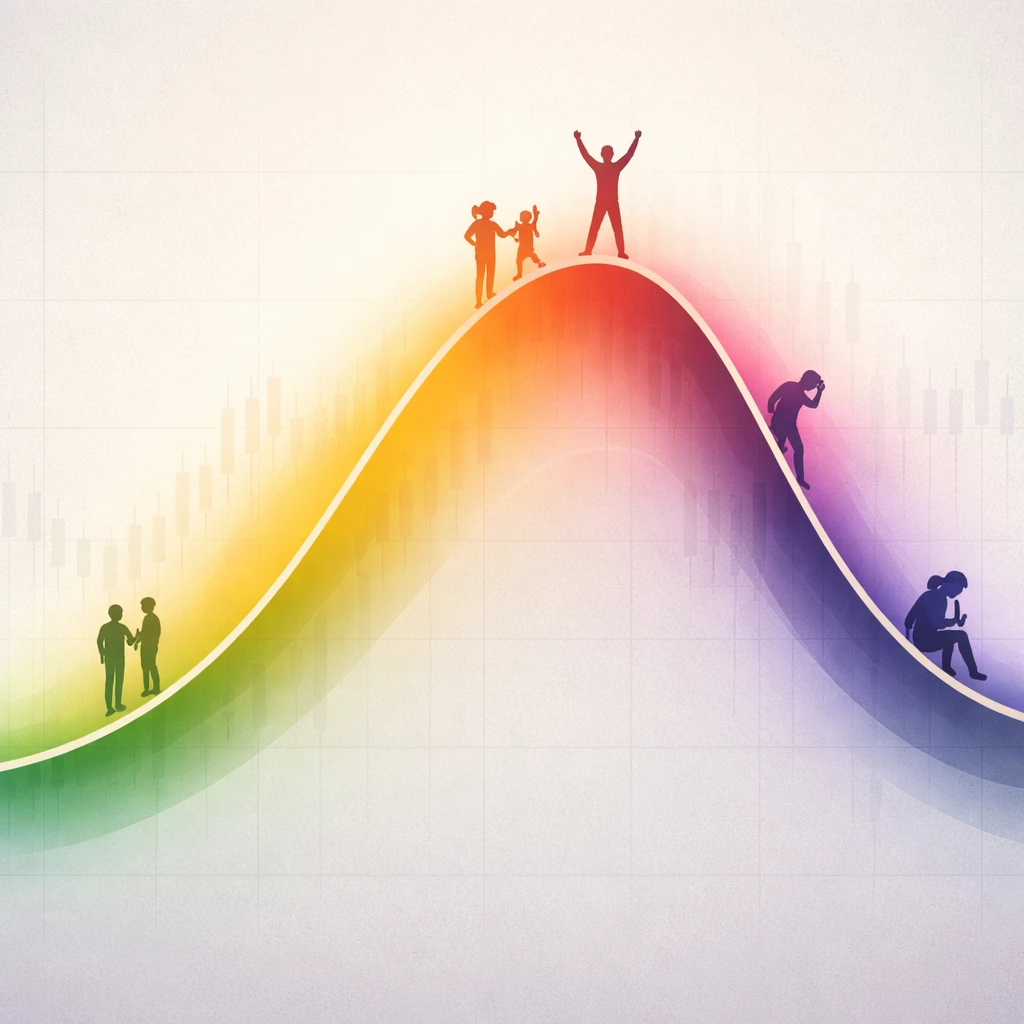
Markets aggregate information, incentives, and expectations, but they also aggregate emotion. Prices respond to changing fundamentals and liquidity, yet the path of those price changes is often shaped by collective swings in fear and optimism. The term emotional cycles in markets describes the recurring psychological patterns that tend to unfold as trends mature, reverse, and reset. Understanding these cycles is not a prediction tool. It is a lens for interpreting how feelings influence decisions under uncertainty, and how discipline can be compromised or supported by the broader emotional climate.
What Are Emotional Cycles in Markets?
Emotional cycles refer to recognizable sequences of sentiment that often accompany market moves. A typical arc begins with cautious optimism, builds through belief and enthusiasm, peaks at euphoria, then transitions to anxiety, denial, and capitulation as prices fall, before stabilizing into despondency and eventual renewed hope. The labels vary across sources, and no single sequence fits every episode. The key point is that collective mood tends to travel in patterns correlated with price and volatility.
This concept is descriptive, not deterministic. It does not claim that every bull or bear leg will traverse identical stages or duration. Instead, it suggests that human cognitive and emotional tendencies make certain reactions more likely at particular points in a move. For instance, extended gains can fuel overconfidence and risk underestimation, while prolonged losses can induce myopic focus on pain and heightened sensitivity to further downside.
Why the Concept Matters for Discipline
Discipline in markets involves consistent decision-making aligned with predefined principles. Emotional cycles challenge that consistency. When the crowd is exuberant, sticking to risk limits or analysis thresholds can feel unnecessarily conservative. During distress, taking any risk can feel intolerable, even when the analysis is unchanged. In both cases, the external emotional environment amplifies internal impulses, pulling decisions away from planned processes.
These cycles also affect the mechanics of long-term performance. Compounding is sensitive to drawdowns, and drawdowns are often magnified when fear or euphoria encourages impulsive changes in exposure or concentration. A single large mistake made at an emotional extreme can offset a series of sound decisions. By recognizing the recurring emotional backdrop, practitioners aim to reduce the probability of committing disproportionate errors during turning points.
Decision-Making Under Uncertainty
Financial decisions combine incomplete information, changing probabilities, and time pressure. Emotions interact with these constraints in predictable ways:
Affect heuristic. Feelings provide a rapid summary judgment about risk and reward. Positive mood can compress perceived risk and inflate perceived opportunity. Negative mood can do the reverse. This shortcut can be useful for quick triage, but it can distort probability assessments.
Loss aversion and myopic loss aversion. People tend to weigh losses more heavily than equivalent gains. When attention narrows to recent outcomes, small losses loom larger, encouraging premature abandonment of well-justified positions or principles. Conversely, a series of gains can reduce vigilance and encourage risk seeking.
Overconfidence and confirmation bias. Success reinforces the belief that one’s model is correct, while contradictory evidence receives less weight. This bias often crescendos near peaks in optimism, when alternative narratives feel implausible.
Recency bias and availability. Recent price action dominates expectations. During sharp rallies, investors extrapolate strength; during deep selloffs, they extrapolate weakness. This bias interacts with media coverage and social signals to intensify mood swings.
Stress and arousal effects. Moderate arousal can focus attention and improve vigilance. Excessive arousal, whether from excitement or fear, impairs working memory, narrows attention to salient but potentially misleading cues, and accelerates decision timing beyond what analysis supports.
The Anatomy of a Typical Emotional Arc
Descriptions of market cycles often map sentiment to a price curve. While schematic, such maps capture useful intuition:
Early recovery. Prices stabilize after a decline. Skepticism dominates, and participation is tentative. Underappreciated improvements begin to accumulate, but confidence is scarce.
Broadening optimism. Evidence builds. Participation expands. The memory of the last downturn fades, and investors begin to accept higher valuations or lower risk premia as reasonable.
Euphoria. Confidence peaks. New narratives justify stretched assumptions. Caution can appear outdated. Leverage or concentration becomes more common as perceived downside shrinks.
Stumble and denial. A setback arrives. Initially it is framed as noise. The dip seems buyable, and prior beliefs hold. If weakness continues, cognitive dissonance rises.
Fear, capitulation, and exhaustion. Selling accelerates as losses mount. Forced de-risking may occur. Participants seek certainty, even at unfavorable prices, simply to stop the discomfort.
Despondency to rebuilding. After an intense flush, attention shifts to capital preservation and reassessment. Gradually, data rather than emotion reenters the conversation, and a new cycle can begin.
This arc rarely unfolds cleanly. Different assets, sectors, or time horizons can sit in different emotional phases simultaneously. A long-term investor may be in rebuilding mode while a short-term participant in the same asset experiences euphoria or fear within a single week.
How Emotional Cycles Distort Perception and Choice
Emotional cycles change what feels salient. During euphoria, outlier successes and compelling stories occupy attention. During fear, worst-case scenarios dominate. The shift in salience affects three practical dimensions of choice:
Time horizon contraction. Elevated emotion shortens focus. Long-run analysis is displaced by immediate outcomes. This narrow perspective can misalign actions with the original objective of the position or portfolio.
Risk perception asymmetry. The same data is interpreted differently across phases. In optimism, soft data is granted the benefit of the doubt. In distress, even strong data is discounted.
Process abandonment. Routines that support disciplined decisions are skipped when they are most needed. Checklists, peer review, or scenario comparisons feel slow relative to the urgency of the moment.
Mindset-Oriented Examples
Example 1: The momentum of good news. A trader experiences several weeks of gains in growth stocks. Media attention is positive, colleagues are excited, and social feeds affirm the trend. The trader begins to view pullbacks as trivial and spends less time validating assumptions. When a material change in rates shifts valuation support, the trader’s first instinct is to reaffirm the prior narrative. By the time doubts surface, position sizing reflects the euphoria phase rather than the original plan. The result is not a strategy failure as much as a discipline failure under positive emotion.
Example 2: The discomfort of drawdowns. A portfolio manager faces a losing month driven by sector-specific weakness. Sleep quality deteriorates, and attention narrows to intraday swings. The manager reduces exposure repeatedly to avoid further pain, even in situations where analysis suggests unchanged fundamentals. Weeks later, the portfolio’s risk characteristics bear little resemblance to the initial mandate. The emotional climate produced a sequence of reactive decisions that compounded variance without clear evidence of improved expected outcomes.
Example 3: Sideways markets and frustration. An investor operating with a multi-quarter horizon becomes frustrated during a prolonged range. Small losses and reversals erode patience. The investor begins to switch frameworks frequently, hoping to reduce discomfort. The constant framework drift creates transaction costs and noise that mask whether the original thesis is wrong or simply early.
Feedback Loops: Why Emotions Amplify Price
Emotional cycles do not occur in a vacuum. Market structure and social dynamics create feedback loops:
Leverage and margin. Rising prices can encourage additional leverage, which adds sensitivity to future price declines. During stress, margin calls force sales that push prices lower, intensifying fear.
Benchmarking and career concerns. Underperformance relative to peers during exuberant phases increases pressure to participate, while underperformance during declines increases pressure to de-risk. These incentives align with the prevailing mood and can amplify it.
Information cascades. When people observe others taking the same side, they infer hidden information and follow. The cascade can overshoot fundamentals on both the upside and downside.
Media and social proof. Headlines and online signals compress complex narratives into simple stories. Repetition produces familiarity, which can be misread as truth, and the cycle tightens.
Recognizing Your Place in the Cycle
Identification often begins with internal cues rather than price charts. Practitioners describe several indicators that prompt a closer look at their state:
Physiological signals. Noticeably elevated heart rate, shallow breathing, or disrupted sleep can precede reactive decisions. These signals suggest arousal is high and attention may narrow.
Language and framing. When words such as always, never, or obviously dominate internal dialogue, it may indicate rising conviction divorced from probabilistic thinking.
Process drift. Skipping steps in analysis, removing cross-checks, or avoiding dissenting views often coincides with emotional extremes.
External saturation. When non-market acquaintances frequently discuss a hot theme, or when news coverage becomes one-sided, it may signal that sentiment is stretched, regardless of whether price will reverse.
Maintaining Discipline Without Predicting the Cycle
Emotional cycles are more useful for risk awareness than for timing. Practitioners often employ process supports that do not depend on forecasts:
Pre-commitment to process. Teams write decision criteria and documentation standards in calm periods. When emotions rise, the presence of a predefined process can anchor behavior.
If-then implementation intentions. Some decision-makers use conditional rules for their behavior, such as if a position moves a specified percentage in a short period, then a review with a colleague is scheduled. The rule manages behavior, not market direction.
Checklists and red-team reviews. Structured prompts reduce omission errors. Inviting a colleague to adopt the role of skeptic helps counter confirmation bias during optimism or fear.
Scenario ranges and base rates. Documenting plausible scenarios and historical frequencies supports perspective when emotions push toward single-outcome thinking.
Decision logs. Recording the rationale for entries, exits, or holds allows later evaluation. Over time, patterns emerge that reveal when emotional states were influencing choices.
These tools do not remove emotion. They create friction against impulsivity and preserve alignment with clearly articulated objectives.
Short and Long Horizons
Emotional cycles compress and stretch across timeframes. In fast markets or leveraged products, a complete emotional swing can occur within days. In broad indices or multi-asset portfolios, cycles can extend across quarters or years. The mismatch between personal horizon and market rhythm is a common source of strain. Short-term participants embedded in long-horizon strategies may feel perpetual impatience. Long-horizon participants who monitor tick-by-tick flows may experience elevated stress that adds no informational value. Calibrating information flow to the intended horizon can reduce emotional noise.
Group Dynamics and Shared Emotion
Market participants rarely operate in isolation. Desk conversations, meetings, and message channels transmit mood rapidly. Groups can improve discipline by distributing analysis and checking blind spots. They can also magnify extremes when social alignment matters more than evidence. Familiar dynamics include:
Groupthink pressure. Dissent feels costly when the group converges on a compelling story. The cost is higher in performance-chasing environments.
Reputational risk aversion. Individuals may avoid raising concerns at peaks of optimism to protect status, only to distance themselves after the fact.
Overcorrection after losses. Teams may react to a drawdown by broadly shrinking risk, even where the loss was specific to a subset of decisions. The emotional desire for visible action outweighs targeted responses.
Awareness of these dynamics helps keep discussions analytic rather than performative, particularly at cycle extremes.
Emotions as Information
Emotions are not the enemy of rationality. They encode experience, signal changes in the environment, and help prioritize attention. Fear can alert a decision-maker to rising uncertainty or overlooked convexity. Excitement can indicate opportunity recognition. The challenge is calibration. When emotion is disproportionate to evidence, it distorts behavior. When it is aligned with evidence, it can enhance vigilance and resolve.
One useful mindset is to treat emotion as a hypothesis generator. If fear spikes, one can infer that the distribution of outcomes feels wider or more negatively skewed and check whether the underlying inputs justify that impression. If excitement rises, one can check whether the thesis depends on assumptions that have quietly strengthened or on stories that have simply become popular.
Long-Term Performance and Survival
Long-term results are the product of many small decisions made across varied emotional climates. Emotional cycles primarily damage performance through two pathways: large errors committed near extremes and cumulative drift away from a coherent process. Avoiding catastrophic errors preserves capital and optionality. Avoiding process drift preserves the linkage between decisions and stated objectives, which makes evaluation meaningful. Together, these supports increase the chance that skill, if present, can express itself through time.
Survival has a mathematical aspect. Large drawdowns require disproportionately larger subsequent gains to recover. Emotional cycles tilt behavior toward these damaging drawdowns by encouraging concentration when risk feels low and capitulation when risk feels high. By recognizing the pattern, decision-makers can protect against their own worst days without needing to forecast the market’s next turn.
Common Pitfalls Related to Emotional Cycles
Several recurring mistakes are closely tied to emotional swings:
Overfitting to the latest regime. Rewriting models to fit recent winners or losers without sufficient out-of-sample validation is common near emotional peaks or troughs.
Shifting benchmarks mid-course. During euphoria, participants compare themselves to the highest-returning peers. During fear, they compare to cash or the most defensive peer group. The moving yardstick masks process quality.
Escalation of commitment. Adding to a position primarily to avoid admitting error, or exiting primarily to avoid further discomfort, both reflect emotion-led decision-making rather than evidence-led adjustments.
Neglect of capacity and liquidity. Excitement can drive position sizes beyond what liquidity can support in stress, creating vulnerability to feedback loops during declines.
Information diet imbalance. During extremes, the mix of inputs often shifts toward short, frequent, and emotionally laden content. The signal-to-noise ratio deteriorates just as important decisions loom.
Practical Reflections for Individual Discipline
Several non-prescriptive reflections can help align mindset with disciplined practice:
Separate analysis from identity. When a thesis becomes part of personal identity, disconfirming data feels like a threat, and emotion rises. Keeping identity tied to process quality reduces pressure to defend any single view.
Clarify the unit of evaluation. Decide in advance whether success is judged per trade, per week, or per quarter. Without clarity, emotional cycles will push evaluation to the most flattering or least painful window.
Design friction deliberately. Cooling-off intervals, second-reader reviews, and structured notes slow decisions at emotional peaks. The goal is not delay for its own sake, but protection against avoidable mistakes.
Right-size information flow. Match the frequency and type of updates to the time horizon. Excess monitoring can induce action bias without improving inference.
Use counterfactuals judiciously. Comparing results to what might have happened can inform learning, but it can also feed regret. During extremes, limit speculative counterfactuals and focus on whether the decision process was followed.
Limits of the Emotional Cycle Framework
The emotional cycle narrative is a simplification. Several caveats apply:
Heterogeneity of participants. Different investors have distinct constraints, mandates, and horizons. Their emotional trajectories can diverge, and aggregate sentiment can mask critical differences between subgroups.
Structural shifts. Changes in policy, technology, or market microstructure can alter how emotions translate into price. For example, the presence of passive flows or systematic strategies can change the speed and amplitude of moves.
Non-repeatability of specific paths. Even if cycles recur, no two instances are identical. Using the framework as a timing tool risks overconfidence in pattern recognition.
Data limitations. Sentiment is hard to measure cleanly. Surveys, positioning data, options pricing, and media tone each provide partial views. Reliance on any single measure can mislead.
Integrating the Concept Into a Professional Mindset
Professionals integrate awareness of emotional cycles into culture and routines rather than forecasts. This often includes explicit discussions about current emotional climate, documentation of process deviations for later review, and ongoing calibration of information flow to objectives. The objective is not to eliminate emotion. It is to ensure that emotion informs rather than dominates choice.
Key Takeaways
- Emotional cycles describe recurring sentiment patterns that tend to accompany market trends, but they are descriptive and not timing tools.
- These cycles influence discipline by altering risk perception, shortening horizons, and encouraging process abandonment at extremes.
- Decision-making under uncertainty is sensitive to affect, loss aversion, and recency, which can distort probability judgments during euphoria and fear.
- Practical supports such as pre-commitment to process, structured reviews, and decision logs help counter impulsivity without relying on market predictions.
- Long-term performance benefits from avoiding large errors at emotional extremes and from preventing cumulative drift away from a coherent, documented process.