
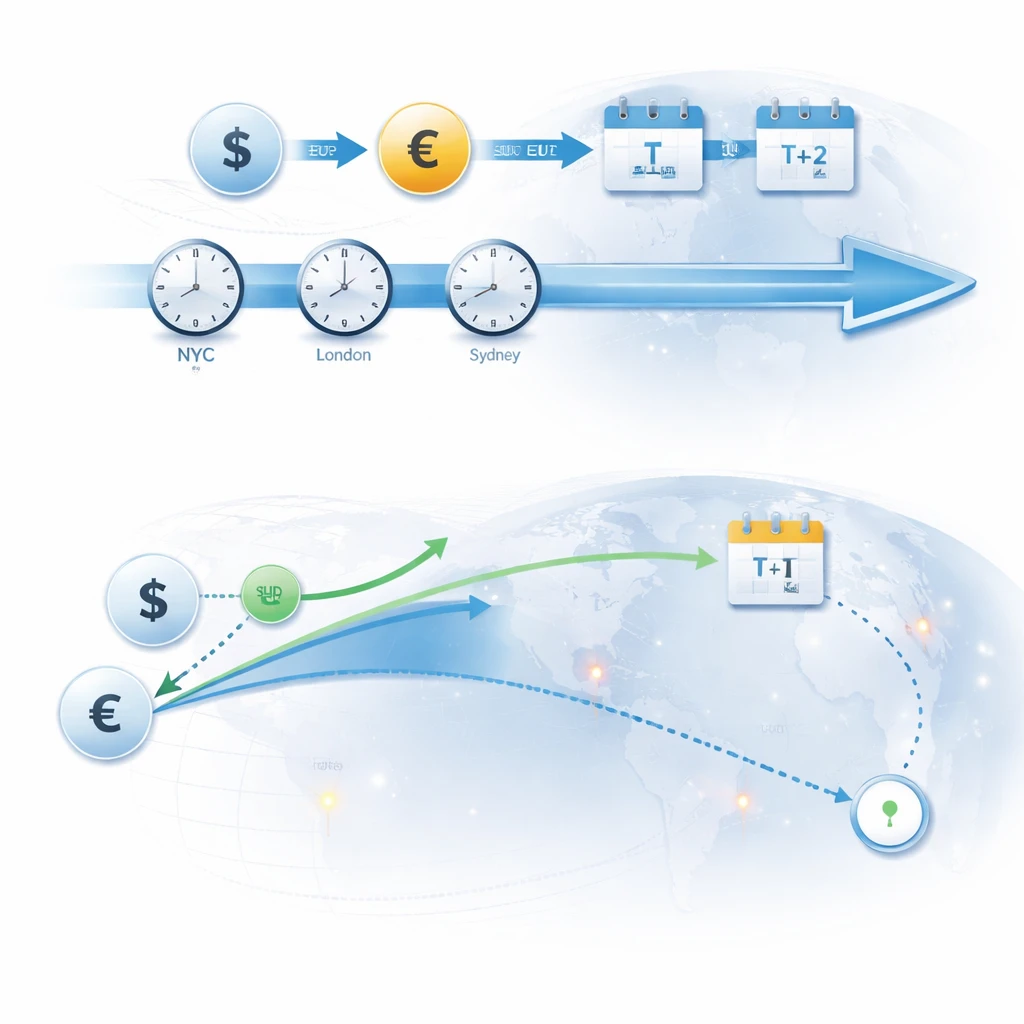
Foreign exchange is the largest and most liquid financial market, connecting currencies and payment systems across jurisdictions. Within this market, two basic transaction types organize most activity: spot FX and forward FX. Understanding their definitions, pricing logic, settlement conventions, and practical uses is a core part of currency market literacy. The distinction shapes how cash moves across borders, how interest rate differentials are reflected in exchange rates, and how institutions align future currency needs with present-day pricing.
Defining Spot FX
Spot FX is an agreement to exchange one currency for another at a price agreed today, with settlement on the standard spot date. In most major currency pairs, the spot date is the second good business day after the trade date, often described as T+2. Some pairs have different conventions. For example, USD–CAD typically settles T+1. The value date is adjusted for local currency holidays and business day calendars in both jurisdictions.
Spot FX is quoted continuously during global trading hours by banks, electronic communication networks, and market makers. Quotes appear as a bid and an ask. The bid is the price at which a dealer is willing to buy the base currency, and the ask is the price at which the dealer is willing to sell the base currency. The difference is the spread, which compensates the dealer for inventory risk, operating costs, and balance sheet usage.
Settlement and Operations in Spot FX
Spot FX settles with the physical delivery of the two currencies to the parties’ designated accounts. Settlement risk, sometimes called Herstatt risk, arises because the two legs of payment may occur at different times during the day due to time zones and payment system cutoffs. Market infrastructure such as CLS Bank provides payment-versus-payment settlement for eligible currencies, which reduces settlement risk by ensuring both legs complete simultaneously.
Operationally, spot settlement relies on accurate instructions, correct value dates, and alignment with cutoffs in payment systems such as Fedwire, CHAPS, TARGET, and domestic RTGS systems. Any failure in instructions or funding can cause a failed settlement, with potential operational costs and reputational consequences.
Liquidity and Market Structure
Spot FX underpins price discovery for the entire currency complex. Interbank venues such as EBS and Refinitiv Matching, along with multi-dealer platforms and single-dealer portals, facilitate continuous quoting. Liquidity is deepest during overlapping trading sessions across London, New York, and to a lesser degree Tokyo and Singapore. Spreads tend to compress in liquid hours and widen during holidays, data releases, or stress events.
A Simple Spot Example
Suppose a European distributor purchases goods priced in dollars and needs USD in two business days to settle an invoice. The distributor enters a EUR–USD spot trade, agreeing to exchange euros for dollars at today’s spot rate with settlement on the spot date. The agreed price and the resulting amount of USD will be fixed today, although the actual cash payments occur on settlement day.
Defining Forward FX
Forward FX is an agreement today to exchange one currency for another on a future date beyond spot, at a rate agreed at inception. There is no exchange of principal until the forward value date. A simple forward, often called an outright forward, sets a single price for that future exchange. A closely related instrument, the FX swap, combines a spot exchange with a forward reversal and is used for funding and rolling positions. The outright forward, however, is the straightforward contract that delivers one currency against another on a specified future date.
Forward Dates and Conventions
Forwards can be arranged for standard maturities such as one month, three months, and six months, or for so-called broken dates that match the precise calendar needs of the parties. The forward value date must be a good business day in both currencies based on relevant holiday calendars. Day-count conventions from money markets feed into the valuation of forward points, and the date roll follows established rules such as modified following, although the specific application depends on the currencies and the documentation that governs the trade.
How Forward Prices Are Determined
The forward rate does not imply a prediction of where the future spot will be. Rather, it reflects interest rate differentials between the two currencies over the contract period. The standard no-arbitrage relationship, sometimes summarized by covered interest parity, links the current spot rate, the domestic and foreign interest rates, and the forward rate. Abstractly, the higher interest rate currency tends to trade at a forward discount relative to the lower interest rate currency, all else equal.
In practice, dealers quote forward points, which are the difference between the forward rate and the spot rate expressed in pips. If points are positive, the forward rate will be above spot for the conventional currency quoting style. If they are negative, the forward rate will be below spot. The size and sign of forward points are influenced by short-term interest rates, cross-currency basis, credit conditions, and supply or demand for funding in specific maturities.
An Outright Forward Example
Consider a Japanese manufacturer that knows it must pay a US supplier in dollars three months from now. The manufacturer objects to the uncertainty that would come from waiting until three months to source USD in the spot market. It agrees today on a three-month USD–JPY outright forward. The forward rate is set by current spot and forward points derived from interest rates in dollars and yen and any basis that dealers apply. On the forward value date, the manufacturer delivers yen and receives dollars, exactly as agreed at inception.
Non-Deliverable Forwards
For currencies with capital controls or limited convertibility, market participants often use non-deliverable forwards (NDFs). An NDF references an official or market spot fixing on the settlement date and settles the difference in a convertible currency, commonly USD. There is no exchange of principal in the restricted currency. NDFs allow pricing of forward exchange rates and management of currency exposures where deliverable forwards are impractical. Key NDF centers include Singapore, London, and New York, with common tenors from one month to one year.
Documentation, Credit, and Collateral
Forward FX, like most over-the-counter derivatives, is typically executed under standardized legal frameworks such as ISDA Master Agreements, often with Credit Support Annexes that govern collateral. Counterparty credit exposure arises because the forward contract has a mark-to-market value between trade date and settlement. Collateralization and margining reduce but do not eliminate counterparty risk. Spot FX also involves settlement risk, but it does not have the same long-dated mark-to-market exposure that forwards carry.
How Spot and Forwards Fit into the Market Structure
The FX market is largely over the counter, with banks and dealers providing liquidity to corporations, asset managers, hedge funds, sovereigns, and retail aggregators. Spot desks stream prices and manage inventory by internalization and interbank hedging. Forward and swap desks source forward liquidity, hedge interest rate exposures, and manage term funding in multiple currencies.
Pricing on the forward curve is anchored in money markets and cross-currency funding conditions. The spot rate provides the reference point, and forward points translate relative interest rates into future exchange rates for specific maturities. During market stress, cross-currency basis can widen, shifting forward points in ways that reveal funding shortages or balance sheet constraints. This transmission mechanism ties the FX market closely to global dollar funding conditions and domestic money markets.
Relationship Between Forwards and FX Swaps
An FX swap combines a spot leg and a forward leg. The initial spot exchange provides currency funding now, and the forward leg reverses it on a later date at a price determined by the same interest differential logic. Dealers often quote and risk manage in swap points, which are mathematically equivalent to forward points for the same maturity. While an outright forward results in a single future exchange, an FX swap changes funding now and then reverses it later. The two instruments are connected by pricing and by the need to manage currency funding across time.
Venues and Execution
Spot is active on anonymous central limit order books for interbank trading and on disclosed request-for-quote platforms for clients. Forwards and swaps trade mostly by request for quote or through streaming points layered over spot feeds. Because forwards embed credit exposure over time, pricing includes an element for counterparty credit and collateral terms, which can lead to client-specific quotes even when the underlying spot and interest rates are the same.
Settlement Infrastructure
Spot settlement relies on payment systems and, for many currencies, CLS. Forward outright settlement on the value date also uses payment systems, often with pre-advised instructions and pre-funding arrangements. For NDFs, settlement is a net cash payment in the settlement currency. Accurate management of cutoffs, standard settlement instructions, and confirmation matching reduces operational errors for both spot and forward transactions.
Why Spot and Forwards Exist
Several economic and operational motives explain why the market uses both spot and forwards rather than a single instrument.
- Immediate currency needs. Spot FX matches immediate funding and payment requirements. When a company needs to pay an invoice in two business days, spot aligns with the settlement cycle of trade documentation and banking processes.
- Intertemporal pricing. Forwards translate relative interest rates into future exchange rates. This allows market participants to lock a future exchange without altering their balance sheet today, aside from mark-to-market considerations and collateralization.
- Funding flexibility. The combination of spot and swaps allows institutions to raise or place funds in alternative currencies for defined periods and to respond to short-term imbalances in cash flow.
- Operational certainty. Many cross-border contracts specify amounts in a foreign currency at a future date. Forwards provide a deterministic conversion on that date, which assists in budgeting, accounting, and risk measurement.
- Market completeness. The presence of both spot and forwards creates a more complete market, enabling term structures of prices across maturities. This improves price discovery and allows the FX market to reflect conditions in money markets and bond markets.
Real-World Context and Examples
Exporters and Importers
An exporter invoicing foreign clients faces a timing mismatch between recognizing revenue and receiving foreign currency cash. Spot FX addresses near-term receipts or payments when cash changes hands within standard settlement windows. Forward FX aligns future deliveries or payments with a predetermined exchange, reducing uncertainty in financial planning. Contracts may specify different currencies in different stages, and firms often micromanage date alignment to match when cash will actually move.
Global Bond Portfolios
Consider an asset manager who holds foreign currency bonds. Coupon receipts and principal repayments occur on future dates. The manager maps those dates to forward maturities. The forward curve derived from overnight and term interest rates provides the pricing to convert those cash flows into the base currency at known rates. Depending on the portfolio’s mandate and reporting currency, this use of forwards can help attribute returns between local bond performance and currency effects. The interaction between forwards and repo markets also influences practical availability of term pricing.
Project Finance and Cross-Border Contracts
Large infrastructure or energy projects often involve multi-year contracts denominated in a currency different from the sponsors’ functional currency. Forward FX along a schedule of milestone payments gives clarity on future conversions. Broken-date forwards allow exact matching of irregular milestones. Documentation for such projects commonly embeds provisions that depend on forward availability and defines the settlement currency of any contractual adjustments.
Central Banks and Sovereign Entities
Reserve managers operate in spot to rebalance currency holdings, fulfill intervention mandates, or meet payment needs. They may also use forwards and swaps to manage short-term liquidity in the reserve portfolio or to facilitate currency provision to domestic banks during stress. The pricing of forwards during market stress often reflects the scarcity or abundance of specific currencies, which central banks monitor as an indicator of funding conditions.
Restricted Markets and NDFs
In markets with capital controls, the inability to deliver the local currency offshore leads to an NDF market where forward pricing still embeds interest differentials and basis factors. Corporates with forecast cash flows in those currencies may reference NDFs for planning. Because settlement occurs in a convertible currency, operational risk differs from deliverable forwards, and the fixing methodology for the reference spot rate becomes a critical term.
Pricing Mechanics in Detail
Although dealers often quote forward points directly, it is useful to connect those points to underlying interest rates. A stylized relationship links spot, forward, and interest rates for the two currencies over the period to maturity. If the domestic currency yields more than the foreign currency, the domestic currency tends to trade at a forward discount. If it yields less, it tends to trade at a forward premium. This pricing is not a forecast but an algebraic consequence of financing costs.
Forward points are measured in pips and often quoted as bid and ask around a mid. A dealer might show +12.5 pips at one month for a given pair, which would be added to or subtracted from spot depending on the quote convention. The correct application depends on whether the market convention quotes the pair as domestic per foreign or foreign per domestic. Misapplying points is a common operational error for novices. Dealers standardize terms in confirmations to reduce such errors.
Cross-currency basis can cause deviations from simple interest differentials. This basis reflects frictions such as balance sheet constraints, regulatory costs, or collateral mismatches. During stressed periods, the basis can widen, altering forward points even if policy rates are unchanged. Observing forward points across maturities yields insight into funding conditions and banks’ demand for a given currency.
Operational Considerations and Risk
Much of FX practice involves getting dates, instructions, and calculations correct. The calendars for both currencies must be considered to determine good business days. Some pairs have non-aligned public holidays that can push value dates further than expected. When rolling a position, dealers use short-dated swaps termed tom/next or spot/next to shift the value date by one day. Cutoff times, market conventions for rollovers, and the treatment of weekends all matter for accurate cash management.
Counterparty risk differs between spot and forwards. In spot, the primary risk is failed settlement on value date and the associated replacement cost. In forwards, mark-to-market exposure can persist from trade date until maturity, especially for longer tenors. Collateralization practices, such as daily variation margin under a Credit Support Annex, reduce exposure. The legal framework, netting provisions, and dispute resolution processes support robust risk management.
Valuation and accounting require consistent application of discount curves and spot sources. Forward valuations depend on the current spot, the relevant interest rates over the remaining term, and any basis adjustments. For NDFs, the fixing source and time are critical because a small change in the reference rate can alter the cash settlement. Accounting standards differentiate between deliverable forwards and NDFs, and between hedging and non-hedging designations. Organizations align their documentation and systems accordingly.
Liquidity profiles vary across instruments and maturities. Spot in major pairs is deep. Forwards in liquid tenors such as one and three months are usually accessible, while very long-dated forwards or certain exotic pairs may be thinly quoted. NDF liquidity depends on the currency and tenor. Quotes widen during holidays, around major data releases, and during periods of stress. Execution quality reflects both the underlying market and the credit and collateral terms attached to a specific counterparty relationship.
Comparing Spot and Forward FX
Spot and forward FX serve different temporal needs and express different facets of the same market. Spot is about immediate exchange with near-term settlement, centered on price discovery and transactional liquidity. Forward is about aligning a future exchange with today’s pricing of time value, which links the FX market to money market conditions.
On a quote screen, the spot rate is the headline number. Forwards appear as forward points or outright forward rates for specific maturities. A single forward rate embeds a path of expected funding costs and market frictions over the period. The presence of an active forward curve communicates information about expected central bank policies, collateral terms, and cross-currency funding, even though it does not predict future spot levels.
Operationally, spot involves immediate post-trade processes to confirm instructions and fund settlement in two days. Forwards involve ongoing credit exposure management, collateral movements, and periodic revaluation. These differences shape how institutions allocate responsibilities across trading desks, treasury, operations, and risk management.
What You Will See on Actual Quotes and Confirmations
Market participants encounter a consistent set of fields in RFQs and trade confirmations:
- Currency pair and direction. Pairs are quoted in a standard base-terms format. The direction clarifies which currency is being bought or sold.
- Trade date and value date. Spot is typically T+2, while forwards specify a future value date. Tom/next and spot/next swaps adjust the date by one day when operational needs require it.
- Rate and points. Spot prints as a rate. Forwards may print as an outright rate or as spot plus points. The sign convention of points follows market standard for the pair.
- Notional and settlement instructions. These define how much of each currency will change hands and to which accounts, usually via standard settlement instructions lodged with custodians or banks.
- Documentation and collateral terms. For forwards and NDFs, confirmations reference the master agreement, netting framework, and any collateral arrangements that condition pricing and exposure.
Limitations and Sources of Friction
No market is frictionless. Several factors commonly affect the relationship between spot and forwards:
- Holiday and calendar effects. Non-overlapping holidays can widen forward points around specific dates and complicate settlement planning.
- Credit and collateral. Counterparties with different credit profiles or collateral schedules may receive different forward pricing even when observing the same spot and interest rates.
- Regulatory and balance sheet costs. Dealer quotes incorporate capital and liquidity costs, which can be more pronounced for longer tenors or during balance sheet reporting periods.
- Basis risk. When proxy instruments are used to approximate a desired exposure, differences in fixing sources or calendars can create residual mismatches.
- Market stress. In stressed conditions, forward points can move sharply due to funding shortages or risk aversion, and liquidity can deteriorate, especially in longer tenors or less-traded pairs.
Bringing the Concepts Together
Spot and forward FX form a single continuum organized by time. Spot anchors the market with immediate prices and settlement. Forwards project the cost of carrying one currency against another into the future. Their coexistence ensures that currency exchange is available at both immediate and future dates, with pricing that integrates interest rates, credit terms, and market frictions. Institutions use this structure to organize cash flows, align accounting with economic exposures, and transmit funding conditions across borders.
Key Takeaways
- Spot FX exchanges currencies at a price agreed today for settlement on the standard spot date, usually T+2, and underpins price discovery and liquidity in the currency market.
- Forward FX sets a future exchange at a rate determined today, with pricing driven by interest rate differentials, cross-currency basis, and collateral terms rather than forecasts of future spot.
- The forward curve connects FX to money markets and funding conditions, while spot provides the anchor price used to derive forward points and outright forwards.
- Operational details such as calendars, settlement infrastructure, and documentation matter for both spot and forwards, with added credit and collateral considerations for forwards and NDFs.
- Real-world users include corporates, investors, and public institutions that align currency exchanges with actual cash flow timing through spot for immediate needs and forwards for future dates.