
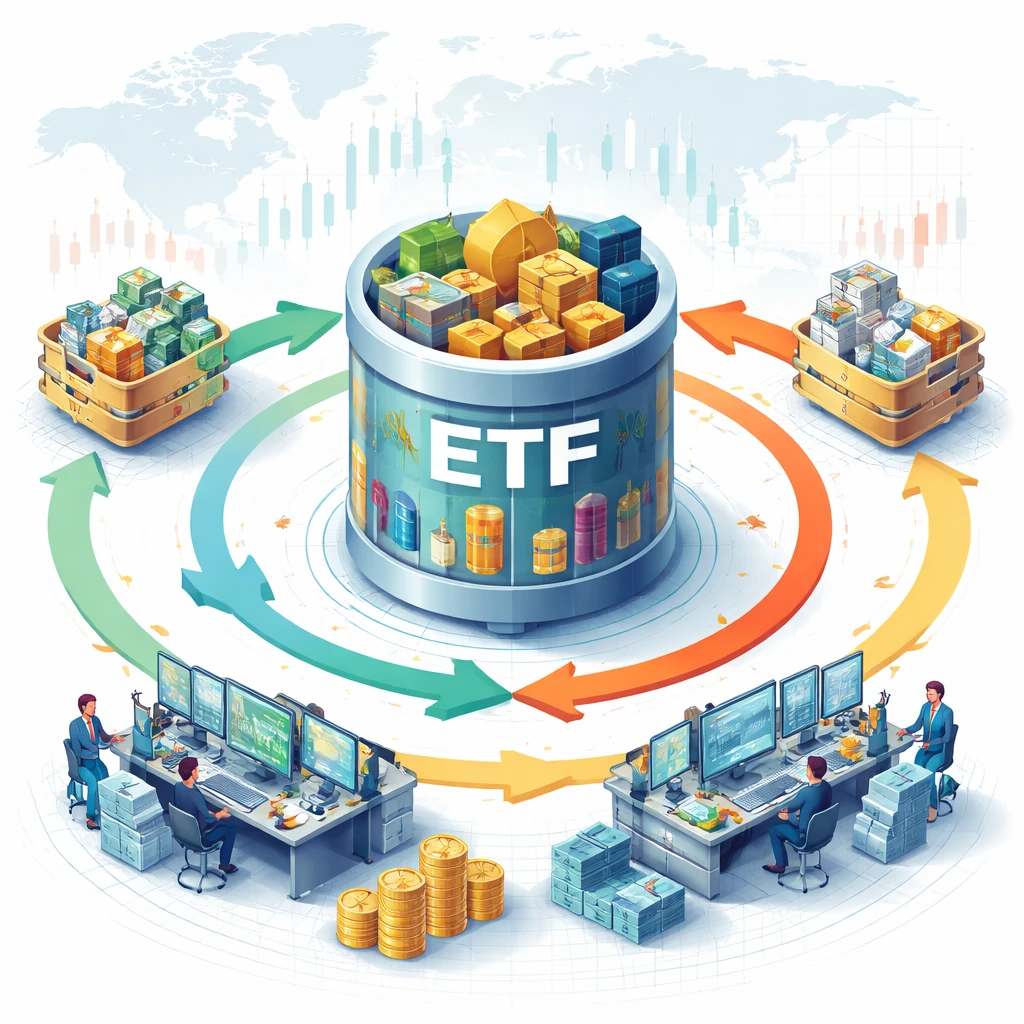
An exchange-traded fund, commonly called an ETF, is a pooled investment vehicle that holds a portfolio of assets and issues shares that trade on an exchange. Each share represents a proportional claim on the ETF’s underlying holdings. Unlike traditional mutual funds, which are bought and sold once per day at net asset value, ETF shares trade throughout the day at market prices set by supply and demand. The design seeks to combine diversified exposure with the convenience of exchange trading.
ETFs occupy an important place in modern market structure. They connect individual and institutional market participants to broad or targeted segments of equities, bonds, commodities, or other exposures through a standardized, regulated wrapper. Understanding what an ETF is requires looking at both its legal form and its trading mechanics, and seeing how those elements interact with the larger ecosystem of exchanges, brokers, custodians, and market makers.
Core Definition and Economic Purpose
An ETF is an investment fund that issues shares which are listed on a stock exchange. The fund typically follows a stated objective, often to track the performance of an index. The fund holds a portfolio of assets that is intended to match or closely approximate the target exposure. The prices of ETF shares fluctuate during market hours, and investors can buy or sell those shares through brokerage accounts in the same manner as they would buy or sell a listed stock.
The economic purpose of an ETF is to deliver a set of exposures in a cost-efficient, operationally simple wrapper. For many investors, constructing a diversified portfolio security by security is impractical. ETFs reduce that challenge by pooling capital and executing a coherent investment policy across many underlying instruments. The exchange listing allows continuous secondary market liquidity, which separates the timing of investor demand from the fund’s portfolio management activities.
How ETFs Fit Into the Broader Market Structure
ETFs belong to the family of pooled vehicles that also includes mutual funds, index funds, unit investment trusts, closed-end funds, and exchange-traded notes. Each structure solves a similar problem of aggregation with different trade-offs in pricing, liquidity, and governance. ETFs are distinct because they combine intraday exchange trading with a creation and redemption mechanism that links the market price of the ETF to the value of its underlying holdings.
At a high level, the ETF market operates across two layers:
- Primary market. Large financial institutions, often called authorized participants, interact directly with the ETF issuer. They deliver a specified basket of assets to the fund in exchange for newly issued ETF shares, or they return ETF shares to the fund and receive the basket. This process is called creation and redemption.
- Secondary market. Once ETF shares exist, they trade between buyers and sellers on an exchange. Market makers quote bid and ask prices. Most individual transactions occur in this layer without the fund needing to transact in the underlying securities.
This two-tier structure helps align ETF share prices with the value of the fund’s holdings. If ETF shares drift away from the value of the underlying basket, professional traders can profit by creating or redeeming shares, a process that tends to close the gap.
Why ETFs Exist
ETFs emerged to combine several advantages that were historically scattered across different vehicles:
- Operational simplicity. Exchange trading allows straightforward access through standard brokerage infrastructure.
- Diversification. One share can represent exposure to many securities or a defined segment of the market.
- Transparency. Many ETFs publish their holdings daily or disclose their index methodology, which clarifies what exposure is being delivered.
- Cost control. Competition and scale have often led to relatively low ongoing fees. Trading costs and spreads still matter, but the internal cost of management is usually transparent as an expense ratio.
- Tax and accounting features. In some jurisdictions, in kind redemptions can reduce realized capital gains within the fund. This benefit is not universal and depends on local regulation and fund design.
These features explain the growth of ETFs across equity, fixed income, and alternative exposures. The mechanism is not a guarantee of superior outcomes, but it is a practical solution to packaging investable exposures in a liquid, regulated format.
What an ETF Owns and How It Tracks
Most ETFs follow a benchmark index. The fund can hold every constituent in the index, called full replication, or it can sample a subset designed to mimic the risk and return characteristics of the index. Sampling is common in fixed income ETFs where the underlying index can contain thousands of bonds that trade infrequently and in small sizes.
Tracking is never perfect. The difference between the ETF’s performance and its benchmark is known as tracking difference. Several factors contribute to this gap: expense ratios, transaction costs, sampling, cash drag from dividends before reinvestment, securities lending practices, and any index reconstitution frictions. A separate but related concept is tracking error, which measures the variability of that difference over time.
Creation and Redemption Mechanics
The distinctive feature of ETFs is the ability to create and redeem shares in large blocks called creation units. Authorized participants, typically large broker dealers, deliver the specified portfolio of securities or cash to the ETF in exchange for a block of new ETF shares. Conversely, they can return ETF shares and receive the portfolio in return.
There are two common modes:
- In kind. The AP delivers or receives a list of securities closely matching the ETF’s holdings. This method limits the need for the fund to trade in the market, which can reduce transaction costs within the fund.
- Cash. The AP provides cash and the fund purchases the necessary securities, or the fund sells securities and pays cash. Cash transactions are more common in markets where in kind transfers are impractical or in some actively managed ETFs.
The daily list of securities that can be used for creation or redemption is called the creation basket or redemption basket. It is designed so that APs can assemble or deliver the basket efficiently. The exchange of baskets for ETF shares is typically conducted at or near the fund’s net asset value, which helps anchor the market price to underlying value.
Pricing, NAV, and Intraday Values
An ETF’s net asset value is calculated by totaling the market value of its holdings, subtracting liabilities, and dividing by the number of shares outstanding. NAV is usually computed once per day after the market close for the fund’s primary listing. During market hours, exchanges or data vendors publish an intraday indicative value, sometimes called iNAV, that estimates the per share value of the ETF’s portfolio in real time.
ETF shares trade at market prices that can be slightly above or below NAV. The difference is called the premium or discount. In normal conditions, arbitrage by APs and market makers tends to keep prices close to NAV. Deviations can widen when the underlying securities are closed or illiquid. For example, a United States listed ETF that holds Japanese equities can trade while the Tokyo exchange is closed. During those hours, market prices reflect expectations based on currency movements and related instruments rather than live quotes for the underlying shares.
Secondary Market Liquidity and the Role of Market Makers
Liquidity in ETFs has two layers. The first is the on screen depth that traders can see. The second is the potential liquidity that arises from creations and redemptions with the underlying securities. Even if the visible order book appears thin, an experienced market maker can source the underlying basket and price a trade accordingly. The cost of this service appears in the bid ask spread and in any price impact from larger orders.
Market makers manage inventories of ETF shares and the associated hedges. They set quotes based on the estimated value of the underlying basket, expected volatility, hedging costs, and competition from other liquidity providers. In stressed markets, spreads often widen as the cost of hedging increases. When underlying bonds or loans trade infrequently, the ETF’s price can reflect a more continuous assessment of value than the last recorded cash trade, which is one reason fixed income ETFs sometimes appear to move ahead of individual bond prices during volatile periods.
Comparison With Other Fund Structures
Mutual funds. Shares of open end mutual funds are purchased and redeemed at end of day NAV. This simplifies pricing but eliminates intraday trading. Mutual funds do not use exchange market makers and do not have a creation basket mechanism. Operational differences can lead to different tax and transaction cost outcomes depending on jurisdiction and fund policy.
Closed end funds. CEFs issue a fixed number of shares that trade on exchanges. They do not generally offer ongoing creation or redemption. As a result, premiums and discounts relative to NAV can persist for long periods. ETFs, by contrast, typically limit persistent gaps through the arbitrage link to the underlying basket.
Exchange traded notes. ETNs are unsecured debt obligations of an issuing bank with returns linked to an index. They do not hold a portfolio of assets. ETN pricing and risk depend on the creditworthiness of the issuer as well as the index performance. This structural difference separates ETNs from ETFs even though both trade on exchanges.
Types of ETFs
ETFs span a wide range of exposures. Common categories include:
- Broad market equity. Portfolios that aim to represent entire markets or large segments, such as total market or large cap indexes.
- Sector and industry. Funds targeting technology, healthcare, financials, or other defined segments.
- Factor or style. Portfolios constructed around characteristics such as value, quality, momentum, or low volatility. These approaches follow published methodologies to tilt exposures toward selected attributes.
- Fixed income. Government, corporate, municipal, or high yield bond portfolios. Some target specific maturities or credit qualities.
- Commodity and currency. Structures vary. Some hold futures contracts. Others hold physical bullion through a trust. Currency funds may hold deposits or futures.
- Thematic and niche. Portfolios based on themes such as clean energy or cybersecurity. These funds often rely on custom indexes or active management to define membership.
- Active ETFs. Portfolios managed with discretion to select securities rather than track a static index. Disclosure practices vary by jurisdiction. Some publish holdings daily. Others use proxy portfolios to protect trading strategies while still supporting market making.
- Synthetic or swap based. In certain markets, funds obtain exposure through derivatives such as total return swaps rather than holding the physical basket. This introduces counterparty risk and requires collateral management.
Governance, Custody, and Regulation
ETFs operate within a defined legal framework that sets standards for disclosure, custody, valuation, and shareholder rights. In the United States, most ETFs are organized under the Investment Company Act of 1940 or, in the case of commodity pools and grantor trusts, under other applicable statutes and regulations. In the European Union, many ETFs follow the UCITS framework, which prescribes diversification and liquidity requirements and sets rules for eligible assets. Local listing rules and exchange regulations add another layer of oversight.
Custodians hold the fund’s assets separate from the issuer’s balance sheet. Independent auditors review financial statements. Index providers license methodologies and supply constituent data that funds use to construct and rebalance portfolios. Transfer agents and administrators maintain shareholder records and handle operational tasks such as calculating NAV, processing creations and redemptions, and publishing reports. This infrastructure is designed to create clear accountabilities and to limit operational risk.
Costs and the Sources of Tracking Difference
Every ETF has an expense ratio that covers management fees and operating costs. Additional costs arise from trading spreads, brokerage commissions, and any market impact from large orders. There can also be creation and redemption fees at the fund level to offset portfolio transaction costs, although these are usually borne by the APs transacting directly with the fund.
The realized performance of an ETF relative to its index depends on the sum of these frictions. Securities lending revenue, when applicable, can partially offset expenses. Index methodology changes, corporate actions, and dividend timing add further nuance. For bond ETFs, pricing sources and fair value adjustments can influence daily NAV, which in turn affects measured tracking difference.
Premiums, Discounts, and When They Occur
Premiums and discounts arise when the ETF’s market price diverges from NAV. The magnitude and persistence depend on the efficiency of the arbitrage mechanism and the liquidity of the underlying securities. Typical situations include:
- Underlying market closed. International equity ETFs can trade at apparent premiums or discounts while their home markets are closed. Once the local markets reopen, prices often realign with updated information.
- Underlying illiquidity. If the ETF holds instruments that trade infrequently, the ETF’s price may move ahead of stale marks in the NAV. This can be visible during periods of market stress.
- Operational constraints. Suspension of creations or redemptions, exchange halts, or index rebalances can affect the normal flow of arbitrage and widen gaps.
Real World Illustrations
An equity ETF tracking a broad index
Consider a large ETF that aims to track a widely followed equity index. The fund publishes a creation basket each morning. Throughout the day, market makers quote prices based on live values of the underlying stocks. If the ETF’s price rises slightly above the value of the basket, an AP can buy the underlying stocks, deliver them to the fund, and receive new ETF shares. Those shares can then be sold at the higher market price. This process increases supply and tends to bring the ETF price back in line. The reverse occurs if the ETF trades at a discount.
A bond ETF during a volatile session
In fixed income, many bonds do not trade continuously. During a volatile session, the ETF’s price may reflect the market’s best estimate of bond values derived from futures, interest rate swaps, and related instruments. NAV may lag because it uses evaluated prices that change on a delayed basis. When bond markets reopen or liquidity improves, NAV and ETF prices typically converge. This behavior does not imply that the ETF is broken. It reflects the different speeds at which information flows through the underlying market and the exchange-traded wrapper.
Distributions, Reinvestment, and Corporate Actions
Most equity ETFs collect dividends and periodically distribute them to shareholders. Some funds distribute monthly or quarterly. Bond ETFs distribute the interest income they receive from their holdings. The fund’s prospectus spells out the distribution policy, including how capital gains are handled and whether the fund seeks to minimize them through in kind redemptions. Shareholders can often choose to receive cash or enroll in a dividend reinvestment plan at the brokerage level, subject to local availability and terms.
Corporate actions such as stock splits, mergers, rights issues, and tender offers flow through to ETF holdings according to index rules or portfolio manager decisions. The administrator adjusts shares and cash balances, and the ETF’s published holdings reflect these changes. During index rebalances, funds trade to align with the new constituent list and weights. These events are routine but can temporarily increase turnover and trading costs within the fund.
Risk Dimensions Specific to ETFs
ETFs carry the risks inherent in their underlying assets. Equity market risk, interest rate risk, credit risk, currency risk, and commodity price risk all transfer through the wrapper. In addition, ETFs introduce structure specific considerations:
- Liquidity risk. While ETF shares trade intraday, liquidity ultimately depends on the ability to transact in the underlying basket. In stressed conditions, spreads can widen and transaction costs can rise.
- Tracking risk. Tracking difference can accumulate over time due to fees, frictions, and sampling. Tracking error can vary with market conditions.
- Counterparty and collateral risk. Synthetic ETFs that use swaps depend on the solvency of counterparties and the quality of posted collateral. Securities lending programs create borrower and collateral management risks that must be governed by policy.
- Operational and closure risk. Funds can merge or liquidate if they fail to achieve scale. During a closure, the fund returns NAV to shareholders after selling assets. This process can create temporary spreads or tax consequences depending on jurisdiction.
- Regulatory and tax complexity. Rules differ by country. Tax treatments for dividends, interest, and capital gains can vary with the fund’s domicile and structure. Commodity pools, partnerships, and grantor trusts have distinct reporting characteristics.
Data, Transparency, and Due Diligence Inputs
ETFs generally provide frequent holdings disclosures, expense data, and index methodologies. Many issuers publish daily baskets, historical premiums and discounts, average bid ask spreads, and tracking statistics. Index providers supply reconstitution schedules, inclusion criteria, and calculation methods. These disclosures allow analysts and students to study how well an ETF delivers its stated exposure and how its market trading characteristics evolve over time.
Settlement, Corporate Structure, and Share Class Variants
ETF trades settle according to the rules of the listing venue. In the United States, equity and ETF trades settle on T+1 as of 2024, which means the trade is finalized one business day after execution. Other markets may use different cycles. The fund itself can be organized as a standalone trust or as a share class of a larger fund. In a share class structure, a mutual fund and an ETF can own the same pool of assets while offering different trading experiences and tax profiles under local law.
Some commodity ETFs are organized as grantor trusts that hold physical assets, such as gold bars in a vault. Others are commodity pools that hold futures contracts. The legal structure influences custody, taxation, and reporting obligations. It is important to understand the structure because it shapes how the fund achieves exposure and what risks and costs are passed through to shareholders.
How ETFs Are Used in Practice
ETFs appear in portfolios for many reasons: to obtain broad market exposure, to tilt toward a sector, to hold a target duration in bonds, or to express a view on a theme. Institutions use them for interim exposure when moving between managers or during cash flows. Advisors can build asset allocation models with combinations of equity and bond ETFs. Traders can hedge positions temporarily using liquid index ETFs. These use cases illustrate the flexibility of the wrapper without implying that any specific allocation or trade is appropriate for a given person.
Limits to the ETF Mechanism
ETFs are not magic. They rely on functioning markets for their underlying assets and on the willingness and capacity of APs and market makers to facilitate creations, redemptions, and secondary market liquidity. During extraordinary events, spreads can widen and premiums or discounts can appear. Some specialized or narrowly focused funds may have limited on screen liquidity. Active ETFs can deviate from their benchmarks in unpredictable ways because there is no benchmark. Synthetic structures can experience collateral shortfalls or counterparty events, even when collateral policies are conservative.
Putting ETFs in Context
ETFs are one part of a broader toolkit that includes direct security selection, mutual funds, separate accounts, and derivatives. The choice of vehicle depends on objectives, constraints, and operational preferences. For example, a pension fund might prefer a separately managed account for customization and governance reasons, while a smaller institution might favor the simplicity of an ETF to gain similar exposure. Neither approach is inherently superior across all dimensions. Each carries its own mix of costs, controls, and implementation details.
Realistic Expectations
An ETF can only deliver what its holdings and methodology allow. A broad market ETF will follow the market with some tracking difference. A sector ETF will concentrate in that sector and reflect its specific risks. A bond ETF that targets short duration will be less sensitive to interest rate changes than a long duration fund, all else equal, but will still experience price variation. Viewing ETFs through the lens of exposures, frictions, and structure helps set realistic expectations for how they behave in different environments.
Conclusion
An ETF is a regulated fund that holds a defined set of assets and trades on an exchange at market prices. Its creation and redemption mechanism links those market prices to underlying value. The structure offers diversified exposure, transparent rules, and intraday liquidity within a framework that relies on market makers, custodians, and authorized participants. Understanding the basic definitions and mechanics provides a foundation for evaluating any specific ETF’s costs, risks, and appropriateness within a broader portfolio context.
Key Takeaways
- An ETF is a pooled fund that holds assets and trades on an exchange, with shares representing proportional claims on its portfolio.
- The creation and redemption process ties ETF market prices to the value of the underlying basket, helping limit persistent premiums and discounts.
- Tracking difference arises from fees, frictions, and implementation choices such as sampling, and it can vary through time and across markets.
- ETFs span many structures and asset classes, including equity, bond, commodity, active, and synthetic funds, each with distinct risks and disclosures.
- ETFs rely on a broader ecosystem of APs, market makers, custodians, and regulators; their behavior reflects both the wrapper and the underlying markets.