
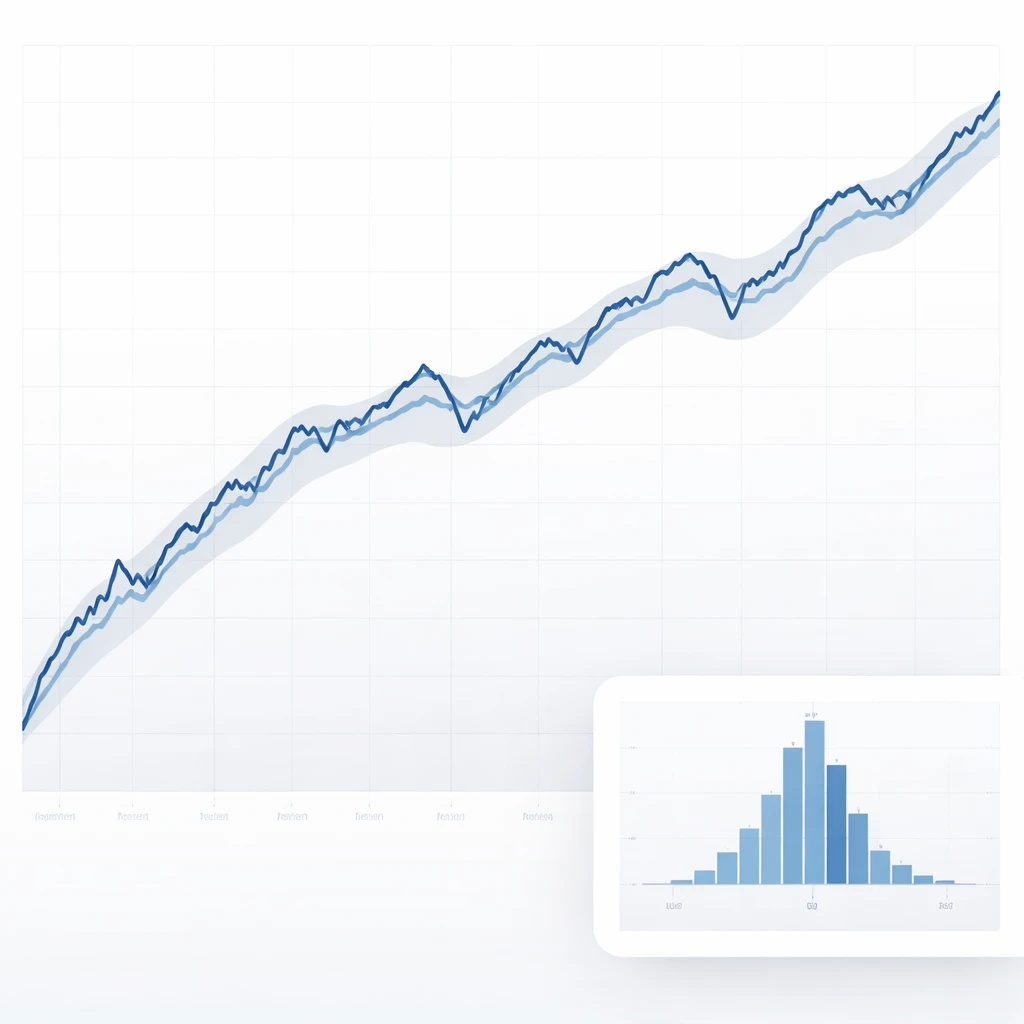
Tracking error is a central concept in the study of exchange-traded funds and index mutual funds. It quantifies how closely a portfolio’s returns follow a stated benchmark, not by the average difference in returns, but by the variability of that difference over time. In the context of ETFs and index funds, understanding tracking error reveals how replication choices, market microstructure, costs, and operational details shape the realized behavior of a fund relative to its index.
Definition: What Tracking Error Measures
Tracking error is the standard deviation of the fund’s active returns, where active return is the fund’s periodic return minus the benchmark’s periodic return. If you compute the return difference each day or each month, tracking error summarizes how much those differences fluctuate around their average. A low tracking error indicates the fund follows the index closely on a period-to-period basis. A higher value indicates more dispersion in those differences.
Two points are essential:
- Tracking error is about volatility of the return difference, not the average difference.
- It depends on the measurement interval and the sample period. Daily, weekly, or monthly inputs can produce different values.
In index investing, tracking error is often reported on an annualized basis. A common practice is to compute the standard deviation of daily active returns and scale by the square root of the number of trading days in a year. The resulting annualized figure reflects the expected dispersion of the fund’s annual relative performance if day-to-day patterns persist.
Tracking Error Versus Tracking Difference
Tracking error is frequently confused with tracking difference. The distinction matters:
- Tracking difference is the average return gap between the fund and the index over a period. It captures persistent bias, which might reflect management fees, withholding taxes, or structural index choices.
- Tracking error is the variability of that gap over time. It captures how much the relative performance bounces around from one period to the next.
A fund could have a small negative tracking difference due to its expense ratio but still exhibit very low tracking error if it replicates the index precisely each day. Another fund might have little average bias but high tracking error if it uses sampling or derivatives that introduce day-to-day noise around the benchmark.
Where Tracking Error Fits in the Broader Market Structure
Index funds and ETFs operate within a network that includes index providers, custodians, authorized participants, market makers, trading venues, and derivative markets. Each part of this network can influence realized tracking error:
- Index provider and methodology. Definitions of investability, corporate action treatment, and reconstitution schedules dictate what securities should be held and when changes occur. Methodology details affect replication complexity and potential slippage.
- Portfolio replication. Full replication, optimized sampling, or derivative-based replication determine how the fund tries to mirror index exposures. Each approach carries different frictions.
- Primary market activity. ETF shares are created and redeemed in large blocks through authorized participants. In-kind flows can minimize trading costs but still influence cash balances and timing. Cash creations or redemptions can heighten trading needs and costs.
- Secondary market dynamics. Market makers and liquidity providers set ETF prices on exchanges. While secondary market activity does not change net asset value directly, it interacts with the creation-redemption process that affects portfolio trades and, in turn, tracking behavior.
- Settlement, custody, and tax frameworks. Withholding taxes on dividends, settlement cycles, and market access restrictions can introduce structural differences relative to an index’s theoretical returns.
Viewed this way, tracking error is not only a statistic. It is also a summary of how an index product navigates market structure, operations, and regulation.
Why Tracking Error Exists
The ideal of perfect replication is constrained by costs, market frictions, and practical limits. Several recurring forces give rise to tracking error:
- Transaction costs and market impact. Trading the underlying securities incurs bid-ask spreads, commissions, and sometimes price impact. These costs vary with liquidity and volatility.
- Sampling and optimization. When a fund holds a subset of index constituents or uses an optimizer to match factor exposures, it accepts idiosyncratic differences that can create day-to-day deviations.
- Cash drag. ETF creations, redemptions, and dividend receipts can leave residual cash that does not move exactly with the index. Short-term cash holdings cause small return differences until they are invested or distributed.
- Reconstitution timing. Index changes occur on a schedule. Funds often trade near those times but not necessarily at the exact reference prices used by index providers. Timing and liquidity conditions influence slippage.
- Taxes and withholding. Indices often assume gross dividends. Funds receiving net dividends after withholding, or subject to tax treaties, will realize different cash flows.
- Currency effects. If the index is denominated in one currency and the fund’s base currency differs, exchange rate movements and hedging practices can create additional variation.
- Derivatives and collateral. Futures, swaps, or forwards can be efficient, but they introduce roll timing, margin, and collateral returns that may not match index assumptions.
Measuring Tracking Error in Practice
In practice, tracking error is often calculated using daily net asset value returns of the fund and the benchmark, aligned in time and currency. The analyst computes the series of daily active returns, finds their standard deviation, and annualizes it by multiplying by the square root of the number of trading days in the year. The method is similar for weekly or monthly data, with the appropriate scaling.
Several choices affect the estimate:
- Return frequency. Daily data capture microstructure effects and may yield higher estimates than monthly data. Lower-frequency data smooth some noise but reduce the number of observations.
- Time alignment. If the fund holds global securities, index returns and fund NAVs must be aligned to the same valuation point. Mismatches in time zones or use of fair value pricing can distort calculations.
- Currency alignment. Both fund and index returns should be in the same currency. Otherwise, currency moves will contaminate the estimate.
- Use of NAV versus market price. Tracking error relates to portfolio performance, so NAV-based returns are standard. Market price returns reflect trading dynamics and liquidity, which is a different concept.
Ex-post tracking error uses realized returns over a historical window. Ex-ante tracking error is a forecast based on a risk model and expected covariances. ETF sponsors and risk managers may monitor both forms to understand replication quality and potential deviation under different market conditions.
A Simple Numerical Illustration
Consider a hypothetical fund tracking a broad equity index. Over 250 trading days, the analyst computes the daily difference between the fund’s NAV return and the index return. Suppose those daily active returns cluster around a slight negative mean, reflecting fees, and fluctuate modestly day to day. The standard deviation of these differences might be a few basis points. Annualizing that daily standard deviation produces the annualized tracking error statistic. If the annualized value is small relative to the index’s volatility, the fund has closely followed the benchmark on a day-to-day basis.
This example is intentionally stylized. Actual values depend on the asset class, liquidity, replication approach, and operational details described below.
Replication Methods and Their Implications
Index funds use several replication approaches, each with characteristic tracking properties:
- Full replication. The fund holds each index constituent in its index weight. In large, liquid equity indices, this approach can keep tracking error low, with differences mainly driven by costs, taxes, and minor timing effects.
- Optimized sampling. The fund holds a subset of constituents designed to match index risk exposures. This can reduce costs for indices with many small or illiquid names, but it introduces model risk and additional day-to-day variation as the optimizer’s exposures drift between rebalances.
- Representative sampling with derivatives. Futures or swaps may help match exposures efficiently, particularly for broad or less accessible markets. However, basis risk, roll costs, and collateral returns can increase tracking variability.
Fixed income indices present additional challenges. Large numbers of bonds, over-the-counter trading, and episodic liquidity often lead to sampling. As a result, fixed income index funds commonly exhibit higher tracking error than large-cap equity funds, even when the average tracking difference remains modest.
Sources of Day-to-Day Deviation
Beyond replication choice, several recurring mechanisms contribute to active return volatility:
- Corporate actions. Dividends, splits, rights, and mergers have record and effective dates that may not align perfectly with index accounting conventions. The timing of cash receipt and reinvestment can create small gaps.
- Index rebalances and reconstitutions. Indices rebalance on set dates using predefined rules. The fund must trade to reflect new weights, which may occur under different liquidity conditions than the index’s theoretical prices.
- Securities lending. Some funds lend portfolio holdings and earn lending revenue. This can offset part of the expense ratio, affecting the average tracking difference, and may slightly influence day-to-day returns depending on how revenues are recognized.
- Cash management. Dividend accruals and primary market flows create temporary cash balances. Holding cash when the market rises creates a small lag, and when the market falls, it can cushion returns. The day-to-day effect contributes to tracking error.
- Fair value pricing. International portfolios often adjust closing prices of foreign securities to reflect information arriving after local markets close. These adjustments aim to align NAVs with contemporaneous valuations but can introduce differences relative to index returns that follow local closes.
Currency Exposure and Hedging
Currency is a frequent source of divergence for global or regional funds. If the benchmark is quoted in one currency and the fund reports in another, exchange rates affect returns. Some funds use currency forwards to hedge. Hedging reduces currency volatility but introduces its own moving parts: forward points, roll timing, collateral, and small residual exposures. Unhedged funds, hedged funds, and benchmarks that assume a specific currency treatment will naturally display different patterns of tracking error.
Commodity and Derivative-Based Products
ETFs that obtain exposure via futures can experience tracking dynamics that differ from physically replicated equity funds. Futures curves, roll schedules, and margin collateral returns influence performance relative to spot-based or total return indices. During periods of steep contango or backwardation, the cost or benefit of rolling can dominate day-to-day differences, the timing of rolls can matter, and thus tracking error may rise. None of these effects imply a directional view, but they do explain why derivative-based replication exhibits distinctive relative-return variability.
Stress Periods and Liquidity
Market stress magnifies many of the frictions listed above. Spreads widen, price impact increases, and some underlying markets may close or experience trading halts. Rebalancing during such episodes can produce larger deviations from index returns. For global portfolios, asynchronous market hours complicate valuation alignment and fair value adjustments. It is common to observe higher tracking error during or immediately after stressed conditions, followed by a return toward typical levels as liquidity normalizes.
Estimation Pitfalls and Data Choices
Care is needed when interpreting tracking error because methodology choices influence the statistic:
- Short samples. A brief history can lead to unstable estimates. A few unusual days can dominate the calculation, especially for daily data.
- Mixed frequencies. Comparing a fund’s daily NAV to a benchmark’s monthly return, or mixing time zones, produces misleading results.
- Structural breaks. Changes in replication approach, fee schedules, or benchmark methodology can shift the distribution of active returns. Estimates that span regimes may not describe the current configuration.
- Outliers and data quality. Corporate action miscodings, stale prices, or restatements can create spurious spikes. Cleaning and verification are part of sound measurement.
Analysts sometimes compute both an NAV-based tracking error and an alternative estimate using intraday indicative values, especially for ETFs that hold international securities. The two measures answer different questions. The NAV-based statistic aligns with portfolio accounting, while intraday measures speak to real-time pricing dynamics.
How Fund Design Choices Influence Tracking Behavior
Several design decisions shape the profile of tracking error and tracking difference:
- Expense ratio. Although it primarily affects tracking difference, fee levels can indirectly affect tracking error if they influence the intensity of optimization, sampling, or securities lending.
- Rebalance policy. More frequent rebalances reduce drift from index weights but may raise transaction costs. Less frequent rebalances save costs but allow exposures to drift, potentially increasing day-to-day deviations.
- Creation and redemption mechanics. In-kind activity that mirrors index baskets can align portfolio composition with the benchmark and internalize some trading. Cash transactions may require the fund to trade more in the market, raising costs and short-term dispersion.
- Collateral and cash sweep. The choice of collateral instruments for derivatives or securities lending, and the yield on cash sweep vehicles, affects realized returns relative to index assumptions.
A Practical, Real-World Context
Consider a large ETF that seeks to track a broad, well-traded equity benchmark. It uses full replication, holds every constituent in its index weight, and receives dividend income that it periodically distributes. Day to day, the active return differences are small. At quarter-end, the index rebalances and adds a few new constituents. The ETF trades to reflect the new weights, incurring spreads and minor impact. Dividend cash sits in the fund for several days before distribution, introducing a brief cash drag. Over the year, the expense ratio contributes to a slightly negative average difference, while the daily dispersion around that average remains modest. This profile reflects low tracking error and a small negative tracking difference.
Now consider an ETF tracking an emerging market benchmark where some local markets have foreign ownership limits, narrower windows for settlement, and higher spreads. The fund uses optimized sampling to manage costs and access constraints. It holds currency forwards to reduce exchange rate volatility against its base currency. In this setting, the combination of sampling risk, currency hedging, and episodic liquidity can produce a visibly higher tracking error, even if the average difference remains contained. Periods of market stress or changes in access rules can temporarily elevate the statistic.
Interpreting Reported Figures
Many index funds and ETFs publish both tracking difference and tracking error. A small tracking difference with a small tracking error suggests tight replication and modest costs. A small tracking difference with a higher tracking error suggests that day-to-day dispersion is present but happens to average out. A persistent negative tracking difference with a low tracking error often points to costs and taxes being the dominant drivers. The interpretation should consider the fund’s asset class, replication method, and operating environment.
It is also useful to consider the benchmark’s own volatility. A tracking error of a few basis points has different practical significance in a low-volatility bond index than in a high-volatility equity index. Context matters for assessing whether the observed dispersion is material for the intended use of the fund within a diversified portfolio.
Relationship to Active Risk in Portfolio Theory
In portfolio theory, the standard deviation of active returns is known as active risk. Index funds aim for minimal active risk relative to their benchmark, subject to cost and operational constraints. Optimized sampling is often framed as a choice to accept a small amount of active risk to reduce trading and holding costs. The optimal balance depends on the structure of the index and the relative size of costs versus the risk of deviating from the benchmark. Though the theoretical framing is general, in practice the parameters are shaped by liquidity, turnover, and the index provider’s methodology.
Special Cases: Leveraged and Inverse Products
Leveraged and inverse funds target a multiple of daily index returns. Compounding over time means their longer-horizon returns will not equal the stated multiple of long-horizon index returns. When measured against the unlevered index over horizons longer than a day, the differences can be large and variable. If tracking error is computed relative to a non-matching target, it will appear elevated. In these cases, measurement needs to align with the fund’s stated objective and the precise benchmark definition used by the sponsor.
Reading Index Methodology and Fund Documents
Index methodologies describe security eligibility, weighting, corporate action handling, and reconstitution calendars. These choices influence how easy or difficult it is to replicate the index. Fund documents and factsheets typically disclose replication approach, use of derivatives, securities lending, and tracking statistics. Comparing the methodology with the fund’s stated practices clarifies whether observed tracking error stems from structural features or from temporary market conditions.
Putting It Together: An Integrated View
Tracking error arises from the interaction of index design, replication choices, and market frictions. At one end of the spectrum, a large-cap equity index replicated in full with in-kind creations and minimal cash balances tends to produce low dispersion around the benchmark. At the other end, portfolios that rely on sampling, derivatives, or trade in less liquid markets face more moving parts. Liquidity cycles, corporate events, and currency can push the realized statistic around. None of this implies a directional forecast. It is simply the mechanics of how a real, investable portfolio maps onto a theoretical construct.
Key Takeaways
- Tracking error is the standard deviation of a fund’s active returns and captures day-to-day dispersion around the benchmark, not the average gap.
- Tracking error differs from tracking difference, which measures the average return shortfall or surplus over time.
- Replication method, transaction costs, cash management, currency treatment, and index reconstitution are primary drivers of tracking error in ETFs and index funds.
- Measurement choices matter. Frequency, time and currency alignment, and data quality all influence the reported statistic.
- Higher tracking error is common in less liquid or more complex markets, particularly when sampling or derivatives are used, and during periods of market stress.