
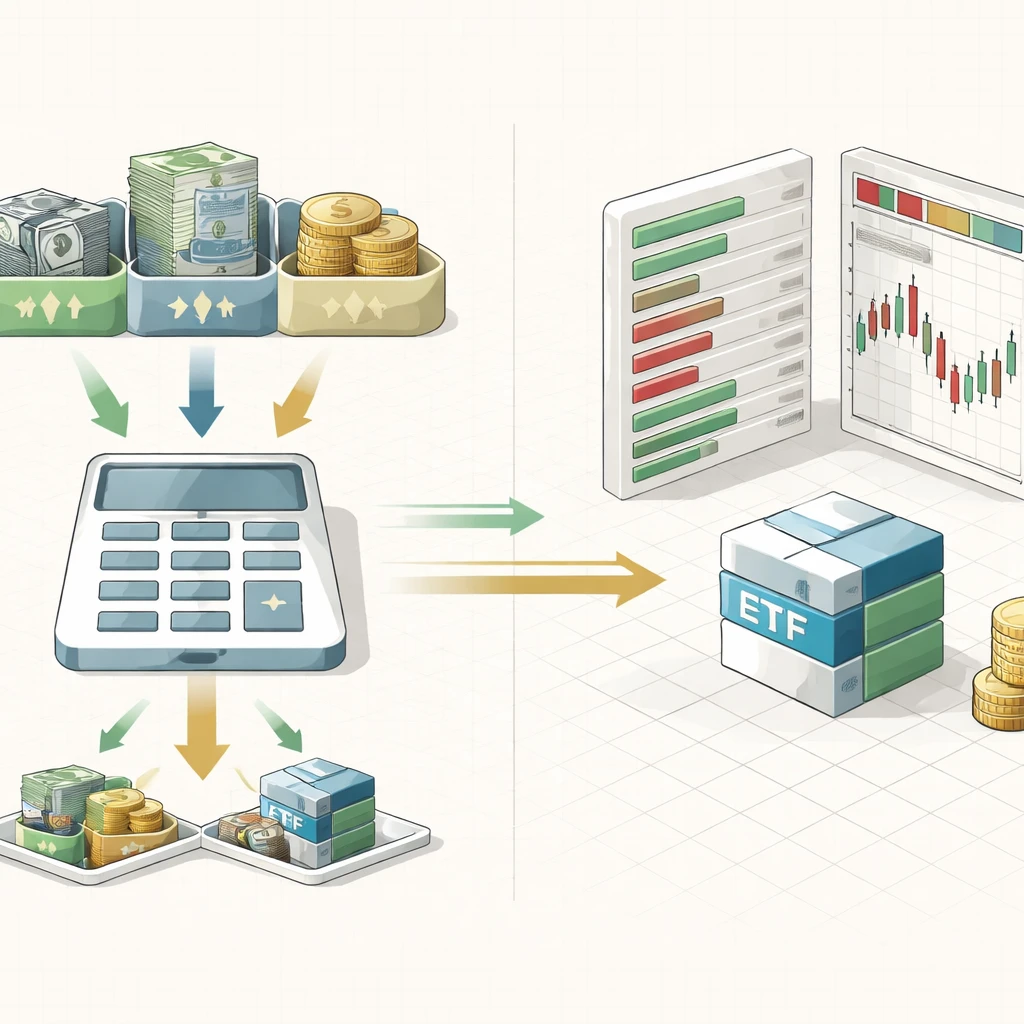
NAV vs Market Price is a foundational idea in understanding how pooled investment vehicles are valued and how their shares change hands in the marketplace. The distinction is conceptually simple: net asset value is an accounting measure of what a fund’s assets are worth per share, while market price is the price at which buyers and sellers actually trade shares during the day. The interesting questions sit in the gap between these two numbers. Why do they usually align closely for exchange-traded funds, but not always? Why do closed-end funds often show persistent discounts or premiums? How does the broader market structure shape these outcomes?
This article introduces precise definitions, places the concepts in the context of fund structures, and uses practical examples that mirror common real-world conditions. The discussion focuses on explanation rather than prescription and avoids strategy or recommendations.
Defining NAV
Net asset value (NAV) is the per-share value of a fund’s assets minus its liabilities, as measured by the fund’s administrator using established accounting policies. NAV is typically calculated once per day after markets close for mutual funds and at least once per day for exchange-traded funds. Some data providers publish intraday estimates, but the official NAV used for accounting and performance reporting is the end-of-day figure.
At a high level, NAV per share equals: (total value of portfolio holdings + accrued income + other assets − liabilities and expenses) divided by shares outstanding. The detail inside this formula matters. Prices for portfolio securities are sourced according to a valuation policy. Listed equities are generally marked to the closing price or an official close. Bonds and less liquid instruments may rely on evaluated prices from pricing services. Derivatives positions are marked to market. Accrued interest and dividends owed to the fund are included as receivables; management fees and other expenses accrue as liabilities.
Two points deserve emphasis. First, NAV reflects the fund’s portfolio at a particular point in time and therefore is synchronized with a specific closing market snapshot, not with the flow of intraday trading. Second, NAV is the basis for statutory financial statements, expense calculations, and standardized performance figures. When a mutual fund investor buys or redeems shares, the transaction prices at the next computed NAV, not at an intraday quote.
Defining Market Price
Market price is the price at which a trade in fund shares is executed on an exchange at a particular moment. For exchange-traded funds, this is observable throughout the trading day as the last trade price and as the evolving bid and ask quotations. Market price is shaped by supply and demand among investors, and by the liquidity provision of market makers who continuously quote buy and sell prices. The difference between the best bid and best ask is the spread, which compensates liquidity providers for inventory risk, hedging costs, and operational overhead.
Unlike NAV, which is a single end-of-day valuation, market price is a stream of transaction data. In calm conditions, the price tends to drift closely with changes in the underlying portfolio’s value. In stressed conditions, or when underlying markets are closed, market price can diverge more visibly from contemporaneous estimates of asset value.
Why the Concepts Exist
The coexistence of NAV and market price follows from how pooled vehicles are structured and how modern markets function. Funds exist to hold diversified portfolios and allocate ownership across many investors. Accounting, regulation, and disclosure require a consistent measure of what the fund owns and what each share is worth based on that inventory. NAV fulfills that role. At the same time, investors often prefer intraday liquidity. Exchange trading allows shares to change hands continuously, and the exchange price reflects the immediate willingness of buyers and sellers to transact given information, uncertainty, and trading frictions. Market price fulfills that role.
In other words, NAV answers the question: what does each share represent in underlying assets based on the fund’s books? Market price answers a different question: at what price can two parties trade a share right now? The two numbers are anchored to the same portfolio, but they are produced by different mechanisms and on different schedules.
How NAV Is Calculated in Practice
Fund administrators follow detailed procedures to calculate NAV:
- Security pricing: Equity positions are typically valued at an official closing price. Fixed income securities are often priced using vendor models that incorporate recent trades, dealer quotes, and yield curves. Thinly traded instruments may use evaluated or matrix prices rather than last trade.
- Income and expenses: Accrued interest, dividends receivable, and other income are added. Management fees, custody fees, and other accrued expenses are deducted.
- Corporate actions and derivatives: Stock splits, dividends, futures variation margin, and option valuations affect the asset side. Collateral arrangements and swap valuations are handled according to contracts and accounting rules.
- Fair value adjustments: For international holdings that stopped trading before the fund’s pricing time, some funds apply fair value adjustments to reduce stale pricing. This can bring NAV closer to what a willing buyer might pay given later movements in related markets.
- Shares outstanding: For open-end structures, share counts change with creations and redemptions. The per-share NAV divides net assets by the current number of shares after those changes are reflected.
The result is a single number per share for the close of the accounting day. That figure drives financial reporting and standardized returns. For mutual funds, it is also the transactional price used for subscriptions and redemptions submitted before the market’s cutoff time.
How Market Price Emerges
Market price is the outcome of order matching on an exchange. Buyers submit bids and sellers submit offers. Market makers post continuous quotes and adjust them as conditions change. The midpoint between the best bid and ask is often used as a cleaner indicator of value than the last trade, which can be printed at a bid or ask. Spreads generally widen when volatility rises or when the underlying assets are expensive to hedge. They narrow when competition among liquidity providers is high and hedging is straightforward.
For ETFs, a key feature of market microstructure is that liquidity providers can hedge their risk by trading the underlying basket or closely related instruments. If an ETF is mispriced relative to its portfolio value, arbitrageurs can buy one and sell the other, then use the fund’s creation-redemption mechanism to flatten positions. This ability to exchange ETF shares for the underlying basket makes ETFs different from closed-end funds, and it ties ETF market prices to NAV within practical limits.
Three Fund Structures and Their Implications
Understanding the NAV and market price relationship requires distinguishing among common fund structures.
- Mutual funds (open-end funds): Shares are purchased from and redeemed with the fund at NAV once per day. There is no intraday market price. The NAV is the transactional price and the accounting measure.
- Exchange-traded funds (ETFs): Shares trade intraday on exchanges. NAV is calculated at least daily for accounting and reporting. Market price reflects real-time trading. The authorized participant program enables creations and redemptions in large blocks, which anchors prices to NAV via arbitrage incentives.
- Closed-end funds (CEFs): Shares trade intraday, but there is no routine creation or redemption with the fund. Supply is largely fixed. Premiums and discounts to NAV can persist for long periods because the arbitrage channel is limited or absent.
Why NAV and Market Price Differ
Several mechanisms can push market price away from NAV, sometimes for minutes, sometimes for longer.
- Timing and stale prices: NAV reflects a specific closing snapshot. Market price reflects information arriving continuously. If the underlying assets close earlier than the ETF trades, intraday prices can diverge from the prior close. International equity ETFs often illustrate this when foreign exchanges are closed while the ETF continues to trade.
- Hedging and transaction costs: Liquidity providers incorporate costs into quotes. When hedging is difficult or expensive, spreads widen and market prices can sit at a small discount to the midpoint of estimated value.
- Uncertainty about underlying value: When the underlying market is illiquid, fragmented, or halted, ETF market price can become the most timely signal of consensus value. During stress, discounts in bond ETFs have reflected the cost and uncertainty of transacting the underlying bonds rather than a failure of the ETF to track its portfolio.
- Creation-redemption frictions: Creations and redemptions occur in large blocks and at specified times. If the cost to assemble or liquidate the basket rises, market price can move to a premium or discount that compensates the parties facilitating these flows.
- Fund policy choices: Use of fair value pricing in NAV, or temporary cash holdings, can create one-off differences between accounting NAV and the trading price implied by peers or futures.
The ETF Creation-Redemption Mechanism
ETFs are designed with an in-kind exchange process. Authorized participants, typically large broker-dealers, can deliver a specified basket of securities to the fund in exchange for new ETF shares (a creation) or return ETF shares to receive the basket (a redemption). The contents of the basket aim to replicate the portfolio or a close proxy. This mechanism links the ETF to its underlying assets.
If the ETF trades above the value of its basket, an arbitrageur can buy the basket, create ETF shares, and sell those shares at the higher market price. If the ETF trades below, the arbitrageur can buy ETF shares, redeem them for the basket, and sell the underlying assets. These actions add supply when the ETF is rich and remove supply when it is cheap, which pressures the ETF back toward its asset value. The process is not instantaneous or costless. It occurs when the expected profit exceeds the costs of trading, financing, and operations.
Because arbitrage is subject to costs and risks, small premiums and discounts are normal. They do not indicate malfunction. The key insight is that the structural ability to exchange shares for the basket underpins the tight linkage seen in many liquid ETFs. In less liquid markets, or for funds holding complex assets, the linkage can be looser.
Premiums, Discounts, and How They Are Measured
A fund’s premium or discount is often defined as (market price − NAV) divided by NAV. Because market price moves intraday while NAV is computed at the close, this statistic is most informative when compared using consistent timing. Some analysts use the last market price against the same-day closing NAV. Others prefer to compare the market price midpoint close to a contemporaneous estimate of the portfolio value.
For ETFs, data vendors sometimes publish intraday indicative values based on the current prices of the underlying holdings. This is commonly called an iNAV or IIV. The iNAV helps market participants gauge where the ETF might trade relative to its assets while markets are open. However, iNAVs can be noisy for bonds and derivatives, or for international holdings when the local market is closed. The iNAV is a tool, not a guarantee.
Closed-end funds do not offer routine creations and redemptions, so premiums and discounts can be larger and more persistent. In that setting, the discount reflects the market’s willingness to pay for a share of the portfolio given manager reputation, fees, distribution policy, and investor sentiment about the asset class. The discount is not mechanically closed by arbitrage.
Real-World Context and Examples
Example 1: Broad U.S. Equity ETF on a Normal Day
Consider a large ETF that tracks a broad U.S. equity index. The portfolio consists of highly liquid stocks that trade throughout the day. Market makers can hedge ETF flow by trading index futures and baskets of the component stocks. In this environment, the ETF’s market price usually stays within a few basis points of the estimated portfolio value, and the bid-ask spread is narrow. Arbitrage is straightforward, so deviations tend to be small and brief.
Example 2: International Equity ETF When Home Markets Are Closed
Now consider an ETF that holds Japanese equities. The Tokyo Stock Exchange closes before U.S. markets open. The ETF still trades in New York during the U.S. session. Its NAV for the day will reflect the closing prices in Tokyo plus any fair value adjustments the administrator applies. During U.S. hours, the ETF’s market price incorporates new information, such as movements in U.S. stocks, currency shifts in the yen, and futures signals. It is common for the ETF to trade at a premium or discount to the prior local close because the market price reflects a more current consensus of value. When Tokyo reopens, the local market typically moves toward the information embedded in the ETF price and related futures.
Example 3: Investment-Grade Bond ETFs During Market Stress
During acute stress, corporate bonds can become difficult to trade. Quotes may exist, but dealers may not be willing to transact size at those levels. In such periods, bond ETFs have sometimes traded at visible discounts to their last computed NAVs. The discount usually reflects that the evaluated prices used in NAV were slow to incorporate the costs and risk premiums demanded by the bond market at that moment. ETF market prices can adjust faster because ETF shares are continuously traded. As underlying bond trading resumes and evaluated prices catch up, NAVs and ETF prices typically converge.
Example 4: Closed-End Fund with a Persistent Discount
Suppose a closed-end fund holds municipal bonds and pays a steady distribution. The fund does not create or redeem shares in response to demand. If investor appetite for municipal bond exposure wanes, the market price of the closed-end fund can drift to a discount versus its NAV and remain there. The discount reflects the market’s clearing price for the fund’s stream of cash flows and governance features, not an error in NAV calculation. Without a routine arbitrage channel, the discount is not forced away.
Broader Market Structure and Information Flow
NAV vs market price also illustrates how information flows across markets. ETFs can serve as transmission channels that aggregate information from derivatives, currency markets, and related securities into a single traded instrument. Market price therefore can lead NAV when the administrator’s valuation inputs are stale or when the underlying exchange is closed. Conversely, when underlying prices are fresh and liquid, NAV provides a precise end-of-day anchor that ETF market prices tend to orbit.
The creation-redemption process coordinates primary and secondary markets. In the primary market, authorized participants transact with the fund at terms linked to NAV. In the secondary market, investors trade with each other on exchanges. When the secondary market price diverges from implied portfolio value by more than the cost to create or redeem, primary market activity usually follows. This is a structural feedback loop that stabilizes pricing for many ETFs.
NAV in Reporting, Fees, and Performance
NAV is central to how funds report results. Performance figures such as total return are calculated using NAV per share, with dividends and capital gains reinvested. Expense ratios are derived from the fund’s fee schedule and average net assets. Distributions are declared and paid based on the fund’s accounting income and gains, which flow through NAV. These practices standardize comparisons across funds and filings.
Market price, by contrast, affects the execution outcomes for buyers and sellers in the secondary market. The presence of a spread, the depth of the order book, and intraday volatility all influence execution prices. Even when NAV and market price are aligned on average, realized transaction prices can differ from the midpoint because trades print at the bid or ask. These microstructural details explain why NAV and long-term performance reporting can look smooth while the trading experience is lumpy within a day.
Common Misconceptions
- “An ETF at a discount is broken.” Small discounts are normal. They often reflect costs, timing differences, or transient imbalances. The existence of a discount does not indicate an error in the fund’s holdings.
- “NAV is more real than market price.” NAV is an accounting measure at a point in time. Market price is a transactional measure in real time. Each is real within its context. In some conditions, market price provides the more timely signal of value. In others, NAV is the cleanest anchor at the close.
- “iNAV equals fair value.” Intraday indicative values are estimates. They can be noisy if inputs are stale or if the portfolio holds assets that do not trade continuously. They are useful guides, not guarantees.
- “Closed-end fund discounts must disappear.” Without a routine arbitrage pathway, discounts and premiums can persist. They reflect investor preferences, fees, and expectations about distributions and risk.
Putting the Concepts Together
Viewed through the lens of market structure, NAV vs market price is less a puzzle and more a coordinated system with different parts serving distinct roles. Accounting policies produce an auditable measure of per-share value. Exchanges produce a live price that clears supply and demand. For ETFs, the creation-redemption link narrows the gap between the two by enabling arbitrage when it is economical. For closed-end funds, the absence of that link allows sentiment and liquidity conditions to play a larger role in where shares trade relative to the portfolio.
Real-world episodes reinforce these mechanics rather than contradict them. International ETFs reveal timing effects when home markets are closed. Bond ETFs during stress show how market prices can lead NAVs when evaluated prices lag. Broad domestic equity ETFs in normal conditions illustrate how tight the connection can be when underlying assets are liquid and inexpensive to hedge. In each case, the observed premium or discount is a consequence of the structure and the state of the market, not a mystery.
Key Takeaways
- NAV is an end-of-day accounting value per share, while market price is the intraday exchange price that clears supply and demand.
- ETFs link NAV and market price through creations and redemptions, which support arbitrage when deviations exceed costs.
- Premiums and discounts arise from timing, costs, and uncertainty, and are typically small for liquid equity ETFs but can be larger for bonds, international holdings, and closed-end funds.
- Market price can lead NAV when underlying prices are stale, especially during stress or when home markets are closed.
- NAV anchors financial reporting and performance measurement, whereas market price governs trading outcomes and execution dynamics.