
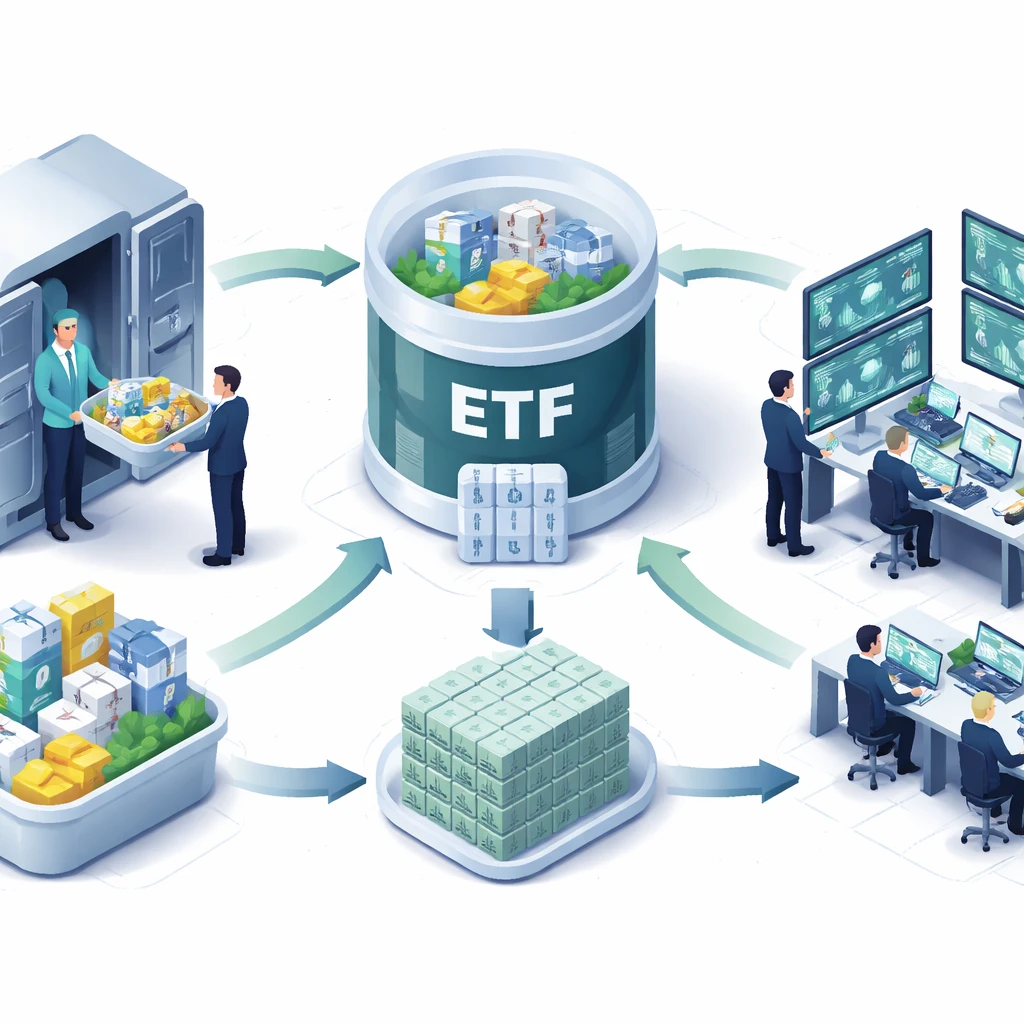
Exchange traded funds are investment funds whose shares trade on stock exchanges throughout the day. The core structure combines the pooled portfolio of a traditional fund with the trading mechanics of a listed security. Understanding this structure helps demystify how prices are formed, why ETFs often track their reference indexes closely, and what can happen when markets are under stress. The discussion below focuses on the mechanics rather than strategies or recommendations.
What an ETF Is and Why Structure Matters
An ETF is an open ended fund that issues and redeems shares in large blocks through a specialized primary market while allowing investors to buy and sell individual shares in a secondary market. Open ended means the share count can expand or contract based on demand. The design is built around the creation and redemption process, which is the mechanism that generally keeps the trading price close to the value of the underlying portfolio.
The structure exists to combine four features that were previously separate. Investors gain diversified exposure similar to a mutual fund, intraday tradability similar to a stock, typically transparent holdings and baskets that support efficient trading, and a process that can facilitate tax efficiency in some jurisdictions through in kind portfolio transfers. The interplay among these features is what gives ETFs their distinct role in modern markets.
ETF Ecosystem: Who Does What
Several institutions interact to make an ETF function. The issuer designs the product, maintains regulatory filings, and oversees operations. A custodian holds the portfolio assets. An administrator handles fund accounting and calculates the net asset value, often called NAV. An index provider supplies rules and data when the ETF tracks a benchmark. Market makers quote bids and offers on exchanges. Authorized participants, known as APs, are broker dealers that create and redeem ETF shares directly with the fund. These roles can be housed within different firms or under the umbrella of a large asset manager.
Investors do not interact with the fund directly when they trade on an exchange. They transact with other investors or with market makers in the secondary market. The primary market is reserved for authorized participants who assemble the published basket of securities and deliver it to the fund in exchange for a fixed block of new ETF shares called a creation unit. The reverse is also possible. APs can return ETF shares to the fund and receive the basket of underlying securities in a redemption.
Primary Market vs. Secondary Market
The dual market concept is central. In the secondary market, individual ETF shares trade just like common stock with bids, offers, volumes, and intraday price moves. In the primary market, only APs transact with the fund in creation units that may be sized at 25 thousand, 50 thousand, or more shares depending on the product.
When secondary market demand exceeds supply, APs can create new shares. They buy the specified basket of underlying securities, deliver it to the fund, and receive creation units that they break into individual shares for sale on an exchange. When selling pressure is heavy, APs can redeem. They gather ETF shares, deliver them to the fund, and receive the basket back. This expand and contract mechanism adjusts share supply in response to demand and is a structural feature that distinguishes ETFs from closed end funds.
Net Asset Value, Intraday Value, and Trading Price
The net asset value is the per share value of the fund’s portfolio calculated by the administrator, usually once each business day after the underlying markets close. NAV is an accounting measure. During the trading day, an indicative intraday value is often disseminated at short intervals, sometimes referred to as IIV or IOPV. The IIV estimates the real time value of the portfolio based on last traded prices or quotes of the underlying securities.
The ETF’s exchange price can deviate from both NAV and the IIV for short periods. Deviations occur for many reasons, including lags in pricing illiquid bonds, currency conversions, time zone differences, and transaction costs. The creation and redemption process gives APs and market makers a way to arbitrage large divergences by creating shares when the ETF trades richer than its portfolio or redeeming when it trades cheaper. That arbitrage pressure generally narrows the gap so that trading prices stay close to underlying value in normal conditions.
The Basket: Pro Rata and Custom
The heart of primary market activity is the basket. Each trading day, the issuer publishes the list of securities and quantities that APs must deliver to create one unit or will receive in redemption. In many equity index ETFs the basket is a near pro rata slice of the portfolio. In bond ETFs, baskets may be representative samples due to trading frictions and the scale of fixed income markets.
Regulations in several jurisdictions allow custom baskets. With a custom basket the portfolio manager can accept a set of securities that differs from the pro rata composition while meeting constraints that preserve fair value. Custom baskets are used to manage costs, handle inflows and outflows in less liquid markets, and facilitate rebalances. The rule framework that governs custom baskets is designed to prevent selective treatment of APs and to ensure that the fund is not disadvantaged relative to shareholders.
Creation and Redemption Step by Step
Creation begins when an AP identifies secondary market demand or a pricing differential that makes a creation economical. The AP borrows or buys the securities in the published basket and delivers them to the fund’s custodian. The fund issues a creation unit of ETF shares to the AP’s account. The AP can then sell individual ETF shares to investors on an exchange. Settlement generally occurs on the same cycle as the underlying securities.
Redemption is the reverse. The AP accumulates ETF shares, perhaps by buying them on exchange, and delivers the block to the fund. The fund sends the redemption basket to the AP. If the AP has clients who want the underlying securities, the AP can deliver directly. Otherwise the AP may sell the received securities into the market.
In kind transfers are common for many equity ETFs. Some funds, especially those that hold derivatives or certain foreign securities, may use or require cash creations and redemptions. With cash the AP delivers money instead of securities, and the fund transacts in the market to buy or sell the required instruments. Cash creates operational flexibility but can increase transaction costs that affect tracking.
How the Structure Anchors Prices
The ETF price is largely anchored by the ability of APs and market makers to transform ETF shares into the underlying basket and back again. Suppose an ETF trades at a premium to the estimated value of its portfolio. An AP can buy the underlying securities, deliver them to the fund, receive shares at NAV, and sell those shares in the secondary market at the higher price. That flow tends to increase supply of ETF shares and push the trading price down toward value. If the ETF trades at a discount, the AP can buy ETF shares on exchange, redeem them with the fund for the basket, and sell the securities. That decreases ETF share supply and tends to lift the price.
The mechanism is not a guarantee. It relies on market liquidity, AP balance sheets, and transaction costs. In fast or fragmented markets, or when underlying securities are closed while the ETF continues to trade, the ETF price can diverge from NAV for longer periods. In those cases the trading price may provide a real time estimate of where the basket could clear if it were priced continuously.
Replication Approaches: Physical, Sampling, and Synthetic
ETF portfolios are built in several ways. Physical replication holds the actual securities in the index, sometimes all of them and sometimes a subset. Full replication is common for large cap equity indexes where trading is straightforward. Sampling is used when the index has many constituents or includes securities with limited liquidity. In sampling the manager holds a set that matches key risk characteristics of the index so that returns remain close, accepting small deviations to control costs.
Synthetic replication uses derivatives to deliver the index return. A common approach is a funded or unfunded total return swap with a bank counterparty. The ETF delivers cash or collateral to the bank and receives the index return, minus any fees, while holding collateral assets. Synthetic structures can provide access to markets where physical ownership is difficult due to local rules or taxes. They introduce counterparty risk, collateral management considerations, and additional disclosures that investors review in the prospectus.
Active and Index ETFs
Index ETFs follow published rules and aim to match the performance of a benchmark before fees and expenses. Active ETFs rely on portfolio management decisions. Many active funds publish holdings daily and operate with baskets similar to index funds. Others use semi transparent models that reveal enough information to support market making while keeping detailed positions less visible. The structure that supports creations and redemptions is the same, although basket design and disclosure practices may differ.
Commodity and Currency Structures
Equity and bond ETFs hold securities. Commodity and currency exposure introduces additional structural choices. Physically backed precious metal ETFs hold bullion in vaults through a custodian. Futures based commodity funds hold exchange traded futures and collateral, rolling contracts as they approach expiration. Currency funds can hold bank deposits, short term government securities, or engage in forward contracts. These choices affect costs, taxes, and how closely the ETF tracks a spot price or a reference index.
Share Class Variations
In some jurisdictions a fund sponsor may operate an ETF share class of an existing mutual fund. That framework allows the same portfolio to serve both mutual fund shareholders and ETF shareholders. The operational details are complex, including how creations and redemptions are processed and how tax and distribution rules are applied, and not all asset managers use this approach. The more common model is a standalone ETF with its own trust or corporate wrapper.
Custody, Fund Accounting, and Securities Lending
The custodian is a critical control point. It safeguards the portfolio assets, tracks corporate actions, and interfaces with transfer agents and clearing systems. The administrator calculates NAV, monitors expenses, and produces financial statements. Many funds engage in securities lending, where a lending agent loans portfolio securities to qualified borrowers in return for collateral and a fee. Lending revenue, net of fees, can help offset fund expenses. Lending programs are governed by policies that address borrower quality, collateral types, diversification, and indemnification.
How ETFs Fit Into the Broader Market Structure
ETFs sit at the intersection of the asset management industry and exchange trading. As exchange listed securities they are subject to listing standards, market rules, and regulation of broker dealers and trading venues. As funds they are subject to investment company laws that govern diversification, leverage, disclosure, valuation, and custody. Index licensing agreements link ETFs to benchmark providers, and clearinghouses and central securities depositories support settlement of both ETF shares and the underlying instruments.
ETFs also act as conduits for liquidity. When an ETF that holds corporate bonds sees heavy secondary trading, market makers can use creations and redemptions to access the underlying bonds or to satisfy client demand without altering the long term portfolio of traditional investors. In cross border funds, time zone differences add a layer of market structure complexity. An ETF that holds Asian stocks and trades during New York hours may act as a vehicle for price discovery when the local markets are closed, which can show up as larger premiums or discounts to last official NAV.
Pricing Frictions and Tracking Difference
Tracking difference is the gap between the ETF’s return and that of the reference index over time. Several factors contribute. Management fees and operating expenses subtract from returns. Transaction costs arise when the fund rebalances, handles corporate actions, or processes cash flows. Sampling introduces small differences by design. Tax treatment, withholding on dividends, and fair valuation of securities that have not traded recently also matter. Securities lending revenue can offset some costs.
During volatile periods, the ETF’s screen price may move away from calculated NAV because the underlying is hard to price continuously. Bond ETFs in particular can exhibit discounts to stale NAVs when dealer quotes lag. That is a feature of price discovery rather than a failure of the structure. When the underlying market catches up, the gap typically narrows as new information is incorporated on both sides.
Real World Illustrations
Consider a broad equity ETF that tracks a large cap index. On a strong inflow day, market makers see persistent buy interest and a spread that justifies a creation. An authorized participant buys the index basket across trading venues, delivers it to the custodian, and receives creation units. The newly created shares are sold to investors. The secondary market price stays close to the IIV because the AP’s activity adds supply at roughly the portfolio value plus modest costs.
Now consider a bond ETF during a liquidity shock. Dealers widen quotes on individual bonds, and some bonds do not trade for hours. The ETF continues to trade. Its price reflects where market makers estimate the basket would clear if forced to sell. The ETF may show a discount to last NAV, which still incorporates older bond prices. As markets normalize and bond prices update, published NAVs move closer to the ETF’s trading level observed during the disruption.
A commodity example highlights structural constraints. A futures based oil fund that concentrates in near dated contracts can run into position limits, exchange accountability levels, or internal risk limits. If demand surges, the sponsor may adjust its strategy within the fund’s mandate, such as spreading exposure across more maturities, or it may temporarily restrict creations to stay within risk and regulatory bounds. When creations are paused, ETF shares can trade at larger premiums or discounts until normal operations resume. These episodes illustrate how the ETF wrapper is influenced by the structure and rules of the underlying markets.
Regulatory Framework and Investor Protections
ETFs operate within regulatory regimes that set standards for disclosure, diversification, liquidity risk management, valuation, and governance. In the United States many ETFs are registered under the Investment Company Act of 1940, with exchange listing under the Securities Exchange Act of 1934 and oversight by self regulatory organizations. In Europe, UCITS rules standardize many aspects of fund operation including eligible assets, diversification, and risk controls. Commodity pools and exchange traded notes follow different frameworks that have their own risk profiles and disclosures.
Disclosure is central to the structure. Prospectuses and daily holdings files inform market makers and investors about portfolio composition, investment objectives, fees, risks, and operational details. Basket publications tell APs exactly what is required for primary market transactions. These information flows support efficient pricing and provide the basis for regulatory oversight.
Liquidity: Secondary vs. Underlying
ETF liquidity has two dimensions. Displayed liquidity on the exchange, which includes posted bids and offers and reported volumes, reflects the willingness of market makers and investors to trade shares at a point in time. Underlying liquidity comes from the ability of APs to source or sell the basket securities in the primary market. A thinly traded ETF can still accommodate large orders if the underlying securities are liquid and the creation and redemption mechanism is functioning. Conversely, an ETF may show heavy screen volume, but if the underlying is difficult to trade, spreads can widen and premiums or discounts can increase during stress.
Lead market makers often have quoting obligations under exchange rules. They use basket files, disclosed holdings, and relationships with APs to manage inventory and hedge risk. Technology supports this process through models that map ETF exposures to proxies in the underlying markets, which is easier for large cap equities and more complex for structured credit or segments with limited transparency.
Valuation, Fair Value Adjustments, and Time Zones
Valuation of portfolio securities follows policies set by the fund’s board or governing body. When markets close at different times, funds apply fair value methodologies to estimate prices for securities that have not traded recently. For example, an ETF that holds Japanese equities and trades during U.S. hours may adjust the value of its holdings based on movements in futures or related instruments. These adjustments aim to produce a NAV that better reflects current information even when local exchanges are closed.
Distributions, Dividends, and Tax Considerations
Funds distribute income and realized capital gains according to local regulations and the fund’s policies. The frequency and form vary by jurisdiction and asset class. In kind redemptions can allow funds to remove low basis positions, which may reduce taxable capital gain distributions to remaining shareholders where rules permit. That attribute is one reason ETFs can be tax efficient in certain markets. The actual tax experience depends on an investor’s circumstances and location, and on the specific structure of the ETF.
Operational Risks and Controls
Operational soundness underpins the ETF wrapper. Key risks include settlement failures in creation and redemption, errors in basket files, index data issues, collateral management in synthetic structures, and cybersecurity. Controls include segregation of duties between portfolio management and operations, independent oversight by a board or trustee, audits, and compliance programs. Exchanges and regulators enforce trading halts when necessary, and funds have procedures for extraordinary circumstances, such as suspending creations when underlying markets are closed for extended periods.
Comparing ETFs, Mutual Funds, and Closed End Funds
Mutual funds issue and redeem at end of day NAV directly with the fund. They do not trade intraday and typically handle flows in cash. ETFs trade throughout the day, with creations and redemptions handled by APs against baskets. Closed end funds issue a fixed number of shares at inception and do not offer routine redemptions. As a result, closed end fund prices can trade at persistent premiums or discounts to NAV because there is no structural arbitrage through creations and redemptions. The ETF design is intended to keep price and value aligned more tightly, subject to market conditions.
Why ETF Structure Exists in Modern Markets
The ETF wrapper grew out of a practical need. Market participants wanted diversified exposure without sacrificing trading flexibility. Exchanges and market makers wanted products that could be hedged and priced with transparent tools. Regulators sought structures with clear disclosure, custody, and governance. The result is an instrument that transmits liquidity between investor demand and underlying markets while providing a standardized, regulated format for broad or targeted exposures.
The structure also scales. A single ETF can serve many small investors trading on screen, large institutions crossing blocks, and intermediaries hedging risk with creations and redemptions, all while the fund’s portfolio management remains focused on tracking an index or pursuing an active mandate.
Limits and Failure Modes
Structure reduces, but does not eliminate, frictions. If underlying markets are closed while the ETF trades, prices can move away from last NAV. If there are regulatory or operational constraints such as foreign ownership limits, the fund may rely on derivatives or depositary receipts, which introduce basis and counterparty risks. If an ETF holds instruments that are hard to source, creations can become costly or temporarily unavailable, affecting premiums and discounts.
These are not defects in isolation. They reflect the fact that an ETF is a bridge between different market systems. The bridge works well when both sides are functioning and transparent. When one side is impaired, the ETF reveals the impairment through wider spreads, reduced depth, or a bigger gap between price and NAV. Understanding the structure helps interpret these signals.
Putting the Structure in Context
In practice, the ETF wrapper has become part of the fabric of market microstructure. It enables rapid transmission of risk preferences, allows portfolio adjustments without trading each underlying security, and supports standardized access to asset classes. The creation and redemption process disciplines prices. Basket publication and holdings transparency enable market makers to quote competitively. Custody and valuation policies anchor the fund in traditional regulated frameworks.
These features explain why ETFs have grown across equities, fixed income, and commodities. The appeal is not a promise of performance. It is the architecture that aligns tradability, diversification, and operational clarity. As with any financial structure, results depend on the quality of implementation, the liquidity of underlying markets, and the robustness of oversight.
Key Takeaways
- ETFs are open ended funds with shares that trade intraday, supported by a primary market for creations and redemptions handled by authorized participants.
- The basket based mechanism ties ETF prices to the value of underlying portfolios and enables arbitrage that usually limits premiums and discounts.
- Operations rely on a coordinated ecosystem that includes issuers, custodians, administrators, market makers, index providers, and regulators.
- Replication methods vary across physical, sampling, and synthetic approaches, each with distinct costs, risks, and disclosure requirements.
- Deviations between trading price and NAV can occur, especially during stress or when underlying markets are closed, and these deviations reflect the realities of market structure rather than a structural guarantee of perfect alignment.