
Definition and Scope
Exchange traded fund liquidity refers to the ease and cost of trading ETF shares at or near a fair price. It is commonly discussed in terms of visible trading volume and quoted bid ask spreads on the exchange, but a full account also includes the ability of market makers and authorized participants to create or redeem shares by trading the underlying securities. ETF trading is the activity of buying and selling ETF shares on an exchange, where prices are set continuously by supply, demand, and competitive quoting from market participants.
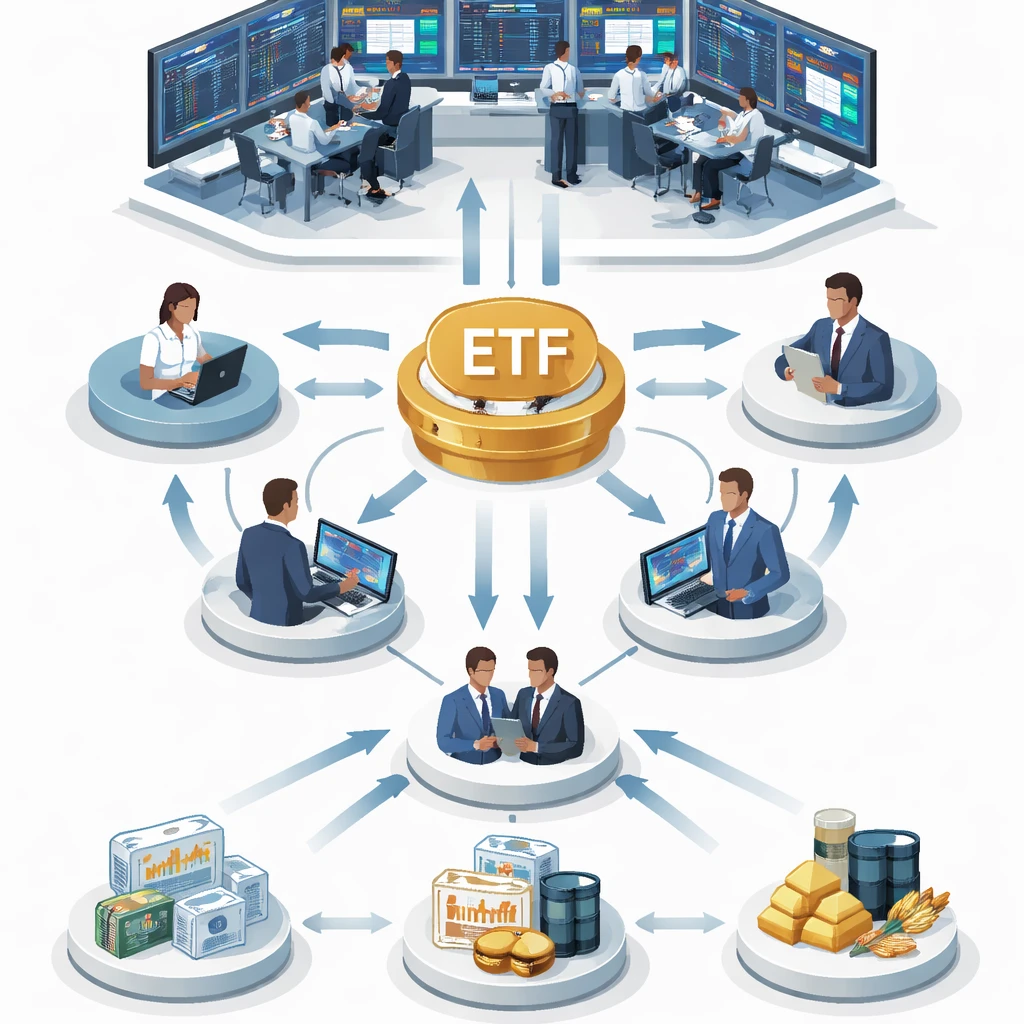
This topic sits at the intersection of market microstructure and fund mechanics. Understanding it requires distinguishing between two layers of activity. The first is the secondary market, where investors trade ETF shares with one another. The second is the primary market, where authorized participants interact with the ETF issuer to create or redeem blocks of shares in exchange for a specified basket of securities or cash. The interaction of these layers is what makes ETF liquidity distinct from the liquidity of a conventional closed end fund or a single stock.
Why ETF Liquidity Exists
ETF liquidity exists because the structure permits arbitrage between the ETF share price and the value of its underlying portfolio. When the ETF deviates from the value of its basket, authorized participants can create or redeem shares to capture the difference. That activity tends to narrow pricing gaps and anchor the ETF price to the current value of its holdings. The presence of multiple market makers, along with designated lead market makers on many exchanges, further supports continuous two sided quotes. The result is a market where the ability to trade is not limited to the number of shares already outstanding, because new shares can be created and existing shares can be redeemed as needed.
In practical terms, ETF liquidity is a combination of two resources. One is secondary market depth, which includes displayed quotes and resting orders. The other is underlying portfolio liquidity, which supports primary market activity. A fund that owns highly liquid securities, even if it does not trade frequently itself, can often be traded in meaningful size because dealers can quickly hedge or assemble the basket.
ETF Liquidity in the Broader Market Structure
ETFs are listed on exchanges alongside individual stocks. Prices are disseminated by national market systems, and order flow may be routed to exchanges or off exchange venues. At the same time, ETFs connect the exchange ecosystem to the over the counter bond market, futures markets used for hedging, and the primary creation and redemption channel with the issuer and transfer agent. This interconnection means ETF liquidity both depends on, and contributes to, liquidity in the underlying markets.
During normal conditions, the exchange quote for a liquid equity ETF tends to be very close to the value of its holdings. In fixed income or international markets that close earlier, the ETF price can lead the published net asset value because it reflects intraday updates to yields, credit spreads, or currency values that the official NAV, calculated after the close, may not immediately capture. In that sense, ETFs transmit information across markets and time zones, and their trading can participate in price discovery for the assets they hold.
Primary and Secondary Markets
Secondary market. Most investors access ETF liquidity by trading on the exchange. Quotes are visible, volumes are published in real time, and spreads reflect competition among market makers. The cost of transacting is visible in the bid ask spread and implicit in market impact, which is the price movement caused by the trade itself.
Primary market. Authorized participants, typically large broker dealers, can assemble the ETF’s prescribed basket and deliver it to the fund in exchange for a block of ETF shares, known as a creation unit. They can also return shares to the fund to receive the basket, known as a redemption. These in kind flows are accounting transactions between APs and the fund’s custodian. They do not occur on the exchange and do not contribute to the reported exchange trading volume, but they are central to the fund’s ability to align price and value.
The capacity to create and redeem shares makes ETF liquidity scalable. If there is persistent demand to buy, APs can create new shares, sell them into the market, and hedge by acquiring the underlying securities. If there is persistent selling pressure, APs can redeem shares and sell or reallocate the basket. This mechanism keeps the ETF’s float flexible and helps maintain orderly markets.
How Prices Are Formed
Several reference points inform ETF pricing. The most commonly cited are the official net asset value, the intraday indicative value, and the executable prices displayed by market makers.
- NAV. The end of day net asset value reflects the fund’s holdings priced at the close of the primary listing markets. NAV is used for accounting and reporting. It is not an intraday trading price.
- Intraday indicative value. Many ETFs publish an intraday estimate of NAV using near real time market data. This estimate is helpful, but it can be noisy in fast markets and in less transparent assets, such as certain bonds.
- Displayed quotes. The best bid and offer, along with the depth at multiple price levels, shows where trades can be executed immediately. Market makers arrive at these quotes by valuing the basket, assessing hedging costs, and adding an allowance for volatility and transaction costs.
Market makers use the cost to obtain and hedge the basket as the central input. If the underlying securities are easy to source and hedge, the spread can be very tight. If the assets are difficult to source, thinly traded, or subject to wider price gaps, the spread widens to reflect risk and expected costs.
Premiums and Discounts
Because ETFs trade intraday while official NAV is calculated once per day, the market price can be above or below NAV at any given moment. A premium occurs when the ETF trades above NAV. A discount occurs when it trades below NAV. Persistent and large premiums or discounts might signal frictions in the creation and redemption channel, constraints on underlying liquidity, or a difference between stale valuations in NAV and real time valuations in the ETF price.
Premiums and discounts are often small in equity ETFs that hold very liquid stocks. In fixed income ETFs, especially those holding bonds that do not trade frequently, the ETF can appear to trade at a discount during stress because the bond valuations used for NAV do not update as quickly as the ETF price. In those periods, the ETF price can function as a more immediate reflection of market levels, while NAV catches up as bond quotes and trades are incorporated by pricing services.
Visible Volume versus Underlying Liquidity
ETF volume on the screen is not a complete measure of the ability to trade. A newly launched ETF might show modest daily volume, yet still be possible to trade in size because the underlying securities trade actively. Conversely, an ETF can display high volume concentrated in small intraday bursts, with limited depth at specific moments, if underlying markets are thin.
Analysts often think in terms of implied liquidity, which links trade capacity to the liquidity of the basket. If an ETF holds a diversified set of stocks that each trade millions of shares per day, a market maker can create and hedge additional ETF shares without relying on preexisting ETF volume. The practical limit is set by how much of the basket can be transacted without excessive market impact. This concept is especially relevant when evaluating funds that track broad equity indexes compared with those tracking niche segments or less liquid bonds.
Spreads and Total Trading Cost
Two components dominate the cost of trading an ETF. The first is the quoted bid ask spread, which is the immediate compensation to liquidity providers. The second is market impact, the price move generated by the trade. A third component, more specific to ETFs, is any premium or discount to NAV at the time of execution. The sum of these elements determines the effective cost of entering or exiting a position, separate from the fund’s expense ratio.
Spreads are narrower when competition among market makers is strong and when hedging the basket is straightforward. Spreads widen around material events, such as earnings releases for concentrated sector funds, macroeconomic data for rate sensitive funds, or during the first and last minutes of the trading day when price discovery is still stabilizing or liquidity is being withdrawn for the close.
Trading Mechanics and the Role of Order Types
ETF trades are executed through standard order types used for equities. A market order executes immediately against the best available prices. A limit order specifies a maximum buy price or minimum sell price. Stop orders convert to marketable orders after a trigger. Auctions at the open and close establish single clearing prices that pool liquidity. These mechanics shape the execution price and the interaction with the displayed book.
Because ETFs reference an underlying basket, additional considerations affect execution quality. Opening minutes can reflect uncertainty in the underlying securities, especially when those securities trade on multiple venues or in different time zones. Closing auctions can concentrate liquidity and reduce transient spreads. Between those intervals, displayed and hidden liquidity interacts on exchanges and alternative trading systems, and wholesalers may internalize retail order flow under regulatory obligations to provide price improvement.
The Creation and Redemption Process in Detail
Creation and redemption can be in kind, in cash, or a mix. In kind is common in equity ETFs and involves delivering the specified basket to create shares, or receiving the basket when redeeming. Cash creates are more common when underlying assets are hard to transfer or assemble, such as certain bonds or derivatives based funds. In both cases, the process is governed by the fund’s documentation and supported by the custodian and transfer agent.
The composition of the basket can be exact or optimized. Many index funds use optimized baskets that replicate the risk characteristics of the index rather than every constituent, which reduces the transaction burden while preserving tracking. Some jurisdictions and fund structures allow custom baskets, where APs and the issuer agree on a basket that meets portfolio needs while facilitating liquidity, for example by transferring out less liquid lots during redemptions. These operational choices influence the cost of primary market activity and therefore influence secondary market spreads.
Liquidity Across Asset Classes
Equities. Broad equity ETFs benefit from liquid underlying stocks, high quote competition, and tight spreads. Niche or small cap equity ETFs can trade efficiently but may show wider spreads if the underlying names have limited depth.
Fixed income. Bond ETFs connect exchange trading to over the counter markets. Because many bonds trade infrequently, market makers hedge with related instruments, such as Treasury futures or credit index derivatives, and adjust quotes to reflect the cost of sourcing specific bonds. Discounts to NAV during volatile periods are not uncommon, particularly when evaluated prices lag the market.
Commodities and currency linked funds. Funds that obtain exposure through futures or swaps tie their intraday liquidity to the liquidity of those derivatives and any collateral holdings. Quotes reflect the cost of rolling and hedging, as well as exchange hours for the underlying contracts.
Stress Conditions and Price Discovery
ETF trading during stressed markets highlights how the structure functions. When underlying markets are less transparent, ETF prices can adjust more quickly than NAVs or dealer quotes. For example, in a period of credit market strain, high yield bond ETFs have exhibited intraday discounts relative to NAV. Subsequent updates to bond valuations often reduced those discounts as pricing services incorporated fresher information. During such intervals, arbitrage may be constrained by wider transaction costs, risk limits at dealers, or limits up limit down pauses on the ETF itself. Even so, the presence of two sided quotes, though wider, reflects continued willingness to provide liquidity through the exchange.
Equity market volatility shows different dynamics. At the open, if many underlying stocks are not yet trading, market makers will quote the ETF with spreads that account for price uncertainty. As underlying names open and their prices become observable, ETF spreads typically narrow. Near the close, liquidity providers may widen or withdraw quotes ahead of the auction to manage inventory risk, then participate in the closing print.
Real World Examples
Broad U.S. equity ETF. Consider an ETF that tracks a large cap U.S. index. The constituents are liquid, so dealers can hedge with minimal cost. The ETF often displays penny wide spreads and deep depth at the best prices. Although the fund may trade tens of millions of shares daily, the system would support larger flows through creations and redemptions because the underlying stocks trade actively and can be sourced quickly. Even if the ETF experiences a day of unusually high demand, APs can assemble the basket and increase shares outstanding without disruption.
Small cap equity ETF. In a fund tracking smaller companies, underlying names may have wider spreads and less depth. The ETF may display a visibly wider spread and lower posted size. Still, if the basket is diversified, market makers can often accommodate meaningful orders through primary market activity. Quoting reflects the cost to transact in the smaller stocks, including the risk of price moves while hedging.
Investment grade bond ETF. A fund holding corporate bonds interacts with an over the counter market where some bonds do not trade every day. Dealers manage quotes using reference runs, TRACE data, and hedges like Treasury futures. During calm markets, the ETF trades close to intraday estimates of bond values. During a volatility spike, the ETF may trade at an apparent discount relative to the prior official NAV. As bond quotes refresh, the reported discount can narrow. The ETF’s intraday price can provide a real time reference for the credit market when individual bonds are slow to trade.
Data and Measures Used to Assess Liquidity
Market participants look at several measures to understand ETF liquidity. None is sufficient on its own, but together they form a useful picture.
- Bid ask spread. A direct measure of immediate trading cost. Narrow spreads usually indicate competitive quoting and easy hedging.
- Displayed depth. The size available at the best prices and in the order book. Depth can fluctuate with time of day and events.
- Average daily volume. A measure of how much has traded recently. Helpful for context, but not a hard limit on trade capacity because of creations and redemptions.
- Creation and redemption activity. The growth or shrinkage of shares outstanding can indicate primary market use and the willingness of APs to intermediate flows.
- Premium or discount to NAV. Persistent or large deviations invite closer examination of basket liquidity and calculation practices.
Regulatory and Operational Supports
ETF trading occurs within a framework designed to promote fair and orderly markets. Exchanges appoint lead market makers or designated liquidity providers for many listings with quoting obligations. Limit up limit down rules pause trading in the event of extreme price moves relative to reference bands. Opening and closing auctions provide centralized price discovery. For fixed income ETFs, transparency rules for bond trading and the dissemination of trade reports through systems such as TRACE enhance the ability of market makers to value baskets. Fund boards and custodians oversee creation and redemption operations, and issuer disclosures describe basket policies and any use of cash instead of in kind transfers.
These features do not eliminate volatility or trading costs, but they set expectations for how trading should function under a variety of conditions. They also help maintain the linkage between the ETF price and the value of the underlying portfolio by keeping the arbitrage channel open and competitive.
Common Misconceptions
Several misunderstandings recur in discussions of ETF liquidity.
- Myth: ETF volume is the only measure that matters. Reality, the ability to create and redeem ties liquidity to the basket. Low reported volume does not necessarily imply poor tradability if the underlying is liquid.
- Myth: Premiums and discounts always indicate a problem. Reality, small deviations are normal, and in some asset classes larger deviations can reflect differences in valuation timing rather than a structural issue.
- Myth: ETFs guarantee liquidity regardless of conditions. Reality, liquidity providers widen spreads when volatility rises or when underlying markets are constrained. The structure supports trading, but costs can increase.
Putting the Concepts Together
ETF liquidity and trading combine the continuous price discovery of exchange markets with the scalable supply of shares enabled by creation and redemption. Prices are tethered to the basket through arbitrage, and trading costs reflect both secondary market dynamics and the cost of transacting in the underlying securities. When assessing liquidity, it is useful to consider the underlying asset class, the operational design of the fund’s baskets, the time of day, and current market conditions. Real world trading behavior, including how spreads and premiums behave during both quiet and volatile periods, provides evidence of how well the structure is functioning.
Key Takeaways
- ETF liquidity is a blend of exchange trading and the capacity to create or redeem shares using the underlying basket.
- Prices are anchored to portfolio value by arbitrage, which tends to limit premiums and discounts under normal conditions.
- Visible volume is not a hard limit on tradability, underlying basket liquidity often sets the true capacity to trade.
- Trading costs include spreads, market impact, and any premium or discount to NAV at execution.
- During stress, ETFs can aid price discovery, though spreads widen and deviations from NAV may increase as underlying markets adjust.