
Definition and Core Idea
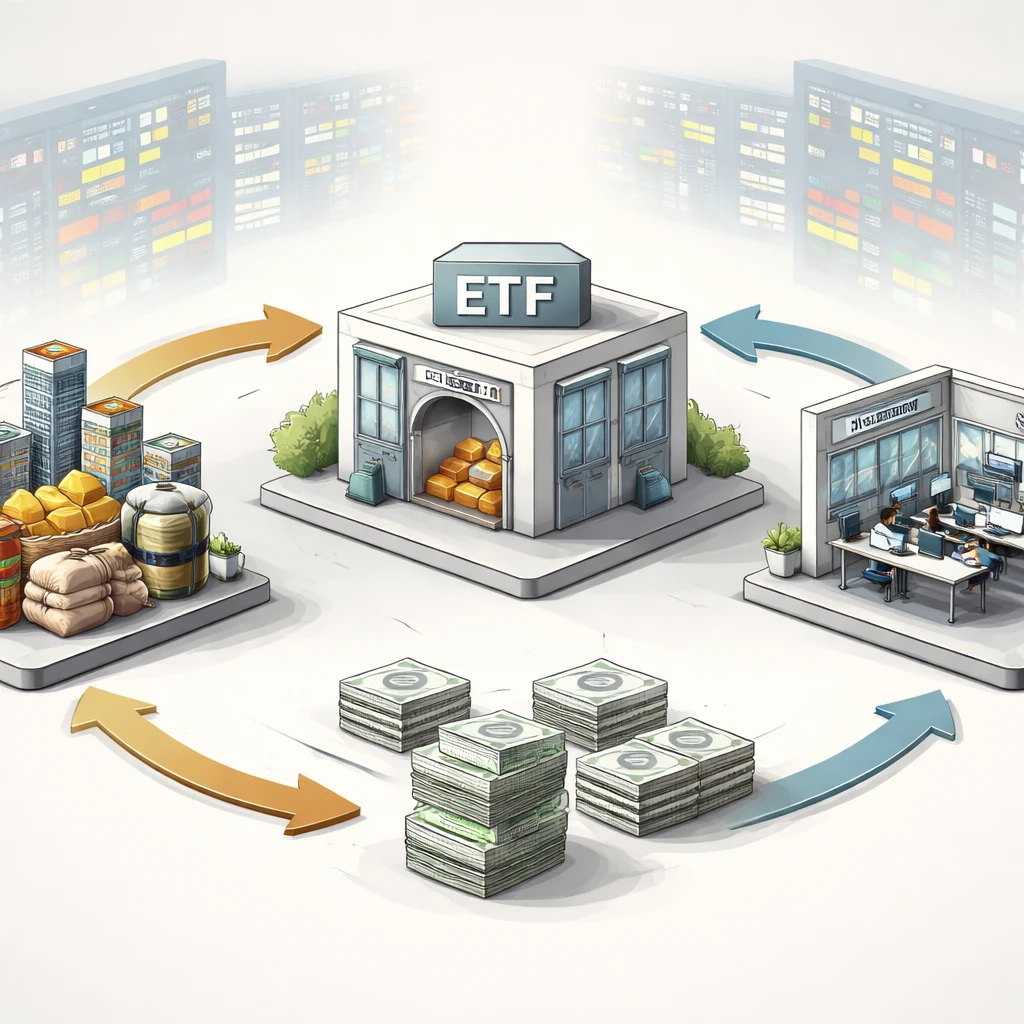
Exchange-traded funds rely on a primary market process known as creation and redemption. Creation is the issuance of new ETF shares in large blocks to institutions that have signed agreements with the fund, commonly called authorized participants. Redemption is the removal of ETF shares from circulation when those institutions return shares to the fund. These primary market exchanges occur between the ETF and authorized participants, typically in-kind for a basket of underlying securities, although cash can be used in certain cases. Secondary market trading, where most investors buy and sell ETF shares, takes place on exchanges among market participants. The creation and redemption process links these two markets so that the ETF share price remains close to the value of its underlying holdings.
At a high level, when ETF shares trade at a premium to the value of their portfolio, authorized participants have an incentive to create new shares by delivering the basket of securities to the fund and receiving ETF shares that can be sold in the market. When ETF shares trade at a discount, the process reverses. This supply and demand response encourages convergence between the ETF price and the fund’s net asset value.
Place in the Broader Market Structure
Creation and redemption sit at the junction of primary issuance and secondary trading. Several entities interact to make the mechanism work:
- ETF sponsor and portfolio manager: designs the fund, sets rules for basket composition, and oversees portfolio management.
- Custodian and transfer agent: safekeeps assets and keeps records of ETF shares outstanding.
- Authorized participants (APs): typically large broker-dealers under contract with the fund to exchange baskets for ETF shares and vice versa.
- Market makers and liquidity providers: quote prices on exchanges and often coordinate with APs, though not every market maker is an AP.
- Index provider: for index-tracking ETFs, defines the target portfolio and corporate action treatment.
- Exchanges and clearing firms: facilitate secondary trading and post-trade settlement.
Creation and redemption is the primary market that sits behind the screen price. Most investors interact only with the secondary market. The primary market becomes visible through the behavior of premiums and discounts, changes in shares outstanding, and the liquidity conditions observed in the quoted spreads.
Why the Mechanism Exists
The mechanism serves several important functions within the ETF structure:
- Price alignment: Arbitrage incentives encourage the ETF price to stay close to the value of the underlying portfolio.
- Scalable supply: Shares can expand or contract based on investor demand without the ETF sponsor conducting a traditional capital raise.
- Liquidity support: Even if the ETF itself has modest on-screen volume, APs can add or remove shares to accommodate inflows and outflows.
- Operational efficiency: In-kind transfers of securities reduce transactional frictions inside the fund, particularly for index-tracking portfolios.
- Tax considerations in some jurisdictions: In-kind redemptions can facilitate the removal of low-cost-basis positions from the portfolio. Specific tax outcomes depend on local law and are not uniform globally.
Without creation and redemption, an ETF would function more like a closed-end fund, where the supply of shares is fixed and market price can diverge materially from the value of underlying holdings for extended periods.
How Creation Works
Creations occur in units called creation units, which are large blocks of ETF shares, often 25,000 to 100,000 shares, though sizes vary by fund. The ETF sponsor publishes or makes available to APs a list of the securities and quantities that constitute the creation basket for that day. The basket is designed to match the fund’s portfolio exposures. In pro rata approaches, the basket mirrors the portfolio in scaled proportions. In optimized approaches, the basket is a representative subset that closely tracks the fund while reducing trading costs.
On the creation date, an AP delivers the basket to the ETF’s custodian. In exchange, the ETF issues creation units to the AP. The AP can then sell these ETF shares on the exchange, provide them to clients, or hold them as inventory. Many funds allow, and some require, a small cash component to balance fractional shares, cover fees, or account for corporate actions. In certain markets or asset classes, notably emerging markets or specific fixed income sectors, creations may be partially or fully in cash due to settlement complexities.
A numerical example of a creation
Suppose an equity ETF holds 500 stocks and has a net asset value of 50.00 per share. If the ETF is trading in the secondary market at 50.50, an AP observes a premium relative to the fund’s asset value. The AP can assemble the published creation basket of stocks worth approximately 5 million, deliver the basket to the fund, and receive 100,000 ETF shares as a creation unit. If the AP sells those ETF shares at 50.50, the gross proceeds are 5.05 million.
The potential profit is the 50,000 difference, less trading costs, creation fees, hedging costs during the assemble-and-deliver window, and any taxes or stamp duties in relevant markets. This activity adds new shares to the market and increases supply. As supply rises, the ETF price pressure typically softens, narrowing the premium toward the fund’s asset value. The AP might hedge the market risk of the underlying securities while assembling the basket by shorting futures or related instruments, but the details of hedging are operational choices specific to the AP and not a requirement of the ETF structure.
How Redemption Works
Redemption is the reverse process. When ETF shares trade below the value of the underlying portfolio, an AP can buy ETF shares in the market and return them to the fund in exchange for the redemption basket of securities. Redemptions reduce the number of ETF shares outstanding, which can alleviate discount pressure.
A numerical example of a redemption
Continuing the earlier numbers, if the ETF trades at 49.50 while its underlying portfolio still values at 50.00 per share, an AP can buy 100,000 ETF shares for 4.95 million, redeem them with the fund, and receive the redemption basket valued near 5 million. The gross difference of 50,000 compensates the AP for costs and risks. As redemptions occur, the ETF’s share count falls and the discount tends to narrow toward the portfolio value.
In-kind redemptions transfer securities out of the fund to the AP, which may then sell them in the market or use them to cover short positions. Some funds or jurisdictions rely more heavily on cash redemptions, in which case the ETF sells securities to raise cash. Cash redemptions can introduce trading costs inside the fund and may influence tax outcomes depending on local regulations.
Arbitrage and the Price Link to Net Asset Value
The creation and redemption process is often described as an arbitrage mechanism. The term is used in a practical sense. The price of the ETF in the secondary market can deviate from the fund’s indicative value for short periods because quotes move continuously while the value of the underlying portfolio updates with trades in component securities. When deviations exceed the estimated cost to create or redeem, APs have an incentive to act.
Several reference values help anchor this process. The fund computes an official end-of-day net asset value based on closing prices. During the trading day, a disseminated estimate of portfolio value, sometimes called the intraday indicative value, provides a reference point for markets, though it is only an estimate and can be noisy for less liquid assets. Market makers, APs, and sophisticated traders often compute their own real-time valuations using live prices for as many constituents as possible and models for the rest.
The strength of the link between ETF price and asset value depends on costs and frictions. Wide bid-ask spreads in underlying securities, short-selling constraints, foreign market holidays, and custody or settlement frictions can all widen premiums or discounts. In stressed markets, the cost of capital for APs and balance sheet considerations can limit the speed of arbitrage, leading to larger deviations that persist longer.
Basket Design and Its Variations
ETFs can use several approaches to basket design, each with trade-offs in tracking precision and cost control.
- Pro rata baskets: The basket closely mirrors the ETF’s holdings in proportion. This approach tightens tracking but can be costly when the portfolio holds many small or illiquid positions.
- Optimized baskets: The basket is a representative subset that statistically tracks the portfolio. This can reduce trading costs for APs while maintaining acceptable tracking accuracy.
- Custom baskets: Some jurisdictions allow portfolio managers to assemble baskets that deviate from pro rata weights to reflect liquidity, corporate actions, or tax management. Governance controls and disclosures are used to manage conflicts of interest.
- Cash components: Small cash adjustments, often called cash in lieu, simplify settlement when fractional shares or unavailable securities are involved. Larger cash components may be used in markets with settlement frictions.
For international equity ETFs, fair value adjustments and time-zone differences can affect how the basket is computed. If underlying markets are closed, the fund may use pricing models that estimate current values from related instruments, such as futures or American Depositary Receipts, to construct the day’s basket.
Fixed Income and Other Asset Classes
Fixed income ETFs adapt the same basic framework to a market that trades differently from equities. Many bonds are infrequently traded, and reliable real-time prices can be scarce. Portfolio managers and APs therefore rely on evaluated pricing services, recent trade data, and models to estimate bond values. Baskets often contain representative bonds that match key risk exposures, such as duration, credit quality, and sector, rather than literal pro rata slices of every position.
Because some bonds are hard to source in the quantities needed for creations, funds may use greater cash components for fixed income ETFs. The ETF then acquires the target bonds over time. These differences can lead to periods where fixed income ETFs trade at noticeable premiums or discounts, particularly during market stress when underlying bond prices are stale or when liquidity conditions diverge between the ETF shares and the cash bond market.
Commodity and currency ETFs may follow different operational rules, often relying on futures, swaps, or physical inventories. Synthetic ETFs use derivatives such as total return swaps to deliver index exposure. In such structures, creations and redemptions are typically cash based and are used to adjust notional exposure under the swap rather than to exchange physical baskets.
Operational Timeline and Settlement
ETF portfolios disclose baskets daily to APs, generally before markets open. APs submit creation or redemption orders within specified windows. Most creations and redemptions settle on standard market cycles, commonly T+2 for equities, though specifics vary by asset class and market. During the day, market makers quote prices on the exchange based on their valuation of the portfolio and their expected costs of creating or redeeming shares if needed.
There are cut-off times for primary orders. If an AP misses a cut-off, it may need to wait until the next business day. Complex corporate actions, cash dividends, and index rebalances are reflected in the basket specifications and can add operational detail. The ETF may charge a creation or redemption fee designed to approximate the transaction costs that the fund would otherwise incur, which helps protect existing shareholders from dilution due to primary market activity.
Stress Periods and Constraints
The arbitrage link depends on the willingness and capacity of APs to assemble or accept baskets. During stress, balance sheet usage, risk limits, and hedging costs can constrain activity. Markets with settlement challenges or capital controls may require higher premiums to motivate creations or deeper discounts to motivate redemptions. Trading halts in component securities can also interrupt customary operations, because the AP cannot straightforwardly price or source the halted securities. Funds may temporarily adjust baskets or pause primary market activity for operational reasons, consistent with regulatory frameworks and disclosures.
History shows that large fixed income ETFs have occasionally traded at discounts during bond market stress, even while shares continued to change hands actively on exchanges. In such episodes, the ETF price can reflect a clearing price for the portfolio’s risk when many individual bonds have not traded recently. Over time, as underlying markets reopen and price discovery resumes, the creation and redemption mechanism tends to reassert the price link, although the path can be uneven.
Global and Structural Variations
ETF frameworks differ by jurisdiction. In the United States, many ETFs disclose detailed baskets daily and rely extensively on in-kind transfers. In some European markets, UCITS ETFs may operate with more cash components, particularly for harder-to-access securities, and there is a mix of physical and synthetic replication. In parts of Asia, local settlement rules, foreign ownership limits, and holiday calendars can influence the feasibility and cost of in-kind baskets. Each regime relies on a primary market agent, analogous to the AP, and on market makers to support secondary trading, but the exact roles and legal agreements differ.
Cross-listings and currency share classes introduce additional operational layers. The same ETF might be traded in multiple currencies, which requires market makers to manage foreign exchange risk when quoting and when coordinating with creations or redemptions. Stamp duties, transaction taxes, and withholding rules can affect the relative costs of in-kind versus cash processing, which flow through to spreads and to the size of premiums or discounts required to motivate AP activity.
Practical Illustration: A Day in the Life of an ETF
Consider a large-cap equity ETF that tracks a well-known index. Before the market opens, the fund posts its creation and redemption baskets to APs, showing weights and any cash adjustments. A market maker computes a live estimate of the portfolio value using futures and pre-market indications on the largest constituents, while using models for the smallest ones. When the exchange opens, the market maker provides two-sided quotes for ETF shares, calibrated to expected creation or redemption costs.
Mid-morning, investor demand pushes ETF shares to a slight premium to estimated value. An AP decides to create shares. It buys the required stocks in the open market, hedges residual risks with index futures, and delivers the basket to the fund’s custodian. The custodian confirms receipt and issues a creation unit to the AP. The AP then supplies those ETF shares to the market maker, who uses them to fill client buy orders without widening the quoted spread. The premium narrows.
Later in the day, a corporate action requires substituting one security in the basket with a cash-in-lieu amount because the security is subject to a trading halt. The fund updates the basket and communicates the change to APs. Near the close, a sell program pushes the ETF to a small discount. Another AP steps in, buying ETF shares and redeeming them with the fund. The fund delivers the redemption basket, allowing the AP to realize the discount, subject to costs. By the end of the session, the ETF’s price sits within a few basis points of the fund’s final net asset value.
Costs, Fees, and Transparency
Primary market activity is not costless. ETFs typically charge fixed or variable creation and redemption fees that approximate the cost of transacting in the underlying securities. APs incur trading costs, financing charges for inventory, and hedging costs while assembling or liquidating baskets. Transaction taxes, such as stamp duties in certain markets, also play a role. These costs influence the width of the ETF’s bid-ask spread and the size of premiums or discounts needed to motivate APs to act.
Transparency is central to reducing these costs. Many equity ETFs disclose full holdings daily, which helps APs assess risk and plan basket sourcing. Some funds disclose representative samples rather than full portfolios. Fixed income ETFs often provide detailed characteristics, such as duration and sector allocation, along with the day’s basket. Greater transparency reduces uncertainty in valuations, which supports tighter secondary market spreads.
Governance, Oversight, and Risks
Creation and redemption rely on a small set of institutions with the operational capacity to transact at scale. Concentration among APs is a recognized consideration. If activity depends heavily on a handful of firms, the system can be vulnerable to balance sheet constraints at those firms. Funds manage this risk by maintaining relationships with multiple APs, disclosing procedures for extraordinary market conditions, and designing baskets that are practical to source.
Custom baskets and optimized baskets introduce governance questions. Portfolio managers must demonstrate that basket design treats shareholders equitably, aligns with stated fund objectives, and follows compliance controls. Regulators in several jurisdictions have issued rules that require boards and advisors to document the rationale for basket differences and to monitor the impact on tracking and costs.
The mechanism does not eliminate market risk. ETF prices can deviate from portfolio value, sometimes meaningfully, especially when underlying markets are closed, when liquidity dries up, or when information is arriving more quickly in the ETF market than in the underlying securities. Creation and redemption also do not guarantee that large orders will execute at narrow spreads. Those outcomes depend on prevailing market conditions and the costs that APs and market makers face when hedging and sourcing inventory.
What Creation and Redemption Is Not
It is not a trading strategy by itself, and it does not provide a guaranteed arbitrage profit. The observed profits in simple numerical examples ignore inventory risk, hedging slippage, and operational frictions that can erode margins. It is not a promise that ETF shares always trade exactly at net asset value. Deviations can and do occur. The process is a structural feature that, under normal liquidity conditions, encourages alignment between the ETF’s price and the value of its holdings.
Real-World Context
Equity ETFs that track broad indices usually operate with near-continuous creations and redemptions, which support tight spreads and modest premiums or discounts. Sector and thematic ETFs may see more variation in basket costs due to smaller or less liquid constituents. During periods of market stress, large fixed income ETFs have sometimes traded at discounts, reflecting a gap between the rapid price discovery in ETFs and slower updates in cash bond prices. International equity ETFs can show time-zone effects. When a foreign market is closed but the ETF trades in a domestic session, the ETF price may reflect new information, futures market moves, or currency changes, while the official net asset value, based on stale local closes, lags.
These patterns are consistent with the function of creation and redemption. When APs can source or dispose of the required baskets at costs that make economic sense, they act. When costs or constraints are high, deviations widen until the incentive becomes sufficient to overcome them.
Putting the Pieces Together
ETF creation and redemption is the operational core that allows ETFs to combine features of mutual funds and exchange-traded securities. The fund stands ready to exchange baskets for shares with a limited set of institutions, while the public trades shares on exchanges. The resulting feedback loop helps keep prices aligned with portfolio values and allows supply to scale with demand. The detailed implementation varies across asset classes and jurisdictions, but the principle is stable. The primary market mechanism binds the ETF share to its underlying assets through a set of institutional processes, cost considerations, and incentives.
Key Takeaways
- Creation and redemption is the primary market process that links ETF shares with their underlying portfolios through in-kind or cash exchanges with authorized participants.
- The mechanism supports price alignment, scalable supply of shares, and liquidity by incentivizing APs to act when premiums or discounts exceed costs.
- Basket design, including pro rata, optimized, and custom approaches, balances tracking precision with trading and settlement practicality.
- Costs, frictions, and market stress can widen premiums or discounts, especially in fixed income and international ETFs, but the mechanism remains the path for convergence.
- Operational details differ by asset class and jurisdiction, yet the fundamental role of creation and redemption is consistent across ETF structures.