
Introduction
Actively managed exchange-traded funds occupy a distinct place in the modern fund landscape. They combine the intraday tradability and structural features of ETFs with the discretion of an investment manager who selects securities and adjusts exposures over time. Understanding how these products are built, priced, and regulated helps clarify where they fit relative to index ETFs and mutual funds. The discussion below focuses on the core mechanics and institutional context rather than strategies or recommendations.
Definition and Core Characteristics
An actively managed ETF is a pooled investment vehicle that trades on an exchange and is registered as an investment company, typically under the Investment Company Act of 1940 in the United States. Unlike index ETFs that track a defined benchmark, an active ETF gives its portfolio manager discretion to choose holdings and adjust positions without a requirement to replicate an index.
Three features define the category:
- Discretionary portfolio management. The manager makes buy and sell decisions with the goal of achieving a stated objective such as excess return relative to a benchmark, risk reduction, income generation, or a combination.
- Exchange trading. Fund shares list on a stock exchange and trade throughout the day at market prices that may differ slightly from the net asset value, or NAV.
- Creation and redemption mechanism. Authorized participants can create or redeem large blocks of shares with the fund in exchange for a basket of securities or cash. This mechanism underpins liquidity and helps align market price with NAV.
These elements mirror traditional ETFs, but the portfolio is not constrained by a benchmark replication rule. The manager can alter sector weights, credit quality, duration, or factor exposures, depending on the fund’s mandate and disclosed policies.
Position in the Broader Market Structure
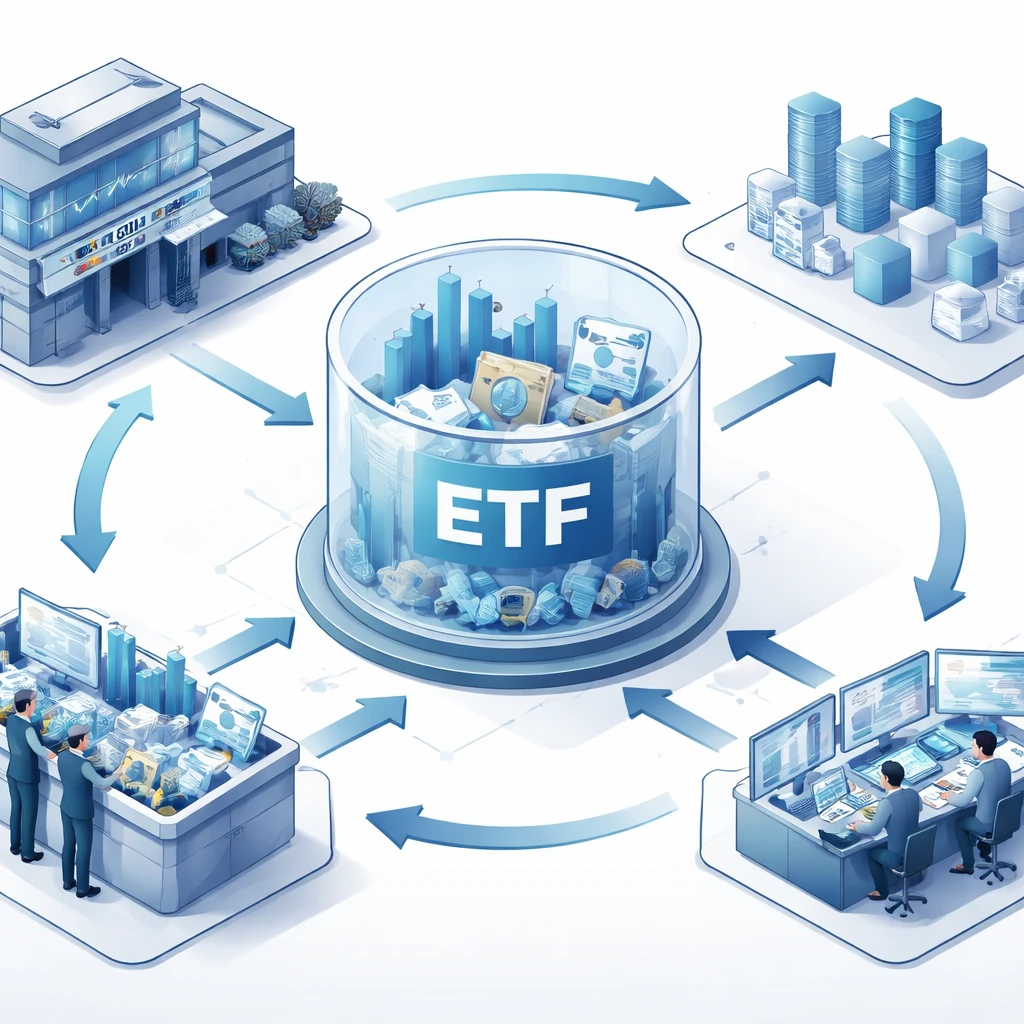
Actively managed ETFs sit within the broader ecosystem of public investment funds, which includes mutual funds, index ETFs, closed-end funds, unit investment trusts, and separately managed accounts. Their placement can be understood by examining how they interact with market intermediaries and end investors.
- Primary and secondary markets. In the primary market, authorized participants interface directly with the fund to exchange baskets for new shares or to redeem shares for baskets. In the secondary market, investors trade ETF shares on an exchange. The interplay between these two markets helps keep the trading price close to NAV.
- Market makers and liquidity providers. Market makers quote bids and offers throughout the day. Their ability to hedge risk with the underlying basket facilitates tight spreads when the underlying securities are liquid and transparent.
- Custodians and administrators. Custodians safeguard assets, process corporate actions, and support the daily calculation of NAV. Administrators handle accounting, shareholder services, and compliance reporting.
This structure resembles that of index ETFs. The key operational difference is that the composition of an active ETF’s portfolio can change for reasons unrelated to index events, which influences basket design, disclosure, and trading dynamics.
Why Actively Managed ETFs Exist
Active ETFs emerged to meet several practical needs within asset management and market microstructure.
- Manager discretion inside an ETF wrapper. Some managers aim to add value through security selection or dynamic risk management. The ETF vehicle offers these managers intraday liquidity, potential tax efficiency from in-kind redemptions, and exchange-based distribution.
- Cost and operational efficiency. Many ETFs operate with leaner distribution channels than traditional mutual funds, which can translate into competitive expense ratios and streamlined operations. The potential to manage capital gains through in-kind transfers can also be appealing for taxable accounts, subject to jurisdiction and fund practices.
- Investor preferences for transparency and tradability. Daily pricing, public quotations, and access via brokerage accounts make ETFs convenient for a wide range of investors. Many active ETFs disclose holdings daily, which increases transparency relative to mutual funds that typically disclose less frequently, though there are important exceptions described below.
- Regulatory developments. Over time, regulators established rules and exemptive relief that enabled active ETFs to operate alongside index ETFs. In the United States, the ETF Rule under the 1940 Act standardized core requirements, and additional approvals allowed for nontransparent or semi-transparent active ETF models that limit daily holdings disclosure.
How Active ETFs Work: Mechanics and Disclosure
At the heart of the ETF structure is the creation and redemption mechanism that links the market price of the ETF to the value of its holdings. Active ETFs use the same core system, with practical nuances related to portfolio secrecy and trading.
Creation and Redemption Baskets
Authorized participants deliver a specified basket of securities or cash to the fund in exchange for new shares. Conversely, they can return shares to the fund and receive a basket of securities or cash. The content of the basket is designed by the fund and may be a pro rata slice of the portfolio or a custom basket that differs from current holdings. Custom baskets are particularly relevant for active ETFs because the manager may wish to add or remove certain positions without revealing the full portfolio composition or because some holdings may be illiquid, difficult to transfer, or subject to restrictions.
Custom baskets can improve tax management by allowing the fund to transfer out low-cost tax lots during redemptions. They can also aid liquidity management when the underlying securities trade in different time zones or have varying market depths. Funds must follow written policies and oversight procedures to use custom baskets.
Transparency Models
Active ETFs differ in how much of their portfolio they disclose and how frequently they disclose it.
- Fully transparent active ETFs. These funds typically publish a complete holdings list daily. Market makers can then estimate the fund’s value in real time and hedge their exposure precisely. This often supports narrower bid-ask spreads, especially for funds holding liquid securities.
- Semi-transparent or nontransparent structures. These models restrict daily holdings disclosure. Instead of a full list, the fund provides alternative tools such as proxy portfolios or verified intraday value calculations. The objective is to protect the manager’s intellectual property and reduce risks of front-running, while still giving market makers enough information to price and hedge the fund effectively.
Both models operate under regulatory standards that address fair value pricing, dissemination of data, and protection of shareholders. The choice between models reflects a trade-off between transparency and potential protection of the manager’s process.
Indicative Values and NAV
ETFs report a daily NAV based on the closing value of the underlying portfolio. During the trading day, market participants use data such as an intraday indicative value, where available, to monitor estimated portfolio value. For fully transparent funds, indicative values can closely track the live worth of the basket when the underlying holdings are trading. For portfolios that include thinly traded securities, foreign holdings outside local market hours, or semi-transparent models, quotes may be wider and indicative values less precise, particularly during market opens or in periods of elevated volatility.
Pricing, Liquidity, and Market Behavior
The market price of an ETF can deviate from NAV by a small amount. In liquid conditions, authorized participants and market makers use creation and redemption to arbitrage away persistent gaps. Understanding the sources of small premiums or discounts is useful for evaluating how active ETFs trade.
- Underlying liquidity. Liquidity of the ETF tends to flow from the liquidity of its underlying holdings. An active ETF that owns widely traded equities usually supports tighter spreads than one holding thinly traded bonds or niche instruments.
- Disclosure quality. Daily holdings disclosure can make hedging straightforward, which improves quoted spreads. Semi-transparent models rely on alternative signals and may trade with modestly wider spreads to compensate market makers for uncertainty.
- Basket design and timing. When baskets are well aligned with the portfolio and represent the true cost of acquiring or selling the underlying holdings, market makers can manage inventory efficiently. Misalignment, or significant changes late in the day, can widen spreads temporarily.
During stress periods, premiums and discounts can widen for both index and active ETFs, particularly in fixed income. In such intervals, the ETF’s market price reflects the level at which liquidity is available in real time, while the NAV may rely on evaluated prices or last traded prices that do not fully reflect current clearing levels. That difference does not necessarily indicate malfunction; it can signal the cost of immediacy in the market at that time.
Costs and Expenses
Actively managed ETFs have several cost components that affect shareholders differently depending on holding period and trading behavior.
- Expense ratio. This annualized fee covers management and operational expenses. Active management generally costs more than a plain index ETF because it involves research, trading, and portfolio oversight. Expense ratios are disclosed in the prospectus and shareholder reports.
- Trading costs inside the fund. Turnover generates commissions, bid-ask spreads on the underlying securities, and market impact. These costs are not usually included in the expense ratio and can affect returns.
- Investor trading costs. Investors who buy or sell shares on the exchange face bid-ask spreads and, depending on their brokerage, commissions or platform fees. Spreads can vary with liquidity and transparency, as described above.
- Tax treatment. In many jurisdictions, ETFs that use in-kind redemptions can reduce realized capital gains distributions. The magnitude of this benefit depends on the asset class, use of custom baskets, and the fund’s specific practices. Bond ETFs and certain derivatives-based strategies may rely on cash transactions more frequently than large-cap equity ETFs, which can change the tax profile. Local tax rules and the investor’s circumstances determine ultimate outcomes.
Risk Considerations
Active ETFs carry the structural characteristics of the ETF wrapper along with risks associated with manager discretion.
- Active risk and tracking variation. Since the portfolio is not tied to an index, performance can diverge meaningfully from common benchmarks. This includes the possibility of underperformance due to security selection, timing, or style exposures.
- Manager and process risk. The outcome depends on the manager’s skill, research infrastructure, and risk controls. Changes in personnel, model assumptions, or data quality can affect results.
- Capacity and liquidity risk. Some strategies do not scale well. As assets grow, trading the underlying holdings can become more costly, which may lead to higher turnover costs or a need to broaden the investable universe.
- Style drift and mandate adherence. An active ETF has a stated objective and policies. If market conditions change, there is a possibility that exposures migrate away from the fund’s original style. Compliance oversight and disclosure aim to limit unintended drift.
- Derivatives and counterparty exposure. Many active ETFs use futures, options, or swaps for hedging or efficient exposure. This introduces collateral management and counterparty considerations, as well as the need to handle margin and cash management prudently.
- Concentration and sector risk. Some active ETFs hold a focused portfolio. Concentration can amplify both positive and negative outcomes relative to a broad market benchmark.
Comparing Active ETFs with Mutual Funds and Index ETFs
Active ETFs share several attributes with mutual funds but differ in important ways.
- Trading and access. ETF shares trade on exchanges during market hours, with price formation driven by supply and demand. Mutual fund shares transact at end-of-day NAV through the fund company or a platform.
- Tax efficiency potential. The ability to redeem in kind can limit realized capital gains within the fund. Mutual funds that redeem shares for cash may need to sell securities and realize gains, which are distributed to remaining shareholders. The actual tax outcome depends on the fund’s practices and applicable tax rules.
- Transparency. Many active ETFs publish daily holdings, while mutual funds generally disclose less frequently, such as quarterly with a delay. Semi-transparent ETF models sit between these poles.
- Costs and distribution. Expense ratios and distribution costs vary widely. ETFs often have streamlined distribution compared with share-class structures in mutual funds. That difference can influence total costs but does not determine them.
Compared with index ETFs, the distinguishing feature is discretion over holdings. Index ETFs seek to match an index and typically emphasize cost minimization and tracking precision. Active ETFs aim to pursue a stated investment objective that may not correspond to an index, which introduces additional sources of risk and variability.
Operational Design Choices
Two design choices shape how an active ETF functions day to day: basket policy and transparency regime.
- Basket policy. Funds specify when and how they will use custom baskets, cash substitutions, and transaction fees. Robust basket design can reduce portfolio trading costs and improve tracking of the manager’s intended exposures.
- Transparency regime. Fully transparent funds facilitate precise hedging by market makers, which can result in tighter spreads. Semi-transparent models seek to protect the manager’s information advantage. The choice reflects trade-offs that are outlined to investors in the prospectus.
Additional operational topics include securities lending, which can generate income for the fund, and cash management to handle dividends, creations, redemptions, and derivative margin. Each practice is governed by policies, disclosure, and oversight designed to align with shareholder interests and regulatory requirements.
Regulatory Context
Active ETFs operate within a regulatory framework that covers disclosure, governance, compliance, and market conduct.
- Investment Company Act oversight. Registration as an open-end fund imposes standards for liquidity risk management, custody, valuation, board oversight, and shareholder reporting.
- ETF Rule and related relief. In the United States, Rule 6c-11 under the 1940 Act permits most ETFs to operate without seeking individual exemptive orders, subject to conditions including daily portfolio transparency or alternative mechanisms for nontransparent structures, publication of portfolio information, and policies for basket construction. Additional approvals support semi-transparent models that balance portfolio confidentiality with price discovery.
- Exchange listing requirements. Exchanges set listing standards for minimum shares outstanding, diversification, and dissemination of key data such as intraday values. Market surveillance seeks to protect against manipulation.
Outside the United States, similar principles apply with jurisdiction-specific rules. For example, European UCITS ETFs follow portfolio diversification and disclosure requirements established under UCITS, and exchange rules govern trading and reporting. The central idea is consistent: enable intraday trading while maintaining robust investor protections.
Real-World Context and Illustrative Examples
Examples clarify how active ETFs operate without suggesting any strategy or outcome.
- Active equity fund with daily transparency. Consider a large-cap equity ETF that publishes its full holdings each morning. The manager adjusts sector weights based on fundamental analysis and may hold a modest cash balance for liquidity. Market makers can hedge exposures precisely because the holdings are public. Spreads tend to be tight when the underlying stocks are liquid and the market is calm.
- Active corporate bond ETF managing liquidity. A corporate bond ETF may vary credit quality and sector exposure within stated limits. The fund uses custom baskets to transfer out bonds with embedded gains during redemptions and to accept more liquid issues during creations. In volatile conditions, market makers rely on evaluated prices and dealer quotes, which can result in wider spreads on the ETF compared with normal times. The ETF’s price reflects the real-time cost of transacting in credit markets.
- Semi-transparent equity model. An equity ETF limits daily disclosure and publishes a proxy portfolio that statistically tracks the actual holdings. Pricing agents verify an intraday estimate of value. Market makers hedge using the proxy and reference exposures, which supports continuous trading while masking the manager’s current positions.
- Derivatives to equitize cash. An active ETF receiving a large creation late in the day might hold futures overnight to maintain market exposure while sourcing underlying securities efficiently over subsequent sessions. This use of derivatives can reduce tracking variance relative to the fund’s stated objective, though it introduces collateral and counterparty considerations.
Tax and Distribution Mechanics
Tax and distribution policies affect after-tax outcomes for shareholders, subject to local law and individual circumstances. The ETF wrapper can be tax efficient in certain jurisdictions due to in-kind redemptions and the ability to manage tax lots through custom baskets.
- In-kind redemptions. When a large shareholder redeems, the fund can transfer securities rather than selling them. By selecting low-cost tax lots for transfer, the fund may reduce realized gains for continuing shareholders. This is common for equity ETFs that hold liquid, exchange-traded securities.
- Cash transactions. In fixed income or derivatives-heavy strategies, redemptions and creations may involve cash more frequently. Cash transactions can lead to realized gains or losses inside the fund, which later flow to shareholders through distributions.
- Distribution schedule. Active ETFs typically distribute income on a monthly or quarterly basis and capital gains annually, if any. Dividend and interest accruals, along with securities lending income, contribute to distributable income.
Whether an active ETF realizes a tax advantage depends on the interaction of its asset class, trading frequency, portfolio turnover, and the use of custom baskets. Disclosures in shareholder reports and tax documents provide the relevant information for each fund.
Evaluating Disclosures and Documents
Fund documents explain how an active ETF operates. Reading them carefully clarifies what the manager can and cannot do.
- Prospectus. Outlines the fund’s objective, principal risks, fees, use of derivatives, benchmark references, and disclosure practices. It also explains the creation and redemption policy, including custom baskets and transaction fees.
- Statement of Additional Information and shareholder reports. Provide further details on investment techniques, risk controls, securities lending, and historical data. Shareholder reports include performance figures, portfolio holdings at period end, and commentary from management.
- Daily and periodic holdings reports. For fully transparent funds, daily files show individual positions and weights. For semi-transparent funds, the issuer provides substitute data such as proxy portfolios and daily deviation metrics.
These materials are central for understanding the fund’s mandate, operational choices, and the data available to the market for pricing.
Common Questions
Do active ETFs always disclose holdings daily
Not always. Many do, but semi-transparent models limit daily disclosure while offering alternative tools for price discovery and hedging. The prospectus specifies the approach.
Are active ETFs more expensive than index ETFs
Expense ratios and trading costs vary. Active management typically costs more than straightforward index replication because of research and trading activity, but there is significant dispersion across funds and asset classes.
Can active ETFs be closed to creations
Yes. In certain circumstances, issuers may temporarily suspend creations, for example around corporate actions or when underlying markets are disrupted. Prolonged suspensions can affect premiums and discounts because arbitrage is constrained.
Do active ETFs pay capital gains
They can. The frequency and size of capital gains distributions depend on portfolio turnover, the asset class, the use of in-kind redemptions, and local tax rules. Equity funds with efficient in-kind processes often limit gains, but outcomes are fund specific.
Practical Considerations Without Recommendations
Active ETFs provide tools for packaging manager discretion within the ETF format. The relevance of any particular fund depends on its stated objective, asset class, costs, and disclosures. Market microstructure aspects such as spreads, depth, and alignment between the basket and the portfolio influence trading quality. Operational choices around transparency and custom baskets affect tax profile and liquidity. These are descriptive characteristics rather than endorsements.
Key Takeaways
- Actively managed ETFs combine intraday trading and the ETF creation-redemption process with discretionary portfolio management.
- Transparency varies by design, from full daily holdings to semi-transparent models that use proxy portfolios or verified indicative values.
- Pricing quality depends on underlying security liquidity, disclosure practices, and basket design, which together influence spreads and premiums or discounts.
- Costs include the expense ratio, trading costs inside the portfolio, investor trading frictions, and tax considerations shaped by in-kind processes and asset class.
- Risks center on active decision-making, capacity, liquidity, and potential concentration, alongside the operational and regulatory features common to all ETFs.