
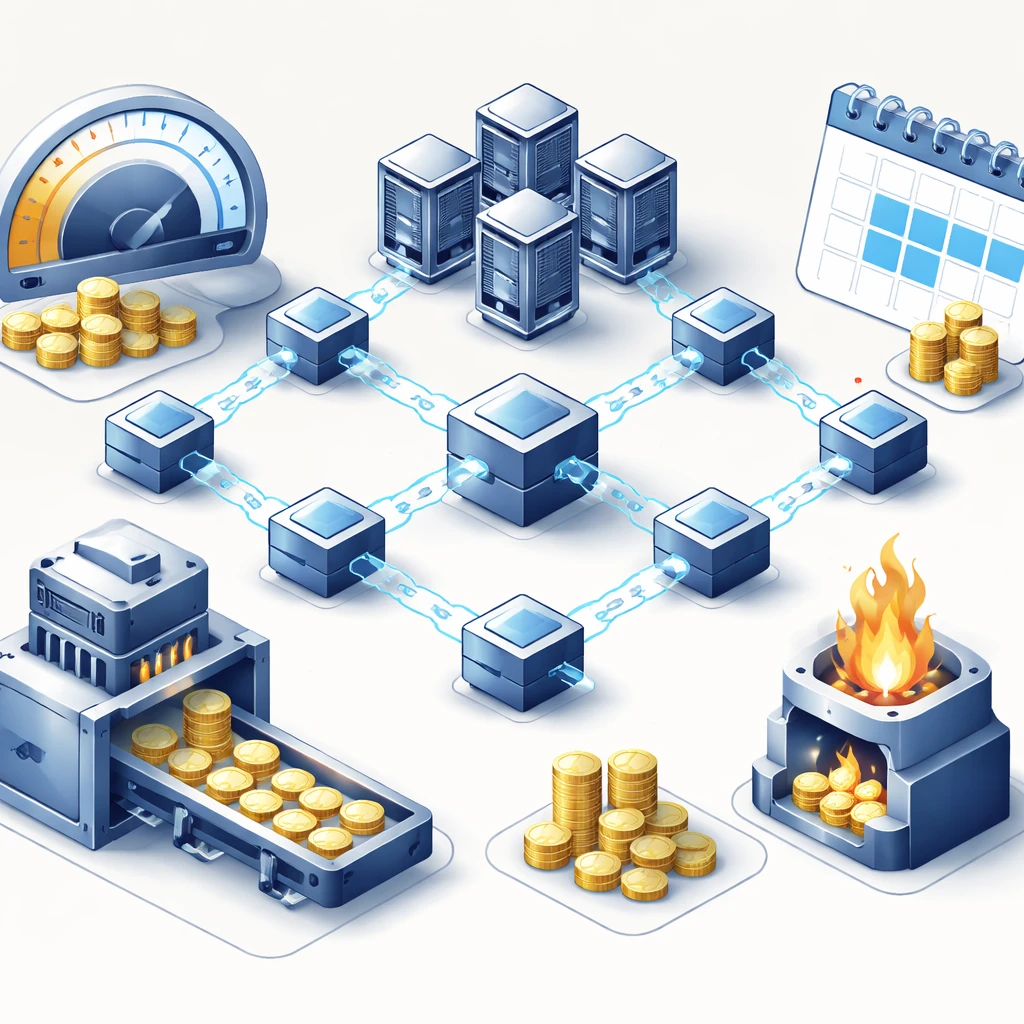
Token supply and inflation sit at the center of crypto and blockchain fundamentals. Every blockchain and token-based protocol defines how new units are created, how many can exist, and how they enter circulation. These rules shape security budgets, participant incentives, and the economic life of an asset across exchanges, wallets, validators, and applications. Understanding supply and inflation is not about predicting prices. It is about reading the monetary policy of a protocol and recognizing the pressures that policy can exert on market structure and behavior.
Defining Token Supply and Inflation
Token supply refers to the number of units of a crypto asset that exist under a protocol’s rules. Analysts distinguish among three related quantities:
- Circulating supply: units that are in public hands and usable in the market. This excludes tokens locked by protocol design, subject to vesting, or irretrievably lost when clearly identified.
- Total supply: units that exist on-chain minus verifiably burned tokens. This includes locked or escrowed tokens not yet circulating.
- Maximum supply: a protocol-defined cap on the number of units that can ever exist, if such a cap is specified. Some assets have no explicit maximum.
Token inflation is the rate at which new units are added to circulating supply over time. A practical measure for a period is the amount of newly issued tokens over that period divided by the circulating supply at the start of the period. It is often annualized. If a protocol burns tokens, net inflation can be lower than gross issuance and can even turn negative over intervals when burns exceed issuance.
It is important to separate token inflation from economy-wide consumer price inflation. Token inflation describes the change in supply of a crypto asset. Consumer price inflation concerns the general rise in prices of goods and services in an economy. A token can experience supply inflation while its market price rises or falls, depending on demand and other factors.
Why Token Inflation Exists
Inflation in crypto is not an accident. It is usually a policy choice embedded in code for specific reasons:
- Security budget: Proof-of-work and proof-of-stake systems pay miners or validators to secure the network. Newly issued tokens are a transparent funding source for this budget. Without sufficient compensation, hash power or stake may fall, weakening security.
- Participation incentives: Protocols often reward validators, delegators, liquidity providers, or other contributors with new tokens to bootstrap and sustain activity.
- Distribution: Early token distributions can be concentrated. Ongoing issuance spreads ownership across a wider group of participants over time.
- Economic flexibility: Some protocols tie issuance to network conditions to stabilize fees, target staking participation, or offset volatility in demand for block space.
These design choices have trade-offs. Inflation can dilute existing holders, while low or zero issuance requires other sources of security funding and incentives, such as fees.
How Supply Fits into Market Structure
Market structure describes how a token trades across venues, who holds it, and how liquidity forms. Supply rules influence several components:
- Float and liquidity: The fraction of supply actually available to trade, often called float, affects bid depth and slippage. High float with broad distribution can support deeper markets. Low float with concentrated holdings can make prices more sensitive to order flow.
- Ongoing sell pressure: Miners, validators, team members, and early investors who receive unlocks or rewards may sell part of their tokens to cover costs. Issuance and unlock schedules influence this structural flow.
- Market capitalization arithmetic: Market cap equals price times circulating supply. A change in circulating supply changes market cap mechanically, even if price per token is constant.
- Intermediated supply: Custodians, exchanges, and staking services can pool tokens. This can obscure underlying distribution and can alter how quickly new supply reaches open markets.
Supply is one side of the ledger. Demand for block space, utility, and speculative interest is the other. The interaction of supply policy and demand dynamics shapes how a token trades without implying a directional outcome.
Issuance Mechanisms and Schedules
Protocols encode issuance in various ways. Several patterns recur across networks.
Proof-of-Work Subsidy
Under proof-of-work, miners who produce valid blocks receive a block subsidy and transaction fees. The subsidy is newly created supply. Some systems reduce the subsidy at fixed intervals, which gradually slows inflation. A well-known example is a halving schedule that cuts the block reward at set block heights, moving issuance toward zero as an asymptote while maintaining a finite maximum supply.
Proof-of-Stake Rewards
Under proof-of-stake, validators receive new tokens and fees for attesting and proposing blocks. Many designs tie issuance to the amount of stake participating in consensus. If more tokens are staked, the protocol might adjust nominal yields to target a particular participation rate. This can stabilize security by encouraging enough stake to be locked.
Tail Emission
Some protocols adopt a small perpetual issuance after an initial emission curve decays. A tail emission provides a steady security budget and discourages long-run fee scarcity from starving validators or miners.
Event-based Minting
Certain applications mint tokens when specific actions occur, such as providing liquidity or using a lending market. Emission can be front-loaded and taper over time, or it can be scheduled to respond to usage metrics.
Burns, Buybacks, and Net Supply
Issuance defines gross supply creation. Net supply change also depends on destruction mechanisms.
- Fee burns: Some networks destroy a portion of transaction fees by sending them to an unspendable address. When on-chain activity is high, daily fee burns can offset or exceed issuance, producing periods of net deflation.
- Protocol buybacks and burns: A protocol might use revenue to purchase tokens on the market and burn them. This converts protocol cash flow into negative supply growth.
- Penalty slashing: In proof-of-stake, malicious or negligent validators can be slashed. Slashed tokens can be burned, reducing supply.
Net inflation at time t equals newly issued tokens minus tokens burned or destroyed during the same interval, divided by the starting circulating supply. Measuring this requires reliable data on both issuance and burns.
Initial Distribution, Lockups, and Vesting
Launch design has long-lasting implications for supply and inflation experienced by public markets.
- Genesis allocation: At network start, tokens can be allocated to founders, early contributors, foundations, investors, or community pools. These allocations may be locked.
- Vesting schedules: Locked tokens unlock over time under rules that may include cliffs and linear vesting. Unlocks increase circulating supply even if no new tokens are minted.
- Treasury management: Foundations and treasuries may distribute grants, liquidity incentives, or ecosystem rewards. These flows effectively convert non-circulating supply into circulating supply.
Public trackers sometimes conflate total supply with circulating supply or omit future unlock information. Readers should distinguish between issuance-driven inflation and unlock-driven increases in float. Both change the supply available to markets, but only the former changes total supply at the protocol level.
Measuring Token Inflation
Accurate measurement requires clear reference points and careful data handling.
Define the Period and Baseline
Annual inflation is often quoted as a percentage of circulating supply at the start of the year. If circulating supply is difficult to determine, some analysts use an average or end-of-period value, which can bias results. The most transparent approach uses a well-documented baseline and reconciles discrete mint and burn events.
Gross vs Net Measures
Gross issuance counts new tokens created before burns or slashing. Net issuance subtracts burns and destroyed tokens. A protocol with fee burns can show low or negative net issuance during periods of high activity even if gross issuance is steady.
Realized vs Theoretical Supply
Lost coins, inaccessible addresses, and long-dormant wallets complicate circulating supply. Theoretical circulating supply is on-chain and unlocked. Realized circulating supply considers that some portion may be functionally absent from markets. There is no universal standard, so reported numbers can differ across data providers.
Supply-Weighted Incentives
Nominal yields on staking or mining do not equal net inflation experienced by all holders. If a fraction of supply is staked and earns rewards, the dilution faced by non-stakers can exceed the headline inflation rate. Conversely, those who stake can offset dilution by receiving a proportional share of new issuance. This is a distribution effect rather than a change in total inflation.
Supply Policy and Security Economics
Issuance funds security and network health. The relationship between fees, issuance, and risk is central to protocol design.
- Security-cost alignment: In proof-of-work, the cost of securing the network equals miner revenue over time. If fees are low and issuance falls too quickly, security budgets can shrink. Designers weigh long-run security against the goal of low dilution.
- Stake-based assurances: In proof-of-stake, the cost to attack scales with the value and proportion of staked tokens. Issuance can be calibrated to encourage a target staking ratio that makes attacks more expensive.
- Fee variability: On-chain activity is cyclical. Protocols that rely on fee burns or fee-funded security experience changing net supply and changing security margins through time.
There is no single optimal inflation path. Choices reflect values: predictable scarcity, dynamic flexibility, or steady security budgets.
Examples in Practice
Bitcoin: Fixed Maximum with Declining Issuance
Bitcoin defines a maximum supply of 21 million coins. New coins enter circulation through block subsidies awarded to miners. The subsidy halves at set heights, typically every four years by block count. This schedule lowers the annual inflation rate over time and moves total supply toward its cap. Transaction fees supplement miner revenue but vary with activity. The design prioritizes predictable scarcity and a transparent path to minimal new issuance, while relying on a combination of fees and the remaining subsidy for security.
Ethereum: Variable Net Supply with Fee Burns
Ethereum issues new ETH to validators for staking participation. Since a 2021 upgrade, a portion of transaction fees is burned. During periods of heavy usage, burned fees can exceed new issuance, producing negative net issuance for those intervals. During quieter periods, net issuance is positive. The result is a flexible supply that responds to network activity while maintaining incentives for validators through issuance and fees.
A Hypothetical DeFi Token with Incentives and Vesting
Consider a protocol that mints a governance token on a fixed schedule of 10 percent annual gross issuance for the first three years, then 2 percent thereafter. It distributes tokens to liquidity providers and staking participants. Founders and early contributors receive allocations that vest over four years with a one-year cliff. Circulating supply increases both from issuance to participants and from scheduled unlocks. If on-chain activity is high, the protocol might buy and burn a fraction of fees, reducing net supply growth in those periods. The token’s market structure reflects the cadence of these flows, which can be estimated from the protocol’s public vesting contracts and issuance curves.
Stablecoins and Elastic Supply
Stablecoins manage supply around a reference value, often one unit of fiat currency. Supply expands when users deposit collateral or fiat to mint new units and contracts when units are redeemed. This elasticity is not inflation in the sense of a protocol minting tokens on a preset schedule. It is a response to demand at a target price. Some algorithmic designs also include burns or expansions governed by rules, but the purpose remains price stability rather than funding security or incentives.
Unlock Calendars and Market Float
Unlocks translate planned supply events into market float. Public calendars summarize cliffs and linear vesting across team, investor, and ecosystem allocations. Several considerations matter for interpretation:
- On-chain mechanics: Unlocks often involve smart contracts that release tokens at set block heights or timestamps. The release does not guarantee immediate market sale, but it makes tokens available for movement.
- Aggregation across categories: Team, investor, and ecosystem allocations can unlock at different rates. Aggregating schedules helps map the total flow of new float over time.
- Interaction with issuance: In many projects, unlock-related increases in float exceed issuance-related increases for extended periods. Analysts sometimes separate these components to understand structural flows.
Unlock calendars are not a forecast of price or liquidity, but they do mark changes in the set of tokens that can be transacted. Combined with distribution data, they provide context for market microstructure.
Distribution, Concentration, and Holder Behavior
Supply is not only about how much exists. It is also about how it is distributed.
- Address concentration: Ownership can be concentrated in a small number of addresses. Some of these belong to exchanges or custodians that hold tokens on behalf of many users. Disentangling these cases requires careful labeling.
- Active vs dormant supply: Tokens that have not moved for long periods may be functionally removed from the market, even if they are not burned. Spikes in active supply, where long-inactive tokens move, can shift available liquidity.
- Stake and lock incentives: Programs that reward staking or locking reduce liquid float while increasing the share of tokens that earn issuance. This changes the distribution of dilution and can impact volatility.
Distribution statistics are commonly used to contextualize potential supply responses to market events. They do not by themselves predict outcomes.
Data Quality and Common Misconceptions
Interpreting supply and inflation often runs into data challenges.
- Circulating supply discrepancies: Different data providers apply different criteria for what counts as circulating. Methodological notes matter.
- Double counting custodied tokens: Tokens held at an exchange address represent many end users. Treating them as a single holder can misstate concentration.
- Burn address identification: Not all burns are obvious. Some protocols use standard null addresses while others use contract-specific mechanisms.
- Confusing token inflation with price inflation: Supply growth does not mechanically determine price levels. Price reflects supply, demand, and market structure.
- Ignoring unlocks: Focusing on issuance while overlooking vesting can understate increases in float that matter to trading venues and liquidity conditions.
Analytical Tools and Practical Reading
Evaluating supply and inflation involves reading protocol documentation, on-chain data, and third-party trackers with a consistent framework.
- Protocol documents and code: White papers, governance proposals, and audited contracts specify issuance curves, burn rules, and vesting mechanics. The most accurate information is often in the code.
- On-chain explorers: Explorers display block rewards, burned fees, and token transfers. For vesting and treasury addresses, labeled tags can be informative.
- Public dashboards: Community dashboards track unlock calendars, staking ratios, and fee burn rates. Their methodologies vary and should be reviewed.
When reading supply data, consider units and horizons. A daily net issuance chart captures short-term variability while a cumulative supply curve explains long-term policy. Both perspectives can be correct about different questions.
Interplay with Fees, Utility, and Demand
Tokens that secure blockchains or power applications derive value from utility and from the assurances that security provides. Supply policy interacts with these drivers through several channels:
- Fee markets: If a network’s fee market becomes robust, issuance can decline while validators and miners remain compensated. If fee markets are thin, issuance may carry more of the security budget.
- Application demand: Tokens used for collateral, gas, governance, or staking may see varying demand across cycles. Supply rules set the backdrop against which utility-driven demand changes.
- Cyclicality: Protocols experience booms in activity followed by quieter periods. Supply mechanisms that adapt to activity, such as fee burns, can smooth outcomes over cycles.
No single mechanism guarantees stability or growth. Design choices locate a protocol along a spectrum from fixed scarcity to adaptive flexibility.
Risk Considerations in Supply Design
Every issuance and burn policy carries risks and mitigations.
- Dilution risk: High sustained issuance dilutes non-participating holders. Protocols may mitigate this by tying rewards to productive activity or by tapering emission.
- Security underfunding: Aggressive reductions in issuance can underfund security if fees do not fill the gap. Protocols attempt to balance predictability with adequate incentives.
- Governance drift: Protocols with adjustable issuance rely on governance to change parameters. Poorly designed governance can lead to shortsighted changes.
- Data opacity: Without transparent disclosure of vesting and treasury movements, markets can misinterpret supply dynamics. Many projects now publish detailed unlock and treasury reports.
Putting It Together Without Forecasting
A careful reading of token supply and inflation yields a coherent narrative about how a crypto asset funds security, distributes ownership, and responds to activity. The narrative is mechanical and testable. Issuance is scheduled in code. Burns and unlocks are observable on-chain. The remaining uncertainties lie in behavior, such as whether recipients sell or hold, and in demand, such as how much block space is needed during a cycle.
Analysts who treat supply as part of market structure can connect policy to possible liquidity conditions. A fixed-cap asset with declining issuance favors predictability in total supply but may rely more on fees to fund security. A variable-supply asset with fee burns offers adaptability but introduces governance risk and activity dependence. An application token with ongoing incentives can expand distribution while affecting float through unlocks. These are structural judgments about design, not forecasts.
Real-World Context: Reading Public Data
Several public examples illustrate how these concepts appear in day-to-day data:
- Bitcoin’s circulating supply rises at a slowing rate, visible in block explorers that tally block subsidies. Halving events reduce the increment of new coins per block. Fee revenue spikes when block space demand is high, but the contribution to miner income often remains secondary to the subsidy during quieter periods.
- Ethereum’s net supply changes daily. Explorers display base fee burns and new validator rewards. When activity accelerates, burned tokens can outpace issuance for a time. When activity cools, net supply tends to increase.
- DeFi protocols publish vesting contracts and liquidity incentive schedules. Dashboards track unlocks by category and date, letting observers map how much float may come online in the next quarter.
These examples highlight the practical mechanics: issuance, burns, fees, and unlocks are not abstract ideas but recorded events that can be verified and modeled.
Conclusion
Token supply and inflation are foundational parameters of any crypto asset. They encode how security is paid, how ownership spreads, and how the asset interacts with cycles of on-chain activity. The details vary widely across networks, yet the questions remain consistent. What is being issued, at what rate, to whom, under what conditions, and with what offsetting burns or locks. How does that translate into circulating supply and market float over relevant horizons. Clarity on these points supports disciplined reasoning about blockchain economies without relying on prediction.
Key Takeaways
- Token supply defines the stock of units that exist, while inflation measures the rate at which new units enter circulation after accounting for burns.
- Issuance funds security and participation, but it can dilute holders; design choices balance security budgets, distribution goals, and predictability.
- Circulating supply differs from total and maximum supply, and unlocks can raise float even without new minting.
- Burn mechanisms, fee dynamics, and staking participation determine net supply changes and distribute dilution across holders.
- Reliable analysis depends on transparent methodology, on-chain verification, and careful separation of supply mechanics from price forecasts.