
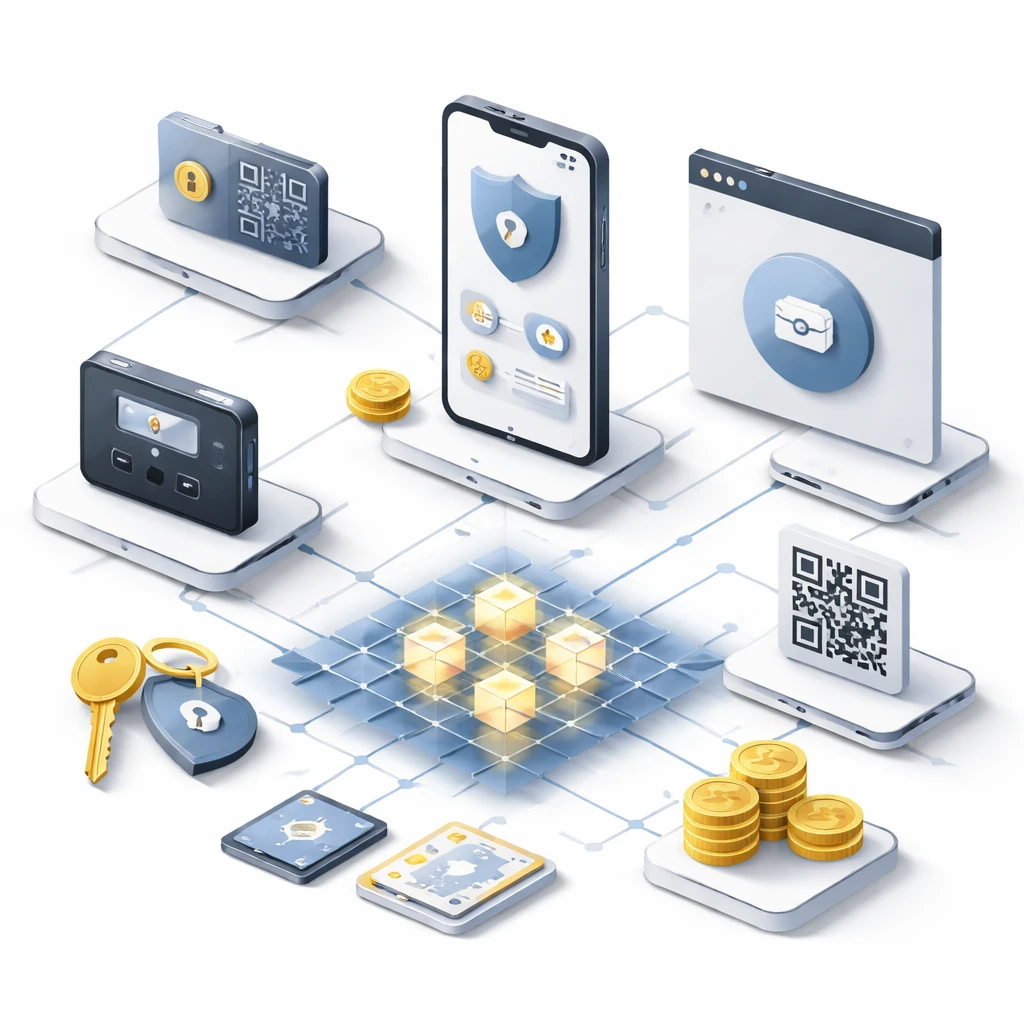
Crypto wallets sit at the center of how individuals and organizations interact with blockchains. Despite the familiar name, a wallet does not store coins inside it. Instead, it holds the cryptographic material that proves control over assets recorded on a blockchain. Understanding what a wallet is, how it authorizes actions, and how it is embedded in the market structure is essential to navigating crypto and blockchain systems with confidence.
What a Crypto Wallet Actually Is
A crypto wallet is a system for managing cryptographic keys and producing valid digital signatures. Coins, tokens, and NFTs live on a blockchain as entries in a shared ledger. The wallet does not move the asset itself. It creates a signed message that tells the network to update the ledger, for example by transferring an amount from one address to another or by calling a function on a smart contract.
Two core elements define the wallet concept:
- Key material. A private key that must remain secret, and a public key that can be shared. The private key is used to sign. The public key, or an address derived from it, is used by others to verify signatures and to route funds.
- Transaction construction and signing. A wallet structures a transaction according to network rules, signs it with the private key, and broadcasts it through a node or a relay so that validators can include it in a block.
From a user perspective, a wallet may be a mobile app, a desktop application, a browser extension, a hardware device, or a service operated by a third party. Regardless of form, the underlying function is management of private keys and authorization of on-chain actions.
Why Wallets Exist
Blockchains do not assign accounts to people in the traditional sense. Control is defined by possession of valid keys. Wallets exist to solve three problems:
- Authorization. Only the holder of the private key can authorize transfers or interactions from an address.
- Usability. Direct key handling is error-prone. Wallet software abstracts formats, encodings, fee settings, and network specifics, and provides an interface to sign correctly.
- Security. Wallets implement techniques to isolate or protect keys from exposure, which is fundamental because possession of a private key equates to control of assets.
How Wallets Fit into the Broader Market Structure
Wallets are the user edge of the crypto market. They connect individuals and institutions to on-chain activities and service providers. Several relationships define this position:
- Nodes and networks. A wallet communicates with blockchain nodes through APIs to read balances, construct transactions, and broadcast signed transactions. Some wallets run light clients, others rely on third party infrastructure.
- Exchanges and onramps. Custodial exchanges maintain wallets at scale on behalf of users. Non-custodial users withdraw to personal wallets. Payment processors and merchant services integrate with wallets for settlement.
- Applications. DeFi protocols, NFT marketplaces, games, and governance systems request wallet signatures to approve actions or permissions. Wallets act as the identity and authorization layer for these applications.
- Custody providers. Institutions often use specialized custody, including multisignature or multi-party computation systems, that are still wallets in the technical sense.
Thinking in market terms, wallets are the interface through which end users express demand for block space, interact with contracts, and manage assets across chains. They are as central to the ecosystem as browsers are to the web.
Keys, Addresses, and Signatures
Most mainstream blockchains use public key cryptography. A private key is a large random number that must remain secret. The public key is derived from it. Signatures created with the private key can be verified against the public key without revealing the private key itself. Bitcoin and Ethereum use curves based on secp256k1 with ECDSA signatures. Solana and several others use Ed25519 with EdDSA signatures.
Addresses are derived from public keys through hashing and network-specific encoding. The address format is a convenience for routing funds and detecting errors. For example, Bitcoin addresses have Base58Check or Bech32 encodings with checksums. Ethereum addresses present as hexadecimal strings prefixed with 0x. Each network defines its own address rules, so the same public key is not guaranteed to map to a valid address across different blockchains.
Ownership and control follow from signatures. If a transaction is signed by the correct private key, the network will accept it as authorization. No additional account identity is required by the protocol. This design is powerful, but it concentrates responsibility in proper key generation, storage, and use.
Seed Phrases and Hierarchical Deterministic Wallets
Modern wallets commonly use hierarchical deterministic, or HD, structures. Instead of generating many independent keys and backing up each one, an HD wallet derives a tree of key pairs from a single master seed. The seed is often represented as a list of 12 to 24 words, called a mnemonic, specified in BIP39. Those words encode the entropy that generates the seed. A passphrase can be added for an extra factor, which produces a different tree even with the same words.
From the seed, standards like BIP32 and BIP44 define derivation paths that produce child keys for specific purposes. For instance, a path indicates the coin type, the account index, and whether keys are used for external receiving addresses or internal change addresses. This structure allows a single backup to recreate a large set of addresses consistently across compatible wallets, which reduces operational risk.
In practical terms, the mnemonic must be treated with the same care as the private key, because it can regenerate the entire wallet. If the mnemonic and any passphrase are lost, the derived keys cannot be reconstructed by the wallet provider or the network.
Custodial vs Non-Custodial Wallets
Wallets differ in who controls the private keys.
- Custodial wallets. A third party holds keys and signs on the user’s behalf. This model resembles traditional account services. Users authenticate to the custodian, not to the blockchain. Balances may be co-mingled in omnibus addresses with internal ledgers tracking user entitlements. Custodial services can implement recovery and compliance processes, but users depend on the custodian’s security and solvency.
- Non-custodial wallets. The user holds the keys and signs locally. The provider cannot move funds without the user’s authorization because it does not control the keys. Responsibility for backup, recovery, and safe operation rests with the key holder.
Both models serve roles in the market. Many onramps and exchanges operate custodial systems to simplify onboarding and regulatory compliance. Non-custodial wallets are central to self-directed use of blockchain networks and decentralized applications.
Hot, Cold, and Air-Gapped Setups
Wallets are also grouped by network connectivity.
- Hot wallets are connected to the internet. They are convenient for frequent interaction with applications or payments. Common forms include mobile apps and browser extensions.
- Cold wallets keep private keys offline. Examples include hardware devices and paper backups. Transactions can be prepared on a connected device, moved to the offline wallet for signing, and then returned online for broadcast.
- Air-gapped workflows isolate signing from any networked system. Data is transferred via QR codes or removable media. This reduces exposure to remote compromise, although it introduces operational steps that must be executed carefully.
The choice of setup reflects the balance between convenience and attack surface. Institutions often combine hot and cold components to segment duties and limit risk.
Types of Wallet Implementations
Several implementation patterns recur across networks.
- Software wallets. Desktop, mobile, or browser-based. They integrate with nodes through APIs, handle address books, fee estimation, and token display. Browser extensions are widely used for smart contract interactions.
- Hardware wallets. Dedicated devices that store keys in secure elements and sign transactions internally. The device exposes only the signature, not the private key. Many include on-device screens to verify details before approval.
- Paper wallets. Physical printouts of keys or mnemonics. They are simple but fragile, and they require careful creation and redemption processes to avoid exposure at generation time.
- Multisignature wallets. Assets are controlled by a policy like 2 of 3 or 3 of 5 signatures. No single key can authorize movement. On Bitcoin, this uses script conditions. On Ethereum and similar networks, smart contracts enforce the policy.
- Multi-party computation wallets. MPC splits a key into cryptographic shares held by separate parties. The shares collectively produce a signature without ever combining into a full private key. This design supports distributed control and institutional operations.
- Smart contract wallets. On account-based networks with programmable contracts, the wallet can be a contract that holds assets and defines rules for authorization. Features can include daily limits, session keys, or social recovery. Development in account abstraction is expanding this category.
- Watch-only wallets. Software that tracks balances and activity for specified addresses without holding keys. Useful for monitoring or accounting.
Account-Based vs UTXO Models
Wallet behavior depends on the underlying ledger model.
In account-based systems like Ethereum, an address has a balance and a transaction count called a nonce. Each transaction must include an incrementing nonce and a fee specification. Wallets estimate gas parameters, display the contract call, and prompt for signature. Tokens are represented as contract balances under standards such as ERC 20 for fungible tokens and ERC 721 for non-fungible tokens. Wallets query contract state to show token holdings.
In UTXO-based systems like Bitcoin, coins exist as unspent transaction outputs. A wallet selects inputs, creates new outputs including change back to itself, and signs the set. Address reuse has privacy implications, so HD wallets rotate receiving addresses. Fee estimation depends on transaction size in bytes rather than the value transferred.
These differences influence user experience. For example, an Ethereum wallet might show a single address with multiple token balances, while a Bitcoin wallet may manage many receiving addresses behind the scenes and display a combined balance.
Permissions, Approvals, and On-Chain Interactions
Wallets do more than send funds. They also approve permissions and call contracts. Two patterns are common:
- Token approvals. To let a contract move tokens on a user’s behalf, an approval is granted from the wallet to the contract. The approval sets an allowance. It is a separate transaction from any later transfer initiated by the contract. Users can revoke or reduce allowances with another transaction.
- Typed data signatures. Wallets can sign structured messages that are not transactions, such as off-chain orders or attestations. Standards like EIP 712 format these messages so the wallet can display human readable fields before signing. The signature can later be verified on-chain or by a matching engine.
Because approvals persist until changed, they are a frequent focus of security reviews. Wallets help by displaying the scope of a permission and by listing existing approvals for reconsideration.
Fees, Nonces, and Confirmation
Every transaction must pay a fee to compensate validators. On Ethereum, EIP 1559 defines a base fee that adjusts with demand, plus a tip to encourage inclusion. Wallets estimate the total fee by observing current network conditions and projecting acceptable inclusion times. The nonce prevents replay and defines ordering from a given address.
On Bitcoin, fees are set per byte. Wallets estimate the necessary rate in satoshis per vbyte based on mempool congestion. Change outputs and input selection affect transaction size, so the wallet’s construction logic influences the final fee. Some wallets support replace by fee, which allows a higher fee version to be broadcast if the initial transaction remains unconfirmed.
Confirmation refers to the number of blocks mined after inclusion. Higher value transfers or complex contract interactions may wait for more confirmations to reduce the chance of reorganization. Wallets display confirmation status and provide transaction IDs for audit and tracking.
Interoperability and Network Support
Many wallets support multiple networks. Some specialize in a single ecosystem, such as a Bitcoin only wallet or a Solana only wallet. Others support many chains with one interface. Even when a wallet uses the same mnemonic across networks, the derivation paths and address formats are network specific. Funds sent to the wrong network or to an incompatible address can be difficult or impossible to recover.
Wallets also interface with cross chain bridges and messaging systems. In those flows, the wallet signs transactions on the source chain and may sign additional messages to claim assets on the destination. Interoperability introduces new counterparty and contract risks outside the base layer, which the wallet cannot eliminate, though it can present details clearly to aid informed decisions.
Security Model and Common Risks
A wallet’s security begins with key generation and storage. Keys must be produced with high quality randomness and kept out of reach of malware or unauthorized parties. The main risks include:
- Phishing and interface deception. Malicious sites or prompts can trick users into signing unintended transactions or granting broad token approvals.
- Malware and key exfiltration. Compromised devices can capture seed phrases, passwords, or signing prompts.
- Physical theft or loss. Devices that hold keys can be lost or seized. Without backups, funds may be irretrievable. With backups, an attacker may be able to restore the wallet if additional controls are not present.
- Supply chain and tampering. Hardware devices or software distributions may be modified before delivery or installation if provenance is not verified.
- Operational mistakes. Sending to the wrong address, selecting the wrong network, or misconfiguring fees can cause loss or delays.
Mitigations vary by context. Examples include isolating keys on hardware, using multisignature or MPC to require multiple parties, and segmenting funds across accounts. The wallet’s role is to present accurate information and require explicit confirmation for sensitive operations.
Recovery and Continuity
Loss of keys is final at the protocol level, so recovery planning is integral to wallet design. Several approaches exist:
- Mnemonic backups. The BIP39 words and any passphrase allow full reconstruction of an HD wallet. The backup must be kept confidential and intact.
- Sharded backups. Techniques such as Shamir Secret Sharing split the seed into parts where a threshold of parts can reconstruct it. This reduces single point exposure at the cost of coordination.
- Social or guardian recovery. Smart contract wallets can designate trusted parties to approve recovery of control to a new key after a waiting period. This avoids a single seed backup, but it introduces governance considerations.
- Institutional policies. Organizations implement access controls, audit trails, and separation of duties around wallet operations. MPC and multisignature policies are often combined with hardware isolation.
For any approach, test procedures and clear documentation are part of operational resilience. The goal is the ability to re-establish control without exposing the secret material in routine use.
Real-World Contexts and Examples
Wallets appear in varied contexts beyond basic transfers. The following examples illustrate practical use without endorsing specific tools.
Paying a Bitcoin invoice from a mobile wallet. A retail service presents a QR code with an address and amount. The customer’s mobile wallet scans the QR code, constructs a UTXO transaction with enough inputs to cover the amount, estimates a fee based on current mempool data, and creates a change output. The transaction is signed within the app and broadcast to the network. The merchant monitors for an initial confirmation before releasing goods. The wallet records the transaction ID and reduces the displayed balance.
Interacting with a smart contract using a browser wallet. A user connects a browser extension wallet to a decentralized application. The dapp requests an ERC 20 token approval with a specified allowance. The wallet shows the contract address, token, and parameters, then prompts for signature. Later, the dapp asks to execute a swap, which is a separate contract call. The wallet estimates gas with EIP 1559 fields, displays the maximum cost, and obtains a signature. After confirmation, the wallet updates the token balances by reading contract state.
Small business treasury with MPC. A company manages stablecoin payroll using an enterprise wallet system based on multi-party computation. Signing shares are distributed across devices held by finance team members and a secure service. Payment batches require approval from two human operators and a policy engine. The system logs each approval and segregates funds into accounts with different daily limits. Because no single device holds a complete key, a single compromise does not grant control.
NFT collection management. An artist uses a hardware wallet to hold primary mint proceeds and a separate hot wallet for routine listing and bidding. The wallet software displays NFTs with metadata like collection name and token ID read from the contract. When listing an item, the wallet signs a typed data order. The marketplace later submits the order on-chain only if a matching buyer appears, which saves gas for the artist.
DAO governance voting. A protocol uses token-weighted voting. Members sign messages that attest to their choices. The wallet presents the proposal text and requested signature scope. The votes are tallied off-chain, then a final transaction executes the approved change. This pattern demonstrates that wallets authorize more than transfers. They also authorize statements and intent.
Privacy, Identity, and Compliance Considerations
Wallets are linked to addresses that can be observed on-chain. Even without names attached, patterns such as address reuse and timing can reveal relationships. Some wallets incorporate features to reduce linkability, such as address rotation in UTXO systems or separate accounts for distinct activities in account-based systems. Advanced privacy techniques exist at the protocol level, but they vary by network and jurisdiction.
Custodial wallets are typically subject to know your customer and other compliance obligations. They maintain internal records that map users to addresses they control. Non-custodial wallets generally do not perform identity verification in the software, although service integrations may. When interacting with regulated entities, the origin and destination of funds may be screened by analytics firms that classify addresses according to observed activity.
Usability and Design Trade-offs
Wallet design balances security, clarity, and convenience. Too much detail can overwhelm. Too little can hide material risk. Examples of design decisions include how to display gas in both native units and fiat equivalents, how to warn about approvals that grant unlimited token access, and how to present human readable contract names while still showing raw addresses so users can verify independently.
Another area of active work is safe transaction simulation. Some wallets simulate contract calls against current chain state to show expected outcomes before the user signs. While helpful, simulations can diverge from final state if conditions change or if contracts contain opaque logic. Clear disclosure and conservative presentation help align expectations with reality.
Future Directions
Several trends are expanding what wallets can do.
- Account abstraction on Ethereum and related networks allows contracts to act as accounts with flexible authorization. This supports features like sponsored transactions, where a third party pays the gas, and alternative signature schemes beyond ECDSA.
- Passkeys and hardware integration aim to bring web authentication advances to wallet access. The idea is to provide phishing-resistant login to wallet software without exposing on-chain keys.
- Improved recovery through social mechanisms, time locks, and programmable limits may reduce dependence on a single mnemonic while preserving self custody.
- Institutional standardization for MPC protocols, transaction policy languages, and auditability is maturing as more organizations use on-chain settlement.
As these developments progress, the functional boundary between wallets, identities, and application portals is likely to blur. The core responsibility remains the same, which is secure authorization of actions on a blockchain.
How to Evaluate a Wallet in Context
Because wallets vary widely, evaluation depends on intended use. A researcher may value open source code and reproducible builds. An enterprise may prioritize policy controls, segregation of duties, and integration with back office systems. A developer may seek strong support for test networks and debugging tools. A collector may look for rich NFT display and careful handling of approvals.
Compatibility also matters. Not all wallets support all chains, token standards, or signing methods. Some focus on Bitcoin and UTXO workflows. Others focus on EVM chains and contract interactions. The most capable option in one domain may be unsuitable in another if it lacks the necessary primitives.
Conclusion
A crypto wallet is the authority that speaks for an address. It holds or orchestrates keys, constructs transactions, and signs with precision so that a decentralized network will accept the result. The visible interface may be simple, but it wraps layers of cryptography, network logic, and security practices. Grasping this structure clarifies why wallets look the way they do, why backup and recovery are central topics, and how wallets connect users to the broader market of applications, exchanges, and services.
Key Takeaways
- A crypto wallet manages keys and signatures, it does not store coins, which live on the blockchain.
- Custodial and non-custodial models allocate control and responsibility differently, each with distinct operational trade-offs.
- HD wallets use a single seed to derive many keys, which simplifies backup but concentrates recovery risk in the mnemonic and passphrase.
- Wallet behavior depends on the underlying ledger model, account-based or UTXO, which affects transactions, fees, and privacy.
- Security and usability are intertwined, and wallet design choices influence how safely users interact with contracts, tokens, and networks.