
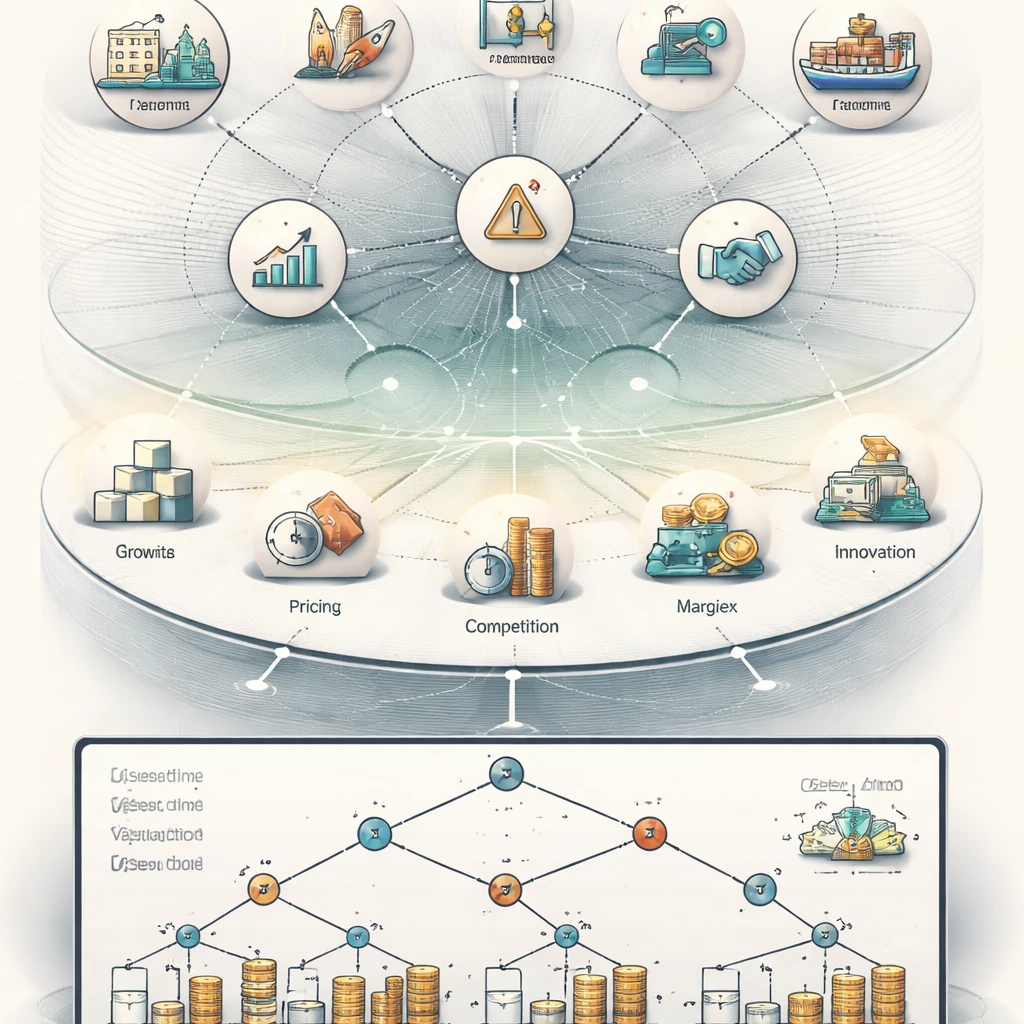
Fundamental analysis typically begins with financial statements, unit economics, and industry structure. Yet markets also trade on stories. These stories, or narratives, organize how investors interpret news, how they expect businesses to evolve, and how they translate qualitative change into quantitative assumptions. Understanding narratives does not mean accepting hype. It means tracing how a widely shared storyline can shift beliefs about revenues, margins, reinvestment, and risk. In practice, rigorous analysis of narratives helps explain valuation gaps and regime shifts that financial ratios alone may not capture.
What Is a Narrative in Fundamental Analysis?
A narrative is a coherent storyline about how a business, industry, or economy will develop. A strong narrative links causes to effects over time. It connects observable signals to expectations about future cash flows and risk. Narratives are not simply investor mood. They are frameworks for interpreting information, setting priors, and choosing which data matter.
For example, a technology firm may be wrapped in a narrative of platform expansion. Under that narrative, investors emphasize developer adoption, ecosystem partnerships, and recurring revenue potential, even before revenue fully materializes. Another firm might sit in a narrative of commoditization, where attention shifts to cost leadership, scale efficiencies, and price discipline. In each case, the story guides which variables appear salient and how valuation models are parameterized.
From News to Narrative to Sentiment
News provides discrete facts. A production delay, a regulatory approval, a product launch, a labor settlement. One item rarely moves long-term value by itself. Narratives form when repeated news aligns with a shared explanatory thread. Over time, the narrative becomes the lens through which new data are filtered. Sentiment is the aggregate emotional temperature attached to the narrative, such as enthusiasm, caution, or fatigue.
Consider a sequence: a firm announces a new service, early customer testimonials appear, several competitors respond, and policymakers issue guidance. Analysts begin to describe a structural shift. Headlines proliferate. The narrative hardens. When that narrative resonates, sentiment can become strongly positive or negative. Importantly, sentiment is not free floating. It is anchored in a story that connects events to possible outcomes. Fundamental analysis benefits from separating the three layers:
- News: verifiable events and data points.
- Narrative: the causal storyline that organizes those events.
- Sentiment: the prevailing emotional tone around the storyline.
A disciplined analyst tracks all three. The goal is to understand whether the story aligns with operational reality and whether the resulting expectations are plausible when mapped to cash flow drivers.
Why Narratives Matter for Long-Term Valuation
Valuation ultimately depends on expected cash flows and discount rates. Narratives influence both. A credible growth narrative can justify higher reinvestment today and stronger future margins if economies of scale or network effects are plausible. A regulatory or geopolitical narrative can raise perceived risk, altering the cost of capital. Over long horizons, the prevailing narrative often dictates which scenarios are considered, how likely they seem, and which competitive outcomes are thought feasible.
In mature industries, narratives often reshape assumptions about capital discipline and returns on incremental investment. In early-stage or disrupted industries, narratives define adoption curves, pricing power, and the durability of moats. This does not mean narratives should dominate financial analysis. It means they are inputs into the assumptions that drive any discounted cash flow or comparable valuation. Ignoring narratives can lead to models that are internally neat but externally disconnected from the expectations that move prices.
Turning Narratives Into Financial Drivers
To analyze a narrative with rigor, translate it into explicit drivers that appear in financial statements. A practical sequence follows.
- Define the proposition: articulate the narrative in one or two sentences. Example: enterprise artificial intelligence will increase demand for accelerated computing over several years.
- Identify the mechanism: describe how the narrative affects units sold, pricing, mix, or costs. For accelerated computing, the mechanism might be higher data center capital expenditures directed to specific chips and networking equipment.
- Map to line items: link mechanism to revenue growth by segment, gross margin drivers, operating expenses, working capital, and capital intensity.
- Establish milestones: set observable markers that would support or contradict the narrative, such as backlog disclosures, order cadence, customer cohort metrics, or regulatory filings.
- Quantify ranges: convert the narrative into scenario ranges for volumes, prices, utilization, and reinvestment, rather than a single point estimate.
The discipline lies in conversion. A narrative that cannot be mapped to units, prices, or costs is not yet ready to influence valuation. Conversely, once mapped, the narrative can be tested against reported data and industry checks.
Evaluating Narrative Quality
Not all narratives are created equal. Quality can be assessed along several dimensions.
- Plausibility and mechanism: does the story specify how outcomes occur, or does it rely on general optimism or pessimism?
- Base rates: are adoption speeds, margin trajectories, and returns within historical ranges for analogous cases, or do they require unprecedented outcomes?
- Falsifiability: are there clear milestones that could disconfirm the story within a reasonable time frame?
- Cross-checks: do supply chain reports, customer budgets, and competitor behavior support or contradict the narrative?
- Incentives: do management, regulators, customers, and capital providers have aligned incentives that would sustain the story?
A narrative that scores well on these dimensions is more likely to support coherent valuation assumptions. A narrative that lacks mechanism, ignores base rates, or resists falsification can distort expectations.
Measuring and Tracking Narratives
Measurement does not reduce narratives to a single number, but several practical tools help track their strength and direction.
- Content analysis: frequency and co-occurrence of key themes in earnings calls, regulatory filings, and industry conferences. Changes in language can indicate a shift in emphasis from growth to profitability or vice versa.
- Sentiment indicators: structured scoring of tone in transcripts and news to track swings from enthusiasm to caution. The objective is not to time short-term moves, but to monitor the emotional weather around the story.
- Search and interest data: patterns in search activity and developer or user community metrics can support or challenge claims of adoption.
- Supply chain checkpoints: lead times, order visibility, backlog disclosures, and capacity additions in upstream vendors test whether the story is materializing.
- Regulatory calendars: proposed rules, comment periods, and enforcement actions set boundaries for what the narrative can deliver.
These tools are inputs, not outputs. They inform the analyst about the arc of the narrative and whether its implied economics can be supported by observed behavior.
Real-World Illustrations
Artificial Intelligence and the Compute Supply Chain (2023 to 2025)
In 2023, a clear narrative solidified: enterprise artificial intelligence would accelerate demand for training and inference infrastructure. News flow included model breakthroughs, enterprise pilots, and elevated capital expenditure guidance from cloud providers. The narrative translated into a mechanism. Hyperscalers committed significant budgets to specialized processors, high-bandwidth memory, and advanced networking. Supply constraints emerged. Vendors with leading architectures reported rapid growth, while component suppliers scaled capacity.
How did this narrative influence valuation? Analysts mapped it to several drivers. First, unit volumes for accelerators and complementary hardware increased. Second, pricing remained firm due to tight supply and performance advantages. Third, gross margins for leading component vendors expanded as mix shifted to premium products. Fourth, cloud providers signaled multi-year investment plans, affecting depreciation schedules and cash conversion. A second-order effect also appeared in power and data center construction, raising questions about energy availability and operating costs.
Testing milestones included disclosed order backlogs, lead times reported by distributors, cloud provider capital expenditure forecasts, and utilization metrics. Counterpoints came from questions about monetization, such as whether enterprise software would capture sufficient value to justify the infrastructure. The narrative evolved from pure growth to a focus on use case deployment and unit economics of inference. This evolution altered expectations about the sustainability of pricing power and the timing of returns.
Electric Vehicles and the Transition Narrative
An earlier example lies in the electric vehicle transition. For several years, the narrative emphasized a rapid shift from internal combustion to electric powertrains. News repeatedly highlighted policy incentives, declining battery costs, and new model launches. The mechanism was specific: technology learning curves would reduce pack costs, enabling price parity; charging infrastructure would expand; consumers would adopt at increasing rates. In valuation, this translated into assumptions about volumes, pricing, and margin structure for manufacturers and suppliers.
Over time, the narrative faced new constraints. Raw material supply, charging bottlenecks, and competitive pricing pressure entered the story. The result was a more nuanced set of scenarios. Strong growth remained possible, but margins and capital intensity required careful modeling. The shifted narrative affected which questions analysts prioritized. Instead of asking only about demand growth, they focused on sustained profitability, model mix, and vertical integration strategies. The initial narrative still mattered, but its influence on margins and reinvestment was revised as evidence accumulated.
Streaming Media and the Profitability Turn
The streaming industry offers another example. Early on, the narrative emphasized subscriber growth and global expansion. Firms prioritized scale, with high content spending. Valuations implicitly assumed long runway growth, limited churn, and eventual pricing power. The mechanism, while plausible, depended on network effects and a belief that distribution advantages would dominate content scarcity.
As competition intensified and capital costs rose, the narrative tilted toward profitability and cash generation. News shifted to account sharing policies, advertising tiers, and content rationalization. The mechanism changed accordingly. Average revenue per user became central. Churn management and content amortization disciplines came to the forefront. Analysts updated models to reflect flatter subscriber trajectories and improved unit economics. This narrative turn did not invalidate prior growth, but it reframed valuation by elevating margins and free cash flow over raw subscriber counts.
Interactions With Valuation Frameworks
Narratives do not replace valuation methods. They contextualize the parameters that feed them.
- Discounted cash flow: narratives inform revenue growth paths, margin trajectories, reinvestment rates, and the persistence of competitive advantage. For a credible platform expansion story, long-run operating margins might trend toward peers with scaled ecosystems, while reinvestment remains elevated before tapering.
- Multiples and comparables: multiples embed narratives. A high sales multiple often reflects a belief in future operating leverage and durable growth. When the narrative shifts from growth to profitability, the market may favor earnings or free cash flow multiples that reward cash discipline.
- Real options: some stories create option value. A firm with an installed base may have the option to layer new services. Valuation can account for this as a probability-weighted path rather than a certain outcome.
The critical step is consistency. Assumptions implied by the narrative should match the cost structure, competitive dynamics, and investment requirements visible in the business. If a narrative assumes premium pricing, the model should reflect the operating expense needed to sustain product differentiation and service quality. If a narrative assumes rapid share gains, the model should show the sales and capital requirements needed to support scale.
Common Pitfalls and How to Guard Against Them
Analysts encounter recurring errors when working with narratives.
- Confirmation bias: seeking only evidence that fits the story. Counter this by listing potential disconfirming milestones and tracking them as carefully as confirming ones.
- Over-extrapolation: assuming that early growth rates persist without friction. Base rate analysis and capacity constraints help temper these paths.
- Category confusion: mixing different narratives. For instance, a policy-driven narrative has different mechanisms than a technology diffusion narrative.
- Ignoring unit economics: enthusiasm for a story that does not translate into attractive customer-level margins often ends poorly. Tie every narrative to contribution margins and payback periods where possible.
- Time horizon mismatch: narratives that are true over a decade can still be volatile over quarters. Keep scopes separate when interpreting data.
A useful discipline is to write a brief narrative memo that states the mechanism, the measurable implications, and the key uncertainties. Update this memo as evidence arrives. The memo can sit next to the financial model and ensures that qualitative and quantitative work remain aligned.
Building a Narrative-Aware Research Process
A narrative-aware process does not chase headlines. It triangulates information and maintains internal consistency. The following practices help.
- Start with the business model: understand how the company makes money, where variable costs sit, and which inputs drive scale economies.
- Map stakeholders: customers, suppliers, regulators, employees, and capital providers. Narratives gain power when multiple stakeholders reinforce them.
- Use primary sources: company filings, transcripts, and regulatory documents. Supplement with industry data, supply chain checks, and technical literature.
- Separate levels of uncertainty: technical feasibility, commercial adoption, and policy environment each carry distinct risks.
- Set checkpoints: specify the data that would change the narrative weight in your scenarios, such as unit growth deceleration, margin inflection, or capex reallocation.
By embedding these practices, the analyst can update models quickly when narratives shift. The aim is not to predict every turn in sentiment. It is to maintain clarity about which assumptions are narrative dependent and which are rooted in observable operations.
Reflexivity and Feedback Loops
Narratives can influence the reality they describe. If a convincing growth story lowers a company’s cost of capital, management can fund expansion on better terms. Successful expansion then validates parts of the story. The feedback loop also works in reverse. A narrative of constraint can raise financing costs, limit investment, and slow performance, which reinforces the narrative. Recognizing these loops helps explain why valuation can detach from near-term accounting results and why inflection points sometimes appear abrupt when feedback effects break or reverse.
Integrating Narrative into Scenario Design
Scenarios help manage narrative uncertainty. Rather than fix a single outcome, consider three or more paths with explicit milestones and probabilities. For each scenario, tie the narrative to drivers such as volume growth, price changes, and operating leverage. The scenario tree can include a base case that reflects conservative adoption, an upside case with stronger network effects, and a downside case with regulatory or competitive headwinds. The purpose is not to guess precise probabilities but to create a structured space in which updates are straightforward when new evidence arrives.
How Narratives End or Transform
Few narratives last indefinitely. They end or evolve when supply catches up with demand, when technology plateaus, when policy changes, or when returns attract new entrants that compress margins. Watch for signals of transformation. Management guidance that shifts from growth to cash return indicates a new emphasis. Competitor language that converges on similar themes can signal commoditization. Customer procurement behavior that shifts from pilot budgets to multi-year contracts reflects maturation. The analyst’s role is to re-map the story as these signals appear and to update valuation drivers accordingly.
Ethical and Policy Dimensions
Some narratives hinge on social and political acceptance. Data privacy, safety standards, labor implications, and environmental impacts all shape what is feasible. Policy narratives can move quickly after salient events. Fundamental analysis benefits from tracking regulatory calendars, comment periods, and enforcement priorities. It also benefits from reading impact assessments and technical standards that influence cost structures. Policies often change the slope rather than the direction of a trend, which means assumptions about speed and profitability may need adjustment even if the core story remains intact.
Practical Example: From Headline to Model
Suppose a major cloud provider announces a multi-year capital plan that includes a higher mix of specialized processors. The headline is the news. The narrative posits sustained demand for compute to support enterprise applications. The mechanism indicates orders for upstream component vendors and systems integrators. To model this, an analyst might translate the plan into annualized units based on disclosed capacity targets, map expected average selling prices, and adjust gross margins for mix. The analyst would also cross-check with vendor backlog, reported lead times, and power availability. If subsequent news shows stalled deployments or lower-than-expected utilization, the narrative weight in the model would be reduced and capital intensity assumptions revisited. The process is iterative and anchored in observable data.
Limits of Narrative Analysis
Narratives are powerful but imperfect. They can be overfit to recent events, they can persist due to social dynamics even when evidence fades, and they can become so consensus that they offer little information content. Clear writing helps avoid these traps. If a narrative cannot be stated succinctly, it may be too vague to guide assumptions. If it requires ignoring contradictory data, it is likely fragile. If it rests on extreme parameter values without precedent, it deserves very low weight in formal valuation.
Concluding Thoughts
Narratives Explained is about discipline, not decoration. The task is to convert stories into mechanisms, mechanisms into drivers, and drivers into numbers that can be compared with reported performance. When practiced with care, narrative analysis improves the coherence of fundamental work and sharpens the link between qualitative change and quantitative valuation.
Key Takeaways
- Narratives organize how investors interpret news and connect qualitative change to cash flow drivers and risk.
- Robust narrative analysis specifies mechanisms, sets milestones, and maps to units, prices, costs, and reinvestment.
- Narratives influence both growth assumptions and discount rates, which makes them central to long-term valuation.
- Tracking transcripts, supply chain data, and regulatory signals helps measure whether a narrative is strengthening or fading.
- Scenarios and falsifiable checkpoints mitigate common pitfalls such as confirmation bias and over-extrapolation.