
Introduction
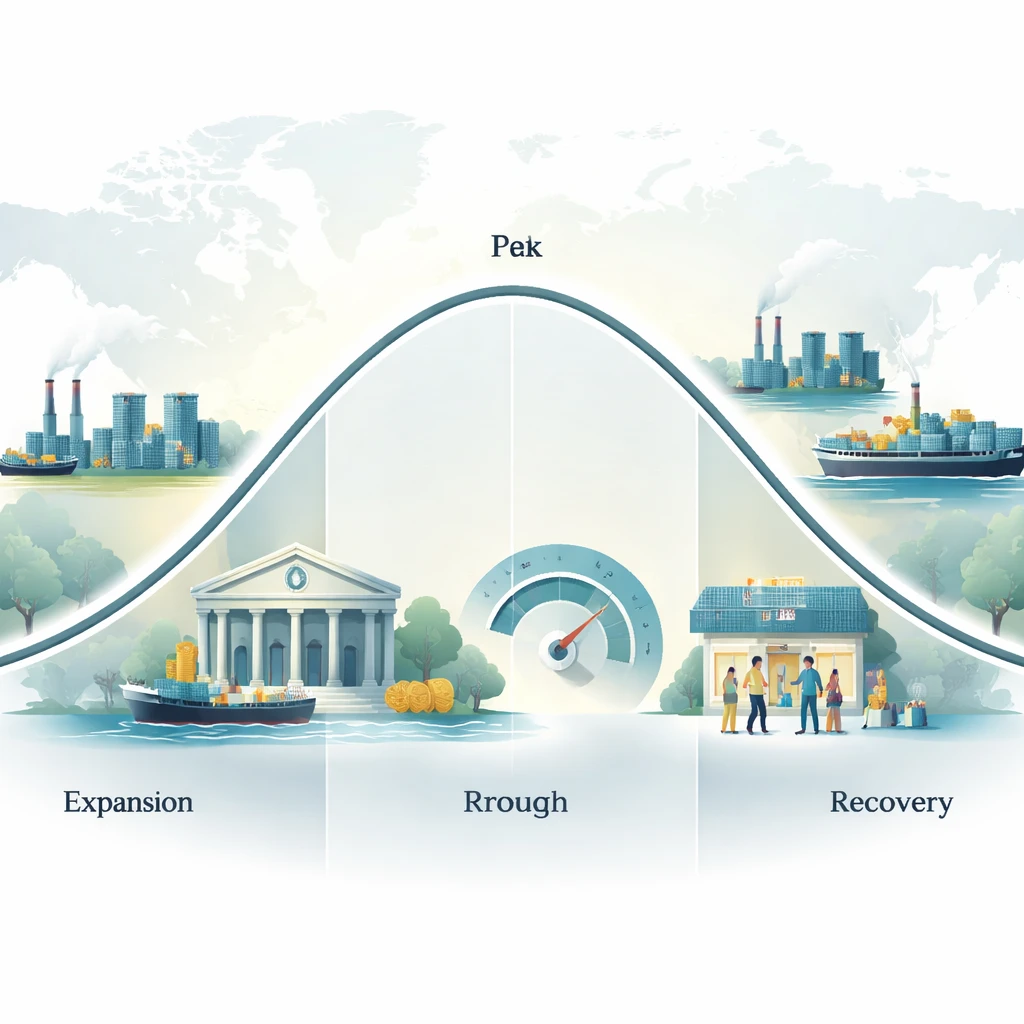
Recessions and recoveries are central features of the macroeconomic cycle. They reshape demand, prices, credit conditions, and policy settings, which in turn alter corporate cash flows and the discount rates used in valuation. Fundamental analysis treats these phases as part of the environment that determines intrinsic value. Understanding how recessions unfold and how recoveries develop helps analysts evaluate the sustainability of earnings, the resilience of balance sheets, and the appropriate long-run assumptions for growth and risk.
This article defines recessions and recoveries, outlines their measurement, and explains the mechanisms through which they influence intrinsic value. It also provides historical context and examples that show how analysts translate macroeconomic cycles into cash flow models and cost of capital estimates.
Definitions and Measurement
A recession is a significant decline in economic activity that spreads across the economy and lasts more than a few months. In practice, institutions such as the National Bureau of Economic Research identify recessions using a broad set of indicators that include output, employment, real income, industrial production, and wholesale-retail sales. A shorthand rule of thumb often cited is two consecutive quarters of falling real GDP, although that criterion is neither necessary nor sufficient in every case.
A recovery is the period that follows the trough of a recession. During recovery, economic activity rises toward or above its prior peak. The speed and quality of the recovery vary. Some recoveries are rapid and broad-based. Others are gradual, uneven across sectors, or interrupted by renewed weakness. Analysts pay attention to the composition of growth in a recovery, because it often signals which sectors are likely to regain pricing power and which may face lasting demand shifts.
Two concepts are helpful in measurement. First, the output gap, defined as the difference between actual and potential output, helps indicate slack in the economy. A negative output gap is typical in recessions and early recoveries. Second, peak-to-trough depth and duration provide a scale of disruption. A deep, prolonged contraction tends to produce more balance sheet strain and slower normalization of labor markets compared with a shallow, brief downturn.
Why Recessions Matter for Intrinsic Value
Intrinsic value depends on expected cash flows discounted at a rate that reflects time value and risk. Recessions and recoveries affect both sides of that equation.
On cash flows, recessions typically depress revenues through weaker volumes and, in many industries, lower prices. Margins often compress as fixed costs meet falling volumes and as firms offer concessions to retain customers. Working capital can turn from a source of cash to a use of cash if inventories build or if customers delay payment. Capital expenditure may be cut, sometimes at the cost of future capacity or competitiveness. Recoveries reverse part of this pattern as demand improves, inventories normalize, and operating leverage lifts margins, although the pace and completeness of normalization vary across industries.
On discount rates, recessions often coincide with higher risk premia and tighter credit conditions even when risk-free interest rates decline. Equity risk premia can rise when uncertainty about earnings increases. Credit spreads tend to widen as default risk becomes more salient. As recovery takes hold, risk premia commonly compress and financing conditions ease, which lowers the cost of capital. The trajectory of discount rates through the cycle is therefore a crucial input to valuation.
These cyclical effects interact with company-specific features. Firms with flexible cost structures, strong liquidity, and diversified demand tend to experience smaller swings in free cash flow than firms with high fixed costs, concentrated customers, or significant short-term refinancing needs. Balance sheet strength and the maturity profile of debt become material to intrinsic value when economic conditions deteriorate.
Transmission Channels to Corporate Fundamentals
Analysts translate macro conditions into firm-level effects by tracing several transmission channels:
- Final demand and revenue mix. Consumer retrenchment, reduced capital expenditures, or export declines change volumes and the relative performance of segments. The effect depends on a firm’s exposure to discretionary spending, durables, housing, or business investment.
- Pricing power and inflation. In recessions, weak demand constrains pricing. In some recoveries, inflation rises faster than demand, lifting nominal revenue while squeezing real purchasing power. The interplay matters for real margins.
- Cost structure and operating leverage. High fixed costs magnify revenue shocks into margin swings. Variable cost flexibility, supplier contracts, and labor arrangements shape the amplitude of profits through the cycle.
- Inventories and supply chains. Inventory corrections in recessions can be abrupt, especially in goods sectors. Recoveries often feature re-stocking that temporarily boosts production and shipments above final demand.
- Credit conditions and liquidity. Access to external finance may tighten in recessions. Interest coverage, covenant headroom, and maturity walls become central. Recoveries relieve funding stress and can reduce spreads on new issuance.
- Policy responses. Monetary easing and fiscal support operate with lags and different distributional effects. Rate cuts influence discount rates, while transfers and government spending support revenue in sensitive sectors.
- Exchange rates and global demand. Currency appreciation can compress export margins, while depreciation may lift them but increase the cost of imported inputs. Global recessions and recoveries transmit through trade and capital flows.
- Commodity prices. Energy and raw material prices can fall in recessions, lowering input costs for some firms but reducing revenue for producers. Recoveries often bring commodity cycles that redistribute income across sectors and regions.
Modeling Cash Flows Through the Cycle
Fundamental analysis often distinguishes between cyclical volatility and long-run capacity to earn returns above the cost of capital. A practical approach is to build cash flow paths that reflect recession shock, recovery dynamics, and a steady-state phase. The goal is to capture both temporary dislocation and the possibility of permanent level shifts.
Revenue Path
Analysts typically separate volume and price. During recession, volumes may fall sharply in discretionary or capital goods, while essential services contract less. In a recovery, volumes may rebound quickly if demand was deferred rather than destroyed. Price behavior depends on competitive intensity and inflation. It is common to model a near-term revenue decline, a multi-quarter recovery slope, and a return to a long-run growth rate anchored in potential GDP, industry maturation, and expected market share.
Illustration: if a firm with 1,000 in annual revenue experiences a 12 percent decline for one year followed by a partial recovery, the shape and speed of that rebound can dominate intrinsic value even if the long-run growth rate beyond year three is unchanged. A two-year trough with a slow ascent yields a lower present value than a single-year trough with quick normalization, holding discount rates constant.
Margins and Operating Leverage
Operating leverage magnifies revenue changes because a portion of costs is fixed in the short run. In recession modeling, it is reasonable to assume margin compression that is larger than the revenue decline would suggest. Analysts assess cost flexibility, supplier terms, hedging, and the feasibility of temporary capacity reductions. In recovery, margins may overshoot temporarily during re-stocking or when utilization rises faster than fixed costs adjust. Over the medium term, margins often revert toward a through-the-cycle level that reflects industry structure.
Capital Expenditure and Working Capital
Cuts to investment can preserve cash during downturns but may defer growth. Recovery phases often require rebuilding inventories and receivables, which can absorb cash even as earnings improve. Modeling free cash flow requires explicit working capital assumptions, especially for firms with complex supply chains or long production cycles. The balance between maintenance capital expenditure and growth investment is central to long-run valuation and should reflect any structural shifts revealed by the recession.
Cost of Capital Through the Cycle
The discount rate typically varies across phases of the cycle. The risk-free rate may decline in recessions, while equity and credit risk premia rise. The combined effect on the weighted average cost of capital depends on capital structure and the magnitude of spread widening. As recovery progresses, premia often compress and refinancing costs decline. Valuation exercises therefore test sensitivity to discount rates. A numerical anchor helps illustrate scale: the present value of a perpetuity that pays 100 per year at an 8 percent discount rate is 1,250. At 10 percent, it is 1,000. A two percentage point increase in the discount rate lowers this stylized value by 20 percent. Even temporary shifts in perceived risk can materially change intrinsic value when a large portion of value resides in distant cash flows.
Terminal Value and Long-Run Growth
Recessions can leave persistent effects on productivity, labor force participation, and capital intensity. Recoveries sometimes accelerate innovation and reallocation, raising potential growth in some segments while lowering it in others. Terminal growth assumptions should reflect these possibilities. A balance sheet recession that prompts deleveraging across households and firms may imply a longer period of below-trend demand. By contrast, a technology-enabled recovery can lift long-run margins for firms that benefit from scale and network effects.
Heterogeneity of Recessions and Recoveries
Not all recessions arise from the same causes, and the mechanisms that drive recoveries also differ. Three stylized forms are common in analysis:
- Inventory-led recessions. Often shorter. A rapid liquidation phase is followed by re-stocking, which produces a brisk early recovery in production and shipments. The long-run level of demand may be largely unchanged.
- Balance sheet recessions. Triggered by excessive leverage and asset price declines. Deleveraging by households or banks suppresses credit creation, leading to a slower, more uneven recovery. Intrinsic value can be influenced for years by impaired collateral values and higher credit spreads.
- Policy-driven or exogenous shock recessions. Examples include abrupt tightening of policy to control inflation or external shocks such as a pandemic. Recovery depends on policy calibration, the speed of reopening or adaptation, and the durability of behavioral changes.
Analysts sometimes describe recovery shapes as V, U, W, or L. These labels are simple mnemonics for differences in speed and completeness. The deeper task is to connect the mechanics that produce these shapes to specific cash flow drivers and risk premia.
Global Linkages and Cross-Border Effects
Modern recessions and recoveries often have international dimensions. Trade volumes, supply chains, and capital flows transmit shocks across borders. A global downturn can compress export demand for open economies and intensify currency volatility. Terms of trade can shift rapidly when commodity prices fall in a recession or spike in the early stages of recovery. For a firm with multi-country operations, exchange rate movements influence both translation of earnings and economic competitiveness. Fundamental analysis therefore maps geographic revenue exposure, input sourcing, and financial liabilities by currency.
Real-World Context: The Global Financial Crisis
The 2008 to 2009 crisis offers a clear case of a balance sheet recession. A housing downturn in the United States exposed leverage in households and financial institutions. Credit markets seized, securitization channels collapsed, and bank balance sheets contracted. For many firms, revenues fell sharply while access to credit narrowed, pushing cash flows down at the same time that discount rates rose through wider risk premia.
Several valuation elements shifted. First, demand for big-ticket consumer durables and business investment plunged, reducing volumes for autos, machinery, and construction-related industries. Second, working capital became a drain as inventories initially proved too high and receivables turned riskier. Third, credit spreads widened dramatically. Even though risk-free rates fell, the cost of debt for many borrowers rose due to spreads and reduced availability. Equity risk premia increased as uncertainty about earnings and the banking system grew.
Policy responses were large. Central banks cut policy rates, provided liquidity facilities, and later engaged in asset purchases. Fiscal support helped stabilize income and demand. Over time, risk premia compressed and financing conditions improved. The recovery, however, was drawn out in several economies as deleveraging continued and housing markets healed slowly. Analysts who modeled a quick reversion to pre-crisis margins often overestimated intrinsic values for sectors directly tied to housing and credit. By contrast, firms with strong balance sheets and flexible cost bases saw faster normalization.
Financial institutions illustrate how recession mechanics flow through the income statement and valuation. Loan loss provisions surged in the downturn as expected credit losses rose. Capital requirements tightened, which diluted returns on equity for a period. During recovery, reserve releases and improved credit quality lifted earnings, but higher regulatory costs and lower leverage moderated long-run profitability. Intrinsic value reflected both the path of losses and the new steady-state regulatory environment.
Real-World Context: The 2020 Pandemic Shock
The early 2020 contraction was unusual in its speed and breadth. Public health measures suppressed services activity while goods demand initially fell then rebounded strongly. Fiscal transfers supported household income, and central banks rapidly lowered policy rates and intervened in credit markets. Corporate revenues in travel, hospitality, and in-person services collapsed. Digital services, logistics, and certain consumer goods segments experienced demand surges.
From a valuation perspective, cash flows diverged. Some firms faced near-term revenue near zero, raising solvency and dilution concerns. Others enjoyed temporary windfalls. Discount rates initially rose through risk premia but soon fell as policy stabilized markets. The recovery phase featured re-opening, reallocation of labor, and supply constraints in semiconductors and logistics. Price pressures rose, and inflation accelerated in many economies through 2021 and 2022. Central banks later tightened policy to contain inflation, which raised discount rates again. The sequence underscored how recoveries can introduce new macro conditions that differ from the pre-recession environment.
Analysts incorporated several elements into intrinsic value assessments during this period: the duration of suppressed revenues, the permanence of behavioral changes such as remote work and e-commerce adoption, the path of margins in the face of supply bottlenecks, and the sensitivity of valuation to higher real discount rates. In industries with strong network effects and scalability, the recovery boosted long-run margin assumptions. In contact-intensive services, the valuation focus remained on balance sheet resilience and the pace of normalization.
Using Economic Data in Fundamental Analysis
Fundamental analysis does not require forecasting every macro variable. It does require a coherent mapping from the economic backdrop to cash flows and discount rates. A practical approach groups data by proximity to firm performance:
- Coincident indicators: payroll employment, industrial production, real income, and retail sales, which align with current revenue conditions.
- Leading indicators: new orders, building permits, survey measures of business expectations, bank lending standards, and credit spreads, which can foreshadow coming changes in activity and financing conditions.
- Lagging indicators: unemployment duration, core inflation, and realized default rates, which confirm trends but adjust with a delay.
The goal is not to track every data release, but to identify which aggregates most directly connect to a firm’s revenue drivers and cost structure. For an exporter, global PMI new orders may be informative. For residential construction suppliers, housing starts and mortgage credit availability may be more relevant. Clarity about these linkages supports disciplined valuation assumptions.
Pitfalls and Limits
Several pitfalls recur when applying recession and recovery concepts to valuation. Data are frequently revised, and turning points are often identified with delay. Extrapolating from the last cycle can mislead if structural conditions have changed, such as regulation, technology, or demographics. Survivorship bias can distort perceived resilience if failed firms drop out of comparison sets. Estimates of long-run growth are sensitive to small errors that compound in the terminal value. Finally, interpreting policy requires attention to distributional effects and lags. Fiscal transfers may support household income more than business investment, while monetary easing can lower discount rates even as bank lending standards tighten.
Scenario Analysis, Stress Testing, and Balance Sheets
Scenario analysis is well suited to recession and recovery dynamics. A base case might feature a downturn of specified depth and length followed by a moderate recovery. An adverse case imposes a longer trough and slower normalization. A favorable case assumes rapid re-stocking and early margin rebound. Rather than seeking precision at every step, the emphasis is on how sensitive intrinsic value is to plausible ranges of cash flow and discount rate paths.
Stress testing complements scenarios by focusing on constraints. Key questions include the ability to service debt through a multi-quarter revenue shortfall, the effect of covenant breaches, and the options to raise liquidity without eroding long-run competitiveness. The maturity profile of debt, interest rate hedging, and access to committed credit lines determine how recessions translate into potential dilution or asset sales. In recovery, refinancing windows and spread compression can restore flexibility.
From Macro Narrative to Valuation Mechanics
Translating a macro narrative into a valuation model involves several disciplined steps:
- Identify the primary macro drivers that influence the firm’s revenue and cost base, distinguishing cyclical effects from structural shifts.
- Quantify a recession shock in volumes and prices, along with expected inventory and receivables adjustments.
- Model margin compression and subsequent normalization using the firm’s operating leverage and cost flexibility.
- Incorporate working capital and capital expenditure dynamics that accompany downturns and recoveries.
- Estimate the cost of capital path by combining risk-free rate expectations with plausible ranges for risk premia and credit spreads.
- Test terminal value assumptions for scarring or acceleration in long-run growth and profitability.
These steps help ensure that the valuation reflects both the transitory nature of recessions and the enduring adjustments that sometimes follow.
Illustrative Valuation Sensitivity
Consider a simplified example. A firm generates free cash flow of 120 per year in a steady environment. A recession reduces free cash flow to 80 in year one and 90 in year two. In recovery, free cash flow returns to 120 in year three and grows at 3 percent thereafter. If the discount rate is 9 percent throughout, the present value of the first three years is lower primarily because of the temporary shortfall. If the discount rate also rises to 11 percent in years one and two and then returns to 9 percent, the compounded effect of lower cash flows and higher discounting in the trough further reduces present value. Small changes in the assumed recovery slope and discount rate path can generate large differences in intrinsic value, even when the long-run growth rate remains unchanged.
This illustration highlights why analysts focus on both cash flow resilience and financing costs during downturns. The combination often matters more than either factor alone.
Sectoral Differences
Sectors respond differently to recessions and recoveries due to demand elasticity, capital intensity, regulation, and exposure to credit. Consumer discretionary, industrials, and materials often exhibit higher cyclical sensitivity. Utilities, healthcare services, and some consumer staples tend to be more resilient in volumes but can still face regulatory or reimbursement changes. Technology displays mixed behavior. Hardware tied to capital spending can be cyclical, while software with subscription models can show relative stability, though customer churn and pricing flexibility still matter.
In recoveries, sectors exposed to re-stocking or pent-up demand may rebound faster. Those that rely on long lead-time projects or that face damaged balance sheets may recover slowly. Energy and commodities often follow their own cycles layered onto the macro cycle, influenced by capacity decisions and geopolitical factors.
Governance, Disclosures, and Accounting Considerations
Recessions and recoveries interact with accounting and disclosure in ways that affect evaluation of intrinsic value. Impairment testing may result in write-downs when expected cash flows decline, which can reset book values and alter reported profitability metrics. Expected credit loss models change bank earnings profiles by pulling forward provisions in downturns and releasing them in recovery. Inventory valuation methods can influence reported margins during rapid price changes. Clear disclosure about order backlogs, cancellation rates, and supply chain constraints helps analysts judge the credibility of recovery narratives.
Why the Concept Matters for Long-Term Valuation
Long-term valuation requires distinguishing cyclical noise from persistent change. Recessions can accelerate trends that were already underway or reveal vulnerabilities that were previously masked by growth. Recoveries can reward firms that invest through the cycle or that adapt quickly to new demand patterns. For intrinsic value, the key questions are whether the long-run earning power has changed and how the discount rate will evolve as conditions normalize. Modeling that respects both the transitory and the structural elements of each cycle helps avoid overreacting to current conditions while recognizing genuine regime shifts.
Key Takeaways
- Recessions and recoveries alter both expected cash flows and discount rates, which together determine intrinsic value.
- The depth, duration, and composition of a downturn, along with policy responses, shape the path and quality of recovery.
- Mapping macro channels to firm-level drivers clarifies how revenues, margins, working capital, and financing evolve through the cycle.
- Scenario analysis and stress testing reveal sensitivity of valuation to plausible ranges of cash flow and cost of capital paths.
- Long-term valuation depends on separating temporary cyclical effects from structural changes in demand, technology, and regulation.