
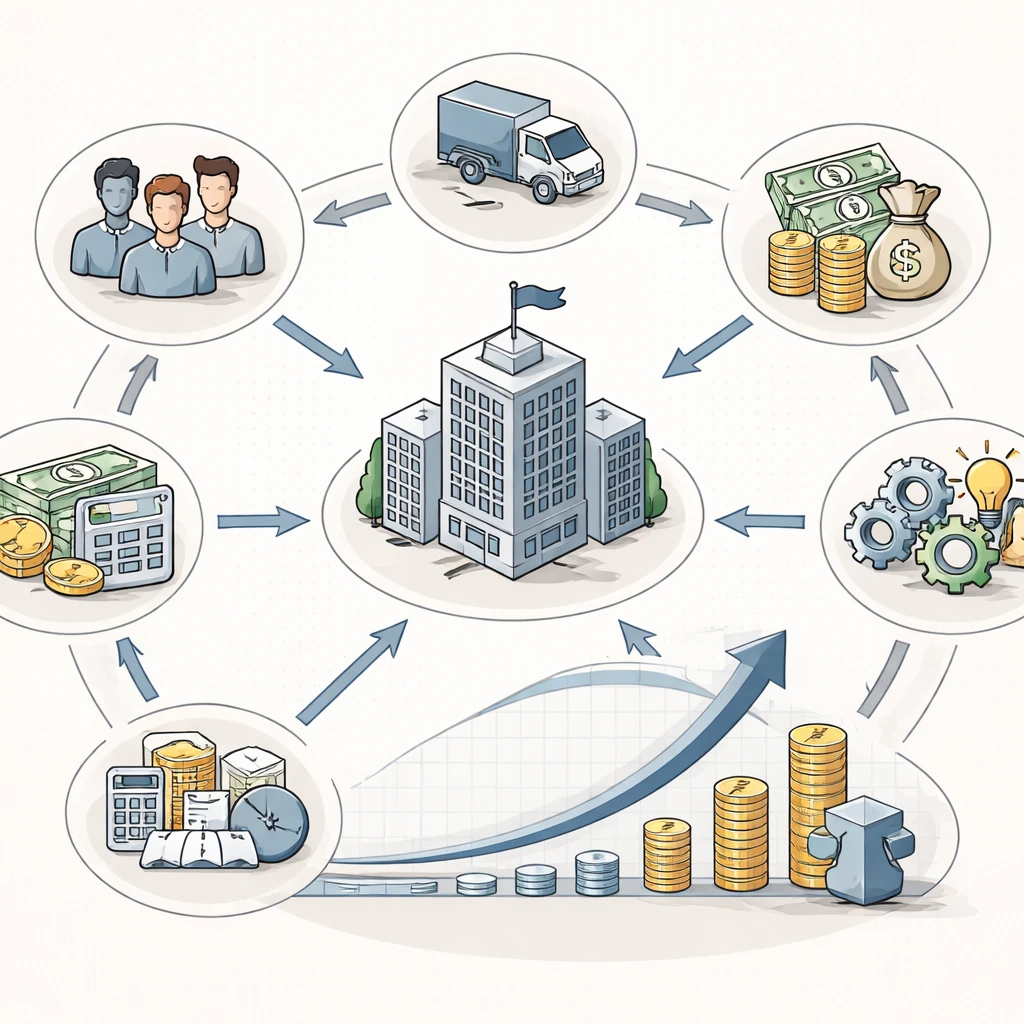
A clear grasp of a company’s business model sits at the center of fundamental analysis. The business model describes how a firm creates value for customers, how it delivers that value through operations and partnerships, and how it captures value through pricing and monetization. It is the practical blueprint that links strategy to cash generation. For analysts who care about intrinsic value, the business model is not background color. It shapes revenue visibility, margin structure, reinvestment needs, and the durability of competitive advantage. Each of these elements drives the stream of cash flows that valuation models attempt to measure.
Definition: What Is a Business Model?
A business model is the coherent system by which an organization creates value, delivers that value to a defined set of customers, and captures a portion of that value as cash flow. It integrates four questions:
- Who is the customer and what problem is being solved?
- What is the product or service and why does it win against alternatives?
- How is the product or service produced and delivered at scale?
- How is money earned, at what margins, and with what investment to sustain growth?
The definition goes beyond a revenue model. A revenue model describes how money arrives, such as subscriptions, advertising, licensing, usage fees, or sales. A business model embeds the full economics of the system, including cost structure, capital intensity, channel dynamics, partnerships, and risks. It also differs from strategy. Strategy sets direction and positioning in the competitive landscape. The business model is the operating logic that makes the strategy economically viable.
Why Business Models Matter in Fundamental Analysis
Valuation depends on cash flows, their timing, and their risk. The business model is the primary driver of all three.
- Cash flow level. The model determines price, volume, and mix. It shapes gross margin, operating expenses, and capital needs. These map to free cash flow.
- Cash flow timing. Prepayment models such as subscriptions create predictable cash collection and lower volatility. Project-based or cyclical models produce uneven cash conversion across periods.
- Cash flow risk. Customer concentration, input cost exposure, regulatory dependency, and technological disruption risks are embedded in the model’s structure.
Analysts examine these mechanics to translate a qualitative description into quantitative drivers. The business model helps set realistic boundaries around growth rates, margin trajectories, working capital cycles, and reinvestment requirements. It also frames the durability of economic profits through the lens of competitive moats, which influences the forecast horizon and the pattern by which returns fade toward the cost of capital.
Core Components to Map
When analyzing a business model, a structured map prevents gaps and speculation. The following components are practical anchors.
1. Value Proposition and Customer Segments
What job is the product hired to do? Which customer segments care most about that job? The answer connects directly to pricing power. A solution that is mission-critical or lowers total cost of ownership typically supports better pricing than a convenience feature. The breadth and homogeneity of the customer base also matter. A fragmented set of small customers can reduce concentration risk but increase sales and support costs. A concentrated base can simplify logistics yet increase counterparty risk and bargaining power of buyers.
2. Revenue Mechanics
How money is earned is essential to modeling cash flows. Common patterns include upfront sales, subscriptions, usage-based pricing, licensing, advertising, transaction take rates, and hybrids. Each comes with different revenue recognition timing, predictability, and sensitivity to cycles.
- Subscription typically yields recurring revenue with lower period-to-period volatility. Churn and pricing power are central metrics.
- Usage-based aligns revenue with customer activity. Volatility rises with macro swings but elasticity can support long-term growth if value scales with usage.
- Advertising is often cyclical and sensitive to demand shocks, yet can scale rapidly if engagement grows and auction dynamics improve monetization.
- Transaction take rate models depend on gross merchandise or payment volume and the fraction captured as revenue. Competitive pressure often compresses take rates over time.
3. Cost Structure and Operating Leverage
Cost structures vary in their mix of fixed and variable costs. High fixed costs coupled with software or digital delivery can create strong operating leverage as scale grows. Businesses with high variable costs may show more stable margins across cycles but limited margin expansion potential. Understanding which costs scale with revenue versus which scale with capacity helps separate sustainable margin improvement from cyclical noise.
4. Capital Intensity and Working Capital
Free cash flow depends not only on margin but also on the investment needed to support growth. Manufacturing or infrastructure-heavy businesses often require significant capital expenditures and inventory. Digital and asset-light models may still consume substantial cash through sales and marketing or research and development. Working capital terms are crucial. Upfront billing, deferred revenue, and negative working capital can finance growth internally. Strict payment terms or inventory builds can absorb cash during expansion.
5. Unit Economics
Unit economics translate the model to a single customer, transaction, or product line. They ground company-level forecasts.
- Contribution margin per unit after direct costs.
- Customer lifetime value driven by average revenue per user or account, gross margin, retention, and discounting.
- Customer acquisition cost and payback period, which indicate the efficiency of growth spend.
- Cohort behavior to assess retention, upsell, and price realization over time.
Sound unit economics make growth additive to value. Weak unit economics often require persistent funding, which can compress intrinsic value even if reported revenue grows quickly.
6. Competitive Advantage and Moats
Moats are features that preserve economic profits by raising barriers to entry or by deepening customer dependence. Common sources include switching costs, network effects, proprietary technology or data, cost advantages from scale or process, brand and reputation effects, and control of bottleneck assets or regulatory licenses. The business model is the mechanism through which a moat is monetized. A payment network converts a network effect into a fee on transactions. A razor-and-cartridge pairing monetizes switching costs and consumables. The strength and trajectory of a moat determine how long returns on invested capital can remain above the cost of capital.
Business Model Archetypes and Cash Flow Profiles
Real firms blend models, but categorizing archetypes helps connect qualitative structure to quantitative implications.
Subscription and Software-as-a-Service
Subscription models trade ownership for access. Customers pay periodically for ongoing use. Predictability improves, churn becomes a central risk, and revenue builds cumulatively. Gross margins can be high if delivery is digital. Operating leverage often emerges once a base of recurring revenue covers fixed costs. Intrinsic value benefits from durability of cash flows and low marginal cost of growth, provided that retention remains strong and the cost of acquiring new customers does not escalate faster than lifetime value.
Marketplace and Platforms
Marketplaces connect buyers and sellers and capture value through a take rate. Early stages are constrained by liquidity. As liquidity improves, customer acquisition costs can decrease and transaction frequency can rise. Network effects can create a moat, yet they can also be local, two-sided, or fragile. Cash flow visibility depends on the stability of take rates and the resilience of gross merchandise volume. Competitive threats include disintermediation, platform leakage, and regulatory constraints on fees.
Licensing and Royalties
Licensing models monetize intellectual property by charging for usage rather than building distribution. Capital intensity may be low. Revenue depends on the licensee’s sales or usage, which introduces counterparty exposure. Margins can be high due to lean cost structures. The key questions involve IP defensibility, contract renewal terms, and the breadth of application domains.
Advertising-Supported Media
Media and digital platforms that monetize attention face cyclical advertising demand. Cash generation hinges on user time, engagement quality, and auction efficiency. Revenue per user varies across formats and geographies. Data advantages and scale can deepen moats by improving targeting and measurement. However, regulatory policies and platform dependencies can affect pricing power and inventory supply.
Manufacturing and Integrated Hardware
Manufacturing models convert materials and labor into products. Margins depend on product differentiation, production yields, procurement efficiency, and distribution. Capital expenditure can be significant. Inventory management and supply chain resilience are central to cash conversion. Intrinsic value turns on the firm’s ability to sustain margins through design, brand, or cost leadership, and to earn returns on new plants or equipment above the cost of capital.
Razor and Consumables
Paired models sell a durable base product at low margins or even a discount to capture recurring high-margin consumables. Printers and ink, consoles and games, or coffee machines and pods are standard examples. The moat resides in switching costs and locked-in compatibility. Intrinsic value depends on the size and durability of the installed base and the rate of consumable usage.
From Business Model to Intrinsic Value
Translating a business model into valuation requires careful linkage between qualitative mechanisms and quantitative assumptions. Three ideas help organize that linkage.
1. Revenue Drivers and Pricing Power
Revenue forecasts should reflect the mechanics of how volume grows, how price changes, and how product mix shifts. For a subscription model, key variables include net adds, churn, average selling price, and upsell to premium tiers. For a marketplace, the core variables include active buyers and sellers, transactions per user, average order value, and take rate. Pricing power is a function of value delivered relative to alternatives. Products that lower a customer’s total cost, increase revenue, or reduce risk more than their price tend to sustain better pricing over time. Such pricing power lowers the fade rate in valuation models by supporting margins even as competition intensifies.
2. Margin Structure and Operating Leverage
Gross margin reflects the economic logic of the product and delivery method. Operating expenses reflect customer acquisition cost, product development, and administrative scale. As revenue grows, fixed costs are spread over a larger base, potentially raising operating margins. Analysts should test how sensitive margins are to modest changes in volume or price. High sensitivity signals both upside and risk. The stability of gross margin across cycles often indicates the strength of product differentiation or cost control in the model.
3. Reinvestment Needs and Return on Capital
Intrinsic value depends on how much must be reinvested to sustain and grow cash flows. The sales-to-capital ratio links growth to required capital outlay. Asset-light businesses may still require significant spending on intangible assets such as software development or brand. The return on such investments can be measured through unit economics, cohort performance, and post-investment productivity. If the business model enables a firm to earn returns above its cost of capital for a long period, value creation is strong. If returns quickly converge to the cost of capital, value relies more on near-term cash generation than long-term growth.
Moats and the Duration of Advantage
Moats influence the duration over which a firm earns economic profits. A business model might deliver strong early growth, but without barriers to replication the economics are competed away. Several moat types interact with business models in distinct ways.
- Switching costs. Software embedded in workflows or platforms that store user histories make departure costly. Subscription models can monetize switching costs and reduce churn. Analysts infer durability from renewal rates, multi-year contracts, and the breadth of integrations.
- Network effects. Marketplaces, payment networks, and communication platforms often become more valuable as participants join. Value accrues if the network improves matching quality or trust. Saturation, multi-homing, and platform fatigue can limit strength.
- Cost advantage. Scale purchasing, proprietary processes, or superior logistics lower unit costs. In manufacturing, this can produce sustainable margin gaps if rivals cannot match volume or process knowledge.
- Intangible assets. Patents, proprietary data, developer ecosystems, and brands can sustain differentiation. The model must continuously renew these assets through R&D or marketing spend. The valuation impact hinges on whether such spending earns high incremental returns.
- Efficient scale and regulatory position. Some markets naturally support few competitors due to demand limits or regulatory structures. Returns can be stable if expansion by new entrants would be uneconomic for all parties.
In valuation, these features inform the explicit forecast period and the rate at which returns fade toward the cost of capital. A strong moat can justify a longer advantage period. A vulnerable model may require a shorter horizon and faster convergence of returns.
A Market Context Example: The Shift From Perpetual Licenses to Subscriptions
Consider a software company that historically sold perpetual licenses with optional maintenance. Under the old model, revenue arrived in large upfront payments at the time of sale, with a smaller stream from maintenance contracts. Cash flows were lumpy, tied to product release cycles and large enterprise deals. Sales teams focused on closing big transactions. Customers evaluated major upgrades every few years, and switching costs at those junctures were meaningful but episodic.
Suppose the firm transitions to a subscription model that offers access to the software, continuous updates, and cloud-based collaboration. The business model changes in several important ways:
- Revenue recognition and visibility. Revenue shifts from large upfront recognition to smaller, recurring amounts. Near-term reported revenue may slow during the transition, but long-term visibility improves.
- Churn and retention become central. The firm invests in customer success and product engagement to keep churn low. Retention and upsell drive lifetime value.
- Gross margin and cost structure. Hosting and service delivery costs appear, but software delivery remains high margin at scale. Sales compensation may shift toward land-and-expand motions rather than large upfront commissions.
- Working capital. Billing can move to monthly or annual cycles. Deferred revenue grows as cash is collected before service delivery, supporting internal financing of growth.
- Moat reinforcement. Continuous updates and integrations deepen switching costs. Collaboration features create network effects within organizations and across teams, which can strengthen renewal rates.
From a valuation perspective, the transition can alter inputs meaningfully. Forecasts place more weight on cohort retention, net revenue expansion per customer, and the ratio of lifetime value to customer acquisition cost. Margin trajectories may improve as the recurring base covers fixed costs. The duration of advantage can lengthen if the subscription model amplifies switching costs and embeds the product in daily workflows. Analysts still need to test sensitivity to price changes, competitive responses, and the risk that acquisition costs rise as the market saturates. The central idea is that the business model shift changes the shape and risk of cash flows that a valuation must capture.
Linking Model Diagnostics to Valuation Assumptions
Analysts convert business model diagnostics into valuation parameters through a disciplined process.
- Map revenue to operational metrics. Tie revenue to measurable drivers such as subscribers, churn, average revenue per user, transaction volume, or orders per active user. Use reported key performance indicators where available.
- Test margin sensitivity. Identify which costs scale with revenue and which with capacity or time. Simulate modest changes in demand or pricing to see how operating margin and free cash flow respond.
- Quantify reinvestment. Estimate sales-to-capital ratios and the portion of operating expenses that function as investment in future growth, such as R&D or content creation. Reflect these in free cash flow and in the expected return on incremental capital.
- Assess moat durability. Use evidence such as renewal rates, switching activity in procurement data, multi-homing behavior, and competitor pricing to inform the length of the excess return period.
- Set a fade path. Specify how returns on invested capital converge toward the cost of capital. Stronger moats usually imply a slower fade. Weak moats often mean a faster fade and a shorter explicit forecast horizon.
Pitfalls and Red Flags in Business Model Assessment
Several common errors can distort intrinsic value analysis if not addressed.
- Confusing revenue growth with value creation. Revenue that requires heavy discounting, aggressive incentives, or high churn can erode intrinsic value even as reported top-line grows.
- Ignoring unit economics. If incremental customers do not cover acquisition and support costs over a reasonable horizon, scale can magnify losses rather than fix them.
- Assuming infinite pricing power. Price realization must be anchored to customer value. Monitor evidence of pushback, substitution, or contract renegotiations.
- Underestimating counterparty and platform risk. Models that depend on distribution controlled by a dominant platform can face sudden policy changes that compress margins.
- Neglecting off-balance-sheet commitments. Long-term content obligations, leases, or take-or-pay contracts can lock in costs and constrain flexibility during downturns.
Evidence and Sources Analysts Use
Reliable analysis combines quantitative disclosures with qualitative insights.
- Financial statements and management discussion. Segment revenue, gross margin, and cash flow statements reveal the economic engine. Working capital disclosures and capital expenditure detail illuminate investment needs.
- Operating metrics. Many firms disclose subscriber counts, churn, active users, order frequency, or take rates. These allow direct mapping to revenue drivers.
- Customer and partner vantage points. Surveys, product reviews, channel checks, and partner contract terms help validate switching costs, pricing, and product relevance.
- Regulatory and competitive landscape. Rules, standards, and competitor disclosures shape moat durability and risk profiles.
Integrating Moats With Business Model Transitions
Business models evolve. New technology, regulation, or customer behavior can force shifts that strengthen or weaken moats. A firm may move from a one-time sale to a service model, or from direct distribution to a marketplace. Each shift changes how value is created and captured. Analysts examine whether the transition enhances barriers to entry or opens vulnerabilities.
Consider a marketplace that begins offering logistics and fulfillment. This change adds capital intensity but may deepen switching costs and improve user experience. It can also create cost advantages through route density and warehouse utilization. The valuation question becomes whether the improved moat and increased take rate justify the additional capital and operating leverage. A disciplined approach traces the model change to unit economics, margin structure, and required returns on the new capital base.
Why Business Models Influence Long-Term Valuation
Intrinsic value is not only a function of the next year’s cash flows. It rests on the expected cash flow stream across many years and the risk that surrounds it. Business models that produce predictable, recurring revenue, defendable margins, and low incremental capital needs often support a longer duration of economic profits. Models that are cyclical, highly competitive, or capital intensive can still create value, but typically require sharper execution and tighter cost control. The presence and quality of a moat determine whether any advantage can be sustained long enough to matter in discounted cash flow terms.
In practical analysis, the business model anchors three valuation judgments. First, the level of normalized cash flow after accounting for full-cycle economics. Second, the rate at which the firm can reinvest cash at attractive returns. Third, the durability of those returns before competition forces convergence toward the cost of capital. These judgments translate directly into assumptions about growth, margins, reinvestment, and the length of the competitive advantage period.
Illustrative Contrast: Payments Network vs. Commodity Producer
Compare a global payments network with a commodity producer. The payments network connects merchants and card issuers, charges a fee per transaction, and benefits from a two-sided network effect. Volume growth rides secular trends in electronic payments. Capital intensity is moderate. Margins are high due to software-like scaling and fraud prevention expertise. The moat involves brand trust, acceptance breadth, and regulatory licenses. Cash flows are predictable and diversified across geographies and categories, though they remain exposed to macro spending and regulation.
The commodity producer extracts resources and sells into global markets with prices set largely by supply and demand. Capital intensity is high. Cash flows swing with commodity prices and input costs. The cost position relative to the industry curve matters more than brand or network effects. The moat, if present, often takes the form of low-cost reserves or transport advantages. Valuation relies on assumptions about price cycles and disciplined capital allocation over a long horizon.
Both can generate attractive cash flows. The analyst’s job is to tie the business model to the pattern and risk of those cash flows and to reflect that structure in the intrinsic value framework.
Practical Steps to Build a Business Model View
Analysts often follow a repeatable sequence when forming a view on a company’s business model.
- Clarify the customer job-to-be-done and identify the highest-value segments.
- Specify the revenue mechanics with measurable drivers and available KPIs.
- Lay out the cost structure and classify costs as fixed, variable, or step-function capacity costs.
- Estimate reinvestment needs, including working capital and both tangible and intangible capital.
- Evaluate moat sources, evidence for durability, and potential erosion mechanisms.
- Translate findings into cash flow forecasts, ROIC trajectories, and a fade path for excess returns.
This sequence connects narrative to numbers. It does not remove uncertainty, but it ensures that valuation assumptions emerge from the economics of how the firm actually works.
Concluding Perspective
As a concept in fundamental analysis, the business model is the bridge between strategy and valuation. It explains not only where revenue comes from but also why it should persist, how it might expand, and what investment is necessary to support it. When paired with a careful assessment of competitive moats, the business model frames the level, timing, and risk of cash flows that intrinsic value methods attempt to capture. A rigorous understanding of that blueprint is therefore essential for any thoughtful assessment of long-term value.
Key Takeaways
- A business model is the system by which a firm creates, delivers, and captures value, not merely a description of revenue streams.
- Business model mechanics drive cash flow level, timing, and risk, which are central to intrinsic valuation.
- Unit economics, cost structure, and reinvestment needs translate the model’s narrative into quantitative forecasts.
- Moats such as switching costs, network effects, and cost advantages determine the duration of economic profits.
- Shifts in business models can materially alter valuation inputs by changing revenue visibility, margin structure, and capital requirements.